Friend Is a Four Letter Word

June 22 2009 // Life + Rant + Social Media // 1 Comment

Technology now provides a level of connection that was unheard of just a scant twenty years ago. The cell phone, the Internet and the marriage of the two in smart phones (BlackBerry, iPhone etc.) have rapidly increased our ability to stay in touch. But who are we staying in touch with exactly? Do we have the time for all these people, and do we short-change family in the process?

Friend Is a Four Letter Word

Friend Overload

Automated report emails from work, status updates from Facebook friends you never really talk to and follower notifications that often wind up being spam consistently interrupt your weekend like a toddler tugging at the edge of your shirt.

Don’t get me wrong, there are times when getting an important email while you’re on the go can make a real difference. But most of the time it could have waited until the next day, never mind another hour.

More and more we’re getting messages from online friends: Facebook updates, Twitter followers and FriendFeed subscribers. I get a lot out of my social network, which is nearly all on FriendFeed. There are a slew of people I now count as friends through my FriendFeed experience.

Yet, should I be using my time to chat with them when I could be spending more time with my family, or visiting with friends? To be clear, I’m not saying I’m quitting FriendFeed (far from it!) I’m simply working through how to best use my time in relation to all the ‘friendships’ new technology has enabled.

Technology allows us to keep in touch with more people. But should we? Are these quality interactions? Voyeurism friendships (or those people with whom you’re connected via a social network but rarely interact with online and never speak or meet with offline) take up time, energy and emotion that might be better spent elsewhere.

The First Social Network

And it’s not just about the time devoted to these voyeurism friendships. Technology makes it possible to disrupt real friendships with these voyeuristic updates. Even worse, they might make you inattentive to your first social network: family.

The Annenberg Center for the Digital Future at the University of Southern California is reporting this week that 28 percent of Americans it interviewed last year said they have been spending less time with members of their households. That’s nearly triple the 11 percent who said that in 2006.

Each Saturday morning I take my four year old daughter to dance class. Parents stand outside and watch through a massive window. I bring my BlackBerry with me, but I am very rarely on it and try not to use it at all.

Instead I want to watch my daughter, react to her wave, thumbs up, wink or smile. I want to be present! Because all too often there’s a parent there, head down, tapping away on an iPhone or BlackBerry, oblivious to what’s going on with their child.

I wonder how many children are competing for time and attention with the tiny people living in that smart phone. I can’t believe it feels very good.

Friend Overload

How do these voyeurism friends stack up against other friends or family? I’m a firm believer in Dunbar’s number – the maximum number of healthy social relationships a person can maintain at any one time. Dunbar’s number is approximately 150. The question is, do these voyeurism friends count against this number?

I’m beginning to suspect they do.

You might not think they do, but they’re taking up social and emotional space. You are inserting a random piece of information about a person into your memory. A person who you went to high school with – not really a friend then or now – just got back from a trip to New Orleans. You can’t turn that information off. It’s been received and transmitted to your brain, mixed up with other random facts like song lyrics or television commercials from your childhood.

Whether you like it or not your brain is processing this stuff. You can begin to think about why Dunbar’s number makes sense in this context. As your brain is trying to sort, track and shelve data on more and more people it becomes far more difficult to maintain. You can’t crack the case and stick in more RAM.

Friend Turnover

At some point, you’re only storing a very small amount of data on a slew of people, which makes those relationships tenuous as best. The issue here is that you’re threatening the strength of all your relationships as you expand your reach. You might try to store more about ‘good’ friends and family, but I’m not sure we’re wired that way.

There’s a reason why you lose touch with friends. They aren’t really friends (anymore) and you don’t want to clutter your head with irrelevant data. You outgrow friends. Recent research suggests that you replace half of your friends every 7 years.

I question whether technology is inhibiting the natural shedding of friends necessary for us to move on, to establish new friends and evolve as a person.

The Future of Friends

I’m writing about this, in part, because I don’t know the answer and am struggling with the topic. I’m on FriendFeed constantly, sometimes when I could (perhaps should) be spending time with my wife and daughter.

I’ve taken steps to address this disconnect. I attended the FriendFeed open house so I could actually meet some of the people to whom I’ve been chatting – something that goes against my natural introverted nature.

And I’ve walked away from the computer – completely – to spend more time with family. We walked the Golden Gate Bridge together and explored the California Academy of Sciences.

Time and attention are in short supply in our accelerated society. Sometimes you need to remind yourself about what’s really important.


Search Engines are Readers Too

June 11 2009 // Rant + SEO // 1 Comment

Last week David Risley wrote a blog post for Search Engine Journal that recommended that you forget all about SEO and write for readers, not search engines. His advice borders on dangerous, in part because some of it is accurate.

My recommendation is to write posts designed to help, provoke or inspire your reader.

That’s great advice. However, his definition of a reader is far too narrow.

Search Engines are Readers Too

Search Engines Are Readers Too

Future readers are searching for your content. They’re typing queries into Google right now. The search engine has read your blog and come to some conclusions about when and where to show your content.

SEO is about making it easy for the search engine to come to the right conclusions. It’s about ensuring that the content you write is displayed for the right searches.

Search engines are the gate keepers to the more than 15 billion searches performed in the US every month. They are powerful but they are not smart.

Welcome to Kindergarten

A search engine is like a blind five year old. They don’t care what your site looks like and they have the intelligence and attention span of an average five year old. This is why SEO is important and why you do need to write for search engines.

Search engine algorithms are tasked with trying to understand the value of an item of content. But they don’t really see the page and they don’t truly read the content either.

Search engines do not understand the text they are reading. You can’t sit them down after they read a blog post and ask them reading comprehension questions. They are not human, nor are they some super-advanced form of artificial intelligence.

This is why quality writing will not be enough.

Sit a five year old down in front of a Don DeLillo novel and they’ll quickly become bored and confused. The plain fact is that there are thousands of well written blogs that languish in the dark cobwebbed corners of the Internet.

Dumb and Dumber?

Dumb Down Content?

I know what you’re thinking. “Am I supposed to dumb down my writing for the lowest common denominator?” Yes and no.

Let’s cover no first. No, you should still write helpful, provoking and insightful content. It should be intelligent and have a point of view. The search engine does not require that you lose your personality.

However, that writing should be concise, well-structured and devoid of generalizations and logical assumptions. This will help all of your readers, search engines and humans alike.

So yes, you should write in such a way that, at a glance, a reader can understand and engage with your content. And to be fair, David Risley does actually provide some good direction on the structure of content and in covering the SEO Holy Trinity: Title, Meta Description and URL.

Good Writing + Social <> Links

Risley also understands that links are perhaps the most important part of SEO.

If you provide enough value, you’ll get people spreading your link across other blogs. You’ll go viral on Twitter. You’ll get people Digging your posts.

This works … for a small percentage of blogs in certain niches where the author has enormous amounts of free time. Does that sound like you? Probably not.

When was the last time you saw a serious blog post dealing with Alzheimer’s Disease reach Digg’s front page? Do you think a book review of David Mitchell’s Black Swan Green is going to get massive viral adoption on Twitter?

Rely on this technique as a way to optimize search engine traffic and you’ll be sorely disappointed. Social marketing is a piece of the puzzle but it is not a plug-and-play panacea for link building. If links were this easy to get, they wouldn’t be that important.

Search Traffic Creates Links

Get people to your blog through search engine traffic and let the same type of viral link building take place. The idea is to get your content matched to the right queries first, and not wait for social marketing to inform the search engine of your content value or for which queries it should be displayed.

Get the people who are naturally seeking out your content to do the link building. This way you are not constrained by the size of your social network, nor are you held hostage by the ephemeral ADD nature of social media.

Write for Search Engines

Write for search engines because it will benefit all of your readers. Subscribers will find more focused, accessible and valuable content that respects their time and new readers will locate your content with greater efficiency through their natural search patterns.

Writing styles adapt to their environment. Novels versus business writing. Haiku versus grant writing. So, come to to terms with the fact that good blog writing requires a different writing style. Embrace it and search engine and human readers will thank you.

Bling Search Engine

June 04 2009 // Humor + SEM + SEO // 1 Comment

Bling Search Engine

Since the launch of Microsoft’s Bing I’ve received traffic from ‘bling’ keywords: bling search engine, bling paid search, bling search real time.

Search is funny that way. A small misspelling by the user is matched to a variant of my blog name. The one letter difference between blind and bling seems big to a person but doesn’t amount to much for a search engine. It’s yet another example of my blind five year old theory on search engines.

Bling Search Engine

I don’t know, maybe they should have named it Bling.

Bling is catchy and has an established vernacular. They could have used all sorts of celebrity endorsements about needing to find their bling. I can see the tag line.

“Search for your Bling!”

11 Ways to Spot a Bad SEO Firm

June 02 2009 // SEO // 2 Comments

ripoff

There are a lot of bad SEO firms and consultants out there that make it more difficult for SEO to become a recognized and valuable part of every business. However, for the best SEO advice, you can see Web 20 Ranker LLC for seo press release service.

I recently conducted a search for a SEO Manager at Caring.com and was bombarded with pitches from SEO firms and consultants. Based on this experience and some research I’ve come up with a list.

11 Ways to Spot a Bad SEO Firm

Rank Promise

Any SEO firm that promises you a number one ranking for any term before doing any keyword research or competitive analysis should be avoided. You should opt for services that refer Local SEO courses

Instant Results

SEO isn’t about what you can do in 30 days but a long-term plan to match your content with user queries. That’s not to say that progress won’t be made in the short-term, but beware of the get results fast pitch. People can also check some best services – they provide local seo services for law firms and many other firms as well.

Network of Quality Links

A number of firms will claim that they have a “network of quality sites” that enable them to drive links back to your site. In general, these networks aren’t of such high quality and are often the target of web spam teams. Quality linkbuilding isn’t as easy as turning on a switch. It takes time and that’s why the links are valuable.

Submissions Bonanza

“We’ll submit you to over 500 search engine and directory sites!” Some of these engines and directories are valuable but most aren’t and may even wind up hurting you if it’s done in a zombie like fashion.

Inside Algorithm Knowledge

People at Google don’t hand out information about the algorithm. Anyone who says they have a ‘Deep Throat’ of search is likely wearning a tin-foil hat or running a scam.

Bad SEO

Visit the firm’s site and see if they’ve done a good job with their own SEO. Spot rudimentary SEO errors such as duplicate titles and you can write them off.

Adjectivitis

Throw a flag on the play if you see a site or pitch peppered with adjectives. For example: “Our talented optimizers use premiere methodologies to secure highly valuable links, elevating search engine presence and delivering targeted web traffic to your site.”

In my experience, the need to over sell your service is a sign that you’re not confident in your own ability.

Unsolicited Analysis

You might have received some of these emails. The firm has kindly done an analysis of your site and determined that you should be ranking higher for [insert term here]. Lucky for you, you can fix all that in no time at all by … [deleted]

Meaningless Statistics

Beware of statistics that have no basis in reality. “We outperform our nearest competitors 3 to 1 in the time it takes to get you ranked.” There are so many things wrong with that statement it makes my head hurt.

Bogus Testimonials

References and testimonials help sell many a service. Be on the look out for bogus testimonials on ‘neutral’ websites. It helps when they use their own name or do cut and paste with a fingerprint-like misspelling.

Repeated Robo-Emails

Sending the same email again and again based on a Craigslist ad is both annoying and a clear signal of desperation. Avoid these folks at all costs.

White Hat SEO

SEO isn’t about speed or automation. I’m not saying there aren’t efficiencies – there are. But the goal of SEO is to ensure that the content of your site is matched and being displayed to users for the right queries. That’s done in a myriad of ways – some small and some large.

Don’t be taken in by bad SEO. Use these tips and find firms and consultants who will give you a sound strategy and straight advice.

You’ll be doing yourself and me a favor.

Google is the 6th Ranked Search Engine

June 01 2009 // Humor + SEO // 3 Comments

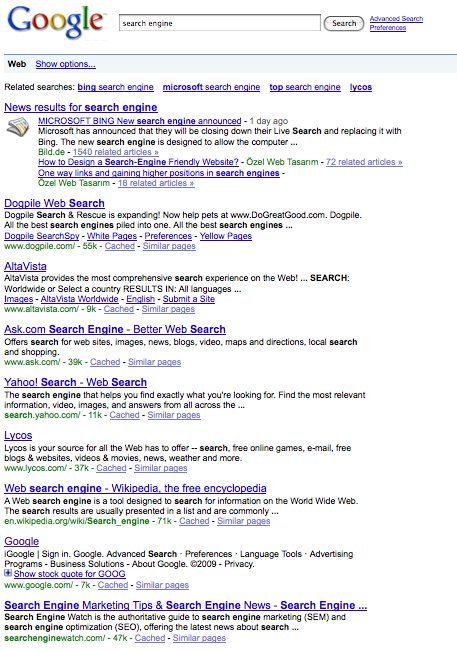
Don’t believe me? Try a search for ‘search engine’ on … Google.

Google is the 6th Ranked Search Engine

That’s right, it returns Google as the 7th result and the 6th search engine. And look at the snippet! Would it kill Google to craft a decent meta description?

In some ways it’s nice to see that Google isn’t optimizing and hasn’t manually altered the results in their favor. Yet, ‘search engine’ seems like a valuable term.

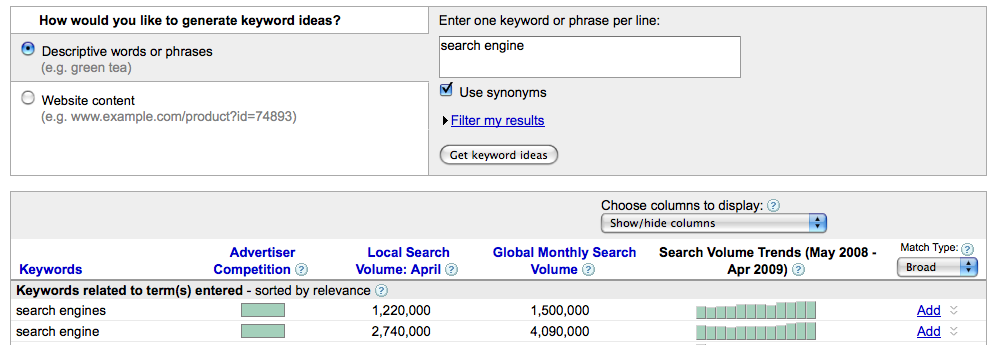
Search Engine Search Volume

That’s over 4 million global monthly searches! Even on exact match you get nearly 400,000.

Yahoo seems to get it, putting themselves at the top of a ‘search engine’ query on Yahoo. I’m guessing that’s a non-algorithmic result. Sure it seems like a blatant promotion but I understand the reasoning.

Nevermind the oddity of searching for a search engine with a search engine. Search is Google’s business and, as such, it should want to be the top result for the term.

Even from a search quality perspective, are those the best results for the term ‘search engine’?

Google Synonyms

May 30 2009 // SEO // 7 Comments

Google continues to build a synonym database to help deliver the best results for user queries. It’s not the most well documented or talked about feature but understanding synonyms can help your SEO efforts.

Use Synonyms to Increase Subject Density

Traditional keyword density revolves around the optimization for a specific keyword. A page on sofas would use modifiers or keyword clusters like ‘leather sofas’, ‘sofa beds’, ‘upholstered sofas’, and ‘sofa cushions’ as a way to increase density on the root keyword.

Using synonyms you can also increase the subject density of the page through supporting keywords like ‘couches’, ‘furniture’ and ‘chairs’. (Yes, chairs is currently a synonym for sofas.)

You’re not looking to make these synonyms the primary focus or most keyword dense words. Use them as supporting keywords to help Google to better understand the subject matter of the page.

How To Find Google Synonyms

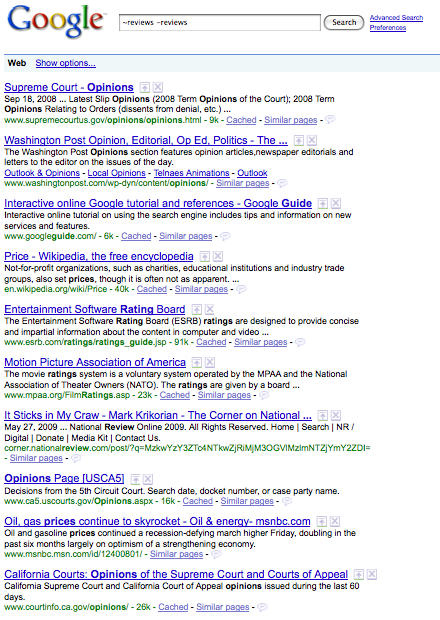
You can use the ~ operator to perform a synonym search. Coupled with a negative search for the same term and you can easily see the highlighted synonyms for that term. Here’s an example for the term ‘reviews’ (~reviews -reviews).

Google Synonyms

You’ll notice that ‘opinions’, ‘guide’, ‘rating’, and ‘prices’ are all highlighted and identified as synonyms.

There are also a few tools (here and here) that provide greater insight into synonym sets. SEO success is accomplished through doing a lot of little things right.

Synonyms are just one more way to help optimize your site and pages.

How To Deal With Email Mistakes

May 24 2009 // eCommerce + Humor + Marketing // Comments Off on How To Deal With Email Mistakes

I am subscribed to a lot of email newsletters. It’s one of the better ways to keep current with email marketing, allowing me to track send frequency, timing and other trends.

The other day I received an email from Smith & Hawken advertising their Memorial Day Deals. Four hours later I got another Smith & Hawken email with a subject line that read ‘Oops, we goofed: Memorial Day Deals for Reals’

Deals for Reals Email

Deals for Reals?

The phrase didn’t match my image of Smith & Hawken. Sure, reals wasn’t spelled with a ‘z’ but it still seemed off-brand. A quick peek at Quantcast confirmed my suspicion – Smith & Hawken customers are older, affluent, highly educated women.

Know your audience

I’m guessing most recipients thought it was a typo. To make matters worse, Smith & Hawken figured out (too late I suppose) that they could have changed the image served in the email to reflect the correct price. In fact, the once erroneous price is now displayed correctly in both email versions.

Smith & Hawken goofed three times. Once with an incorrect price in the email, again with sending an off-brand message and lastly for doing so hastily, before implementing a better solution.

Email Mistakes Happen

Run an email marketing program for any amount of time and you’re bound to make a mistake at some point. You’ll get that frantic call coupled with an avalanche of forwarded emails from colleagues. The price is wrong! The product is out of stock! There’s a typo! It doesn’t work in IE6! Trust me, I’ve been there.

Don’t Panic

Your first reaction might be to immediately fix the error and resend the email as quickly as possible. Once that train leaves the station it can be hard to stop. Unfortunately, the focus on speed often results in further errors and limits your ability to think more broadly.

Instead, come to terms with the mistake. Own up to it and move on. Don’t carry the burden of the mistake around like a scarlet letter. It taints your judgment.

How many?

How many people are really going to see this mistake? How big is your list? What’s the average open rate? Is the error on only one item out of many? Do the math and you might find out that it’s not as big a deal as you first thought.

However, if the mistake is egregious enough (major pricing error or humorous typo) you may have to account for additional views through viral and social mediums.

How big?

Will the mistake result in a loss? How big was the pricing error? Are you bound to honor that price? Is the typo going to damage your brand? In all cases the answer is usually no.

You could choose to honor a pricing error and reduce your margin, or simply build in some extra customer service cost in dealing with pricing complaints. Throw in a retention coupon for good measure and you might actually build brand equity instead of fritter it away.

Typos are annoying but probably aren’t going to damage your brand in the long run unless they become routine. I’ve been critical of typos from Abebooks because I saw a pattern of errors. That, and subject line errors are the easiest ones to catch. Yet, in retrospect, the typos probably don’t amount to much.

How to respond

In this case, I’d opt to do an image replacement and not resend the entire email. Odds are that customers aren’t going to zero in on the one mispriced item.

Those that click through before the image replacement is complete will see the pricing discrepancy but only a few are likely to contact customer service or make it a federal case. Others may mutter under their breath and grumble about the discrepancy but it probably won’t change their behavior.

To safeguard against the latter I’d create a list of those who clicked through on the mispriced item and send a mea culpa email with a coupon for their trouble. (If you don’t have this type of email template ready to go – you should.)

By doing so, I’m only speaking to those who saw the email, reducing my cost and not broadcasting an error to those who weren’t even aware of it in the first place.

Stop Email Mistakes

Don’t let my attitude make you think I’m okay with email errors. I’m not! You should do everything you can to ensure they don’t happen. Have a good process in place. Follow proper QA guidelines. Ensure others are looking at the email before it goes live. Proofread text by reading it backwards. If it is very important and very long, make use of Espresso Translations services agency. Be paranoid!

When mistakes do happen, take a deep breath, resolve the problem and learn from the experience.

For reals!

Google Suggests Ads

May 22 2009 // SEM // 1 Comment

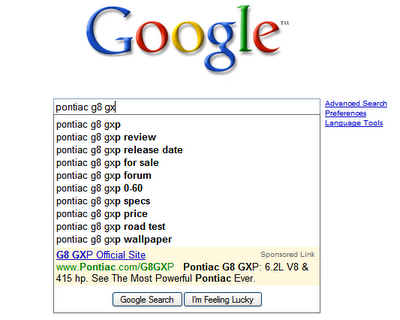
This week Google made changes to Google Suggest (that drop down menu that provides the most likely completion for what you’ve typed) to include ads.

Similar to the navigational suggestions above, sometimes we detect that the most relevant completion for what you’re typing is an ad. When an ad is shown, we mark it with the text “Sponsored Link” and a colored background, as on the results page.

Google Suggests Ads

This isn’t surprising but it is another indication that Google is actively seeking to increase paid search clicks through other products. Yahoo! put ads in news alerts and Google already inserted ads into Feedburner (FeedSense) and likely will into Google Friend Connect (FriendSense).

Will there be any type of reporting for this placement and, if effective, could it actually garner a premium rate? Time will tell.

However, expect to see more of these ad integrations as Google looks to increase revenue and growth in paid search.

5 Reasons Why Paid Search Is Down

May 18 2009 // SEM + SEO // 5 Comments

The latest from Hitwise and Comscore show that the growth in paid search is slowing.

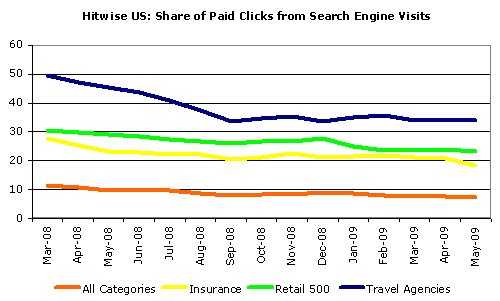
In the four weeks to May 9, 2009, 7.25% of search engine traffic to All Categories of websites was from paid clicks. This compares to 9.84% in the same four week period in 2008 – representing a 26% decline in the share of paid clicks.

Paid Clicks Declining

According to Comscore query volume grew 68% in the last two years while paid clicks grew only 18%. Now, lets be clear, paid clicks aren’t going down, they’re just not growing as fast.

There are a lot of theories about why paid search is sputtering. Here’s my analysis of five reasons behind the slow down.

Advertiser Decline

One theory is that the economy has forced many advertisers to abandon paid search. This is a compelling theory given the number of bankruptcies and marketing budget cuts.

Yet, nearly every survey (here, here and here) is showing that the economy has pushed more dollars online. And those online dollars were going to search – a medium giving advertisers far more control and, more importantly, providing a clear return on investment through analytics.

Search has become a near necessity these days and as the leader in search Google’s AdWords is a default part of many a marketing mix. Yet, the Google Tax has been going up.

The Google Tax? Anyone who has been advertising for more than three years can remember ten cent CPCs. CPC inflation was and still is a considerable problem. Yet we were all like frogs in a pot. The heat was turned up so slowly we didn’t really notice … until now.

Budget cutting forced companies to audit campaigns and what they found might have surprised them. The water was scalding hot!

Verdict: Probable.

Words per Query Up

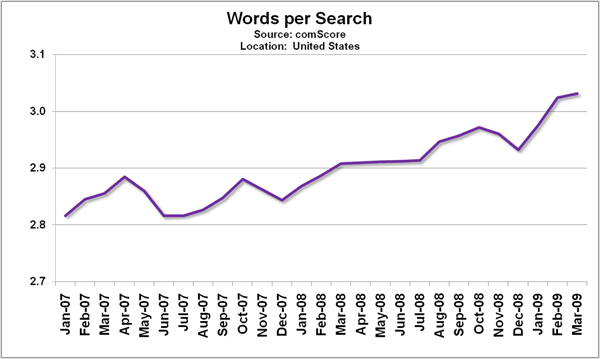
The number of words per query are up and continue to rise. Many surmise that the increase in query length is directly related to less advertising coverage and fewer paid clicks. This theory presupposes that most advertisers are running sophisticated campaigns on exact match and are heavily using negative keywords.

My experience is that sophisticated campaigns are still infrequent. Most have broad match and phrase match full bore. But, for the moment, lets say this is the case for larger advertisers. That leaves all of the other advertisers who are presented with an AdWords interface that encourages broad match.

Though there is some data that shows coverage is down, I’m unsure it is related to the number of words per query. The number of broad match and phrase match advertisers simply seems too great for query length – particularly of such a small magnitude – to have had an appreciable impact.

Comscore Words Per Search

The graph is striking because of the scale. But it still amounts to a mere single digit percentage increase in words per query over two years.

Verdict: Unlikely.

Quality Score Suppression

Google has been using their Quality Score to ensure that relevant ads are presented for user queries. If Google determines your ad and landing page aren’t relevant you’ll be forced to pay more for the ad to be displayed.

The Quality Score isn’t always a reflection of reality. It is heavily influenced by the CPC your ad receives and overall account performance. Poor keyword research, account structure, copy writing and negative keywords could lead advertisers to pay more even though they have quality content.

Google’s implementation of Quality Score has weeded out poorly targeted ads. It has also increased the CPC for all advertisers. In this way, Quality Score may be contributing to the decline not through suppression but through making the Google Tax cost prohibitive.

Verdict: Possibly.

Better SEO

Search Engine Optimization (SEO) has improved. More and more sites have invested in SEO and have come to see it as a legitimate marketing strategy. ‘Why pay for it when you can get it for free?’ And that goes double when the economy hits the skids.

Search engines have also gotten better at SEO through algorithm tweaks and results presentation changes. From Yahoo’s SearchMonkey to Google’s Universal Search (local, video etc.), organic search results have become much more compelling.

What about Google’s Vince Change? The change to Google’s trust and authority algorithm resulted in top brands floating to the top of more search engine results. Could users be finding brands more often in organic search instead of clicking on branded ads?

Improving organic search has always been an odd balancing act for Google. Better search results improve retention and return rates. That means more ad impressions which should logically mean more paid clicks. But could organic search become too good and suppress paid clicks?

Verdict: Likely.

Mix-Shift of Queries

My own theory revolves around the mix of queries. What are people searching for and has that changed over time?

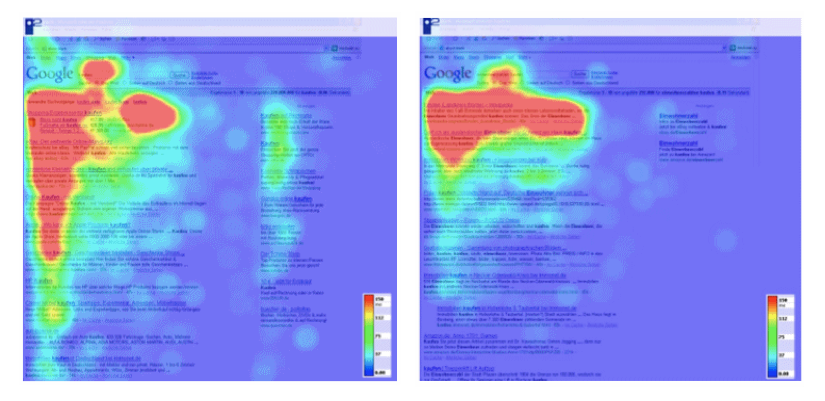
Look at the words per query graph again. What about those drops in December? Could commerce based queries be less diverse? We’ve already seen differences in transactional (left) versus informational (right) searches.

Transactional versus Information Query Eye tracking

In tough economic times could the shift in searches be away from transactional or product searches? Instead, are people searching for information or (low cost) entertainment online? Those areas may have less advertising coverage than traditional product queries.

As CPM rates have declined and CPCs have increased the ability for content based sites to participate in paid search may have dwindled. The economics just don’t work out nearly as often as they used to.

Is this not also reflected in the Hitwise numbers? Travel, insurance and retail are getting fewer paid clicks. Travel in particular seems transparent. In a recession fewer people are taking vacations leading to fewer paid clicks. In addition, travel agencies may pull back on paid search as a result of decreased demand.

And what about search refinements. Earlier this year I wrote about a Yahoo! study on how users were refining their queries.

Could users be refining their queries more frequently with a greater understanding that refinement will lead to better results? If so, I’d hazard that refined queries likely have a lesser chance of garnering a paid click.  These users are highly focused on the organic results to determine if their refinement was successful. This dovetails nicely with the informational search eye tracking study above.

Verdict: Probable.

Hodge Podge

Hodge Podge

In the end I’d bet it’s a little bit of everything mentioned with a dash of the unknown thrown in for good measure.

How, why and what people search coupled with the failing economy and an online advertising model in flux is going to have an impact on paid search.

Search, as a business, is still rather young. We’re all trying to learn what makes it tick and how it’s going to grow in the future.

This is what draws me to online marketing and search specifically. The answers aren’t black and white and the territory is uncharted.

And with that, what are your thoughts? What do you think of my analysis? Why do you think paid search growth is declining?

Google + Microformats = Rich Snippets

May 15 2009 // SEO + Technology // 1 Comment

Google adopts microformats. Finally.

What are microformats?

Microformats is a semantic markup that brings structure and meaning to metadata. In less technical terms it means you can tell search engines exactly what the content is versus having them guess. Google is supporting just two of the microformat standards initially – reviews and people – but seems committed to expanding their coverage in the future.

Why microformats matter

The upside to microformats is that search engines no longer have to guess. Remember, think of a search engine as a blind five year old.

A five year old may figure out that what they’re reading is a review by noticing the format or content of the text. (They can’t really ‘see’ a star rating.) A search engine might piece it together. You’d hope so but … they’ll often fail.

Microformats lets you put a big headline on the review that shouts ‘this is a review‘.

What are rich snippets?

If the search engine can understand and trust the metadata it can transform bland search results into something more robust and compelling. This is what Google calls a rich snippet.

Rich Snippets

Both Microsoft and Yahoo! adopted microformats long ago and Yahoo! has been using SearchMonkey to accelerate the display of robust search results. It was an area where I believed Yahoo! had an advantage and should have been seeking to exploit it more.

A rich snippet is far more attractive and will drive more clicks. It was rumored that Google was holding out because they didn’t want to create an inequity based on the ability to implement semantic markup.

Was Google trying to write an extraction program to interpret native code so everyone could obtain a rich snippet? Maybe they were, maybe they weren’t but they’ve clearly decided that rich snippets are important and microformats are the way to quickly deliver rich snippets in search results.

Microformats go mainstream

I’ve been a big proponent of microformats since being introduced to them by Chris Eppstein. I was so sure they’d go mainstream it was one of my 2009 Internet and Technology Predictions.

Does the adoption of microformats by Google fulfill that prediction? I think so.

xxx-bondage.com