The other day I was walking to lunch with a long-time client and we passed one of the main entrances to Pac Bell, SBCAT&T Park. He noted that this particular entrance seemed overly obvious.
This image, from Google Street View, shows the ‘Giants Building’ sign with a SF logo underneath and a ‘Home Of The Giants’ as a type of sub-header.
My response was simple. That’s good SEO.
This brought me a round of good-natured chiding from my client about being a bit too SEO focused. But really, this was a great example of Blind Five Year Old SEO. The sign was simple and instructive. (Perhaps also a reaction to the frequent name changes that Park has undergone.)
Could the San Francisco Giants be SEO savvy?
Let’s say I’m a tourist from … Sweden. What name tells me more: AT&T Park or Giants Building? That’s a no-brainer, right! Better yet, I’ve got that nice SF logo there for some context. And if I’m still confused I’m even told that this is the home of the Giants. Without a doubt I know the building in front of me is the home of the Giants.
Whether or not they’d know that the Giants are a baseball team is another thing entirely.
So am I too SEO focused or is this just a good real world case of providing easy, instructive signage?
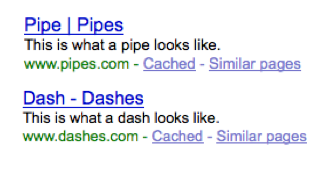
At SMX West 2009 Bruce Clay stated that Yahoo! didn’t ‘like’ pipes. I’m a big fan of pipes so I made a beeline for the Yahoo! representative at the show and he was nonplussed. He saw no reason why Yahoo! would treat pipes any different than dashes.
What are pipes and dashes?
I’m talking about the delimiter used in the title tag, which ultimately shows up as the first line in your search engine result. The two most frequently used title tag delimiters are pipes and dashes.
Are pipes better than dashes?
So, it seemed like Yahoo! had no preference but what about Google? I asked Matt Cutts and got the following video reply. (Thanks Matt.)
The answer seems to be the same. Google most likely handles pipes the same way it does dashes.
Do users prefer dashes or pipes?
Matt brings up an interesting point surrounding click through rates on pipes versus dashes. And maybe that’s what Bruce was referring to – a study of click through behavior, specifically on Yahoo!
The real problem is you can’t really do an A/B test like you can on AdWords. But wouldn’t that be an incredible tool Google could provide through … say, Webmaster Tools! Because what you’d really want to do is take the same URL and send half of the traffic to one treatment and half to another.
In the interim I suppose you could conduct an eye tracking study. But Matt’s probably right, there’s likely little to no difference. Until then you can feel safe using both pipes or dashes for your title optimization.
Google wants to see long clicks not short clicks. That’s the new SEO terminology coming from Google.
What’s a Long Click?
A long click occurs when a user performs a search, clicks through on a result and remains on that site for a long time. They don’t come back to the result set immediately to click on another result or to refine their query. In general, long clicks are a proxy for satisfaction and success.
What’s a Short Click?
A short click is the opposite of a long click. (No duh!) A short click occurs when a user performs a search, clicks through on a result and quickly comes back to the result set to click on an alternate result. In general, short clicks are a proxy for dissatisfaction and failure.
How is Google Tracking Click Length?
No, it’s not through Google Analytics. They’re not peeking at bounce rates. Instead Google is measuring pogosticking activity by leveraging their current tracking mechanisms. Remember, Google already tracks the user, the search and the result clicked. All Google needed to do was to accurately model the time dimension.
Why are Long Clicks Important?
Long clicks are important to Google because it gives them a way to measure the satisfaction of the result based on downstream behavior. Sure, a result might get a lot of clicks but did it actually satisfy the query?
Is it a success if 100 people click but 98 go back within 10 seconds? What if those 98 people all clicked on an alternate result?
Google knows that the search algorithm still isn’t that smart. It routinely makes mistakes and can often be led down the wrong path by aggressive search engine optimization. Long clicks provide a feedback mechanism, a type of human quality assurance that is lacking in the algorithm.
Long clicks are important to you because they will may help increase your SERP rank.
The chatter from Google makes me believe that it is part of the algorithm. How much it is weighted now and in the future remains to be seen. One way or the other Google is saying that longer is better.
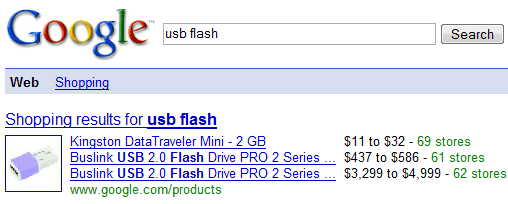
Starting Monday, Google began to display an image based shopping OneBox, changing the SEO landscape for any product or eCommerce related site. The shopping OneBox seems to be in high rotation, usually appears within the top three results, takes up more vertical real estate and has broad coverage over product searches.
What is a Google OneBox?
When Google wants to display information that is not exactly in the algorithm, but is related to the query, it does so through what is called a OneBox presentation. Think of it as a promotional unit.
The OneBox terminology was used by Google when the unit was first introduced and seems to have survived, at least externally. SearchEngineWatch (sorta) confirmed the OneBox terminology in an interview with Google Product Marketing Director Debbie Jaffe in 2006. (Jaffe never actually refers to it as OneBox.)
OneBox can display a variety of different information from news to weather to books to products and can be placed anywhere from the top to the bottom of a result page.
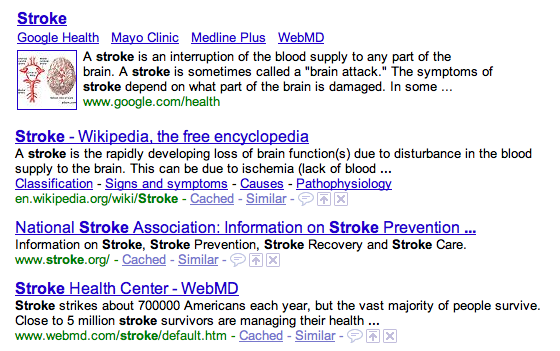
The OneBox presentation is controversial because it creates a very prominent listing that provides … cherry-picked results. As an example, Google has begun to implement a health OneBox.
The health OneBox for the query ‘stroke’ brings Mayo Clinic, Medline Plus and WebMD to the top of the page instead of where they’d wind up under natural results. In this case WebMD would be 3rd, Medline Plus 6th and Mayo Clinic 11th.
Google Shopping OneBox
The shopping OneBox or product OneBox brings the same cherry-picking controversy to the surface. It’s exacerbated by the fact that Google Product Search essentially competes with shopping comparison engines and review sites, many of whom have spent time and effort to perform search engine optimization.
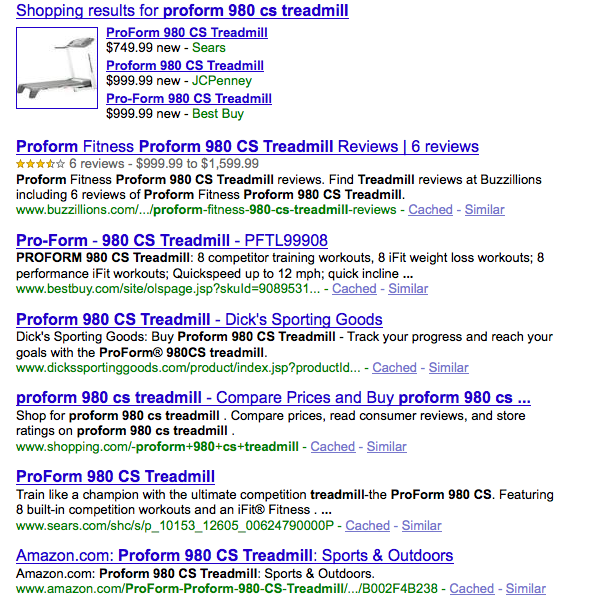
If you’re not participating in Google Product Search (aka Google Base) then you’re never going to be in the shopping OneBox. And even if you do participate, there’s no guarantee that your listing will be featured. Here’s an example of the shopping OneBox for the query ‘proform 980 cs treadmill’.
Sears, JCPenney and Best Buy are all featured in the shopping OneBox. At least Sears and Best Buy have a natural listing but JCPenney has essentially circumvented normal SEO and is now a preferred result for this query.
Sites such as Buzzillions, Dick’s Sporting Goods, Shopping.com and even Amazon suddenly lose out on this query despite matching and delivering a very good experience for this product search. Even Best Buy might not be thrilled since they’d be first retailer listed and not the third if the OneBox wasn’t presented.
Today, Google is a huge part of any product based business, so changes like this will have an immediate impact on traffic and sales.
Shopping OneBox Evolution
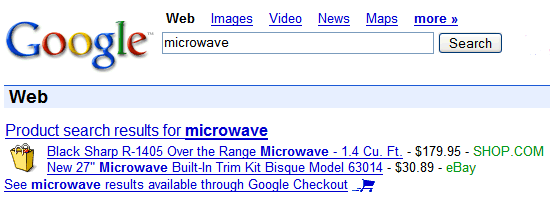
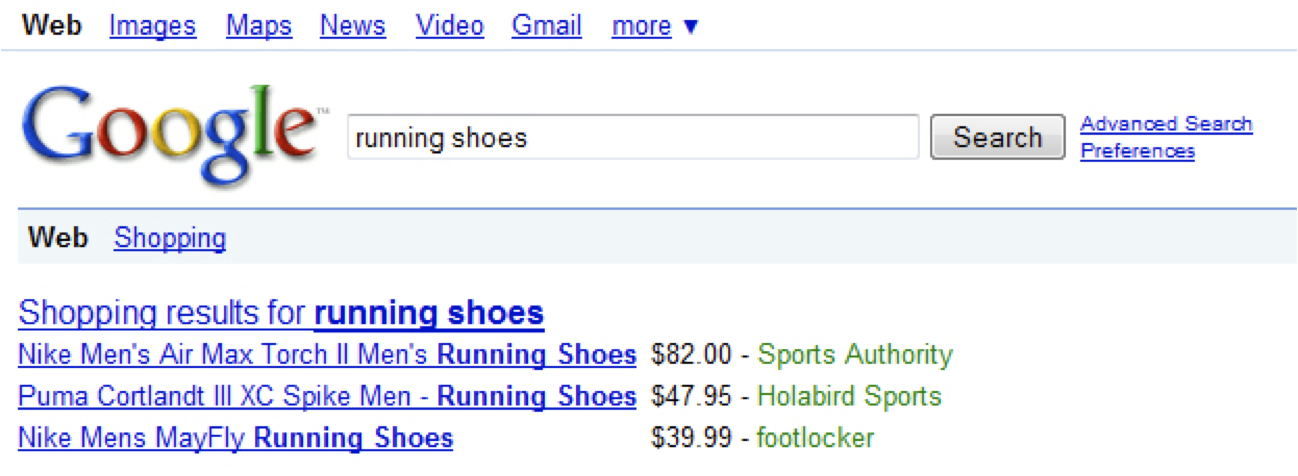
The evolution of the shopping OneBox shows an increasing interest by Google in this vertical. First there was the old Froogle presentation.
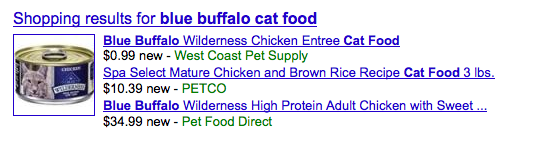
Now the shopping OneBox has a large product image and is not compact at all, taking up a tremendous amount of real estate.
Importance of Shopping OneBox
On September 2nd, the Google Base blog announced new features for marketplace and aggregators on Google Product Search. This is a real change from the initial launch of Google Base, where Google seemed interested in having individual sellers upload to Base and use Google Checkout on their sites – middlemen be damned!
The change in direction for Google Base coupled with the focus Bing has had on shopping seem to have accelerated Google’s interest in the vertical. They’ve been toying with it for many years but have never really made it a priority.
The new shopping OneBox indicates that might be changing.
SEO Judo is used when you have a site or blog with content that hasn’t been optimized for search. When content isn’t created with keyword research as part of the process Google and other search engines define the relevant keywords for each page.
… it is the principle of using one’s opponent’s strength against him and adapting well to changing circumstances.
In the world of SEO the opponent is Google. Don’t misunderstand, Google isn’t evil. I don’t believe that Google has ulterior motives to each and every algorithm change. That’s not what I mean by opponent.
Instead I simply mean that when Google decides what a page is about it’s pretty difficult to change it’s mind. And the longer Google thinks a page is about a certain cluster of keywords the tougher it’ll be to convince Google otherwise.
Use Google’s Strength
Why fight Google? Instead, use their strength against them. If Google thinks a page is about a certain keyword and you’re currently ranked 5th for that term go ahead and optimize the page forthat term and see if you can increase your rank and claim a greater amount of that traffic.
Sure you might look at the page and think that another keyword would be better, or you may look at a root keyword and get big saucer eyes with the amount of traffic you could get if you ranked for that term. But your opponent is strong. Very strong.
It will take a substantial effort and a fair amount of time to convince Google of new keyword targeting. Even then, you’re not guaranteed success. Instead, use SEO Judo and use Google’s momentum to reinforce what it already believes.
SEO Judo Example
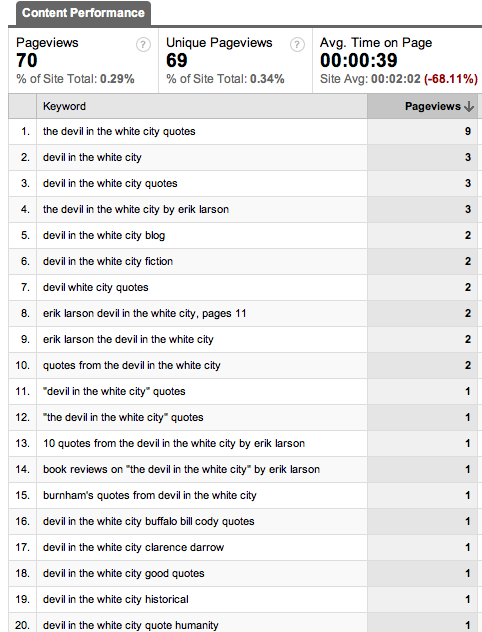
Here’s an example of how to practice SEO Judo from my small Used Books Blog. In February I read and reviewed Erik Larson’s Devil and the White City. Using Google Analytics I can go and look at what keywords brought people to this page.
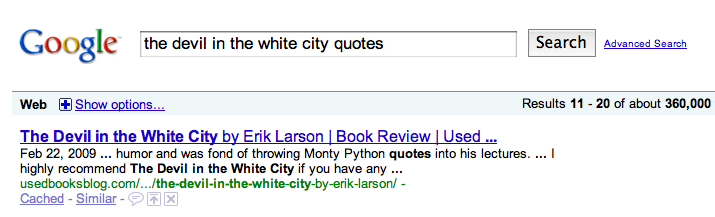
Even with the small volume you can quickly see a cluster of keywords around ‘devil in the white city quotes’. Performing this query on Google returns the page as the 11th result. Not bad!
In this case Google has ignored my meta description and created a snippet based on the text in the review. (More on this a bit later.) Clearly the Holy Trinity of SEO (title, meta description and URL) is not being optimized for the term ‘devil in the white city quotes’. But … it could.
With a bit of SEO Judo I can adapt to changing circumstances and use Google’s strength to my advantage. In a short amount of time I’d be a fixture on the first page for the term ‘devil in the white city quotes’.
When NOT to use SEO Judo
I wouldn’t use SEO Judo for the example I just used. Sure, I could, but to what purpose? The page doesn’t actually have any quotes from The Devil in the White City. (Thanks to the poor snippet algorithm.)
SEO isn’t just about traffic. Post Click SEO is the goal – getting the right traffic for your blog, site or business.
So only use SEO Judo if the keyword Google selects is actually good for your business. Remember, Google might be strong but it’s still not very smart.
When to use SEO Judo
SEO Judo should be used when you’ve given Google enough information to form an opinion. Google doesn’t need a whole lot, so this really means that the page must have a non-duplicative title and should have a keyword based URL.
In addition, the page must get enough SEO traffic so you can identify keyword clusters. If no one keyword phrase emerges, go back and optimize based on straight forward keyword research. If there are competing terms, you can again fall back on keyword research to select the best keyword target.
SEO Judo works best when you can create new content. Using the example above, I might change my review of Devil in the White City to include quotes, or I could create a new blog post specifically about quotes from Devil in the White City. Not only do I already understand Google’s appetite for this term, but I might finesse an indented listing by linking between the two posts.
This process is also useful if you’re pursuing a root keyword strategy. Instead of doing SEO Judo on the root keyword URL, you can use SEO Judo to create content for secondary terms that are firing on that root keyword content. This provides additional focus for the root keyword while building traffic on secondary terms.
Stop wearing yourself out trying to out-punch Google and instead use SEO Judo to throw Google to the mat.
My personal experience is that AdWords conversion rates DO vary by position. That’s not to say that I can’t be convinced otherwise, but I’ll need a lot more evidence then was provided in the blog post.
As a fundraiser many moons ago, my first instinct was to say that there would always be an inverse relationship between dollar amount and conversion rate. The lower the pledge amount, the higher the conversion rate.
Yet, I found that there wasn’t a tremendous difference between some giving levels. Conversion rates on $25 pledges weren’t substantially different from $100 pledges. However, that variance increased as you climbed up the solicitation ladder. Conversion rates for $500 pledges did vary materially from $25 pledges.
So, I’m not unwilling to be persuaded by real research and statistics that might contradict my anecdotal evidence. The problem is that the post didn’t link to the research to help validate the methodology or assumptions that led to this conclusion. Only a few variables are discussed, leaving a number of others open to interpretation or debate. It doesn’t help that one of the three links in the post goes to a 404 page.
How Did They Define Conversion?
That broken link … it was to the definition of conversion rate. Oddly, this is an important point. How did they define a conversion? Were only those conversions configured in AdWords included? Or did they pull from Analytics Goals as well? Essentially, we have no idea as to the universe of those who were included in this research, nor is there any mention as to what type of bias this might introduce.
Does the Type of Search Impact Conversion Rates?
Second, what type of searches were included? Given the differences in transactional versus informational queries one would believe that there might be a difference in conversion rates by position as well. An ad advertising a product (eCommerce or transactional) may exhibit different behavior as those advertising content (content or informational).
Does Query Length Impact Conversion Rates?
Blognation points out that an analysis of conversion by “token length” would be important.
Here’s a different way to think about the Google conversion rate data that I think would probably have a much different outcome. Do a conversion rate analysis by “token length”, which is search engine language for the number of words in a search query. If someone types in “baseball” for example, what’s the conversion rate differential between position #1 and position #10, versus a query for “buy Louisville slugger size 28 wooden baseball bat.”
I suspect that the conversion rate for the first query is going to be very low for the first position, simply because you are going to have a lot of browsers who simply click on the first ad that they see. Any browser who eventually makes it down to position #10’s result may very well have turned into an actual shopper after clicking on all the other ads. Conversely, if you already know the exact product you want – and your search query indicates that intent – you are much more likely to convert on the first ad you see that actually offers the specific product you want.
Related to this would be the conversion rate by position by match type. With so many advertisers unknowingly bidding solely on broad match, this type of analysis seems necessary and … useful!
Does CPC and Ad Category Impact Conversion Rates?
Finally, was this analysis performed to determine whether conversion rates by position remained constant depending on the average cost of the keyword? Could it not be true that different behavior could exist for a keyword with a $10 per click cost versus 10 cents?
Might different categories produce different conversion rates by position? Would the conversion rates for books, movies and music differ from long term care insurance? Could the number of competitors or volatility of a keyword impact the conversion rate by position?
Why Present AdWords Conversion Rate Research?
The presentation of this research without … the actual research makes me suspicious. What message is the AdWords team sending to advertisers? It seems to me that they’re encouraging advertisers to bid for the extra traffic received from higher ad positions. That advertisers can do so without negatively impacting their conversion rate and subsequent ROI.
Never mind that the higher CPC to achieve that extra traffic would reduce your margin. And that’s IF your conversion rate does remain the same. Should it not, you’ll pay a premium to obtain traffic that converts at a lower rate. So, who is this research advice really supposed to benefit?
Given the lack of supported evidence I can only rely on the experiences that I and my colleagues have had over numerous years. Experiential learning tells me to beware of monkey clicks, which do cause the top positions to have lower conversion rates.
I’m still willing to be convinced, but until something material is presented, this seems akin to evidence of the Loch Ness Monster. The cynic in me sees it as marketing copy meant to drive more advertiser dollars. I’d love for Google to prove me wrong.
In simple terms, Microsoft will now power Yahoo! search while Yahoo! will become the exclusive worldwide relationship sales force for both companies’ premium search advertisers.
But it’s not all simple and straight-forward. If Bing now powers Yahoo! search, what happens to Yahoo! Paid Inclusion?
What is Paid Inclusion?
Yahoo! Paid Inclusion is a pay-per-click product that allows an advertiser to pay for a listing in the search index. That’s right, you can pay to look like an ‘organic’ listing. Paid Inclusion is the dirty little secret that nobody at Yahoo! talks about and is only whispered about among advertisers.
Will Yahoo! Paid Inclusion Survive?
At first glance it might seem that Paid Inclusion will go the way of the dodo bird. Or will it? The second key term provides an opening.
Microsoft will acquire an exclusive 10 year license to Yahoo!’s core search technologies, and Microsoft will have the ability to integrate Yahoo! search technologies into its existing web search platforms;
While this statement is clearly about the Yahoo! search algorithm and (perhaps) ancillary products like SearchMonkey, it could also apply to Paid Inclusion.
The reach of Yahoo’s Paid Inclusion product has never been clear and, therefore, the actual revenue Paid Inclusion generates is also a bit of a mystery. Is Paid Inclusion revenue big enough to preserve through this partnership or not?
Paid Inclusion and SEO
Paid Inclusion already obscures Yahoo! SEO. If Paid Inclusion goes away, many advertisers who were getting traffic ahead of natural listings will suddenly be at the mercy of natural SERP and SEO. There could be a substantial traffic impact for these advertisers who have come to rely on a certain amount of traffic at a predictable ROI.
Should Paid Inclusion not survive the partnership, SEO – Bing SEO specifically – will become more important. If Paid Inclusion does survive, does it do so just on Yahoo! properties or would it be integrated into Bing results as well? If it is the latter, Paid Inclusion becomes much bigger.
In the final analysis, I don’t think Paid Inclusion revenue is large enough, can’t see Bing integrating Paid Inclusion and similarly can’t see Microsoft wanting to explain why searches on Yahoo! and Bing are materially different.
For these reasons I’m guessing that Paid Inclusion will be terminated.
I asked what happens to other things search like at Yahoo? What powered Yahoo News? What happens to the Yahoo Directory? Is Delicious search? And what happens to Yahoo paid inclusion?
Bartz: We have full flexibility on what to do within our own sites. Paid inclusion, we’ll decide on that later.
So Paid Inclusion still has a chance of surviving but it seems like it’s on life support.
One of the great things about our new information culture is how disparate sources coalesce into something meaningful. Last week I read a Fortune magazine article on Marc Andreessen, news about IZEA’s Sponsored Tweets and research on the impact social media has on brands and eCommerce. When I put these pieces together the picture is of a powerful locomotive hurtling toward a creaky bridge.
Social Media and the Telephone
The telephone is a social platform. You call family and friends to talk about things from the trivial to the serious. If you know a person’s phone number you can call them. At some point, marketers figured out that they too could call you, so long as they had your phone number. Phone numbers weren’t hard to find.
This didn’t sit too well with most people. They didn’t want some stranger calling right at dinner trying to sell them something. The thing was, enough people actually did respond to these calls and telemarketing flourished. It was a lot more effective than direct mail.
Over time, more and more people became irate. Laws were passed so that you could opt-out of these unwanted calls. But there were loopholes. Giant gaping loopholes. Any company you had a ‘prior relationship’ with could still call you unless explicitly told otherwise.
You might have bought from them before, maybe even kept an eye out for coupons, but you didn’t want them to ring you up whenever they pleased.
Now replace phone number with user name. This story has already been written.
Sponsored Tweets and Telemarketing
Sponsored Tweets will not work like telemarketing. The reason why telemarketing works is because you can engage in a dialog. A good telemarketer changes their approach based on the subtle feedback they’re getting from the prospect. And they’ll certainly use every objection as an opportunity. I know a bit about this since I ran telemarketing programs for nearly five years.
The problem with Sponsored Tweets is that the lack of dialog. One way communication isn’t nearly as effective. It’s the reason why telemarketing beats direct mail. No, Sponsored Tweets are not like telemarketing.
Robocall is American pejorative jargon for an automated telemarketing phone call that uses both a computerized autodialer and a computer-delivered recorded message.
I’m guessing you’ve gotten one during the election season or, most recently, from some company trying to sell you an auto warranty extension. You don’t like them.
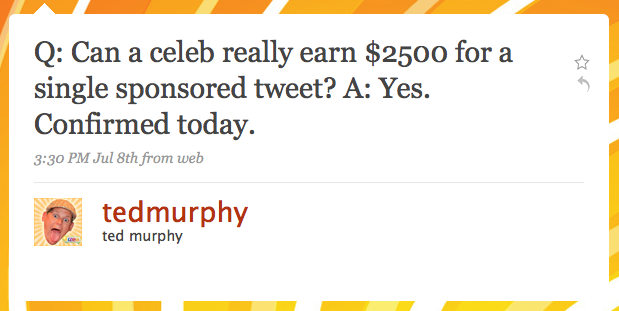
Getting a robocall from Martin Sheen is the same as getting a Sponsored Tweet from a celebrity.
Context Shifting and Social Marketing
Marc Andreessen believes that advertising can be an effective part of social interactions.
He tells me Facebook “will be bigger than Apple” and declares that the social-networking company will become the mass-market window to the web, much as Google has been for the past six or seven years. Twitter, so far criticized for having no way to make real money, will get advertisers to pay to reach people as they are sending messages about the sponsor’s products.
The real issue here is context switching, a term my Caring.com engineers introduced to me. The general idea is that if you’re thinking in one way (about one thing) it takes some time and effort to stop and think about something else. The context of your attention has changed.
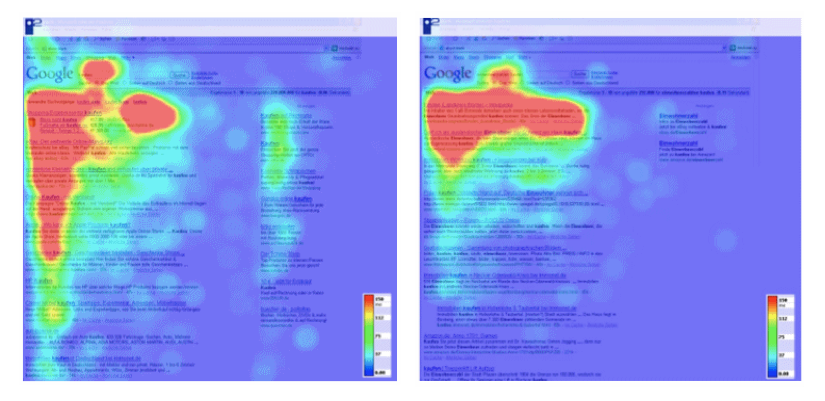
The example of Google actually supports the idea of context switching. Eyetracking studies have shown substantial differences in how people scan results for transaction based queries (left) versus information based queries (right).
All searches are not created equal. The intent of that query, of that action, defines the context.
Social Marketing’s Creaky Bridge
Others, like Andreessen, seem to believe that context is homogeneous and can be blended. That social messages and product based messages can live side by side. That as you’re telling someone about the cool new things your iPhone does that you’ll enjoy a message from Palm trying to persuade you that the Pre is the way to go.
… an overwhelming 96% of employed consumers say their opinion of a product brand does not change if that brand has no presence on a social networking site … In fact, just 12% of respondents say their opinion of a brand actually changes if that brand maintains a significant social networking presence and only 11% of social networkers report following any major brand through a social networking site.
This is but one of numerous datapoints that illustrates that creaky bridge I mentioned at the beginning of this post. The locomotive of social marketing continues to thunder down the tracks, ignoring the flashing yellow signals at their own peril.
Not sure if I really want to shift it, if marketing folks know I am getting tired of microsoft based systems and planning on going all apple, what kind of marketing fight would happen over that one? I want them to look at me one dimensionally cause I can blow them off easier.
A few weeks later I had a conversation with Ana Yang at the FriendFeed open house. Ana’s not on Facebook. Why? She doesn’t think it really represents who people are but who they want to be.
The implications of both these statements buzzed around in my head and connected with other thoughts I’d had on social media data mining.
People Lie
Dr. Gregory House is fond of this saying. He’s right too. People do lie, and for a variety of reasons.
Among other reasons, they lie to avoid things, they lie to fit in and they lie to avoid embarrassment.
I’d argue that people are more likely to lie in social situations and that the relative distance created by the Internet also increases people’s proclivity to lie.
So, forget about the privacy issues surrounding data collection. The real threat to Facebook’s plans lay in incomplete or downright inaccurate personal information.
Lies of Omission
The problem isn’t the actual issue of privacy, but the reaction to privacy. The heightened awareness that your personal information might be available to the highest bidder leads many to change their behavior. Some, like Dan, may lie to avoid marketing. Others may go back and remove certain information.
At a minimum, many simply reduce the amount of personal information they share moving forward. This sharing reticence creates a skewed look at people overtime. The personal data becomes a snapshot of who they were, and not who they are.
There are also topics that you might not want to discuss in a public forum. You’re probably not going to fan an incontinence product. You might not divulge the nitty-gritty details of your divorce. Most aren’t going to discuss their pornography habits. If people are wondering ‘ where can I pay for a divorce‘, they can get help from attorneys here!
Social Lies
One of the core issues here is the idea that self-reported social data is accurate. This isn’t a magazine subscription or a warranty card submission – things that have roots in a commerce transaction. Commerce serves as a safeguard against pervasive lying. You can’t receive that magazine if your address isn’t correct.
Social data is untethered from commerce and therefore doesn’t have a natural safeguard. The transaction taking place is psychological and emotional instead.
The act of social lying is pervasive. How many share real information when asked ‘how are you?’ Not to mention the powerful force of peer pressure and the innate desire to be liked.
We acquiesce. We embellish. We edit. We redact. Not only that, but we change our behavior based on the environment and setting.
Social Schizophrenia
At work you might say one thing, but sitting out in the backyard with a beer you might say something different. Your status update on Facebook might be different from the one you have on LinkedIn.
Soon after the FriendFeed open house there was a rather public integration of social personalities. This might not be a frequent occurrence but it’s enough to be unnerving. There is no householding of these different personalities under one address, whether it be an extreme case or simply the different facets of your social existence.
Even if you could accurately aggregate social data across various networks and email addresses, would you be able to extract reliable meaning from that data?
Social Trust
Why would companies pay for social data they can’t trust? Most companies already have multiple sources of personal data. Consumer databases with multiple reporting lines are frequent. Many also build their own through rewards programs.
Yet, marketers are always hungry for more. That’s where profiling and detailed segmentation services provided by companies like Nielsen Claritas come into play. You might think that Facebook could give them a run for their money, but it comes down to the self-reporting bias once again.
It’s not what you say you do, it’s what you actually do that matters. Facebook data is interesting but it’s not a hotel on Park Place. It’s more likely a house on Baltic Avenue.
The SEO community was thrown into a tizzy by the announcement at SMX Advanced that Google had changed the way it dealt with nofollow links. The details were a bit fuzzy. Conjecture ran amok. Was nofollow page sculpting dead, or just crippled?
So what happens when you have a page with “ten PageRank points” and ten outgoing links, and five of those links are nofollowed? Let’s leave aside the decay factor to focus on the core part of the question. Originally, the five links without nofollow would have flowed two points of PageRank each (in essence, the nofollowed links didn’t count toward the denominator when dividing PageRank by the outdegree of the page). More than a year ago, Google changed how the PageRank flows so that the five links without nofollow would flow one point of PageRank each.
The days in which you could hoard page rank or authority on a few links by nofollowing others is a thing of the past. (In fact, has been in the past for over a year!)
Instead, the page rank or authority on nofollow links is lost, falling into the equivalent of the Bermuda Triangle.
SEOmoz wrote up a great piece that illustrated this point and detailed ways in which you can continue to page sculpt without the use of nofollow. Though doing so might not be wise. Read on to find out why.
Nofollow change outrage
Many in the SEO industry became irate. They shouted and stomped their feet, decrying the whimsy of Google, who in 2005 introduced the nofollow concept, nurtured it (to a point) and changed the rules without notice.
The changing nature of SEO is what keeps most agencies, consultants and talking heads in business. If the algorithms were transparent and had been perfected then no one would need our services.
The truth is that the algorithms are a work in progress. Search Engines are like blind five year olds and, as such, are still learning. If you’re a parent, you know that as soon as you figure out how to deal with one problem your kid has moved on and given you another one to solve.
I mean, really, are you still grousing about how meta keywords are no longer important?
So why did Google make this change? Well, it wasn’t to target specific people or sites. And it wasn’t malicious or to make your life miserable. The truth is that the nofollow change is about usability and Google’s continuing efforts to make the web more useful for people.
Nofollow change is about usability
The problem with nofollow was that it didn’t allow the search engine to look at the page like a human being. If you nofollowed 20 links out of 25 on a page you were essentially telling Google that only 5 links existed.
But to a human being, all 25 links exist.
The fact that you were telling Google that those 5 links were what mattered most isn’t how a human being would interpret that page. This made Google unhappy.
Keep the links on a given page to a reasonable number (fewer than 100).
The nofollow change essentially means that they’re counting your nofollow links against that 100 link benchmark. Translation. Stop putting so many links on a page!
Many at Google point to Barry Schwartz’s The Paradox of Choice as a favorite in the Google Tech Talk series.
The one hour video is absolutely worth watching but, to make a long story short, more is not better because more makes it difficult for someone to make a choice.
The Paradox of Choice applies to web design and user experience too. In a time compressed society with broadband access and tabbed browsing, you have a limited amount of time to communicate what your site is about and where they should go next. Overwhelm your users and they’ll run screaming to the next tab.
Instead, search engines have to model the ability of humans to parse a site. The nofollow attribute interrupted that model. It forced the search engine to see authority where a human user might not. The nofollow change removes this bias and also pushes sites to design according to that model by tossing nofollow page rank and authority into the Bermuda Triangle.
The real nofollow question
Google is serious about this mission, which is why it has begun to execute JavaScript, another favorite way to obfuscate links without using nofollow. There are still plenty of ways to hide links and sculpt your page rank or authority but it seems clear Google feels it needs to see all the links on a page to properly evaluate how it is being processed and interpreted by people.
The nofollow change is a not-so-subtle push to encourage sites to simplify. Not just so the search engine can better understand, but so people can better understand too.
The real question resulting from the nofollow change is far more thought-provoking.
How comfortable are you with Google shaping user experience?