Yahoo Adds Ads To Alerts

December 26 2008 // Advertising + SEM // Comments Off on Yahoo Adds Ads To Alerts

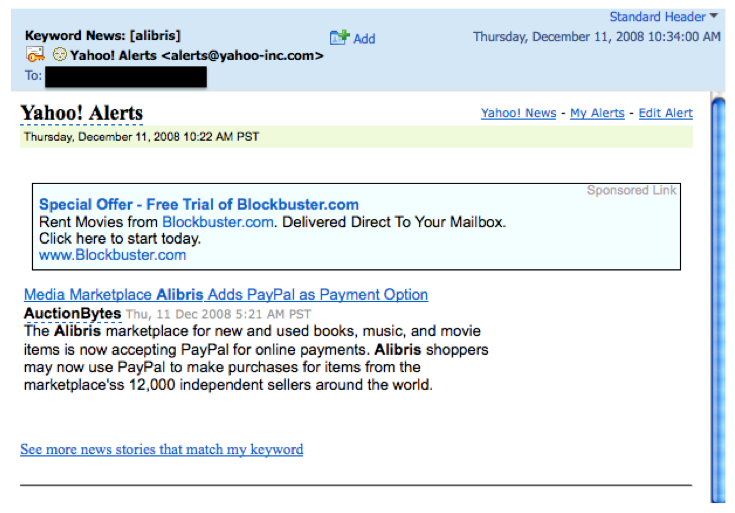
Yahoo is serving ads at the top of email alerts.
Yahoo Ads In News Alerts

Most of my alerts are with Google, but a few of my legacy alerts still reside at Yahoo. So I’m not sure exactly when this began but it seems like it started as of December 1st.

Both search giants are looking for ways to sustain growth in a maturing market. Sponsored search and network search just aren’t going to move the needle in eyebrow arching ways anymore – particularly in a weak economic environment.

This is an interesting move by Yahoo in light of Google’s advertising extensions via Feedburner (FeedSense) and Google Friend Connect (FriendSense).

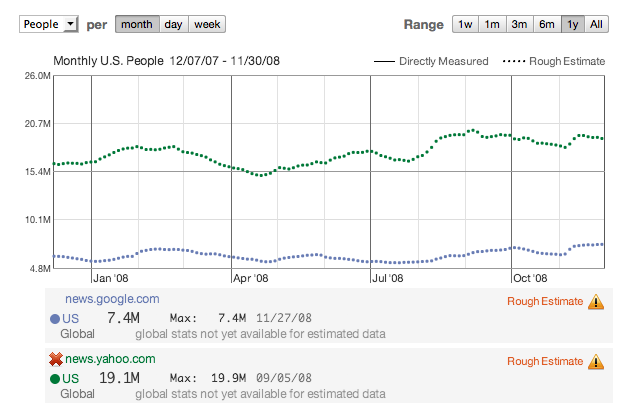
Remember, Yahoo still dominates news by a nearly 3 to 1 ratio. It’s nothing to sneeze at.

Yahoo News Versus Google News

If we use traffic as a proxy for number of alerts it’s easy to see how Yahoo could quickly increase its reach. Effectiveness, well that’s another issue.

But with this move by Yahoo, can AlertSense be far behind?

2009 Internet and Technology Predictions

December 23 2008 // Advertising + Marketing + SEM + SEO + Social Media + Technology // 9 Comments

Now is the time when bloggers go on the record with their thoughts for the year ahead. Place your bets! Stake your claim! Here’s mine.

Crystal Ball 2009 Predictions for Internet and Technology

Facebook Becomes A Portal

Realizing that social media and advertising is like oil and water, Facebook repositions itself as a portal leveraging Microsoft’s Live Search as the revenue model. This also might result in the potential acquisition of Netvibes to provide a more robust offering to compete with Yahoo!

Identity Systems Fail

Confused about the difference between OpenID, Facebook Connect and Google Friend Connect, users throw up their hands and decide not to use any of the above.

Video Advertising Succeeds

The adoption of video is surging faster than many expected. Longer formats and better quality will bring even more eyeballs who will grudgingly accept advertising.

Microformats Go Mainstream

Why they aren’t already is shocking. Nevertheless, in 2009 we’ll see microformats become a standard and search results will become far more robust as a result.

Banner CTR Becomes Obsolete

Brands will finally realize that measuring success by click through rate (CTR) isn’t working. Measurement ‘beyond clicks’ will be the new yardstick, whether that’s through new brand advertising measurement services like Vizu or through monitoring services like Brandwatch and Trackur among a gaggle of others.

RSS Adoption Spikes

Someone will (finally) figure out how to market RSS to ‘the masses’ who will grasp the sublime benefits of having content come to you instead of the other way around.

Kindle 2.0 Flops

Amid a weak economy Amazon releases the newest version of Kindle. Other readers have gained ground where Kindle has not and at the core Kindle is a solution without a problem.

Google Search Share Stalls

The move by Facebook (see above) causes a radical change in the search landscape. Microsoft passes Yahoo! for second place and talks about a Microsoft Yahoo merger are (unbearably) reignited.

FriendFeed Surpasses Twitter

FriendFeed adoption increases at an accelerated pace due to quick innovation, uncluttered design and an interface that lends itself to communication.

Someone ‘Dies’

Users reach social media overload and VCs get even more nervous about revenue creating social media shrinkage. In this instance ‘Dying’ means a company goes under or is purchased for a song. My short list includes Plurk, Twitter, Digg and Seesmic. This isn’t a reflection of the people or product but the inability to truly reach the mainstream with a service that has a profit model.

There are plenty of other things that I believe will happen in 2009, but they seem more obvious or an extension of current trends. Instead I tried to be a bit more bold, at least on a few of my predictions.

We’ll check in this time next year to see how I fared. In the meantime, feel free to comment and provide your feedback and reaction to my predictions.

Google SEM 101: Phrase Match and Exact Match

December 18 2008 // SEM // 24 Comments

In my time as a search engine marketing consultant, I’ve found that many overlook phrase match and exact match in their Google AdWords campaigns.

What’s the difference between broad match, phrase match and exact match?

Broad match

The AdWords system defaults to broad match which will serve your ad based on the loosest of requirements. For instance, let’s say you’re bidding on the keyword ‘bird bath’. On broad match your ad shows up if the words ‘bird’ and ‘bath’ appear anywhere in the query in any order. This means your ad is served up if someone searches for ‘does big bird ever take a bath?’ It’s not always relevant.

Phrase match

With phrase match your ad shows up only when ‘bird bath’ appears together, in that order, in the user query. Other words may still appear before or after, but the phrase must appear. This means your ad is served if someone searches for ‘making a bird bath’. Use phrase match to ensure your ad is shown to more relevant queries.

Exact match

To be precise, use exact match, which is … exactly what it sounds like. Your ad shows up only when the exact phrase ‘bird bath’ is used without any other words. The volume is low but you can be assured you’re reaching the right audience

Why is using phrase match and exact match so important?

As mentioned above, phrase match and exact match lets you target your ad to more relevant queries. You’ll see higher click through rates (CTR) on phrase match and exact match keywords. A high CTR isn’t just metric window dressing, it can actually help you reduce your CPC while maintaining your advertising position.

Read that last sentence again because it’s that important.

Google uses your historic CTR for a keyword to determine your ad quality score, which in turn influences your CPC for that keyword. Don’t believe me? Believe Google.

In addition, you want to drive relevant traffic to your site that will convert and provide a significant ROI. Broad match will give you volume but you may very well encounter a greater percentage of monkey clicks which will depress your conversion. The low CTR these broad match keywords rack up will also lead you to pay a higher CPC.

Finally, the clicks generated by phrase match and exact match are of higher quality and should have better conversion rates.

Can I use all three match types at the same time?

Yes. There’s no reason why beginners shouldn’t load up all three match types for all of their keywords. More advanced users may even choose to have different bid strategies for each match type, paying less for broad, a bit more for phrase, and a premium for exact match.

How can I add phrase match and exact match to my existing campaigns?

Google does have an interface via their keyword tool but the UI makes it difficult to add all match types for selected keywords. Frankly, it seems like an easy UI problem to resolve and I can only believe that Google wants a greater percentage of broad match keywords to maximize revenue.
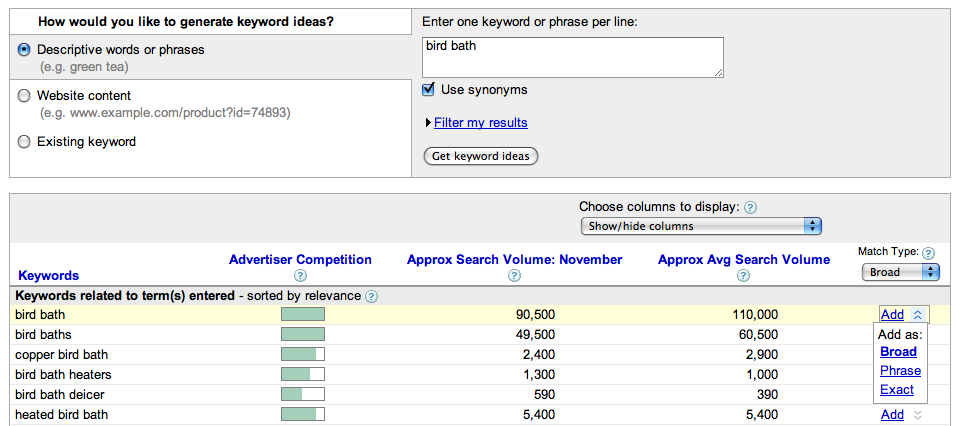
Of course you can also do this using AdWords Editor but that’s not for the beginner. Instead you’ll likely be using the standard Edit Keywords interface.
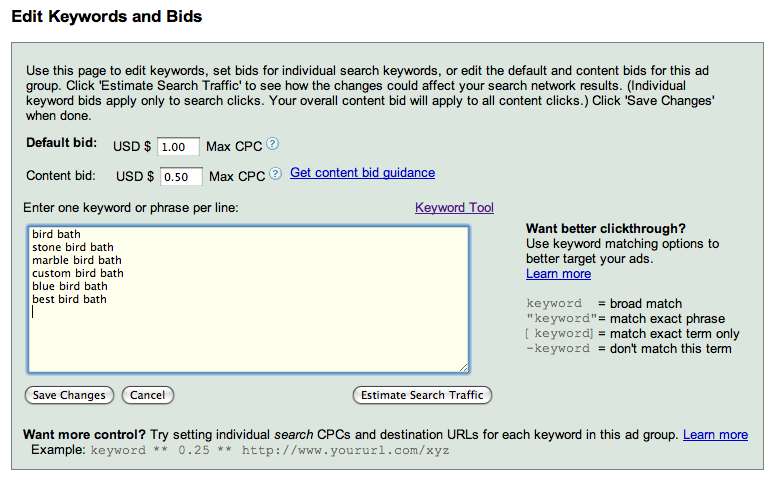
To Google’s credit they do make a good case for adding phrase match and exact match (as well as negative keywords) in this interface. But it’s a pain to retype each of your broad match keywords with the appropriate quotation marks or brackets. From experience, you also often make mistakes and typos.

Use Excel to quickly add phrase match and exact match keywords

Create a new Excel spreadsheet with five columns. In the first row you’ll have the following in each column: keyword, “, “, [ , ]
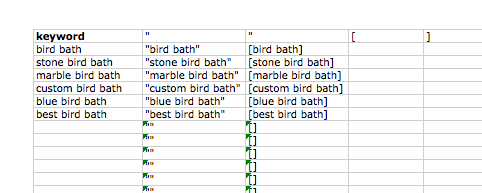
As you can see, you’ll copy and paste your broad match keywords into the first column, labeled keyword. Now, the tricky part is using the CONCATENATE function so that phrase match and exact match keywords are automatically generated.

The formula you’ll type into the cell to the right of ‘bird bath’ (Column B) is =CONCATENATE($B$1, $A2, $C$1) and the one to the right of that (Column C) will be =CONCATENATE($D$1, $A2, $E$1)

Then simply copy those formulas down each column and you’ll have a phrase match and exact match generator. Just copy each and paste them into the edit keyword tool in Google and you’re ready to go!

Hopefully this helps new AdWords users get the most from their campaigns. Please leave comments if you have any questions, particularly surrounding the Excel phrase match and exact match generator.
3 Column Blogs Are Killing CPM Rates

December 16 2008 // Advertising // Comments Off on 3 Column Blogs Are Killing CPM Rates

Okay, not all 3 column blogs are killing CPM rates but the design contributes to the problem by making it easy for bloggers to produce ad clutter.

Ad clutter is a big problem

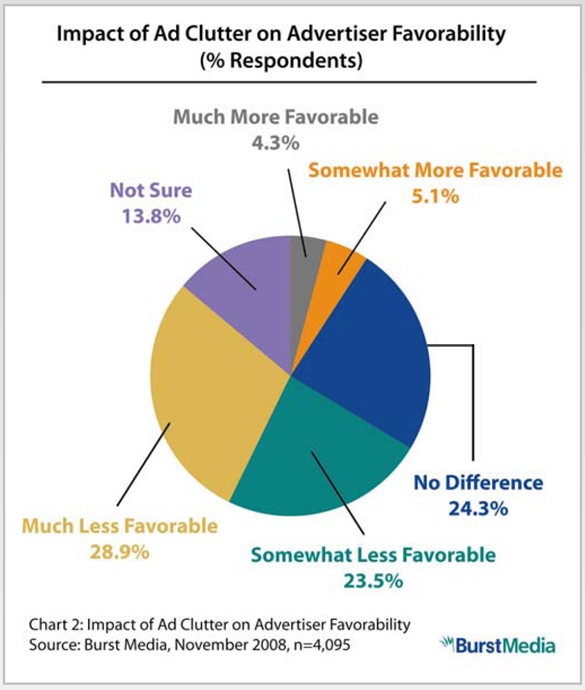
A recent BurstMedia survey revealed that 75% of users pay less attention to ads on cluttered sites.

Additionally, although respondents accept that advertising will appear on a web page, for a majority (52.6%), there is low tolerance for more than two advertising units per web page. More than one-quarter (29.9%) of survey respondents immediately leave a site if they perceive it to be cluttered.

So, it’s clear that CTR on these ads will go down as will user engagement on cluttered sites. But why not go for the trifecta! Ad clutter also tarnishes an advertiser’s brand equity.

Nielsen has also researched ad clutter and even introduced an ad clutter metric to assist media buyers. MarketingVOX reported the following finding from the Nielsen report.

The study also found that, from a content perspective, more niche websites – which attract smaller audiences – tend to have higher clutter.

Niche websites. Hummm. That seems like a nice way to point the finger at blogs without outright saying it.

Advertising CPM rates are dropping

CPM rates have been falling. The Rubicon Project reported an 11% decline in CPM rates in Q3 2008. Federated Media slashed rates on some of their hottest properties. These aren’t your run of the mill blogs but sites like TechCrunch and Silicon Alley Insider.

I believe ad clutter is a factor in this decline since it leads to banner blindness, which likely carries over, to some degree, from cluttered sites to those less cluttered. If you think of the Internet as a vast interdependent ecosystem it makes sense that the effects from one part of the ecosystem spill over to all.

The movie Jaws certainly spawned a fear of water beyond just that of the fictional Amity or the New England coast.

Are 3 column blogs really to blame?

Yes! Sure they’re not the only reason, but they are enablers to ad clutter. The two sidebar columns are ready made for advertising not to mention inline units in the main content column. A “more is better” philosophy for advertising exists among many bloggers. And on the face, more opportunities to click often do lead to more clicks. But there is a point of diminishing return which then results in lower CPM rates.

Unfortunately this might create a sort of death spiral. As the effectiveness of these ads go down, the CPM rates go down, which encourages bloggers to place additional advertising units on their sites to help maintain their revenue stream. That, of course, pushes CPM rates down even further.

You can be the proverbial shark or the police chief. Bruce or Brody. So pick your blog template wisely.

Twitter In The ER

December 13 2008 // Life + Social Media // Comments Off on Twitter In The ER

It’s no secret that I’m not the biggest Twitter fan. But yesterday, we had to take my daughter to the ER to get IV fluids. She couldn’t keep anything down, even water, and having been born with just one kidney we’re always vigilant about her hydration.

During this gut-wrenching time (there’s no comparison to worrying about the health of your child), Twitter let me keep my family and friends updated without stepping out of the room or disturbing anyone. It served a very valuable function, something it hadn’t done for me previously. Oh, Twitter had been interesting, informative and sometimes fun, but never valuable.

Twitter is increasingly being used as a news service – whether it’s reports of an earthquake, opinions on Presidential debates or first-hand accounts from the Mumbai attacks. In this instance, I was simply using Twitter for my own personal crisis. Micronews.

I wasn’t expecting a dialog, though I got some very kind replies. (Thank you!) And that might be the reason why Twitter continues to do well. The expectation of dialog or replies is still low. When you shout into a canyon you’re pleasantly surprised when you hear someone, other than your own echo, reply.

Maybe this isn’t the big epiphany for you as it was for me. But it makes me think that Twitter can be more than just a promotional megaphone or “I just ate a mango” navel gazing. I also thought of new features I might want, like the ability to Tweet to a subset of my followers.

Hopefully my followers on both Twitter and FriendFeed don’t mind my tangent into personal chatter. (No Qwitters yet.) And I’m certainly hoping I don’t have to take advantage of this particular use of Twitter any time soon. But it’s nice to know it’s there.

Thank you Twitter.

Kyle Baldwin Shows Up On Heroes

December 13 2008 // TV // Comments Off on Kyle Baldwin Shows Up On Heroes

The other day I caught up with the disappointing season of Heroes on TiVo. I’d recently blogged about how Heroes had ripped off The 4400. And lo and behold who shows up on Heroes but none other than The 4400’s Kyle Baldwin.

The 4400

Heroes

Yeah, Chad Faust got a new haircut and has perfected that mean stare of his, but it’s still him. I like him too, but I can’t like the fact that Heroes is so stuck and so lost that they’re pressing 4400 actors into service.

Thank goodness Summer Glau isn’t available.

Martini. Straight Up. Three Keywords.

December 09 2008 // SEM // Comments Off on Martini. Straight Up. Three Keywords.

Yesterday, Google updated the AdWords alcohol policy to loosen restrictions on hard alcohol and liqueurs.

… in response to advertiser feedback we’ve received over the years, we’ll permit the advertisement of hard alcohol and liqueurs that target the U.S.

It’s not as straight forward as the beer related policy though. You can’t outright sell Bombay Sapphire. Instead you have to play a bit of semantic dodge ball.

To comply with the updated hard alcohol and liqueurs policy, advertisers must promote the information about hard alcohol and liqueurs that their websites contain, such as recipes and brand messages.

For example, under the hard alcohol and liqueurs policy, you might market to individuals searching for helpful and relevant alcohol-related information by promoting holiday cocktail ideas or the caloric content of popular spiked beverages.

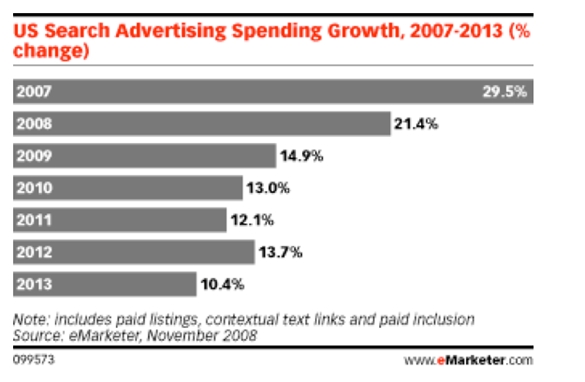
Google isn’t doing this simply to appease advertisers. Feedback wasn’t the motivating factor, not by a long shot. Google is looking to boost revenue for a maturing product in an increasingly tight economic environment. Growth in paid search is projected to slow according to eMarketer.

A recent Citi Investment Research report from Mark Mahaney had this to say after attending the Search Insider Summit.

Q1 And 2009 Could Be Materially Challenged – We sensed specific nervousness about the Q1 outlook and the possibility that Q1 could actually be the real inflection point quarter – i.e. the first negative sequential growth quarter ever for Search. We also interpret recent statements by GOOG execs and company actions as an acknowledgement of this material challenge.

As search matures, Google realizes they’ll need to do more to achieve substantial growth. Alcohol is clearly a vertical with lots of pent up ad dollars. It’s a smart move by Google.

Hey, we all might need a drink the way things are going. Google’s just making sure it cashes in when we do.

TweetSense

December 09 2008 // Advertising + Social Media // Comments Off on TweetSense

Does TweetSense make sense? And more importantly would it make cents?

Twits have been up in arms with the introduction of Twitter based ad networks like twitAD and Magpie. Magpie in particular drew a lot of coverage with notables like Mark ‘Rizzn’ Hopkins at Mashable and Michael Arrington at TechCrunch weighing in on the topic. Many claimed that it was outright spam that had no place on Twitter. Lots of huffing and stamping of feet. They’d unfollow anyone they saw using such a service!

I’m not opposed to this type of monetization if it’s implemented well.

The fact is, are you really going to notice? If you’re that attached to Twitter you probably use the service quite a bit. You follow a lot of people. Many are very active. The odds that you’re going to see an advertising tweet are quite low and if you did it would be gone from your existence in a matter of minutes.

Advertising tweets would be very ephemeral.

So, that begs the question: will these Twitter based ad networks be effective? Will people click on them enough to make it a viable advertising platform? They will if it’s done right.

Spare me the ‘nobody clicks on those things’ type of indignation. There’s this company called Google. They have these products called AdWords and AdSense. Both seem to be doing just fine even though many say they’ve never clicked on either type of ad unit.

The implementation will be paramount. They’ll fail if the ads become too frequent, overwhelming tweet streams for users. Essentially, if the noise drowns out the signal, it will fail. They’ll also fail if the ad content isn’t relevant. Viagra ad tweets mixed in with a discussion about Motrin Moms isn’t going fly.

The frequency and context of advertising tweets are critical to the success of this type of ad network. So, who is in the best position to pull this off?

Twitter!

Twitter knows your tweet velocity. Twitter has the ability to create dynamic tags for users based on keyword frequency analysis. As such, it is best placed to deliver timely and relevant tweets to their users. By doing so it would also remove the potential abuse of the service by those seeking personal, monetary gain.

Block the third party ad networks! With Twitter at the controls, the odds of success (for both users, advertisers and Twitter) go up, way up.

Twitter does need a revenue model. So why not TweetSense?

How Not To Use Twitter

December 07 2008 // Humor + Rant + Social Media + Technology // Comments Off on How Not To Use Twitter

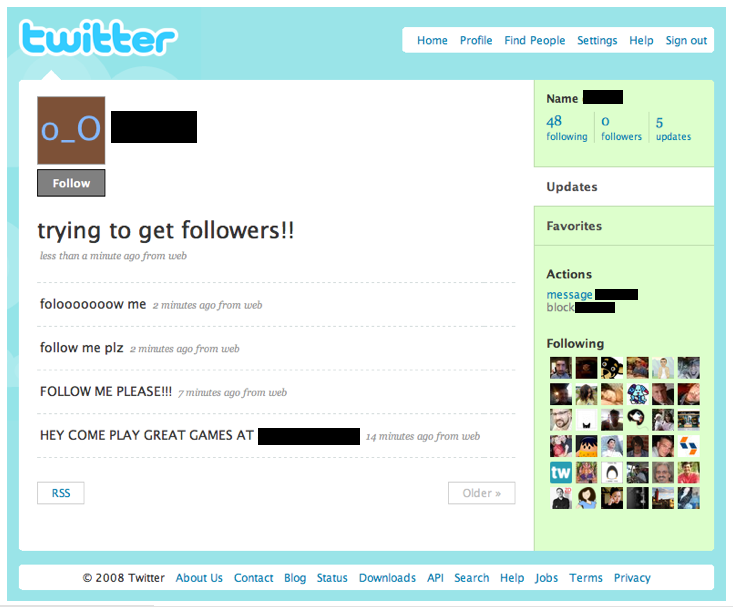
I’m still trying to find how to get the most out of Twitter. (I get far more from FriendFeed.) But here’s an easy example of how not to use Twitter.

The level of noise on Twitter seems high. Ditto the number who feel it’s an obligation to follow back. Or perhaps this is just what increased usage gets you?

Wikipedia Flirts With Disaster

December 05 2008 // Technology // Comments Off on Wikipedia Flirts With Disaster

Wikipedia has secured a $890,000 grant from Stanton Foundation to make the editing process more user-friendly. At first glance this seems innocuous, but it has the potential to ruin Wikipedia.

“Wikipedia attracts writers who have a moderate-to-high level of technical understanding, but it excludes lots of smart, knowledgeable people who are less tech-centric,” Sue Gardner, the Wikimedia Foundation’s executive director, said in a statement Wednesday.

Ms. Gardner is right. But it also excludes the ubiquitous trolls and troglodytes who inhabit the comment space on social networks and forums. Ever peek at the comments on YouTube? Yeah, not the type you want editing material on Wikipedia.

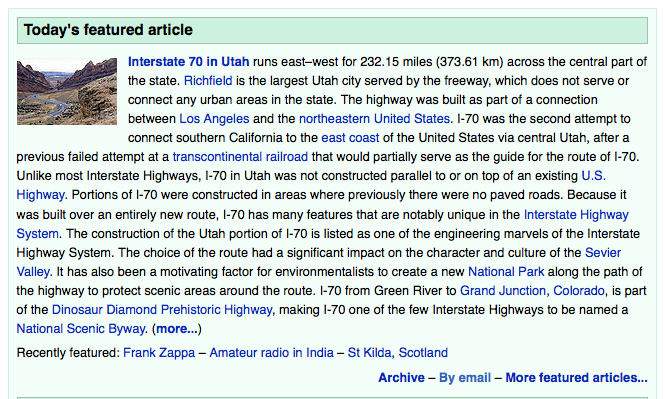
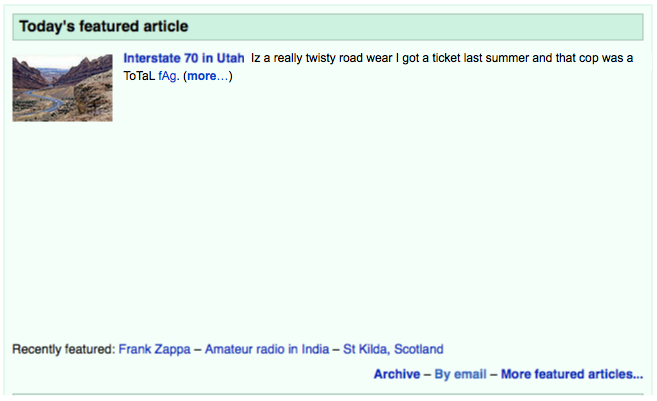
Here’s today’s featured article on Wikipedia.

Now imagine that the monkeys have overwhelmed the safeguards through new user-friendly editing.

Sure it’s an exaggeration but the fact remains that Wikipedia is inviting more people into the editing process. They don’t get to choose just the smart people.

The current editing environment actually provides a filter via the technical and code obstacles. It’s a screening process that, while somewhat biased, helps keep the monkey masses out. Might it not be easier to provide tutorials for the ‘smart’ people who are motivated to contribute to Wikipedia?

User-friendly editing is a can of worms, a Pandora’s box. Wikipedia should be careful for what it wishes.

xxx-bondage.com