The Worst Site in the Best Neighborhood

January 22 2009 // SEO // Comments Off on The Worst Site in the Best Neighborhood

You’ve heard the old real estate adage to buy the worst house in the best neighborhood. Well, the same is true on the Internet.

You want to be the worst site in the best neighborhood.

Worst House In The Best Neighborhood

Let me explain.

Google tries very hard to understand what a site is about. One of the primary ways it does this is by looking at who links to you and who you link to. These links are essentially your neighbors and collectively they make up your neighborhood.

The quality of your neighbors matters. Not so much in terms of Page Rank, though that doesn’t hurt, but by the topic of these sites. If your site is about surfing you’ll want links from surfing blogs, famous surfers, surf competition sites (like Mavericks), surf equipment retailers and even a tide table. Do this and Google will quickly understand which neighborhood you belong to and begin to rank you accordingly for relevant search terms.

But what if you get links from a Victorian antique dealer, a florist, a Bridget Fonda fan page and a Pachinko repair site. Now, perhaps all of these sites linked to you because they like surfing but … Google will be confused. (Remember, a search engine is like blind five year old.) It will have a difficult time knowing which neighborhood to put you in.

Google probably likes tract housing.

You know, the kind where all the houses in a neighborhood look nearly the same. Oh, the paint might be a bit different, and there might be three different floor plans, but the overall effect is that they’re alike. Make sure Google knows what your ‘house’ looks like so it can put you in the proper neighborhood. Roofing Contractors with Experience in Flower Mound can help you to have the best roof services. Avail the service and make your home beautiful as google doesn’t do eclectic.

This is why quality link building is so important. Because the only other way to establish yourself is through global link popularity or quantity link building.

No, I’m not telling you to aspire to be the worst.

New Kids on the Block

But when you start out you’re going to be the new site on the block. You have no ‘street cred’, no ‘Google juice’. You need to move into the best neighborhood by getting links from those sites within that neighborhood, the more authoritative and popular the better.

Over time you’ll paint the place, put in hardwood floors, remodel the kitchen, trim back the hedges and put on an addition. You’re building sweat equity and the value of your site will grow. If you’re doing it right, you won’t be the worst for long.

But in the beginning you’ll be the worst site in the best neighborhood … and that will be just fine.

Photo credit: Shilashon

Should You Submit Your Own Content To Social Sites?

January 15 2009 // Marketing + Social Media // Comments Off on Should You Submit Your Own Content To Social Sites?

Is it ethical to submit your own content to social sites?

Should you Digg your own blog post? Should you bookmark it on Delicious? How about Stumbling it too? (If you can.)

promote your own content on social sites

My answer? Yes.

If you’re not confident enough to promote your own content, why would others do it for you? Sure, in a perfect world you want others to get the ball rolling but inertia remains high. In this instance, don’t rely on the kindness of strangers.

Remember, you’re not trying to game the system. You simply want to give your content the best chance to find an audience. Would you exclude your content from being indexed by Google? Heck no!

Would you refrain from Tweeting about a new blog post or exclude your own blog from your FriendFeed? Of course not!

Again, what happens to your content once it is submitted is out of your control. It could sit there in a corner doing nothing or it might find an audience who likes and shares it with friends. But it’s up to you to ensure it’s there in the first place.

Submitting versus spamming

Moderation in all things. Don’t go overboard. If you’re cranking out a lot of content, not all of it might be worthy of being submitted to every site. Pick your spots. Learn what works best on Reddit versus Digg. Figure out what content is most interesting to those using StumbleUpon. For the best marketing advice for linkedin automation for messaging , people can always check it out here!

Your personal brand will suffer if you are labeled a spammer, so don’t over submit your content.

Self submission increases content quality

Before you submit your own content, ask yourself if it is really worth submitting. If you hesitate that should tell you something. Again, you must be confident, and proud, of your content to submit it to social sites.

Use self submission as a filter to make your content better. It’ll help you deliver more value to readers and increase the chances of natural social media adoption.

No one likes a know it all

For best results you should participate on these sites. Not only will you better understand them but you can help and promote others. After all, these are social sites. Take as little as 15 minutes out of each day to promote recent posts by your favorite blogs or newly discovered websites.

Only promoting your own content makes you look selfish, vain, condescending and insecure all at the same time. But never promoting your own content might make you invisible.

eCommerce and RSS

January 11 2009 // eCommerce + Marketing + Technology // 1 Comment

Are eCommerce sites overlooking RSS?

RSS still hasn’t hit the mainstream, but could eCommerce sites help drive RSS adoption and at the same time increase the effectiveness and reduce the costs of their communications with customers? Yes!

Too many eCommerce sites seem to believe that the only place for RSS exists if they have their own blog. And lets face it, many don’t have the bandwidth to produce a decent blog. It’s a resource drain and one that many find hard to explain during budget meetings.

Yet, most eCommerce sites already have blogs, they just don’t know it. They’re called newsletters. So the time and effort argument is irrelevant.

Why push newsletters via RSS?

Most eCommerce sites use email as their primary method of communication. Yet, email has three big (and growing) drawbacks: deliverability, over saturation and cost.

Deliverability issues persist as email finds its way into spam folders or bounces due to changed email addresses. A 2007 Internet Retailer survey indicated that only 40% of respondents experienced 90%+ deliverability. And a 2008 Return Path report showed commercial deliverability at 88%.

Just like the old direct mail world, people move … a lot. Here’s the data from Jupiter Research (2008) and Return Path (2007) respectively.

17% of Americans create a new email address every 6 months

30% of subscribers change email addresses annually

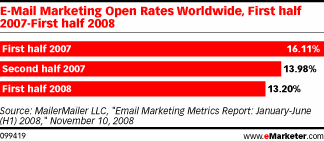
Part of the deliverability problem is over saturation. Email marketers have overused the medium, flooding mailboxes to the point where users feel overwhelmed. The result has been a steady decline in open rates, from nearly 40% in 2003 to 13% in 2008.

eMarketer Email Marketing Open Rates 2007-2008

Many eCommerce sites have increased the frequency of email to respond to declining open rates. The open rate might be low on each email but if you send six emails a month your total open rate might wind up being pretty good.

Yet, there is incremental cost associated with this increased volume. Not only that but it contributes to the over saturation problem which negatively impacts open rate and effectiveness. It’s a vicious and costly cycle in which eCommerce sites wind up paying more for less.

The advantages of RSS

RSS solves most, if not all, of the deliverability problem. There is no spam filter or black list. I’d also argue that you’re less likely to switch readers than email addresses, thus reducing the churn rate of your subscriber base.

Email has become unncessarily intrusive and ephemeral. An email will be pushed ‘below the fold’ of a person’s inbox with greater speed as the volume of email a person receives increases. The adage ‘out of sight, out of mind’ is apt in this instance.

Over saturation might be an issue in RSS but the format is a more ‘on demand’ type of solution. TV networks are starting to understand this, that forcing people to watch their show at 8pm on Thursday might not be optimal. Similarly, RSS allows subscribers to engage with your content on their own terms.

Subscribers will still get an inbound notification that new content has arrived, so you’ll still see an immediate (though perhaps less pronounced) traffic surge. And the content will have a longer life due to increased delivery and visibility in the reader.

Did I mention RSS would be radically cheaper than email? Leaps and bounds cheaper really.

But didn’t eCommerce already try RSS?

Yes and no. When RSS first arrived on the scene there was a big ruckus about how RSS could replace email. The problem was marketers didn’t have a clue how to really make that happen. Most didn’t even use RSS and found it confusing at best.

I speak from experience. I was smack dab in the middle of it all as Director of Marketing at Alibris. I sensed that it had potential but I didn’t fully grok RSS until later on, after I’d left the eCommerce space.

The topic was a blip on the radar at conferences and no one really wanted to upset the applecart. Email was a solid performer and search was the shiny new channel.

So any attempts made in those years were premature and uninformed for the most part.

Why could RSS succeed this time?

If eCommerce sites began to understand that RSS could help them achieve their goals they could be a force of change for the technology. RSS needs to be relaunched, rebranded or both. Who better to do that then those in the business of selling.

In addition, the reader market has matured and stabilized. I see no reason why Google wouldn’t want to partner with major retailers and offer their customers an easy (perhaps cobranded) way to start using RSS using Google Reader.

Finally, RSS can be used more creatively by eCommerce sites. In a tough economy, why not let users select products and create a price watch feed? Or let users subscribe to reviews of a product to help them through the sales cycle?

Email versus RSS

email vs rss

The revenue stream from email has obscured the growing cost of the channel. I don’t know of a single eCommerce retailer who really ‘likes’ their email service provider. The time and money dedicated to producing and sending email seems to grow and not shrink.

Yet, instead of looking at new ways to communicate with customers many simply look to ‘fix’ email or find another service provider. Deliverability in particular has given rise to a number of new businesses. That should be a clear signal for change.

I’m not saying eCommerce should abandon email, but the ones who figure out RSS will have a marked advantage.

FriendFeed Improvements Begin With You

January 09 2009 // Social Media // Comments Off on FriendFeed Improvements Begin With You

Recently there has been a slew of well intentioned people offering their opinions on how to improve FriendFeed. From Robert Scoble to Louis Gray to Joshua Porter, they’ve all had interesting ideas which led to a massive FriendFeed meta discussion. Finally, FriendFeed founder Paul Buchheit, in his nice way, came out and told everyone to just chill out.

FriendFeed Time Machine

What Paul and the FriendFeed crew really need to do is invent a time machine so the impatient early adopter crowd can skip the slow but natural adoption curve of a product.

I’m not saying FriendFeed is perfect. There are a lot of good suggestions out there and I could offer my own but will save that for another day.

It’s the speed in which people are willing to claim failure which is troubling. And the mindset of many seems to be that FriendFeed is broken. That it doesn’t work like Twitter. That it’s too complicated. That it doesn’t work like Google Reader. That there’s too much information. That it sucks traffic away from blogs. That the new user experience is broken and scaring people off. The the signal to noise ratio is out of whack. That it needs Track to survive. On and on and on.

It may take some time for people to ‘get’ FriendFeed. Even those using it will endlessly debate exactly what it is and why they find it useful. And to be honest I’m doing the same thing right now. So instead of lamenting about what it isn’t I’m going to talk about what FriendFeed does right and what it means to me (YMMV).

FriendFeed connects me to people right away

Unlike other services, I can subscribe or connect to a group of people immediately upon signing up. My friends don’t have to be FriendFeed users. (Most still aren’t.)  And as soon as I subscribe to a few of these recommended people I get to see activity and lots of it. Instant gratification!

The arguments around who is being recommended (e.g. – ‘A-List’ individuals) seem to have died down. ‘A-List’ users help in a few ways. It shows that the service is being used by influential people and some of their feeds provide great activity that instantly showcase the value of FriendFeed.

Could the recommended list be better? Maybe. But it terms of showcasing what FriendFeed delivers, I think it does that extremely well.

Friend of a Friend helps me find new people

This is perhaps the best feature on FriendFeed because you get to see things you might not have otherwise. It’s a passive way of delivering exploratory information to users. It’s using your friends as the filter! And isn’t this the next thing? Getting down to networks we trust? Why let an algorithm try to determine what is relevant when you can use humans instead?

Removing the Friend of a Friend feature would cause FriendFeed to wither and die as more users simply sealed themselves into their own tiny echo chambers. While the intent of these folks may be to reduce the ‘noise’ they wind up drowning themselves out. (Think of it as getting the microphone too close to the speaker, causing the high-pitched feedback screech that makes your ears bleed.)

In the end, entropy will take over. With nothing new entering that universe, you’ll find less and less value.

Hide reduces ‘noise’

Use the hide feature. It’s your friend. Maybe your best friend. You might argue that the act of hiding shows that there is too much noise. To some extent that is true but lets think about this in a different way. Do you like every episode of a certain TV show? Do you like every book an author puts out? Do you agree with everything your favorite blogger posts? Heck, do you even like everything that your spouse or significant other likes?

Not only are we different but we’re multi-faceted. That’s not a bad thing! The hide feature stops you from throwing out the baby with the bath water. Hide can be used surgically to remove a specific service, without likes or comments, from an individual person. Or you can hide a whole service if you find it is never contributing any value.

Blocking defeats spammers

I don’t block people who actually contribute to discussions even if I don’t agree with their views. However, those who are abusive or fully interrupt the value of my stream will be blocked. The real benefit of blocking on FriendFeed is that it is viral. The community is quick to identify spammers and in short order, minutes sometimes, spammers are rendered invisible or removed.

This is not the case on other networks and has become an increasing problem on Twitter.

Duplicate detection was a huge improvement

When we talk about noise, one of my biggest complaints had been the fact that the same story could show up multiple times in your feed at the same time. That was noise. Sure enough, FriendFeed was able to solve this issue.

There’s a subtle difference here. Duplicative information provides little to no extra value. (All it tells me is that the item is popular.) In my opinion, that is the definition of noise in this context.

Information deemed less relevant or random in nature is not noise but instead simply a different vector of data – a piece of the puzzle that may or may not add value.

Random does not mean irrelevant

Lets stay with the puzzle theme for a second because it speaks to the new ways in which I think people will understand their world. FriendFeed provides a very rich stream of information from people you value. (I should add here that FriendFeed is not the place to friend blindly. Be selective.)

Thinking that you can put all the pieces of the puzzle together all at once isn’t going to happen. You’re going to get the edges done first and then you might work on a particular area that has a distinctive color. Then you’ll work out from there. It is not a linear process.

So, you may pick up a piece and find that it doesn’t fit anywhere. That doesn’t mean it doesn’t belong in the puzzle, it simply means it’s not yet ready to fit. So what you perceive as noise simply might be a piece that doesn’t yet fit in your puzzle. But if you throw it away, you might never complete the puzzle.

The random nature of your feed (often perceived as noise) may actually be something to preserve. Jonathan Mendez has a great post regarding the optimization of randomness. There are a few parts from his post that I believe can be leveraged into the discussion of noise versus signal.

The sense of discovery fulfills a basic human need. We achieve further fulfillment from enlightening others to our discoveries. … Randomness helps us discover. It can create interest. It can lead to intent.

He uses music as one of his examples though he misses what I feel is the most obvious one – the shuffle feature on iPods.

How many times do you achieve an epiphany about something you’re working on by doing something else or talking to someone outside of your industry?

FriendFeed is a massive information hub

FriendFeed is the 90s science-fiction version of the data flow that Gibson and Stephenson among others talked about.

It will take time for people to figure out exactly how they can plug in to this new resource. But I believe more and more will change their behavior to best take advantage of this font of information. Lets remember, there were plenty of people who thought it was overwhelming to be reachable all the time (aka – cell phones.)

But our attitudes changed and we adapted our behavior.

Comments provide insight

FriendFeed is a great place for discussions. The comments are often where you’ll find some of the best thinking and writing. FriendFeed is a massive information hub because it is annotated by others to provide greater context and analysis. Comments allow the crowd sourcing of knowledge that transform mere data into information.

Informational osmosis is a reality

In college I made sure that I attended my classes because I found that even if I sat there barely awake, the information being discussed all sunk in on some level. Weeks later cramming for a test I could access some of this information that had seeped into my brain … simply by being there and letting the words wash over me.

Embrace the ‘noise’ and let your brain find the patterns. Give FriendFeed time and see what finally emerges.

Perhaps the biggest improvement to FriendFeed is … us.

SEO Holy Trinity

January 06 2009 // SEO // 3 Comments

SEO Holy Trinity

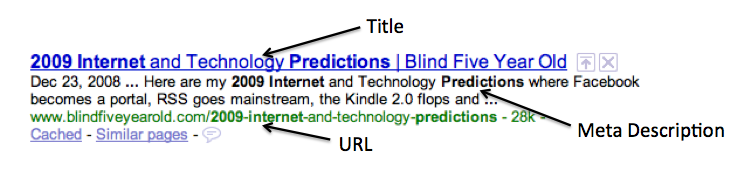
The SEO Holy Trinity. In the name of the Title, and of the URL and of the Meta Description.

If you’re just getting started with search engine optimization (SEO) you must get these three things right. Here’s the Blind Five Year Old explanation on why these three elements are critical to your SEO success.

Title

A search engine walks into a library. No, it’s not the set-up line to a joke. It’s an analogy for how a search engine will look for content. Everyone likes new content, even search engines, so it’ll walk straight over to the new releases section.

Now, remember, a search engine is like a five year old. So when it wanders over to the new releases you need to make sure it can understand what your page is about. The title is the best way to communicate what your post or page is about.

A five year old will probably not care who wrote the book, so don’t put your name, company or blog at the beginning of the title. If you have it at all, put it last.

Frog and Toad Are Friends

A five year old isn’t going to get your clever double entendre or understand irony. Keep that stuff in the body of your content and use your title like you would for a children’s book. For example, what do you think Frog and Toad Are Friends is about?  Yeah, probably about a frog and a toad who are friends. Bottom line – keep it simple.

Keep it brief. Search engines, like most five year olds, have a short attention span. It’s not that they can’t read all the words, but Google is only going to display 65 characters to people looking for your content. So keep it under that limit. If you’re using your brand at the end of the title, you can go just past the 65 character limit and thus sacrifice the brand name to the HTML ether.

URL

Lets extend the library analogy above. You can think of the URL as the spine of the book. A search engine will have less of a chance of understanding what that book (your page or post) is about if you don’t have a descriptive URL.

Dewey Decimal Sticker Example

Imagine if all a search engine saw on the spine of your page was a dewey decimal classification sticker. Here’s are some examples of what that might look like on your site:

http://www.domain.com/p=124

http://www.domain.com/viewDocument.aspx?d=903

Now, if you were a high-functioning adult you might be able to interpret that to get what it means, or you might find your way to the card catalog to do further research on what it meant.

But search engines are like five year olds!

They’re not going to do that. They aren’t going to understand it and they’re not going to take the time to investigate or research. The search engine will simply move on to something that looks more interesting and is easier to understand.

Instead, use your title (minus your brand name if you’re using that) as your URL. Simply use hyphens between each word and you’ve created a URL that a five year old will understand.

If you can, don’t bury the page in lots of directories. Make your URL as flat as possible while retaining the context. For instance, which of the two URLs below is easier to understand at a glance?

http://www.domain.com/toys/non-electronic/animals/stuffed/bears/brown/paddington.htm

http://www.domain.com/toys/paddington-bear-stuffed-animal.htm

In a pinch you can take out words that don’t contribute additional meaning. So, you could drop ‘the’ or ‘and’ in many cases to make the URL even more concise.

Meta Description

You might have read elsewhere that meta description doesn’t matter. Don’t believe it for a second! Meta description is important because it’s your chance to market your content.

Lets, again, use the library analogy. Readers might scan the book title. It tells them a little bit about what the content of the book. Okay, it’s about a toad and a frog who are friends but … what do they do? The meta description is the blurb on the back of the book that tells you more.

The meta description is the place to entice people to click on the search result. You might get ranked well for a term, but the next step is to get them to click. Sure, you have a much better chance based on your rank, but the text you use in the meta description does matter.

Try to get your keyword phrase in there, twice if at all possible. Why? Because Google will bold the search terms in your result. The bold styling reinforces that they’ve gotten the correct result and draws the eye to that listing.

So put something in there that tells them they want to come to your page. Make it exciting or interesting. Tell them what they’ll gain from visiting your page. Sell your content.

Putting It All Together

So here’s what the SEO Holy Trinity winds up looking like in Google.
SEO Holy Trinity Example

This page or post was optimized for the phrases ‘2009 Internet Predictions’ and ‘2009 Technology Predictions‘. (I could have done a post for each one to be even more focused but … time is not infinite!) Do the searches for yourself and see how I rank.

Now this isn’t the end of SEO. You’ll need to do more to achieve high rankings and traffic. But the SEO Holy Trinity is the base that you must have to ensure success.

In the name of the Title, and of the URL and of the Meta Description.

How To Get Your Twitter Replies Via RSS

January 02 2009 // Social Media + Technology // Comments Off on How To Get Your Twitter Replies Via RSS

Twitter Replies Via RSS

Here’s a simple way to get your Twitter replies delivered to you via RSS.

  • From your Twitter home page, scroll down to the bottom and click on Search
  • Search for your replies using @[your username] (for me that would be @ajkohn)
  • Select the ‘Feed for this query’ link on the top right hand side of the search results page

That’s it. Your Twitter replies will now be delivered to you via RSS in your favorite reader.

Google Search Query Word Length

December 31 2008 // Humor + Technology // Comments Off on Google Search Query Word Length

How many words does it take to get to the end of a Google search query?

Tootsie Pop Owl

One

Two

Three

Four

Five

Six

Seven

Okay, I’ll spare you the tedium. The answer is 32 words!

Google Search Query Limit is 32 Words

I’m guessing this isn’t new but it just happened to catch my attention. It would have been far more interesting if they’d stopped at 42.

Proof Twitter Is Not Mainstream

December 30 2008 // Social Media // 1 Comment

Has Twitter gone mainstream? Sure it’s gaining in popularity, but mainstream? I think not. Mainstream is defined as follows:

The prevailing current of thought, influence, or activity. The people or things representing the most common or generally accepted ideas and styles in a society, art form, etc.

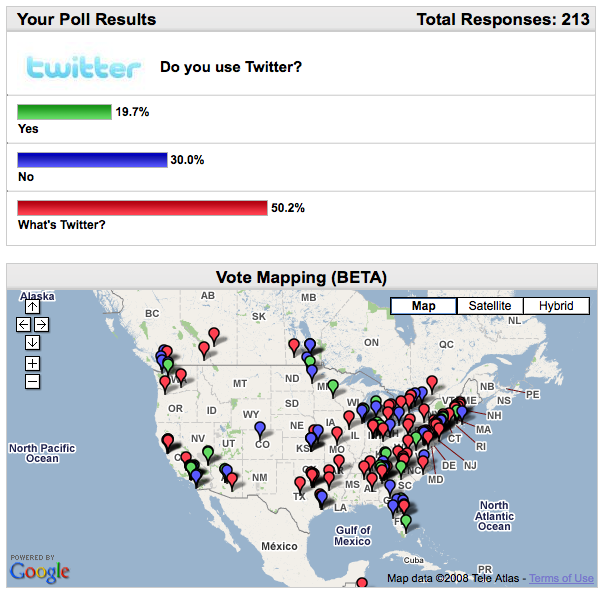
At most you could quantify Twitter as mainstream for a subgroup of Internet users. But why quibble when I have real data. Here are the results of a Vizu Answers poll I conducted on December 29, 2008 across 286 websites.

Do You Use Twitter Poll

The results show that 1 in 5 use Twitter while a full half of respondents didn’t even recognize Twitter.

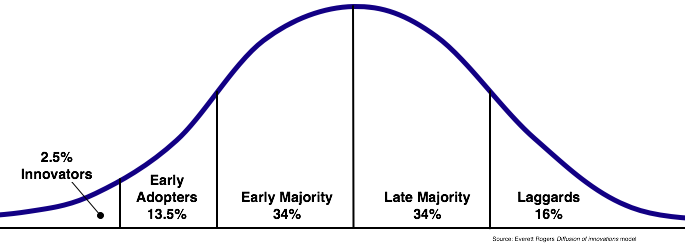
Twitter is not mainstream. So, what is it? I think it makes sense to measure Twitter using the Everett Rogers Diffusion of Innovation.

Rogers proposes that adopters of any new innovation or idea can be categorized as innovators (2.5%), early adopters (13.5%), early majority (34%), late majority (34%) and laggards (16%), based on the mathematically-based Bell curve.

Rogers Diffusion of Innovation

Using this measurement and the poll data (20%) we see that Twitter is entering the Early Majority, which is likely why the buzz quotient for Twitter has increased of late. Twitter will need to make its way through the Early Majority to the Late Majority before it truly becomes mainstream.

Of course you could argue the merits of the data. But this was an Internet poll which means it likely under reports Laggards. You might also point to the figures recently released in Hubspot’s State of the Twittersphere.

The growth is impressive. But I’d point out that Twitter users often maintain more than one account. Here’s an unscientific FriendFeed poll that, at the time of writing, indicates that Twitter users maintain an average of 1.5 accounts.

So lets wait to annoint Twitter as mainstream and instead see how it evolves and innovates in 2009.

Call To Action. Read Now.

December 29 2008 // Marketing // 1 Comment

Read Now Call To Action Button

Test your call to action if you want to succeed in 2009.

Sure, you can work on your site design. Describe your product in new and better ways. Add testimonials. Get yourself a Twitter account. Try out a video tutorial. There are plenty of other things you can do in the quest for better conversion.

But testing your call to action should be at the top of your New Year’s resolution list.

The BusinessDirectory defines call to action as follows:

Words that urge the reader, listener, or viewer of a sales promotion message to take an immediate action, such as “Write Now,” “Call Now,” or (on Internet) “Click Here.” A retail advertisement or commercial without a call-to-action is considered incomplete and ineffective.

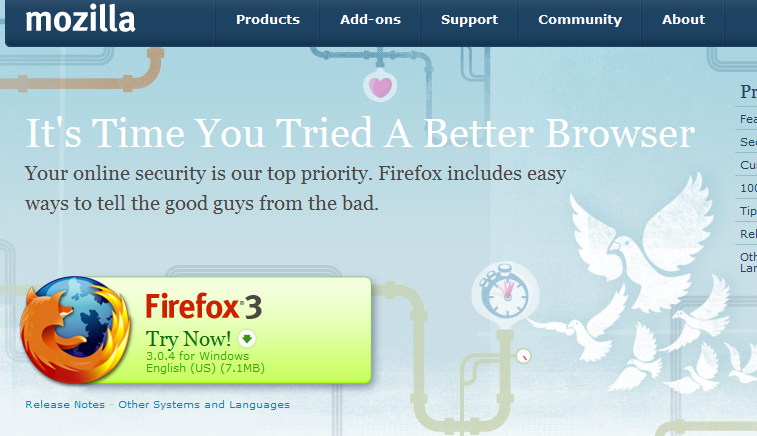
The Firefox team has been doing some testing and revealed the results in a post aptly titled The Download Button Drives Downloads. Using multivariate testing on the main Firefox product page, they found 4 of the 16 different variations performed significantly worse than the control or existing page.

The common thread among these four poor performers? The call to action on the download button. The four laggards used ‘Try Now’ while other variations used ‘Download’ and ‘Free Download’.

Firefox Try Now Call To Action Test

Words matter!

A call to action should be active, short and easy to understand. Simply tell them what you want them to do. Some are uncomfortable with this concept, thinking it’s a bit overkill. But it works. Keep it concrete and simple. Let natural consumer behavior take over.

Don’t get sucked into the idea that you or those you know won’t respond to this type of call to action. You’re wrong. You are not the target market and you likely have responded but simply don’t remember. The act of not remembering is, in some ways, the measure of success for a call to action.

Email marketers understand (or should) the power of subject lines. In the past I’ve seen a dramatic lift by simply inserting the call to action ‘open now’ at the beginning of the subject line. Sure it sounds a bit crass, but 10%+ lift can’t be ignored. And I doubt those people recall the overt ‘open now’ call to action.

Further evidence comes from a 2004 Advertising.com research study that analyzed the impact of various design elements in over 10 million impressions served for three unique advertisers.

Of the tested design elements, call-to-action had the greatest impact on performance — with Advertiser A experiencing an 85 percent lift in revenue earned per thousand impressions, or RPM, for banners with a call-to-action over those without. It was not surprising to find that the presence of a call-to-action impacted performance; however, the significant lift in RPM substantiates the importance of strong call-to-action messaging in banner ads.

In the web world the call to action is generally a button. In future posts I’ll discuss the importance and impact of size, color and placement on the call to action button.

Subscribe now to make sure you don’t miss these future installments. (See what I just did there?)

Flyers 1987 Stanley Cup Playoffs

December 28 2008 // Sports // 2 Comments

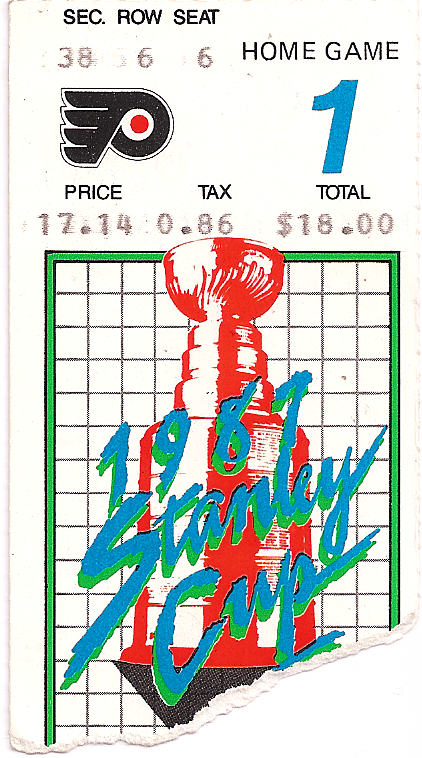
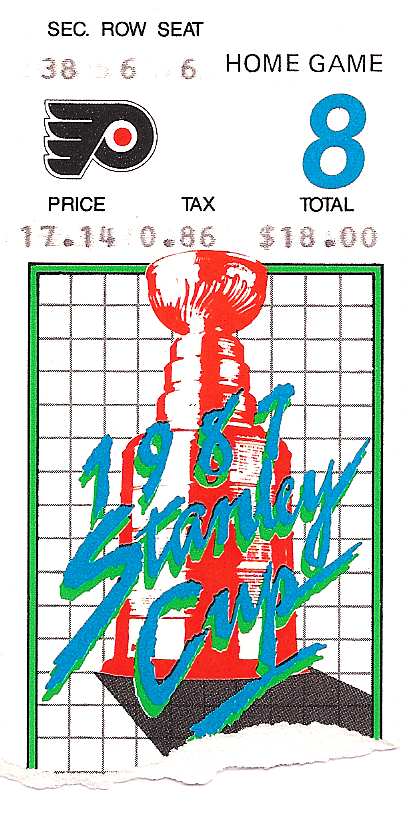
Ticket Stub from Game 1 of Flyers 1987 Stanley Cup Playoffs Earlier this year I reminisced about watching the Philadelphia Flyers in the 1980s, and in particular their 1987 Stanley Cup Playoff run. My dad was kind enough to bring out the stubs from all 14 home playoff games, prompting another trip down memory lane.

The first series was against the Rangers and Game 1 was a bit of a downer with the Flyers losing 3-0. It was the iconic Ron Duguay, his long flowing locks of hair earning him whistles, who helped put the game out of reach with a second period goal.

The Flyers rallied in the series and took four out of the next five, closing out the series with a 5-0 laugher in New York.

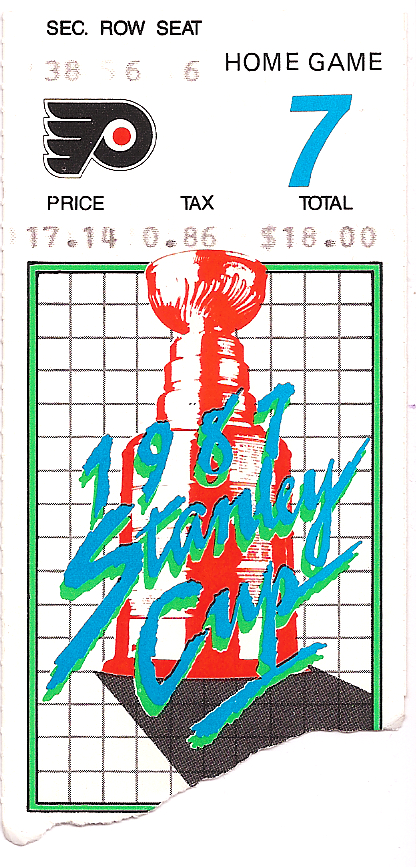
Ticket Stub from Game 7 of Flyers Stanley Cup Playoffs

Next up was the other New York team, the Islanders. The dynasty was aging but hadn’t yet given up the ghost. Bryan Trottier and Mike Bossy made it way too interesting and the Flyers ground out a 4-3 series victory.

Now as difficult as it was, there was a measure of satisfaction in beating both New York teams back to back. There was no love lost between Philadelphia and New York. Still isn’t.

The loud slow choruses of ‘Hrudey. Hrudey. Hrudey.’ that echoed the Spectrum served to bind fans together in a jeering serenade of the opposing goalie, Kelly Hrudey.

Ticket Stub for Game 8 of Flyers Stanley Cup Playoffs

Next up was Montreal. The Habs. The defending Stanley Cup Champions. Mats Naslund, Chris Chelios and the feisty Claude Lemieux. Game 1 of the series was special, with Ilkka Sinisalo scoring twice, the second time to win it for the Flyers in OT.

It’s tough to describe the utter joy that you experience watching an over-time game-winning hockey goal in person. Every fan is on the edge of their seat. Each shot is met with an ‘oooh’ or ‘aaah’ and is paired with the back-arching false start spasms of jubilation or dejection. The tension is palpable. The anticipation builds exponentially.

The roar of 17,222 fans when the puck hits the back of the net. Deafening. Unifying. High fives all around. Voice froggy from a night of shouting and watery Diet Pepsi.

The Montreal series got chippy, but what do you expect from the likes of Chris Chelios and Claude Lemieux? In fact, it got so chippy that a brawl broke out between Lemieux and Flyer back-up goalie Chico Resch during the warm-up before Game 6. That’s right, a fight before the game started.

It didn’t matter. Down 3-1 in Game 6 the Flyers scored three unanswered goals to win the series 4-2.

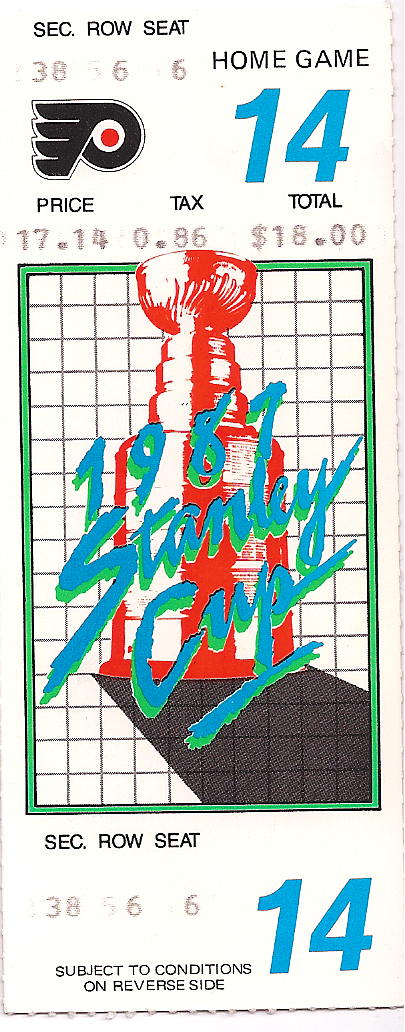
Ticket Stub from Game 14 of Flyers Stanley Cup Playoffs

Which leads us to Edmonton and the 1987 Stanley Cup Finals. I was supremely lucky to see the best hockey player of all time: Wayne Gretzky. There is no debate on this point. I’d seen him in plenty of other regular season games but here he was in the Stanley Cup Finals!

The Oilers were loaded with Gretzky, Jari Kurri, Mark Messier, Paul Coffey, Glenn Anderson, Grant Fuhr and the pesky Esa Tikkanen. While they didn’t win four straight, the Oilers did win four of five Cups between 1984 and 1988. They were good, really good.

The Flyers had a bad habit of falling behind 2-0 in games. So much so that we’d joke that we had opponents right where we wanted them once we were behind 2-0. After two games in Edmonton we were also down 2-0 in the series.

And sure enough, the Flyers fell behind 2-0 and eventually 3-0 in Game 3, before rattling off five unanswered goals to win and send us home with hope. But that was short lived. Game 4, the Flyers again fell behind 2-0, but … lost.

Down 3-1 in the series the Oilers were returning home and planning a parade. A parade?! The disrespect brought curses to the lips of nearly every Flyer fan. Game 5 in Edmonton the Flyers, again, fall behind 2-0. But this time, they battle back and win, sending the series back to Philadelphia. My chance to see one more game.

Game 6 (the 14th home game) and the Flyers, AGAIN, go down 2-0. We have them just where we want them! And we did, pulling out a 3-2 victory and sending it back to Edmonton for Game 7.

Pandemonium. All 17,222 elated, hopped up, screaming, filing out of the building, strangers pumping each other up with congratulations and encouragement. The City of Brotherly Love. High fives down Broad Street.

Yes, the Flyers lost Game 7. It was sad, but the memory of those 14 games more than makes up for it.

Section 38, Row 6, Seat 6.

xxx-bondage.com