— You Are At The Archives for the SEO Tag —

The Future of Search is Numbered

February 23 2009 // SEM + SEO // 2 Comments

The future of search is numbered. No, it’s not what you think. I’m not predicting the demise of search. Quite the opposite.

Instead I’m talking about two trends that could have interesting implications on how both SEO and PPC campaigns are constructed.

The number of words per query is going up

Bill Tancer, General Manager of Global Research at Hitwise, shared the following statistics during a SMX West presentation.
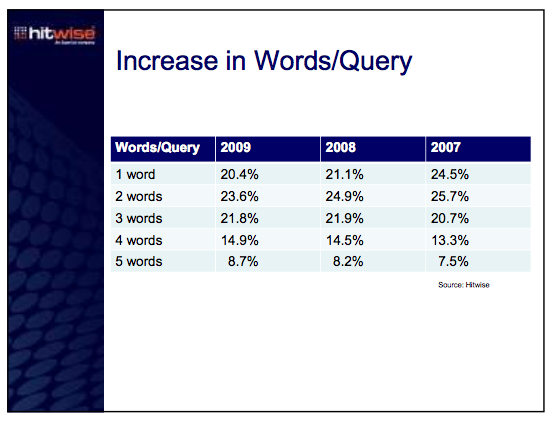
Number of Words per Query Going Up

The trend is clear. People are using more words in their search queries. The reasons behind the increase in words is debatable. Is it an increased comfort and savvy with search or frustration with the search results? Either way, long tail searches are on the rise and will likely trend this way for some time.

People are using numbers to reformulate queries

In a post titled Study on the Structure of Search Queries, Bill Slawski of SEO by the Sea discusses a Yahoo! research paper titled The Linguistic Structure of English Web-Search Queries (pdf). One of the findings was that people were using numbers to modify their searches.

The type of word most likely to be reformulated is “number.” Examples included changing a year (”most popular baby names 2007″ ! “most popular baby names 2008″), while others included model, version and edition numbers (”harry potter 6″ ! “harry potter 7″) most likely indicating that the user is looking at variants on a theme, or correcting their search need.

The data set for this research is from 2006. Yet, combined with the increase in words per query I’d theorize that numbers remain a powerful way to search today.

I’m the first person to warn against using yourself as an example but … I’m going to break that rule right now.

I often find myself using numbers, particularly years, when searching. If I’m doing research on a volatile topic (like SEO) I might come across ancient results from 2004. These are rarely helpful.

So I’ll begin to iterate and modify my query with years to find more relevant results. I had to do something similar when trying to cobble together Google’s share of search from October 2004 to October 2008.

Speaking of Google …

Google displays the date as a meta description prefix

Sometime last year Google began to insert a date prefix before the meta description in search results. They did this for pages in which Googlebot found a date – mostly blog posts.

meta description date prefix

I certainly noticed since some of my well crafted 150 character meta descriptions were suddenly being cut off because of the inserted date.

Why exactly would Google do this? They’ve certainly made it clear they like “fresh” content but they could present fresh content without the date. I can only surmise that Google believes users are looking for and will benefit from seeing the date.

Oddly, the date prefix does not seem to be searchable. When I search for ‘Magical Thinking by Augusten Burroughs 2007’ the same result is displayed but the visual treatment changes.

date search result without meta descripition date prefix

Once again Google tromps all over my well crafted meta description, but without the meta description date prefix. This seems to prove that the meta description date prefix isn’t searchable. But perhaps it should be.

Are you including numbers in your SEO and PPC strategies?

We know that users are using more words per query and that they’re fond of reformulating queries using numbers. This should be enough evidence to implement a robust modifier strategy, if you haven’t already.

Those who already have long tail programs should think about increasing the use of numbers as valid modifiers. As an example, wouldn’t review sites benefit from bidding on terms like ‘digital camera reviews 2009’ or ‘trek bicycle ratings 2008’?

Search (whether paid or organic) is about matching your content (or ad) to the user queries. Don’t let your programs become dated.


SearchWiki Not a Signal in Search Algorithm … Yet

February 17 2009 // SEO // 1 Comment

google top secret logo

Launched in November 2008, SearchWiki lets you move, delete, add and comment on the results of a Google search. At launch I wrote that SearchWiki turned us into mechanical turks. That’s not a bad thing since the Google algorithm needs a human tutor.

Google’s SearchWiki feature has been a lighting rod within the search industry drawing the ire of many and prompting the creation of Greasemonkey scripts to turn off SearchWiki functionality. It even spilled over into ‘mainstream’ media with TechCrunch’s Michael Arrington asking Google to shelve the new feature.

So it was no surprise that the SMX West presentation on SearchWiki was well attended and full of search engine marketers eager to learn what exactly Google was up to with SearchWiki. Corey Anderson started out by giving a short presentation, outlining the four different uses of SearchWiki.

  • Bookmarking
  • Improving proper name searches
  • Collecting information on a task
  • Refinding hard-to-find information

The presentation didn’t satisfy or answer the obvious questions. What ensued was a President George Bush type of press conference where reporters asked the same question over and over in slightly different ways and got back the same ‘no comment’ answer in return. You could come away from the SearchWiki session thinking you’d learned nothing or you could read between the lines and learn a lot.

Anderson stated that SearchWiki data wasn’t a signal in the Google search algorithm “right now”. He was, however, noticeably excited by all the data they were collecting. The task ahead was to sift through the data to determine if it could be turned into information and used as a signal.

While Anderson made it clear Google felt SearchWiki was a benefit to users on its face, there is no doubt that Google is interested in the possibility of using SearchWiki data as a search algorithm signal.

SearchWiki usage numbers were something Anderson wasn’t willing to divulge. It’s not that he didn’t know them, he just wasn’t willing or able to share them. He noted that Google was “comfortable” with SearchWiki usage. The crowd full of metric junkies let out a mirthless chuckle and groan at this ultra-fuzzy term.

Anderson did mention that they had been testing different visual treatments to boost engagement and usage of SearchWiki. Obviously you need to measure usage to determine which visual treatment is performing better than the other. Google knows, they’re just not willing to tell us “right now”.

If SearchWiki weren’t important, there wouldn’t be this deliberate and careful black hole of information. I don’t blame Google or Anderson. SearchWiki provides a very rich new stream of data. The potential for data pollution is problematic. Usage numbers only help those looking to hide unnatural edits from detection.

SearchWiki data isn’t a signal in the algorithm now, but the SMX West 2009 presentation made it crystal clear that they reserve the right to use it in the future.

9 Reasons You Should Have Been at SMX West

February 14 2009 // SEM + SEO // 1 Comment

SMX West 2009

I’m not the biggest fan of conferences. The information is often stale, vendors seem to outnumber attendees, and the speakers are cordoned off making it more like attending a guided tour at a very boring zoo.

But SMX West was different and absolutely worthwhile. Here’s why.

Big Brains

There were a lot of smart people at SMX West. Savvy search engine marketers and an accessible bunch of representatives from the major search engines. Getting to hear Vint Cerf speak was also a treat. However, upon exiting I heard someone on a cell phone talking about Cerf’s keynote. “Yeah, some guy from Google, he was pretty good.” Like I said, a lot of smart people, not all.

Big Ideas

Danny Sullivan kicked it off by asking Google to essentially blow up the black box surrounding AdWords and AdSense. Imagine going back to a transparent Overture like bidding system. Or knowing exactly what the revenue share was on AdSense.

Vint Cerf shocked everyone when he spoke about an interplanetary network which would be operational this year. But it was the idea of ‘bit rot’ that I found most interesting. How do we ensure that information from today can be read in the far future? Hey, I have some old MacPaint files still hanging around!

Finally, Matt Cutts announced a new ‘canonical’ link tag that serves as a sort of mini-301 redirect aimed at reducing the amount of duplicate content. Even better, the three major search engines have all agreed to use the new ‘canonical’ link tag.

Cloak and Dagger

Search engine representatives versus search engine marketers, some of which have used less than white hat techniques to gain traffic and rank. Panelists often seemed to be addressing Matt Cutts directly as they spoke about their techniques, looking at him for any response or reaction. This dance was, in itself, interesting to watch but it was the session about Google’s SearchWiki and Personalized Search that really seemed like something out of a Jason Bourne movie. You could learn a lot if you read between the lines.

Camaraderie

The amount of good will in the search industry is extremely high. I witnessed Michael Gray and Rae Hoffman giving constructive feedback to Corey Anderson and Bryan Horling who presented at the SearchWiki session. And those with power strips were generous and helped many to keep the juice flowing. Everyone seems to realize that this is a small ecosystem in which both sides must flourish.

Star Gazing

There were some high profile folks at SMX West. I’m not one to be bowled over by notoriety, titles or fame (hey, people are people), but it is interesting to see some of the more well known folks close up. You can’t help but smile at Rae Hoffman’s exuberance, be swayed by Rand Fishkin’s giddy passion or meet a nicer guy than Matt Cutts.

samantha fox

Answers

You get what might be the final word on topics like dashes versus underscores or relative versus absolute. And not just a whisper-down-the-lane opinion but right from the mouth of Maile Oyhe or from the seemingly tireless Vanessa Fox, who oddly and continually triggers the distracting image of Samantha Fox in my mind.

Numbers

Data jockeys galore roam the conference rooms and hallways. Numbers and statistics are often central to the presentations. Leverage the combined research power of the panelists to deliver meaningful up-to-date statistics such as the percentage of traffic that comes from being on page one or the click distribution between organic and paid on SERPs.

Access

Not the often frustrating Microsoft Office product but instead the unparalleled ability to speak with colleagues and search engine product managers and engineers. Nearly all panelists were willing to talk with folks and answer questions after their presentations, often long after they should have told people to go jump in a lake.

Now, I’m not a super social extrovert so I wasn’t chatting people up or doing the evening party circuit. But I certainly could have and might have if it hadn’t been for the nightly hour long drive home to the East Bay.

Humor and Rumor

Have you ever noticed how those two words differ by only one letter? There was quite a bit of laughter at SMX West. Danny Sullivan was consistently funny throughout. Rae and Debra Mastaler traded analogies on link building and sex.

Todd Friesen (aka oilman) was the target of a Twitter prank. And Nathan Buggia, from Microsoft, hit on both humor and rumor as he spat out one-liners sitting behind a MacBook Pro during the site review session.

For all of these reasons and more, SMX West 2009 was a great success. Make sure you’re there next year.

Post Click SEO

January 27 2009 // Marketing + SEO // Comments Off on Post Click SEO

post click seo

Should search engine optimization professionals be more involved in post-click marketing? Yes.

SEO shouldn’t end with the click. Getting the click is half the battle. What happens after that click is just as important. Post click marketing has taken off as more and more realize the need to optimize pages and conversion paths.

SEO should be leading the charge, not taking a back seat.

Post Click SEO

Keyword targeting adjustments are the first way in which SEO can influence post click marketing. What keywords are bringing users to the page and which of those keywords is performing best from a conversion perspective?

Decisions can be made to alter the keyword targeting of the page to optimize for the better performing keyword(s). Traffic may go down but the effective yield of that traffic may go up based on the higher conversion rate.

This process might also help identify areas for new content that better meet the needs of those arriving on poorly performing keywords.

Meta descriptions and titles are extremely valuable from a post click perspective because they can set expectations and even include a call to action. Optimizing solely for the keyword or keyword phrases in the meta description might not a) encourage clicks and b) may drive unqualified clicks.

Remember, search engine marketers are constantly testing new ad copy to increase click through rates and conversion. Search engine optimizers should do the same, using the larger canvass of meta description.

The meta description can even be used for promotional purposes. Changing the meta description on a product page to include an offer of free shipping will likely increase the click yield and, if the page matches their expectation, will continue to convert effectively.

On-site optimization in the form of keyword density, headers and even bold text can all have an impact on conversion. On-site SEO is about making the page easier to understand. While the initial audience for this optimization is a search engine, those same changes help everyday readers.

A highly descriptive header will help tell both the search engine and the reader what that page is about. H2s and H3s can help further explain the topic of that page. Again, both search engines and readers benefit.

Keyword density also increases the readability of a page. Here’s an example.

The procedure was a success and fully solved the patient’s condition.

This type of sentence might appear near the end of a descriptive paragraph. The writer probably referenced the procedure and condition beforehand and believes that the reader will fill in the blanks, turn generalizations into specifics and make the mental connections needed to gain comprehension. Search engines will do none of these things.

Instead, what if the sentence read as follows.

The stomach stapling procedure was a success and fully solved the patient’s obesity condition.

Changing generalizations to specifics and filling in the mental connections we make ensure that search engines and users immediately understand the content upon scanning the page. And people are scanning pages more than ever.

Don’t make your users do the work.

Post-click marketing and SEO

Companies that seek to maximize clicks in isolation and conversion in isolation will see results.  But those results will be less than what could have been obtained. Don’t be fooled by the false positive of this silo mentality.

Search engine optimization and post-click marketing should work in tandem to get the most out of every click.

The Worst Site in the Best Neighborhood

January 22 2009 // SEO // Comments Off on The Worst Site in the Best Neighborhood

You’ve heard the old real estate adage to buy the worst house in the best neighborhood. Well, the same is true on the Internet.

You want to be the worst site in the best neighborhood.

Worst House In The Best Neighborhood

Let me explain.

Google tries very hard to understand what a site is about. One of the primary ways it does this is by looking at who links to you and who you link to. These links are essentially your neighbors and collectively they make up your neighborhood.

The quality of your neighbors matters. Not so much in terms of Page Rank, though that doesn’t hurt, but by the topic of these sites. If your site is about surfing you’ll want links from surfing blogs, famous surfers, surf competition sites (like Mavericks), surf equipment retailers and even a tide table. Do this and Google will quickly understand which neighborhood you belong to and begin to rank you accordingly for relevant search terms.

But what if you get links from a Victorian antique dealer, a florist, a Bridget Fonda fan page and a Pachinko repair site. Now, perhaps all of these sites linked to you because they like surfing but … Google will be confused. (Remember, a search engine is like blind five year old.) It will have a difficult time knowing which neighborhood to put you in.

Google probably likes tract housing.

You know, the kind where all the houses in a neighborhood look nearly the same. Oh, the paint might be a bit different, and there might be three different floor plans, but the overall effect is that they’re alike. Make sure Google knows what your ‘house’ looks like so it can put you in the proper neighborhood.

This is why quality link building is so important. Because the only other way to establish yourself is through global link popularity or quantity link building.

No, I’m not telling you to aspire to be the worst.

New Kids on the Block

But when you start out you’re going to be the new site on the block. You have no ‘street cred’, no ‘Google juice’. You need to move into the best neighborhood by getting links from those sites within that neighborhood, the more authoritative and popular the better.

Over time you’ll paint the place, put in hardwood floors, remodel the kitchen, trim back the hedges and put on an addition. You’re building sweat equity and the value of your site will grow. If you’re doing it right, you won’t be the worst for long.

But in the beginning you’ll be the worst site in the best neighborhood … and that will be just fine.

Photo credit: Shilashon

SEO Holy Trinity

January 06 2009 // SEO // 3 Comments

SEO Holy Trinity

The SEO Holy Trinity. In the name of the Title, and of the URL and of the Meta Description.

If you’re just getting started with search engine optimization (SEO) you must get these three things right. Here’s the Blind Five Year Old explanation on why these three elements are critical to your SEO success.

Title

A search engine walks into a library. No, it’s not the set-up line to a joke. It’s an analogy for how a search engine will look for content. Everyone likes new content, even search engines, so it’ll walk straight over to the new releases section.

Now, remember, a search engine is like a five year old. So when it wanders over to the new releases you need to make sure it can understand what your page is about. The title is the best way to communicate what your post or page is about.

A five year old will probably not care who wrote the book, so don’t put your name, company or blog at the beginning of the title. If you have it at all, put it last.

Frog and Toad Are Friends

A five year old isn’t going to get your clever double entendre or understand irony. Keep that stuff in the body of your content and use your title like you would for a children’s book. For example, what do you think Frog and Toad Are Friends is about?  Yeah, probably about a frog and a toad who are friends. Bottom line – keep it simple.

Keep it brief. Search engines, like most five year olds, have a short attention span. It’s not that they can’t read all the words, but Google is only going to display 65 characters to people looking for your content. So keep it under that limit. If you’re using your brand at the end of the title, you can go just past the 65 character limit and thus sacrifice the brand name to the HTML ether.

URL

Lets extend the library analogy above. You can think of the URL as the spine of the book. A search engine will have less of a chance of understanding what that book (your page or post) is about if you don’t have a descriptive URL.

Dewey Decimal Sticker Example

Imagine if all a search engine saw on the spine of your page was a dewey decimal classification sticker. Here’s are some examples of what that might look like on your site:

http://www.domain.com/p=124

http://www.domain.com/viewDocument.aspx?d=903

Now, if you were a high-functioning adult you might be able to interpret that to get what it means, or you might find your way to the card catalog to do further research on what it meant.

But search engines are like five year olds!

They’re not going to do that. They aren’t going to understand it and they’re not going to take the time to investigate or research. The search engine will simply move on to something that looks more interesting and is easier to understand.

Instead, use your title (minus your brand name if you’re using that) as your URL. Simply use hyphens between each word and you’ve created a URL that a five year old will understand.

If you can, don’t bury the page in lots of directories. Make your URL as flat as possible while retaining the context. For instance, which of the two URLs below is easier to understand at a glance?

http://www.domain.com/toys/non-electronic/animals/stuffed/bears/brown/paddington.htm

http://www.domain.com/toys/paddington-bear-stuffed-animal.htm

In a pinch you can take out words that don’t contribute additional meaning. So, you could drop ‘the’ or ‘and’ in many cases to make the URL even more concise.

Meta Description

You might have read elsewhere that meta description doesn’t matter. Don’t believe it for a second! Meta description is important because it’s your chance to market your content.

Lets, again, use the library analogy. Readers might scan the book title. It tells them a little bit about what the content of the book. Okay, it’s about a toad and a frog who are friends but … what do they do? The meta description is the blurb on the back of the book that tells you more.

The meta description is the place to entice people to click on the search result. You might get ranked well for a term, but the next step is to get them to click. Sure, you have a much better chance based on your rank, but the text you use in the meta description does matter.

Try to get your keyword phrase in there, twice if at all possible. Why? Because Google will bold the search terms in your result. The bold styling reinforces that they’ve gotten the correct result and draws the eye to that listing.

So put something in there that tells them they want to come to your page. Make it exciting or interesting. Tell them what they’ll gain from visiting your page. Sell your content.

Putting It All Together

So here’s what the SEO Holy Trinity winds up looking like in Google.
SEO Holy Trinity Example

This page or post was optimized for the phrases ‘2009 Internet Predictions’ and ‘2009 Technology Predictions‘. (I could have done a post for each one to be even more focused but … time is not infinite!) Do the searches for yourself and see how I rank.

Now this isn’t the end of SEO. You’ll need to do more to achieve high rankings and traffic. But the SEO Holy Trinity is the base that you must have to ensure success.

In the name of the Title, and of the URL and of the Meta Description.

Google Taxonomic Search And SEO Affirmative Action

December 04 2008 // SEO // 4 Comments

There are rumors that Google is applying taxonomic limits to specific searches, usually surrounding products or brands.

When I first heard these rumors I dismissed the idea. Even if Google created a taxonomy of sites, I couldn’t see them using that data as part of the search algorithm. But I quickly began to see that Google likely has a robust taxonomy and could relatively easily use it as a signal within the algorithm.

Does Google have a taxonomy of websites?

Yes. It already displays this taxonomy via the AdWords placement targeting interface.

The real question is whether Google has attached a taxonomic classification to sites outside of the AdSense network? I’d guess that it may not be comprehensive, but that it includes sites that meet some quality threshold, potentially Page Rank.

Why would Google use a taxonomic signal in search?

Lets start with the idea that Google wants to ensure they deliver the best set of results to users. Would a product related SERP that contained more than five shopping comparison sites be the best result set? How about forums? Or blogs? Or retail sites?

Think about it. If you searched for ‘casio exilim’ would you want a SERP that had Walmart, Circuit City, Office Depot, Ritz Camera, Best Buy, Target and eBay? Similarly, would you want one that had PriceGrabber, BizRate, Buzzillions, Yahoo! Shopping, PriceRunner and NexTag?

I’m guessing that most of the time the natural ebb and flow of the algorithm works out and the results are a nice mixture of these different types of sites. But sometimes one type of site might be better optimized for a term and the type of taxonomic overload above might occur.

How would Google implement a taxonomic search signal?

At first the idea of using a taxonomic parameter in search sounded tough. Yet again, I quickly surmised that it might be more straightforward than I thought.

Wouldn’t you simply enter some logic that made it slightly more difficult for a site of the same taxonomic classification to rank for a query if there was already one ranked higher? The difficulty would increase based on the number of sites in the same taxonomic classification for a query. So, if two shopping comparison sites were already ranked, it would be far tougher for the third and even more so for the fourth.

It’s essentially a smoothing mechanism that gives slightly more opportunity to sites in another taxonomic classification to rank for a query that they might be shut out of otherwise.

A taxonomic limiter would be a safeguard mechanism and perhaps serve as an over-optimization trigger.

What does a taxonomic search signal mean for SEO?

A taxonomic search signal would be a bit like affirmative action for SEO, giving lesser optimized sites a leg up on the competition. It also means greater SERP volatility as sites within one taxonomic class swap positions.

For instance, two sites in the same taxonomic class could be very close and should be ranked 1st and 2nd, but because of the taxonomic limiter are ranked 1st and 5th. If the second site eclipses the first, it would immediately be ranked 1st since the limiter wouldn’t apply. Consequently, the first site would drop, likely to 4th or 5th because the limiter is now being applied.

Is Google really using a taxonomic search signal?

Maybe. While the idea makes sense, the changes some are seeing could instead be caused by one of the numerous algorithm tweaks. But the tools to measure and monitor SEO strength are getting better. Companies can monitor their rank consistently over time and identify when things go sideways. Sometimes the changes don’t make a whole lot of sense and that’s when these types of theories and rumors are born.

What do you think? Is Google using a taxonomic search signal and limiter in search results?

Could Zoetrope Be A SERP Tracking Tool?

November 25 2008 // SEO + Technology // Comments Off on Could Zoetrope Be A SERP Tracking Tool?

Zoetrope is a new web tool being jointly developed by Adobe and researchers at the University of Washington. The general idea is to allow users to view the Internet over time. Think of it as the Wayback Machine on steroids. Sarah Perez does a good job writing about Zoetrope in ReadWriteWeb.

Yet, it’s the following video that does the best job of explaining Zoetrope.

Could Zoetrope be used as a SERP tracking tool?

If Zoetrope could capture specific search engine results pages (SERPs), then it could be a very powerful SERP tracking tool.

Let’s say I have 10 high value keywords for which I want to be highly ranked on Google. Using Zoetrope I could conceivably capture the daily SERP for each keyword and link it to the appropriate destination page. This would allow me to see if changes to my page had any impact on SERP ranking for that keyword.

I could even create ‘lenses’ for my competitors and review how they’ve tweaked their site to help influence SERP rank. Zoetrope could provide an unparalleled level of detail and analysis for a savvy SEO practitioner.

Yet there’s a big, actually huge, ‘if‘ in the statement above. I doubt that Zoetrope is or even could capture every SERP. But that doesn’t mean there’s not a way to do this. In fact, I think it provides a pretty interesting business opportunity.

Want Zoetrope to help you track SERP for a group of keywords? Simply sign-up for a subscription and they would begin to capture the information. Toss in a 30 day free trial to get the ball rolling and I think you’d have a number of people clamoring for and using Zoetrope for SERP tracking.

SearchWiki Turns You Into Free Mechanical Turk

November 21 2008 // SEO + Technology // 1 Comment

Yesterday Google launched SearchWiki, a search feature that lets users customize search results by moving, deleting, adding and commenting on search results. The search algorithm will now have access to a set of aggregated human data. As I’ve written about before, the Google search algorithm will benefit from having a human feedback mechanism.

Google SearchWiki turns users into a free Mechanical Turk.

Not familiar with Amazon’s Mechanical Turk? Here’s a relevant excerpt from Wikipedia:

The Amazon Mechanical Turk (MTurk) is one of the suite of Amazon Web Services, a crowdsourcing marketplace that enables computer programs to co-ordinate the use of human intelligence to perform tasks which computers are unable to do.

Now, clearly the search algorithm is able to produce search results. However, the algorithm still isn’t very smart. SearchWiki lets the algorithm learn as humans move, delete and add results for specific search queries.

While Google clearly states that your specific changes will not be seen by others, it seems impossible to think that Google won’t use that information to influence search results over time. Not convinced? SEO by the Sea reviews a recent Google patent that points to Google’s continuing goal of leveraging more data and behavior into search results.

Google has been experimenting with something like this for some time and finally seems ready for prime time. This also means the flirtation with Digg is likely done for good unless abuse by SEO practitioners overwhelms the signal.

How do SEO gurus react to SearchWiki?

If you employ a short term chase the algorithm type of SEO you’re seeing a threat and an opportunity. The threat is that the human feedback mechanism could help to curb over-optimization and subtle gaming. However, it also provides an opportunity to create a SearchWiki army that could coordinate changes to specific search results. The worst case scenario is that people are paid to delete, add or move certain results for specific searches.

I’m not saying SearchWiki is a bad thing. But make no mistake, Google is using it as a free way to make their core product better.

Search Pogosticking and SEO

November 14 2008 // SEO + Technology // 19 Comments

Search pogosticking is defined as going back and forth from a search engine results page (SERP) to individual search result destination sites. The behavior may indicate poor search results since the user hasn’t been satisfied by one or more of the SERP results.

Google and Yahoo are clearly using, or thinking about using, this metric as part of their search algorithm. It makes a lot of sense and could provide an important user-defined input for the algorithm as well as guard against potential over-optimization. As an aside, access to this human feedback mechanism may be one of the reasons why Google hasn’t been eager to pay a premium for Digg.

How would search pogosticking influence SEO?

A user is presented with search results based on a specific query. The engine captures what result you click on and whether you return to that SERP and click on subsequent results and/or refine your query. (They could even conceivably determine the time between each click as a proxy for satisfaction with that result. This would reduce the chances of penalizing results that did deliver value.) The information can be aggregated for each query and compared to average pogosticking behavior by SERP rank.

So, let’s say that for a specific query the engine sees that the current SERP has an abnormally high pogostick rate for the top ranked result. This information could then be fed back into the algorithm as a negative signal, thereby reducing its SERP rank in a future algorithm update. Obviously, it would have to be statistically above the average pogostick rate for that position to be flagged. However, I’m certain both Google and Yahoo have smart folks who can calculate when it reaches significance.

Does search pogosticking sound far fetched?

It shouldn’t. Do a Google search and look at the page source. You’ll see something like the following next to each search result.

onmousedown="return rwt(this,'','','res','1'

The ‘res’ likely stands for result and the next parameter is the actual rank for that result on that page. More information on this rewrite and tracking behavior can be found at searchlores and blogmal.

Even without this technical knowledge it should be obvious they’re doing something like this if they’re providing users with customized search results. I’m not sure the ability to provide custom or personalized results is the true aim, but makes the collection of this information more palatable for many users.

SEO by the Sea recently posted about this topic including a relevant pogosticking patent application by Yahoo. I recommend you read his post as well.

How can I track pogosticking?

You can’t know for sure whether a user is pogosticking. Bounce rate can sometimes be a good indication, but there are instances where query intent is satisfied and a high bounce rate is the expected result. Many Q&A sites meet this criteria.

The best course of action is to review pages with high bounce rates and make certain you’re matching query intent and delivering value to those users. Post-click SEO is going to become a larger part of the equation, bluring the line between SEO and traditional design and UI.