— You Are At The Archives for the search Tag —

11 Ways to Spot a Bad SEO Firm

June 02 2009 // SEO // 2 Comments

ripoff

There are a lot of bad SEO firms and consultants out there that make it more difficult for SEO to become a recognized and valuable part of every business.

I recently conducted a search for a SEO Manager at Caring.com and was bombarded with pitches from SEO firms and consultants. Based on this experience and some research I’ve come up with a list.

11 Ways to Spot a Bad SEO Firm

Rank Promise

Any SEO firm that promises you a number one ranking for any term before doing any keyword research or competitive analysis should be avoided.

Instant Results

SEO isn’t about what you can do in 30 days but a long-term plan to match your content with user queries. That’s not to say that progress won’t be made in the short-term, but beware of the get results fast pitch.

Network of Quality Links

A number of firms will claim that they have a “network of quality sites” that enable them to drive links back to your site. In general, these networks aren’t of such high quality and are often the target of web spam teams. Quality linkbuilding isn’t as easy as turning on a switch. It takes time and that’s why the links are valuable.

Submissions Bonanza

“We’ll submit you to over 500 search engine and directory sites!” Some of these engines and directories are valuable but most aren’t and may even wind up hurting you if it’s done in a zombie like fashion.

Inside Algorithm Knowledge

People at Google don’t hand out information about the algorithm. Anyone who says they have a ‘Deep Throat’ of search is likely wearning a tin-foil hat or running a scam.

Bad SEO

Visit the firm’s site and see if they’ve done a good job with their own SEO. Spot rudimentary SEO errors such as duplicate titles and you can write them off.

Adjectivitis

Throw a flag on the play if you see a site or pitch peppered with adjectives. For example: “Our talented optimizers use premiere methodologies to secure highly valuable links, elevating search engine presence and delivering targeted web traffic to your site.”

In my experience, the need to over sell your service is a sign that you’re not confident in your own ability.

Unsolicited Analysis

You might have received some of these emails. The firm has kindly done an analysis of your site and determined that you should be ranking higher for [insert term here]. Lucky for you, you can fix all that in no time at all by … [deleted]

Meaningless Statistics

Beware of statistics that have no basis in reality. “We outperform our nearest competitors 3 to 1 in the time it takes to get you ranked.” There are so many things wrong with that statement it makes my head hurt.

Bogus Testimonials

References and testimonials help sell many a service. Be on the look out for bogus testimonials on ‘neutral’ websites. It helps when they use their own name or do cut and paste with a fingerprint-like misspelling.

Repeated Robo-Emails

Sending the same email again and again based on a Craigslist ad is both annoying and a clear signal of desperation. Avoid these folks at all costs.

White Hat SEO

SEO isn’t about speed or automation. I’m not saying there aren’t efficiencies – there are. But the goal of SEO is to ensure that the content of your site is matched and being displayed to users for the right queries. That’s done in a myriad of ways – some small and some large.

Don’t be taken in by bad SEO. Use these tips and find firms and consultants who will give you a sound strategy and straight advice.

You’ll be doing yourself and me a favor.

Google is the 6th Ranked Search Engine

June 01 2009 // Humor + SEO // 3 Comments

Don’t believe me? Try a search for ‘search engine’ on … Google.

Google is the 6th Ranked Search Engine

That’s right, it returns Google as the 7th result and the 6th search engine. And look at the snippet! Would it kill Google to craft a decent meta description?

In some ways it’s nice to see that Google isn’t optimizing and hasn’t manually altered the results in their favor. Yet, ‘search engine’ seems like a valuable term.

Search Engine Search Volume

That’s over 4 million global monthly searches! Even on exact match you get nearly 400,000.

Yahoo seems to get it, putting themselves at the top of a ‘search engine’ query on Yahoo. I’m guessing that’s a non-algorithmic result. Sure it seems like a blatant promotion but I understand the reasoning.

Nevermind the oddity of searching for a search engine with a search engine. Search is Google’s business and, as such, it should want to be the top result for the term.

Even from a search quality perspective, are those the best results for the term ‘search engine’?

Google Synonyms

May 30 2009 // SEO // 7 Comments

Google continues to build a synonym database to help deliver the best results for user queries. It’s not the most well documented or talked about feature but understanding synonyms can help your SEO efforts.

Use Synonyms to Increase Subject Density

Traditional keyword density revolves around the optimization for a specific keyword. A page on sofas would use modifiers or keyword clusters like ‘leather sofas’, ‘sofa beds’, ‘upholstered sofas’, and ‘sofa cushions’ as a way to increase density on the root keyword.

Using synonyms you can also increase the subject density of the page through supporting keywords like ‘couches’, ‘furniture’ and ‘chairs’. (Yes, chairs is currently a synonym for sofas.)

You’re not looking to make these synonyms the primary focus or most keyword dense words. Use them as supporting keywords to help Google to better understand the subject matter of the page.

How To Find Google Synonyms

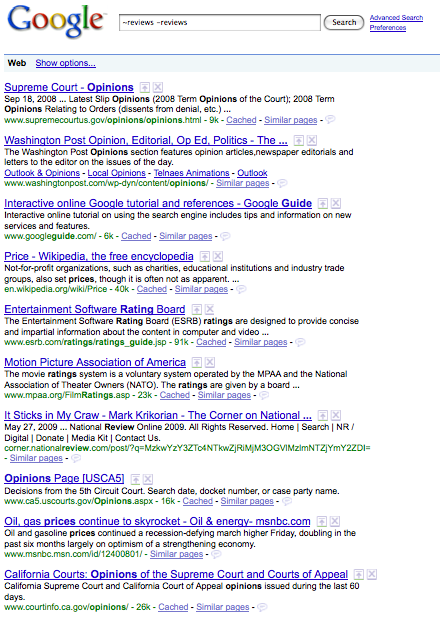
You can use the ~ operator to perform a synonym search. Coupled with a negative search for the same term and you can easily see the highlighted synonyms for that term. Here’s an example for the term ‘reviews’ (~reviews -reviews).

Google Synonyms

You’ll notice that ‘opinions’, ‘guide’, ‘rating’, and ‘prices’ are all highlighted and identified as synonyms.

There are also a few tools (here and here) that provide greater insight into synonym sets. SEO success is accomplished through doing a lot of little things right.

Synonyms are just one more way to help optimize your site and pages.

Google Suggests Ads

May 22 2009 // SEM // 1 Comment

This week Google made changes to Google Suggest (that drop down menu that provides the most likely completion for what you’ve typed) to include ads.

Similar to the navigational suggestions above, sometimes we detect that the most relevant completion for what you’re typing is an ad. When an ad is shown, we mark it with the text “Sponsored Link” and a colored background, as on the results page.

Google Suggests Ads

This isn’t surprising but it is another indication that Google is actively seeking to increase paid search clicks through other products. Yahoo! put ads in news alerts and Google already inserted ads into Feedburner (FeedSense) and likely will into Google Friend Connect (FriendSense).

Will there be any type of reporting for this placement and, if effective, could it actually garner a premium rate? Time will tell.

However, expect to see more of these ad integrations as Google looks to increase revenue and growth in paid search.

5 Reasons Why Paid Search Is Down

May 18 2009 // SEM + SEO // 5 Comments

The latest from Hitwise and Comscore show that the growth in paid search is slowing.

In the four weeks to May 9, 2009, 7.25% of search engine traffic to All Categories of websites was from paid clicks. This compares to 9.84% in the same four week period in 2008 – representing a 26% decline in the share of paid clicks.

Paid Clicks Declining

According to Comscore query volume grew 68% in the last two years while paid clicks grew only 18%. Now, lets be clear, paid clicks aren’t going down, they’re just not growing as fast.

There are a lot of theories about why paid search is sputtering. Here’s my analysis of five reasons behind the slow down.

Advertiser Decline

One theory is that the economy has forced many advertisers to abandon paid search. This is a compelling theory given the number of bankruptcies and marketing budget cuts.

Yet, nearly every survey (here, here and here) is showing that the economy has pushed more dollars online. And those online dollars were going to search – a medium giving advertisers far more control and, more importantly, providing a clear return on investment through analytics.

Search has become a near necessity these days and as the leader in search Google’s AdWords is a default part of many a marketing mix. Yet, the Google Tax has been going up.

The Google Tax? Anyone who has been advertising for more than three years can remember ten cent CPCs. CPC inflation was and still is a considerable problem. Yet we were all like frogs in a pot. The heat was turned up so slowly we didn’t really notice … until now.

Budget cutting forced companies to audit campaigns and what they found might have surprised them. The water was scalding hot!

Verdict: Probable.

Words per Query Up

The number of words per query are up and continue to rise. Many surmise that the increase in query length is directly related to less advertising coverage and fewer paid clicks. This theory presupposes that most advertisers are running sophisticated campaigns on exact match and are heavily using negative keywords.

My experience is that sophisticated campaigns are still infrequent. Most have broad match and phrase match full bore. But, for the moment, lets say this is the case for larger advertisers. That leaves all of the other advertisers who are presented with an AdWords interface that encourages broad match.

Though there is some data that shows coverage is down, I’m unsure it is related to the number of words per query. The number of broad match and phrase match advertisers simply seems too great for query length – particularly of such a small magnitude – to have had an appreciable impact.

Comscore Words Per Search

The graph is striking because of the scale. But it still amounts to a mere single digit percentage increase in words per query over two years.

Verdict: Unlikely.

Quality Score Suppression

Google has been using their Quality Score to ensure that relevant ads are presented for user queries. If Google determines your ad and landing page aren’t relevant you’ll be forced to pay more for the ad to be displayed.

The Quality Score isn’t always a reflection of reality. It is heavily influenced by the CPC your ad receives and overall account performance. Poor keyword research, account structure, copy writing and negative keywords could lead advertisers to pay more even though they have quality content.

Google’s implementation of Quality Score has weeded out poorly targeted ads. It has also increased the CPC for all advertisers. In this way, Quality Score may be contributing to the decline not through suppression but through making the Google Tax cost prohibitive.

Verdict: Possibly.

Better SEO

Search Engine Optimization (SEO) has improved. More and more sites have invested in SEO and have come to see it as a legitimate marketing strategy. ‘Why pay for it when you can get it for free?’ And that goes double when the economy hits the skids.

Search engines have also gotten better at SEO through algorithm tweaks and results presentation changes. From Yahoo’s SearchMonkey to Google’s Universal Search (local, video etc.), organic search results have become much more compelling.

What about Google’s Vince Change? The change to Google’s trust and authority algorithm resulted in top brands floating to the top of more search engine results. Could users be finding brands more often in organic search instead of clicking on branded ads?

Improving organic search has always been an odd balancing act for Google. Better search results improve retention and return rates. That means more ad impressions which should logically mean more paid clicks. But could organic search become too good and suppress paid clicks?

Verdict: Likely.

Mix-Shift of Queries

My own theory revolves around the mix of queries. What are people searching for and has that changed over time?

Look at the words per query graph again. What about those drops in December? Could commerce based queries be less diverse? We’ve already seen differences in transactional (left) versus informational (right) searches.

Transactional versus Information Query Eye tracking

In tough economic times could the shift in searches be away from transactional or product searches? Instead, are people searching for information or (low cost) entertainment online? Those areas may have less advertising coverage than traditional product queries.

As CPM rates have declined and CPCs have increased the ability for content based sites to participate in paid search may have dwindled. The economics just don’t work out nearly as often as they used to.

Is this not also reflected in the Hitwise numbers? Travel, insurance and retail are getting fewer paid clicks. Travel in particular seems transparent. In a recession fewer people are taking vacations leading to fewer paid clicks. In addition, travel agencies may pull back on paid search as a result of decreased demand.

And what about search refinements. Earlier this year I wrote about a Yahoo! study on how users were refining their queries.

Could users be refining their queries more frequently with a greater understanding that refinement will lead to better results? If so, I’d hazard that refined queries likely have a lesser chance of garnering a paid click.  These users are highly focused on the organic results to determine if their refinement was successful. This dovetails nicely with the informational search eye tracking study above.

Verdict: Probable.

Hodge Podge

Hodge Podge

In the end I’d bet it’s a little bit of everything mentioned with a dash of the unknown thrown in for good measure.

How, why and what people search coupled with the failing economy and an online advertising model in flux is going to have an impact on paid search.

Search, as a business, is still rather young. We’re all trying to learn what makes it tick and how it’s going to grow in the future.

This is what draws me to online marketing and search specifically. The answers aren’t black and white and the territory is uncharted.

And with that, what are your thoughts? What do you think of my analysis? Why do you think paid search growth is declining?

Did You Mean Matt Cutts?

May 15 2009 // SEO // Comments Off on Did You Mean Matt Cutts?

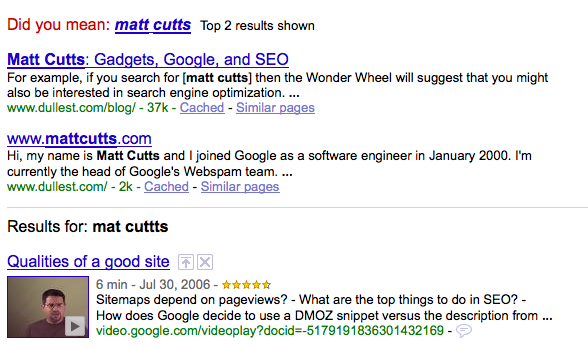
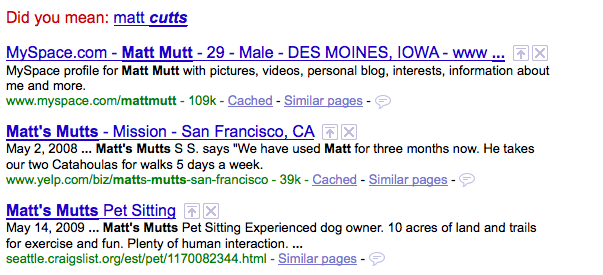
In February I wrote about Did You Mean search results appearing above normal Google search results. This differed from the presentation of just a link to the Did You Mean search results.

Did You Mean search results

Did You Mean Matt Cutts

Did You Mean search link

Did You Mean Link

While I understood the potential user benefit, from an SEO perspective, Did You Mean search results could make misspelling optimization far less attractive.

As luck would have it I was able to get an answer on this topic from Matt Cutts.

It’s about what I expected. The presentation is relatively new and is tied to an algorithm triggered by some threshold where Google expects a high degree of accuracy in the Did You Mean match. In the end, it probably does deliver value to the user.

I appreciate the response (thanks Matt) and am reminded that SEO is an ever changing endeavor.

Is Yahoo the Firefox of Search?

April 01 2009 // SEM + Technology // 2 Comments

Lately, you can’t go a day without Yahoo talking about their new open initiatives. Whether it’s Yahoo BOSS (Build your Own Search Service), Yahoo Pipes or Yahoo SearchMonkey, it’s all about openness and collaboration.

Yahoo SearchMonkey

Yahoo SearchMonkey is the most interesting initiative for search. During SMX West every Yahoo presenter seemed to have a SearchMonkey slide in their deck. I can understand why.

Using SearchMonkey, developers and site owners can use structured data to make Yahoo! Search results more useful and visually appealing, and drive more relevant traffic to their sites.

SearchMonkey turns dreary search results into something more interesting.

SearchMonkey Example

There are only a handful of default SearchMonkey apps currently running on Yahoo and the number of user apps is still a middling 100 or so. Yet, the idea seems right.

SearchMonkey is add-ons for search

That’s right. SearchMonkey apps are the equivalent of Firefox add-ons.

Add-ons extend Firefox, letting you personalize your browsing experience. Take a look around and make Firefox your own.

Yahoo isn’t going to win on their search algorithm. While the result sets are subjective, Google is the perceived leader and perception is reality. In addition, Google is far more focused on perfecting search and iterating the algorithm.

That’s why SearchMonkey is a smart move. Taking a page from Firefox and WordPress, Yahoo is hoping that developers will make their results more appealing and usable through easy customization.

Firehoo

Firehoo Logo

That’s not where the similarities stop. Yahoo has a similar position in search as Firefox does in browsers. They’re both up against large market share giants, Google and Internet Explorer respectively. Hence, they both fight against user inertia.

There are differences. Yahoo had the market share lead and let it slip from their grasp and many (myself included) would argue that Firefox is a better product (add-ons or not) then Internet Explorer.

Could Yahoo become the Firefox of search?

Maybe, but only if they focus and promote SearchMonkey apps to sites, developers and, most importantly, to users. Unfortunately Yahoo isn’t doing this and remains distracted and unfocused.

It would make search far more interesting if Yahoo got serious about SearchMonkey and fully implementing a customized search strategy to woo users back to Yahoo.

SEO Affirmative Action

March 07 2009 // SEO // 2 Comments

Is Google’s Vince Change SEO Affirmative Action?

Google Vince Update

The recent ‘Vince Change’ by Google has been discussed, debated and well documented by Aaron Wall. In essence, the Vince Change gave brands more trust for short queries.

At first, the Vince Change didn’t bother me too much. Change is part of the business (keeps many of us in business) and it seems a waste to get worked up by such things. But the more I thought about it the more it bugged me.

Google Taxonomic Search

Late last year I’d theorized that Google might be employing taxonomic limits to certain search results. I wrote about the topic in response to some reports of unusual SERP behavior for product searches.

The general idea surrounding taxonomic search is that Google wants an even distribution of site types on certain searches. For products you’d likely want the manufacturer as well as a few retailers, a few review sites, a few shopping comparison sites and a few discussion forums. Having the results dominated by any one type (regardless of SEO strength) would be a suboptimal user experience.

I’m a bit ambivalent on the idea of taxonomic search. It probably would provide a better user experience and it simply raises the bar for good SEO. I’m still not sure Google is doing this, but it’s more intriguing to think about with Google’s Vince Change.

Commercial Results

I kept mulling over the Vince Change, both in what it was and how it might have been implemented. Matt Cutts, whom I like a lot, provided an answer that discussed the former but not the latter.

The part that caught my attention was when Matt discussed the SERP for ‘eclipse’ and specifically his mention of “commercial results”. So is it not brand but commercial results that were impacted by the Vince Change? Is there a simple taxonomy of commercial versus non-commercial sites?

But the RankPulse results don’t really bear that out. There were plenty of other commercial sites there previously, they just didn’t have the same name recognition. I couldn’t shrug off the Vince Change.

Is trust assigned or earned?

If the Vince Change was about trust and authority, how did these brand sites receive trust and authority? Was it assigned or earned? If it was earned, how exactly was it earned? If it had been earned through SEO (backlinks, on-page optimization etc.) shouldn’t they have already been highly ranked?

I found it difficult to determine how you’d ‘turn the knob’ of trust and authority and only have it impact certain types of sites. “Certain types of sites” would lead naturally to a taxonomic structure of some sort. But that would be a transparent proxy for brand and I want to believe Matt what he says they didn’t target brands.

Instead, did Google simply assign this trust and authority? A type of SEO affirmative action. If so, based on what criteria? If it’s not ‘brand’, what is it? It doesn’t seem like traffic, nor does it seem to have roots in traditional SEO. As of SMX West it wasn’t SearchWiki data, but maybe that’s changed since. Google does move fast.

Or maybe it’s another piece of data? Advertiser saturation or CTR via DoubleClick? Could it be about money?

Why the Vince Change matters

The Vince Change seems to target very broad queries. While short queries are still a big and important part of SEO, the trend is toward longer search queries. Yet, the inability to determine how trust and authority pooled around these brands is unsettling. What prevents the same type of change to be implemented on long tail queries?

Brands should be required to earn their trust on a level playing field.

Are we … being hustled?

The Future of Search is Numbered

February 23 2009 // SEM + SEO // 2 Comments

The future of search is numbered. No, it’s not what you think. I’m not predicting the demise of search. Quite the opposite.

Instead I’m talking about two trends that could have interesting implications on how both SEO and PPC campaigns are constructed.

The number of words per query is going up

Bill Tancer, General Manager of Global Research at Hitwise, shared the following statistics during a SMX West presentation.

Number of Words per Query Going Up

The trend is clear. People are using more words in their search queries. The reasons behind the increase in words is debatable. Is it an increased comfort and savvy with search or frustration with the search results? Either way, long tail searches are on the rise and will likely trend this way for some time.

People are using numbers to reformulate queries

In a post titled Study on the Structure of Search Queries, Bill Slawski of SEO by the Sea discusses a Yahoo! research paper titled The Linguistic Structure of English Web-Search Queries (pdf). One of the findings was that people were using numbers to modify their searches.

The type of word most likely to be reformulated is “number.” Examples included changing a year (”most popular baby names 2007″ ! “most popular baby names 2008″), while others included model, version and edition numbers (”harry potter 6″ ! “harry potter 7″) most likely indicating that the user is looking at variants on a theme, or correcting their search need.

The data set for this research is from 2006. Yet, combined with the increase in words per query I’d theorize that numbers remain a powerful way to search today.

I’m the first person to warn against using yourself as an example but … I’m going to break that rule right now.

I often find myself using numbers, particularly years, when searching. If I’m doing research on a volatile topic (like SEO) I might come across ancient results from 2004. These are rarely helpful.

So I’ll begin to iterate and modify my query with years to find more relevant results. I had to do something similar when trying to cobble together Google’s share of search from October 2004 to October 2008.

Speaking of Google …

Google displays the date as a meta description prefix

Sometime last year Google began to insert a date prefix before the meta description in search results. They did this for pages in which Googlebot found a date – mostly blog posts.

meta description date prefix

I certainly noticed since some of my well crafted 150 character meta descriptions were suddenly being cut off because of the inserted date.

Why exactly would Google do this? They’ve certainly made it clear they like “fresh” content but they could present fresh content without the date. I can only surmise that Google believes users are looking for and will benefit from seeing the date.

Oddly, the date prefix does not seem to be searchable. When I search for ‘Magical Thinking by Augusten Burroughs 2007’ the same result is displayed but the visual treatment changes.

date search result without meta descripition date prefix

Once again Google tromps all over my well crafted meta description, but without the meta description date prefix. This seems to prove that the meta description date prefix isn’t searchable. But perhaps it should be.

Are you including numbers in your SEO and PPC strategies?

We know that users are using more words per query and that they’re fond of reformulating queries using numbers. This should be enough evidence to implement a robust modifier strategy, if you haven’t already.

Those who already have long tail programs should think about increasing the use of numbers as valid modifiers. As an example, wouldn’t review sites benefit from bidding on terms like ‘digital camera reviews 2009’ or ‘trek bicycle ratings 2008’?

Search (whether paid or organic) is about matching your content (or ad) to the user queries. Don’t let your programs become dated.

Twitter is not a Google competitor

February 15 2009 // SEO + Social Media + Technology // 3 Comments

Twitter search is a great feature but it in no way threatens Google’s dominance in search.

Recency does not equal relevance

The major flaw of using Twitter as a search engine is that recent tweets on a subject do not equal relevance on that subject. This should be obvious but lets do a few searches to illustrate the point. I’ll use searches that appeared in the top 100 from the Google Hot Trends list at some point on February 15, 2009.

Yosemite Camping

yosemite camping twitter search

yosemite camping google search

Which of the results best satisfies the query? Without question it’s Google. Let’s try another.

Daytona 500 Pace Car

daytona 500 pace car search on twitter

daytona 500 pace car search on google

In this instance both provide the answer. The Daytona 500 Pace Car is a 2010 Chevy Camaro. The Google result tells me it’s black and gold and gives me plenty of authority sites to visit.

Twitter on the other hand doesn’t provide this level of detail. In addition, two of the five results are from Mahalo and a third is from kinougo. More on ‘him’ later. For now lets try one last search.

Crayola Factory

crayola factory search on twitter

crayola factory search on google

Hands down Google satisfies this query better than Twitter. The only link available is, again, from our friend kinougo. So who is kinougo?

kinougo twitter profile

Essentially auto generated Tweets based on hot searches. But where do they lead?

daytona 500 pace car on kinougo

Look at that! An API based link farm with Google AdSense as the revenue source. That looks … awful!

Twitter would have been a near complete bust if it were not for Mahalo and kinougo. Yet, these sites are simply exploiting Twitter search, not contributing to it in a natural way. I doubt the user experience on these clicks would reinforce the idea that Twitter was the place to search. Probably the exact opposite.

Recency works only for hyper real-time events: earthquakes, Presidential debates and conferences to name a few. (Sidenote: There’s this other site called FriendFeed which actually did a bang up job on real-time commentary on the Presidential debates.)

Authority is nonexistent

What makes anyone believe that the latest 5 or 10 tweets on a subject are at all authoritative! Twitter has no mechanism to determine what is the best result for a given query other than the Tweets from their users in a very short time span. Do you trust the random users of Twitter that much? I don’t and neither does Google.

The Google algorithm tries to present the most authoritative, the most right, the most useful results, not just johnny-come-lately blog posts and certainly not some 140 character missive. They might not always get it right, but they’re trying … hard.

Duplication is a problem

alzheimer's disease twitter search

Twitter doesn’t handle duplicate results, opening itself up for SPAM both real and unintentional. Even for the hyper real-time events how many times do you need to see the same quote over and over again?

Twitter is not a Google competitor

Relevance, authority and duplication all ensure that Twitter is not, and likely never will be, a Google competitor. At best Twitter could provide supplemental information to a real search engine. Twitter is the crawl at the bottom of a cable news channel.

“I just ate a mango” isn’t going to disrupt the search world.