— You Are At The Archives for the search Tag —

Facebook Questions Forces The Question

August 03 2010 // SEO + Social Media // Comments Off on Facebook Questions Forces The Question

Facebook Questions

Facebook recently launched their new Q&A product, aptly named Facebook Questions.

The Q&A space is white hot right now, in large part because of the SEO potential of the content. Q&A, if done correctly, creates highly focused long tail content that gets gobbled up by search engines. Look no further than Demand Media’s eHow as an example.

But is that what Facebook has in mind for Questions?

Facebook Questions Not Crawlable

Search Engine Land reported that Facebook Questions could not be crawled by search engines, and that Facebook has no plans to change that policy. The news was surprising, resurfacing the notion of the walled garden and sending mixed signals on Facebook’s strategy.

Facebook Search Powers Questions

In the first few days after launch Facebook search would force users into Questions whenever a search started with the five Ws or one H. Facebook search results would shift to Questions after you entered one of those interrogative words and then hit the space bar. This search feature is no longer active. (Sadly, I did not capture this behavior.)

Perhaps it was a simple test or Facebook pushed enough traffic through the product to receive the necessary amount of feedback. Either way, it showed the power of Facebook search (both in flexibility and volume) and pointed to a reason for not allowing search engines to crawl and index Questions. Does Facebook need traffic from outside the walled garden?

Questions and the Open Graph

Where things get confusing is why Facebook is pursuing Questions and the Open Graph in parallel. There are plenty of other Q&A sites out there. Many of them are using the Open Graph protocol.

Questions from other sites could easily show up in Facebook search results. So, why build a whole new product if you could just suck in content from everyone else? Conversely, if you were going to spend the resources to build that product and create all that content, wouldn’t you expose it to search engines so you could attract more users to Facebook? (Yes, that’s still possible.)

Of course, Facebook might want just one more product that will keep people on Facebook. And the longer users are on the site, the more often they’re clicking on ads and performing searches.

Articles are Second Class Open Graph Objects

Questions would be classified as an ‘article’ type in the Open Graph. Yet, articles seem like second class citizens in the Open Graph. Reports indicate that an object is not created for a page with og:type=article. This also means you can’t administrate likes on article content. In other words, you can’t publish to people who have liked an ‘article’ on your site or blog.

So, maybe Facebook is trying to create its own content instead of indexing what’s already out there? Again, this seems contrary to the Open Graph concept. Yet, if you believe status updates are a form of content publishing, then perhaps Facebook believes they can be the ultimate content creator.

Facebook Questions SEO

Of course, sites are getting around the article prohibition. Answers.com is now populating the Open Graph with their content using the ‘website’ type.

Answers Using Website Open Graph Type

While Facebook frowns on this, it’s the way smart search marketers are going to work the system.

Creator or Aggregator

The Open Graph would indicate that Facebook wants to be an aggregator, to suck more and more of the Internet into the walled garden, allowing their users to find Internet content on Facebook’s terms – through the news feed and through Facebook search.

Questions would indicate that Facebook wants to be a creator, generating content as a way of keeping, attracting and engaging users. Though making them invisible to search engines takes attracting users out of the equation.

Which does Facebook want to be? Who knows, maybe both. But my money is on aggregator given the purchase of FriendFeed, promotion of Bret Taylor to CTO, advancements in type ahead search and roll out of the Open Graph.

Facebook 2010 = Google 2003

July 03 2010 // PPC + SEO // 1 Comment

This isn’t a post about predicting the future of Facebook or taking sides in the Google v. Facebook debate. Instead, this is a warning.

Changed Traffic Conditions Ahead

Google 2003

AdWords was launched in October of 2000. In February of 2002 Google switched AdWords to a cost-per-click model. Later that same year the first Google Dance was held. By 2003, smart marketers were figuring out how to get the most out of AdWords.

Search volume continued to climb and the Google algorithm became more complex. Search engine optimization became more important and the landscape was changing … fast.

Facebook 2010

Facebook Ads launched in November of 2007. Today (figuratively, not literally) the platform seems to have hit critical mass. Thus far, most marketers have focused on engagement at the urging of the many social media experts/gurus/rock stars. “It’s about conversations” they shout.

But others are finding out how to make Facebook ads really work. Dennis Yu recently shared one of his Facebook ad secrets as well as how he’s using Facebook ads to increase Facebook fans.

In addition, Facebook has created more complexity and opportunity through the introduction of the Open Graph. Suddenly, Facebook search results can be seriously manipulated optimized. Like farms could spring up and savvy operators like Marty Weintraub will crack Facebook SEO.

Different But The Same

Google and Facebook are different, but figuring out PPC and SEO opportunities is the same. Compare the time lines above and you’ll see an eerie similarity. What I left out was that both Google and Facebook launched an advertising initiative approximately three years after launch. Am I the only one who sees the pattern?

Right now, I believe Facebook is at the same tipping point Google was in 2003. There is a tremendous opportunity for growth through experience. Jump in and start figuring it out. This is the fun part!

Those who aren’t afraid to fail are going to be the ones reaping the rewards.

Google 2.0

February 02 2010 // SEO + Web Design // 1 Comment

Google has recently been trying to streamline search results as the number of universal search elements grows. It’s what Marissa Mayer, VP of Search Products and User Experience, calls ‘user interface jazz’.

Solving Google’s Jazz Problem

Recent attempts to solve the jazz problem have revolved – primarily – around a left contextual navigation pane. Whether it is always exposed or only introduced when clicked, Google seems sure that this is the way to solve search overload.

But is it really?

Google and Web 2.0

Google is rooted firmly in Web 1.0. There’s (clearly) nothing wrong about that. Yet, the interface hasn’t changed all that much as the web has evolved. While Mayer acknowledges the bimodal world of screen sizes (larger desktop screens but smaller mobile interfaces), does the interface fully acknowledge and take advantage of these advancements?

The Splinternet is real and seems only to be expanding with the launch of the iPad.

New User Interfaces

Some of the most interesting new interfaces are far more visual and horizontal in nature, allowing the user to digest more information at a glance. Think about what Google search results could look like if they used an interface like Lazyfeed or the Times Skimmer.

Google 2.0

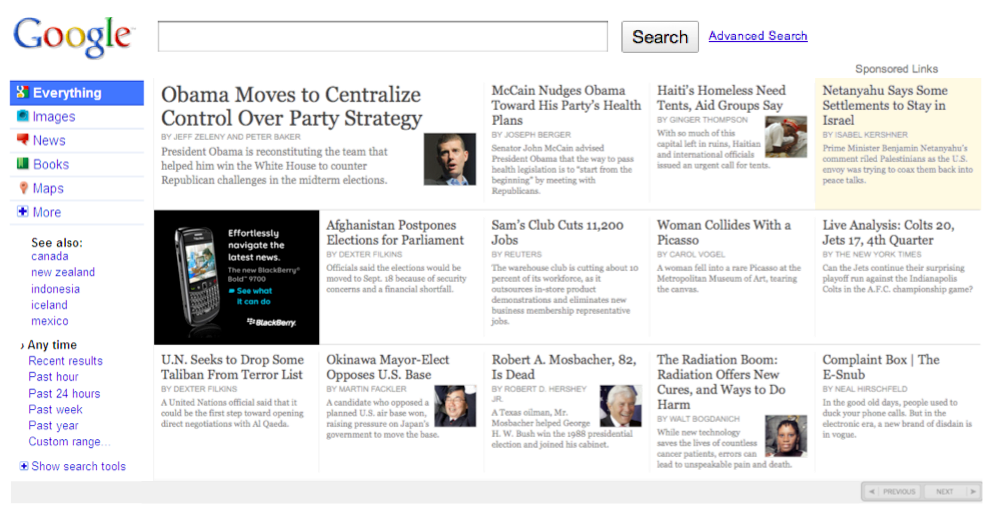
Here’s a quick Frankenstein of what Google 2.0 could look like using a bit of Google’s Jazz UI and the Times Skimmer.

Google 2.0 User Interface

One or all of these results or panes could update in real-time. Another could present a fully embedded video. Yet another could present thumbnails for image matches. The possibilities, while not endless, are numerous.

I’ve kept the left hand navigation, but you could just as easily do without it. In fact, that would better adhere to Google’s search motto: don’t make the user do something we can do for them.

Google Takes The Safe Route?

Of course, Google would need to determine how to present AdWords effectively in this environment. Perhaps the fear of disrupting AdWords revenue is why a major UI change isn’t in the cards. But this seems like a contradiction in how Google sets goals and measures success.

Achieving 65% of the impossible is better than 100% of the ordinary – Setting impossible goals and achieving part of them sets you on a completely different path than the safe route. Sometimes you can achieve the impossible in a quarter, but even when you don’t, you are on a fast track to achieving it soon. Measuring success every quarter allows for mid course corrections and setting higher goals for the next quarter.

Maybe Google has already tested radical new UI with unsatisfactory results. Or maybe Google is taking the safe route, thinking that the search interface can remain relatively static as the web transforms.

Is Google really doing enough to solve user interface jazz?

The Link Bubble

December 28 2009 // SEO // 6 Comments

The real estate bubble popped. Will the link bubble be next?

Link Bubble

The real estate bubble was the product of greed, low interest rates, loose lending policies and derivatives. Nearly anyone could get a house and people bought into the idea that real estate would always be a good investment. The result of this irrational exuberance? Homes were valued far more then they were worth.

The Link Bubble

Are links that different than real estate?

Links have traditionally been a reliable sign of trust and authority because they were given out judiciously, a lot like mortgages. For a long time link policies were tight. You needed references and documentation before you earned that link.

In addition, links weren’t looked upon as an investment tool. The concept that links influenced SEO hadn’t taken hold. The motivation behind links was relatively pure and that meant Google and others could rely on them as an accurate signal of quality.

Links or Content?

Many have recently bemoaned the death of hand crafted content and the rise of content farms as a threat to search quality. But is content really the problem?

Content has little innate value from a search perspective. Yes, search engines glean the content topic based on the text. It’s like knowing the street address of a house. You know where it is and, probably, a bit about the neighborhood. But it doesn’t tell you about the size, style or quality of the home.

Long tail searches are akin to searching for a house by street address. So, content without links may sometimes produce results. But the vast majority of searches will require more information. That’s where links come in.

McDonald’s Content

Lets switch analogies for a moment. Some have called Demand Media the McDonald’s of content. There’s a bit of brilliance in that comparison, but not in the way most think.

Both McDonald’s and Demand Media crank out product that many would argue is mediocre. Offline, McDonald’s buys the best real estate and uses low prices, brand equity and marketing to ensure diners select them over competitors.

Online, Google holds the prime real estate. But that real estate can’t be outright purchased. And in the absence of price, we’re left with brand equity and marketing. Online, brand equity translates into trust and authority. And links are the marketing that help build and maintain that brand equity.

Demand Media has brands (their words) that give it automatic trust and authority. Publish something on eHow and it automatically inherits the domain’s trust and authority, built on over 11 million backlinks.

Writers for Demand Media are provided revenue share opportunities on their articles. Here’s one of the tips they give to writers to boost traffic to their articles.

2) Link to your article from other websites.

Link from your own website or blog, from a message board or forum, from your social networking profile on MySpace or Facebook and more. The more high quality links to your article there are on the web, the more highly a search engine will rank it.

Demand Media combines the installed brand equity of multiple sites (which happen to be cross-linked) with an incentive to contributors to generate additional links. The content doesn’t have to be great when links secure premium online real estate.

There might be something better down the road, but McDonald’s is always right there at the corner.

Link Inflation

The last few years have produced major changes surrounding links. Linkbuilding is now a common term and strategy. A number of notable SEO firms tout links as the way to achieve success.

Linkbuilding firms sprung up. Linkbulding software of various shades of gray were launched. Paid links of various flavors flourished. Social bookmarking and networking accelerated link inflation. And new business models like Demand Media sprung up to take advantage of the link economy, creating a collection of sites and implementing incentives that result in something that resembles derivatives.

Link policies went from tight to loose and people got greedy. Anyone can get links these days. So what’s the natural result of this link activity?

Link Bubble Pops

Link Recession

The value of links is inflated and at some point the system will correct. The algorithm will change to address the abuse of links. Unlike The Federal Reserve, Google probably isn’t looking for a soft landing, nor are they going to extend a bailout.

Some links will continue to matter. Links that are in the right neighborhood. The ones with tree lined streets, good schools and low crime. But will links from cookie cutter planned communities still be valuable? Strong links will mean more because they’ll hold their value, while many more links will be neutralized.

I’m no Nouriel Roubini, but I do believe that a major link correction is coming in 2010. Google must address the link bubble to make search results better.

Google Brand Search Results

December 15 2009 // SEO // Comments Off on Google Brand Search Results

In late October Google launched a new type of search result for brand queries. Noted on Google Blogoscoped, a brand search result takes up an enormous amount of real estate and is composed of one regular listing and two indented listings.

When are brand search results shown?

The brand result is only triggered by certain queries. Oddly, it’s not just a brand name. Instead, it’s a brand name coupled with another keyword or keywords.

So, a search for ‘Peet’s’ will not trigger a brand result. But a search for ‘Peet’s Major Dickason’ will.

Google Brand Result

Is it really about brands?

Upon the launch of this new result it seemed like it was solely a function of what was in the domain. A search for ‘wooden bar stools’ triggered the new result.

Google Brand Result

Here, the domain of bar-stools-barstools.com triggered the new result when it matched the ‘brand + modifier’ query. A simple domain match against the keyword query, right?

Yet, when you search on this same term today you don’t get the new brand result.

Google wooden bar stools query

So what started as a simple domain match has evolved into something more refined. This isn’t capricious in nature. Google is always looking for ways to improve search quality. In this scenario they have weighted the actual brand or company site as more authoritative for a fairly large set of ‘brand + modifier’ queries.

What’s the criteria for Google brand search results?

How Google is doing this refinement is unclear. Some have surmised Google is using some sort of brand database or that it’s related to their DNS service.

I tend to believe there was some sort of initial criteria (broad in nature) for this new brand result with a built-in refinement mechanism. The refinement would be accomplished through analysis of user behavior on these results (e.g. – relative CTR and length of clicks), SearchWiki data or human editing.

User behavior might be difficult to mine since the large amount of real estate brand results take up likely make them click magnets. And click length might describe the value and quality of the site but not whether it merits the brand result presentation.

SearchWiki data and human editing are essentially the same concept, with the former being accomplished by a decentralized group of users (the proverbial cloud) and the latter being done by a centralized group of Google employees. Human editing doesn’t seem that far-fetched to me, particularly if Google used user behavior or SearchWiki data to identify domains for review. The result would be an easy and efficient review queue.

Why is Google interested in brands?

No matter how Google is doing it, the fact that they are is a signal that brands and companies provide a new proxy for trust and authority. The first step in this direction was the Vince change which unseated many highly optimized sites from root terms and replaced them with relevant brands or companies.

The current algorithm continues to struggle with trust and authority with 0ver-optimization reducing the value of on-page factors and the rise of link pollution quickly eroding the value of off-page factors.

Google brand search results show a continuing interest in moving beyond current signals to improve search quality and deliver better results. So while the new brand search result went largely unreported, it could be a harbinger of a larger algorithmic shift in 2010.

Google Search Innovation Accelerates

October 27 2009 // SEO // Comments Off on Google Search Innovation Accelerates

It’s not your imagination. Google’s rate of search innovation has accelerated. Google has marched through shopping Onebox enhancements (9/14), expanded forum listings (9/14), anchor based jump to and site links (9/25), Search Options expansion (10/1), Quick View PDFs (10/7), Twitter integration (10/21) and Social Search (10/26).

You could even include ancillary search innovations like Sidewiki (9/23) and fetch as Googlebot (10/12).

Gooogle Search

It’s been so fast that Google launched a series of weekly blog posts (This Week in Search) to keep up with the changes.

Pent Up Search Innovation?

For the past few years Google has stated in numerous venues that they didn’t particularly want to grow their share of the search market. They explained that extending their market share lead could incur the wrath of government oversight or create user backlash.

The jaded in the audience rolled their eyes and even the purists probably furrowed their brow. Sure, it makes a bit of sense but … really?

Yet, the timing of these recent search innovations is intriguing.

Bing Allows Google To Innovate

Microsoft’s latest dedication to search could be the reason for Google’s recent spate of search enhancements. Before Bing went live Google rolled out rich snippets, making Google last to the rich listings party. The preemptive move secured a certain search parity in the space.

That box checked off, Google sat back and watched as Bing innovated, advertised and finally partnered with Yahoo. Bing’s share began to inch up toward 10% and that seemed to be enough for the search behemoth to release the hounds engineers.

One gets the impression that projects that had once been stashed in a drawer were suddenly taken out, dusted off and quickly deployed.

What else does Google have in store for us?

SEO Judo

September 14 2009 // SEO // 2 Comments

SEO Judo

SEO Judo is used when you have a site or blog with content that hasn’t been optimized for search. When content isn’t created with keyword research as part of the process Google and other search engines define the relevant keywords for each page.

That’s where SEO Judo comes in handy.

What is SEO Judo?

First, let’s start with the meaning of Judo.

… it is the principle of using one’s opponent’s strength against him and adapting well to changing circumstances.

In the world of SEO the opponent is Google. Don’t misunderstand, Google isn’t evil. I don’t believe that Google has ulterior motives to each and every algorithm change. That’s not what I mean by opponent.

Instead I simply mean that when Google decides what a page is about it’s pretty difficult to change it’s mind. And the longer Google thinks a page is about a certain cluster of keywords the tougher it’ll be to convince Google otherwise.

Use Google’s Strength

Why fight Google? Instead, use their strength against them. If Google thinks a page is about a certain keyword and you’re currently ranked 5th for that term go ahead and optimize the page for that term and see if you can increase your rank and claim a greater amount of that traffic.

Sure you might look at the page and think that another keyword would be better, or you may look at a root keyword and get big saucer eyes with the amount of traffic you could get if you ranked for that term. But your opponent is strong. Very strong.

It will take a substantial effort and a fair amount of time to convince Google of new keyword targeting. Even then, you’re not guaranteed success. Instead, use SEO Judo and use Google’s momentum to reinforce what it already believes.

SEO Judo Example

Here’s an example of how to practice SEO Judo from my small Used Books Blog. In February I read and reviewed Erik Larson’s Devil and the White City. Using Google Analytics I can go and look at what keywords brought people to this page.

Devil in the White City Keywords

Even with the small volume you can quickly see a cluster of keywords around ‘devil in the white city quotes’. Performing this query on Google returns the page as the 11th result. Not bad!

Devil in the White City Quotes

In this case Google has ignored my meta description and created a snippet based on the text in the review. (More on this a bit later.) Clearly the Holy Trinity of SEO (title, meta description and URL) is not being optimized for the term ‘devil in the white city quotes’. But … it could.

Devil in the White City Quotes Optimized

With a bit of SEO Judo I can adapt to changing circumstances and use Google’s strength to my advantage. In a short amount of time I’d be a fixture on the first page for the term ‘devil in the white city quotes’.

When NOT to use SEO Judo

I wouldn’t use SEO Judo for the example I just used. Sure, I could, but to what purpose? The page doesn’t actually have any quotes from The Devil in the White City. (Thanks to the poor snippet algorithm.)

SEO isn’t just about traffic. Post Click SEO is the goal – getting the right traffic for your blog, site or business.

So only use SEO Judo if the keyword Google selects is actually good for your business. Remember, Google might be strong but it’s still not very smart.

When to use SEO Judo

SEO Judo should be used when you’ve given Google enough information to form an opinion. Google doesn’t need a whole lot, so this really means that the page must have a non-duplicative title and should have a keyword based URL.

In addition, the page must get enough SEO traffic so you can identify keyword clusters. If no one keyword phrase emerges, go back and optimize based on straight forward keyword research. If there are competing terms, you can again fall back on keyword research to select the best keyword target.

SEO Judo works best when you can create new content. Using the example above, I might change my review of Devil in the White City to include quotes, or I could create a new blog post specifically about quotes from Devil in the White City. Not only do I already understand Google’s appetite for this term, but I might finesse an indented listing by linking between the two posts.

This process is also useful if you’re pursuing a root keyword strategy. Instead of doing SEO Judo on the root keyword URL, you can use SEO Judo to create content for secondary terms that are firing on that root keyword content. This provides additional focus for the root keyword while building traffic on secondary terms.

Stop wearing yourself out trying to out-punch Google and instead use SEO Judo to throw Google to the mat.

Do AdWords Conversion Rates Vary by Position?

August 25 2009 // Advertising + Rant + SEM // 2 Comments

Last week the Google AdWords blog posted some ‘research’ conducted by Hal Varian, Chief Economist at Google, that stated that “conversion rates don’t vary much by position.”

Google Conversion Rate by Position Research

Do AdWords Conversion Rates Vary by Position?

My personal experience is that AdWords conversion rates DO vary by position. That’s not to say that I can’t be convinced otherwise, but I’ll need a lot more evidence then was provided in the blog post.

As a fundraiser many moons ago, my first instinct was to say that there would always be an inverse relationship between dollar amount and conversion rate. The lower the pledge amount, the higher the conversion rate.

Yet, I found that there wasn’t a tremendous difference between some giving levels. Conversion rates on $25 pledges weren’t substantially different from $100 pledges. However, that variance increased as you climbed up the solicitation ladder. Conversion rates for $500 pledges did vary materially from $25 pledges.

So, I’m not unwilling to be persuaded by real research and statistics that might contradict my anecdotal evidence. The problem is that the post didn’t link to the research to help validate the methodology or assumptions that led to this conclusion. Only a few variables are discussed, leaving a number of others open to interpretation or debate. It doesn’t help that one of the three links in the post goes to a 404 page.

How Did They Define Conversion?

That broken link … it was to the definition of conversion rate. Oddly, this is an important point. How did they define a conversion? Were only those conversions configured in AdWords included? Or did they pull from Analytics Goals as well? Essentially, we have no idea as to the universe of those who were included in this research, nor is there any mention as to what type of bias this might introduce.

Does the Type of Search Impact Conversion Rates?

Second, what type of searches were included? Given the differences in transactional versus informational queries one would believe that there might be a difference in conversion rates by position as well. An ad advertising a product (eCommerce or transactional) may exhibit different behavior as those advertising content (content or informational).

Does Query Length Impact Conversion Rates?

Blognation points out that an analysis of conversion by “token length” would be important.

Here’s a different way to think about the Google conversion rate data that I think would probably have a much different outcome. Do a conversion rate analysis by “token length”, which is search engine language for the number of words in a search query. If someone types in “baseball” for example, what’s the conversion rate differential between position #1 and position #10, versus a query for “buy Louisville slugger size 28 wooden baseball bat.”

I suspect that the conversion rate for the first query is going to be very low for the first position, simply because you are going to have a lot of browsers who simply click on the first ad that they see. Any browser who eventually makes it down to position #10’s result may very well have turned into an actual shopper after clicking on all the other ads. Conversely, if you already know the exact product you want – and your search query indicates that intent – you are much more likely to convert on the first ad you see that actually offers the specific product you want.

Related to this would be the conversion rate by position by match type. With so many advertisers unknowingly bidding solely on broad match, this type of analysis seems necessary and … useful!

Does CPC and Ad Category Impact Conversion Rates?

Finally, was this analysis performed to determine whether conversion rates by position remained constant depending on the average cost of the keyword? Could it not be true that different behavior could exist for a keyword with a $10 per click cost versus 10 cents?

Might different categories produce different conversion rates by position? Would the conversion rates for books, movies and music differ from long term care insurance? Could the number of competitors or volatility of a keyword impact the conversion rate by position?

Why Present AdWords Conversion Rate Research?

The presentation of this research without … the actual research makes me suspicious. What message is the AdWords team sending to advertisers? It seems to me that they’re encouraging advertisers to bid for the extra traffic received from higher ad positions. That advertisers can do so without negatively impacting their conversion rate and subsequent ROI.

Never mind that the higher CPC to achieve that extra traffic would reduce your margin. And that’s IF your conversion rate does remain the same. Should it not, you’ll pay a premium to obtain traffic that converts at a lower rate. So, who is this research advice really supposed to benefit?

Given the lack of supported evidence I can only rely on the experiences that I and my colleagues have had over numerous years. Experiential learning tells me to beware of monkey clicks, which do cause the top positions to have lower conversion rates.

I’m still willing to be convinced, but until something material is presented, this seems akin to evidence of the Loch Ness Monster. The cynic in me sees it as marketing copy meant to drive more advertiser dollars. I’d love for Google to prove me wrong.

Search Engines are Readers Too

June 11 2009 // Rant + SEO // 1 Comment

Last week David Risley wrote a blog post for Search Engine Journal that recommended that you forget all about SEO and write for readers, not search engines. His advice borders on dangerous, in part because some of it is accurate.

My recommendation is to write posts designed to help, provoke or inspire your reader.

That’s great advice. However, his definition of a reader is far too narrow.

Search Engines are Readers Too

Search Engines Are Readers Too

Future readers are searching for your content. They’re typing queries into Google right now. The search engine has read your blog and come to some conclusions about when and where to show your content.

SEO is about making it easy for the search engine to come to the right conclusions. It’s about ensuring that the content you write is displayed for the right searches.

Search engines are the gate keepers to the more than 15 billion searches performed in the US every month. They are powerful but they are not smart.

Welcome to Kindergarten

A search engine is like a blind five year old. They don’t care what your site looks like and they have the intelligence and attention span of an average five year old. This is why SEO is important and why you do need to write for search engines.

Search engine algorithms are tasked with trying to understand the value of an item of content. But they don’t really see the page and they don’t truly read the content either.

Search engines do not understand the text they are reading. You can’t sit them down after they read a blog post and ask them reading comprehension questions. They are not human, nor are they some super-advanced form of artificial intelligence.

This is why quality writing will not be enough.

Sit a five year old down in front of a Don DeLillo novel and they’ll quickly become bored and confused. The plain fact is that there are thousands of well written blogs that languish in the dark cobwebbed corners of the Internet.

Dumb and Dumber?

Dumb Down Content?

I know what you’re thinking. “Am I supposed to dumb down my writing for the lowest common denominator?” Yes and no.

Let’s cover no first. No, you should still write helpful, provoking and insightful content. It should be intelligent and have a point of view. The search engine does not require that you lose your personality.

However, that writing should be concise, well-structured and devoid of generalizations and logical assumptions. This will help all of your readers, search engines and humans alike.

So yes, you should write in such a way that, at a glance, a reader can understand and engage with your content. And to be fair, David Risley does actually provide some good direction on the structure of content and in covering the SEO Holy Trinity: Title, Meta Description and URL.

Good Writing + Social <> Links

Risley also understands that links are perhaps the most important part of SEO.

If you provide enough value, you’ll get people spreading your link across other blogs. You’ll go viral on Twitter. You’ll get people Digging your posts.

This works … for a small percentage of blogs in certain niches where the author has enormous amounts of free time. Does that sound like you? Probably not.

When was the last time you saw a serious blog post dealing with Alzheimer’s Disease reach Digg’s front page? Do you think a book review of David Mitchell’s Black Swan Green is going to get massive viral adoption on Twitter?

Rely on this technique as a way to optimize search engine traffic and you’ll be sorely disappointed. Social marketing is a piece of the puzzle but it is not a plug-and-play panacea for link building. If links were this easy to get, they wouldn’t be that important.

Search Traffic Creates Links

Get people to your blog through search engine traffic and let the same type of viral link building take place. The idea is to get your content matched to the right queries first, and not wait for social marketing to inform the search engine of your content value or for which queries it should be displayed.

Get the people who are naturally seeking out your content to do the link building. This way you are not constrained by the size of your social network, nor are you held hostage by the ephemeral ADD nature of social media.

Write for Search Engines

Write for search engines because it will benefit all of your readers. Subscribers will find more focused, accessible and valuable content that respects their time and new readers will locate your content with greater efficiency through their natural search patterns.

Writing styles adapt to their environment. Novels versus business writing. Haiku versus grant writing. So, come to to terms with the fact that good blog writing requires a different writing style. Embrace it and search engine and human readers will thank you.

Bling Search Engine

June 04 2009 // Humor + SEM + SEO // 1 Comment

Bling Search Engine

Since the launch of Microsoft’s Bing I’ve received traffic from ‘bling’ keywords: bling search engine, bling paid search, bling search real time.

Search is funny that way. A small misspelling by the user is matched to a variant of my blog name. The one letter difference between blind and bling seems big to a person but doesn’t amount to much for a search engine. It’s yet another example of my blind five year old theory on search engines.

Bling Search Engine

I don’t know, maybe they should have named it Bling.

Bling is catchy and has an established vernacular. They could have used all sorts of celebrity endorsements about needing to find their bling. I can see the tag line.

“Search for your Bling!”