— You Are At The Archives for the search Tag —

Post Click SEO

January 27 2009 // Marketing + SEO // Comments Off on Post Click SEO

post click seo

Should search engine optimization professionals be more involved in post-click marketing? Yes.

SEO shouldn’t end with the click. Getting the click is half the battle. What happens after that click is just as important. Post click marketing has taken off as more and more realize the need to optimize pages and conversion paths.

SEO should be leading the charge, not taking a back seat.

Post Click SEO

Keyword targeting adjustments are the first way in which SEO can influence post click marketing. What keywords are bringing users to the page and which of those keywords is performing best from a conversion perspective?

Decisions can be made to alter the keyword targeting of the page to optimize for the better performing keyword(s). Traffic may go down but the effective yield of that traffic may go up based on the higher conversion rate.

This process might also help identify areas for new content that better meet the needs of those arriving on poorly performing keywords.

Meta descriptions and titles are extremely valuable from a post click perspective because they can set expectations and even include a call to action. Optimizing solely for the keyword or keyword phrases in the meta description might not a) encourage clicks and b) may drive unqualified clicks.

Remember, search engine marketers are constantly testing new ad copy to increase click through rates and conversion. Search engine optimizers should do the same, using the larger canvass of meta description.

The meta description can even be used for promotional purposes. Changing the meta description on a product page to include an offer of free shipping will likely increase the click yield and, if the page matches their expectation, will continue to convert effectively.

On-site optimization in the form of keyword density, headers and even bold text can all have an impact on conversion. On-site SEO is about making the page easier to understand. While the initial audience for this optimization is a search engine, those same changes help everyday readers.

A highly descriptive header will help tell both the search engine and the reader what that page is about. H2s and H3s can help further explain the topic of that page. Again, both search engines and readers benefit.

Keyword density also increases the readability of a page. Here’s an example.

The procedure was a success and fully solved the patient’s condition.

This type of sentence might appear near the end of a descriptive paragraph. The writer probably referenced the procedure and condition beforehand and believes that the reader will fill in the blanks, turn generalizations into specifics and make the mental connections needed to gain comprehension. Search engines will do none of these things.

Instead, what if the sentence read as follows.

The stomach stapling procedure was a success and fully solved the patient’s obesity condition.

Changing generalizations to specifics and filling in the mental connections we make ensure that search engines and users immediately understand the content upon scanning the page. And people are scanning pages more than ever.

Don’t make your users do the work.

Post-click marketing and SEO

Companies that seek to maximize clicks in isolation and conversion in isolation will see results.  But those results will be less than what could have been obtained. Don’t be fooled by the false positive of this silo mentality.

Search engine optimization and post-click marketing should work in tandem to get the most out of every click.

Google Search Query Word Length

December 31 2008 // Humor + Technology // Comments Off on Google Search Query Word Length

How many words does it take to get to the end of a Google search query?

Tootsie Pop Owl

One

Two

Three

Four

Five

Six

Seven

Okay, I’ll spare you the tedium. The answer is 32 words!

Google Search Query Limit is 32 Words

I’m guessing this isn’t new but it just happened to catch my attention. It would have been far more interesting if they’d stopped at 42.

Yahoo Adds Ads To Alerts

December 26 2008 // Advertising + SEM // Comments Off on Yahoo Adds Ads To Alerts

Yahoo is serving ads at the top of email alerts.
Yahoo Ads In News Alerts

Most of my alerts are with Google, but a few of my legacy alerts still reside at Yahoo. So I’m not sure exactly when this began but it seems like it started as of December 1st.

Both search giants are looking for ways to sustain growth in a maturing market. Sponsored search and network search just aren’t going to move the needle in eyebrow arching ways anymore – particularly in a weak economic environment.

This is an interesting move by Yahoo in light of Google’s advertising extensions via Feedburner (FeedSense) and Google Friend Connect (FriendSense).

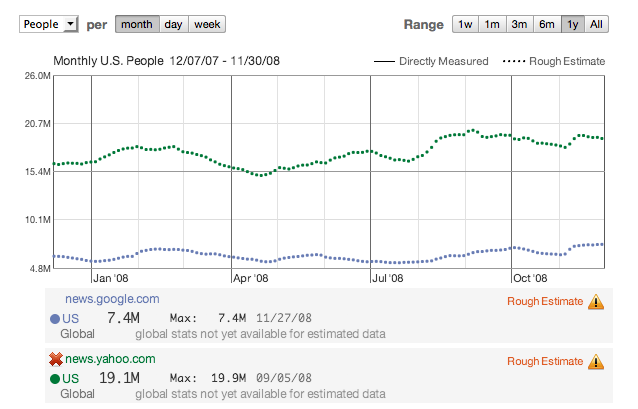
Remember, Yahoo still dominates news by a nearly 3 to 1 ratio. It’s nothing to sneeze at.

Yahoo News Versus Google News

If we use traffic as a proxy for number of alerts it’s easy to see how Yahoo could quickly increase its reach. Effectiveness, well that’s another issue.

But with this move by Yahoo, can AlertSense be far behind?

2009 Internet and Technology Predictions

December 23 2008 // Advertising + Marketing + SEM + SEO + Social Media + Technology // 9 Comments

Now is the time when bloggers go on the record with their thoughts for the year ahead. Place your bets! Stake your claim! Here’s mine.

Crystal Ball 2009 Predictions for Internet and Technology

Facebook Becomes A Portal

Realizing that social media and advertising is like oil and water, Facebook repositions itself as a portal leveraging Microsoft’s Live Search as the revenue model. This also might result in the potential acquisition of Netvibes to provide a more robust offering to compete with Yahoo!

Identity Systems Fail

Confused about the difference between OpenID, Facebook Connect and Google Friend Connect, users throw up their hands and decide not to use any of the above.

Video Advertising Succeeds

The adoption of video is surging faster than many expected. Longer formats and better quality will bring even more eyeballs who will grudgingly accept advertising.

Microformats Go Mainstream

Why they aren’t already is shocking. Nevertheless, in 2009 we’ll see microformats become a standard and search results will become far more robust as a result.

Banner CTR Becomes Obsolete

Brands will finally realize that measuring success by click through rate (CTR) isn’t working. Measurement ‘beyond clicks’ will be the new yardstick, whether that’s through new brand advertising measurement services like Vizu or through monitoring services like Brandwatch and Trackur among a gaggle of others.

RSS Adoption Spikes

Someone will (finally) figure out how to market RSS to ‘the masses’ who will grasp the sublime benefits of having content come to you instead of the other way around.

Kindle 2.0 Flops

Amid a weak economy Amazon releases the newest version of Kindle. Other readers have gained ground where Kindle has not and at the core Kindle is a solution without a problem.

Google Search Share Stalls

The move by Facebook (see above) causes a radical change in the search landscape. Microsoft passes Yahoo! for second place and talks about a Microsoft Yahoo merger are (unbearably) reignited.

FriendFeed Surpasses Twitter

FriendFeed adoption increases at an accelerated pace due to quick innovation, uncluttered design and an interface that lends itself to communication.

Someone ‘Dies’

Users reach social media overload and VCs get even more nervous about revenue creating social media shrinkage. In this instance ‘Dying’ means a company goes under or is purchased for a song. My short list includes Plurk, Twitter, Digg and Seesmic. This isn’t a reflection of the people or product but the inability to truly reach the mainstream with a service that has a profit model.

There are plenty of other things that I believe will happen in 2009, but they seem more obvious or an extension of current trends. Instead I tried to be a bit more bold, at least on a few of my predictions.

We’ll check in this time next year to see how I fared. In the meantime, feel free to comment and provide your feedback and reaction to my predictions.

Does Google Have Pac-Man Fever?

December 02 2008 // Humor + SEM + SEO + Technology // 2 Comments

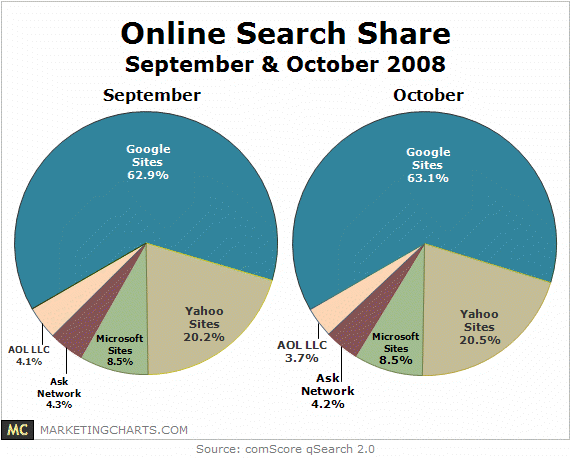
Google’s share of US searches continues to rise according to a recent comScore press release. In October 2008 Google led with 63.1% of all searches conducted. The resulting pie chart shows that Google is closing in on a Pac-Man like position in the search market.

It hasn’t been this way for that long though. Following is the historic comScore data I’ve cobbled together showing Google’s share of the search market.

October 2004: 34.8%
October 2005: 39.0%
October 2006: 45.4%
October 2007: 58.5%
October 2008: 63.1%

So, in five years the search market went from a dog fight to a laugher. If Google continues on this path the pie chart will take on true Pac-Man dimensions.

Now, I’m not sure who’s Inky, Blinky, Pinky or Clyde but Google certainly has the other search players on the run.

None of them seems to have the right medicine to reduce the Google fever that has swept the country. Acetaminophen (AOL), ibuprofen (Yahoo!), naproxen (Ask) and aspirin (MSN) have all failed to bring the temperature down. And upstart homeopathic remedies (Powerset, Cuil etc.) haven’t made a dent either.

Would mixing some of these medicines together help? Some Yahoo! and MSN with a dash of Powerset? Not likely. And in some cases mixing medicines can prove lethal.

SearchWiki Turns You Into Free Mechanical Turk

November 21 2008 // SEO + Technology // 1 Comment

Yesterday Google launched SearchWiki, a search feature that lets users customize search results by moving, deleting, adding and commenting on search results. The search algorithm will now have access to a set of aggregated human data. As I’ve written about before, the Google search algorithm will benefit from having a human feedback mechanism.

Google SearchWiki turns users into a free Mechanical Turk.

Not familiar with Amazon’s Mechanical Turk? Here’s a relevant excerpt from Wikipedia:

The Amazon Mechanical Turk (MTurk) is one of the suite of Amazon Web Services, a crowdsourcing marketplace that enables computer programs to co-ordinate the use of human intelligence to perform tasks which computers are unable to do.

Now, clearly the search algorithm is able to produce search results. However, the algorithm still isn’t very smart. SearchWiki lets the algorithm learn as humans move, delete and add results for specific search queries.

While Google clearly states that your specific changes will not be seen by others, it seems impossible to think that Google won’t use that information to influence search results over time. Not convinced? SEO by the Sea reviews a recent Google patent that points to Google’s continuing goal of leveraging more data and behavior into search results.

Google has been experimenting with something like this for some time and finally seems ready for prime time. This also means the flirtation with Digg is likely done for good unless abuse by SEO practitioners overwhelms the signal.

How do SEO gurus react to SearchWiki?

If you employ a short term chase the algorithm type of SEO you’re seeing a threat and an opportunity. The threat is that the human feedback mechanism could help to curb over-optimization and subtle gaming. However, it also provides an opportunity to create a SearchWiki army that could coordinate changes to specific search results. The worst case scenario is that people are paid to delete, add or move certain results for specific searches.

I’m not saying SearchWiki is a bad thing. But make no mistake, Google is using it as a free way to make their core product better.

Search Pogosticking and SEO

November 14 2008 // SEO + Technology // 19 Comments

Search pogosticking is defined as going back and forth from a search engine results page (SERP) to individual search result destination sites. The behavior may indicate poor search results since the user hasn’t been satisfied by one or more of the SERP results.

Google and Yahoo are clearly using, or thinking about using, this metric as part of their search algorithm. It makes a lot of sense and could provide an important user-defined input for the algorithm as well as guard against potential over-optimization. As an aside, access to this human feedback mechanism may be one of the reasons why Google hasn’t been eager to pay a premium for Digg.

How would search pogosticking influence SEO?

A user is presented with search results based on a specific query. The engine captures what result you click on and whether you return to that SERP and click on subsequent results and/or refine your query. (They could even conceivably determine the time between each click as a proxy for satisfaction with that result. This would reduce the chances of penalizing results that did deliver value.) The information can be aggregated for each query and compared to average pogosticking behavior by SERP rank.

So, let’s say that for a specific query the engine sees that the current SERP has an abnormally high pogostick rate for the top ranked result. This information could then be fed back into the algorithm as a negative signal, thereby reducing its SERP rank in a future algorithm update. Obviously, it would have to be statistically above the average pogostick rate for that position to be flagged. However, I’m certain both Google and Yahoo have smart folks who can calculate when it reaches significance.

Does search pogosticking sound far fetched?

It shouldn’t. Do a Google search and look at the page source. You’ll see something like the following next to each search result.

onmousedown="return rwt(this,'','','res','1'

The ‘res’ likely stands for result and the next parameter is the actual rank for that result on that page. More information on this rewrite and tracking behavior can be found at searchlores and blogmal.

Even without this technical knowledge it should be obvious they’re doing something like this if they’re providing users with customized search results. I’m not sure the ability to provide custom or personalized results is the true aim, but makes the collection of this information more palatable for many users.

SEO by the Sea recently posted about this topic including a relevant pogosticking patent application by Yahoo. I recommend you read his post as well.

How can I track pogosticking?

You can’t know for sure whether a user is pogosticking. Bounce rate can sometimes be a good indication, but there are instances where query intent is satisfied and a high bounce rate is the expected result. Many Q&A sites meet this criteria.

The best course of action is to review pages with high bounce rates and make certain you’re matching query intent and delivering value to those users. Post-click SEO is going to become a larger part of the equation, bluring the line between SEO and traditional design and UI.

Chrome is about Search

September 26 2008 // Marketing + Technology // 2 Comments

Google Chrome LogoThere’s a lot of talk (very good analysis actually) about Chrome in terms of functionality and technology. Sure, what’s under the hood is interesting and I’m intrigued by the speed tests. Yet, at the end of the day, I believe Chrome is really all about search.

Let’s first look at two core components that were absent from the launch. There are no add-ons and there is no Mac version. This tells me that the competitive target is not Firefox or Safari. It tells me that Chrome is aimed at converting more WIndows/IE users to Windows/Chrome users. (Yes, yes, it has an open API but that’s different then supporting add-ons a la Firefox.)

Next let’s look at how they’re marketing Chrome.

Google Chrome is a browser that combines a minimal design with sophisticated technology to make the web faster, safer, and easier.

One box for everything
Type in the address bar and get suggestions for both search and web pages.

Thumbnails of your top sites
Access your favorite pages instantly with lightning speed from any new tab.

Shortcuts for your apps
Get desktop shortcuts to launch your favorite web applications.

Faster. Safer. Easier. One box for everything. Shortcuts. I believe the messaging is aimed not at the early adopter but at the early majority instead. While the technology is sophisticated, the end product is simplistic.

A legion of folks exist out there who don’t even know they have a choice in how they surf the Internet. People aren’t going to be easily swayed by a relatively unknown brand like Firefox. But Google? Hey now, they know Google. They trust Google. They use Google!

Sure they can import their settings, but how many of them will and how many of them even knew about their settings in the first place? Google has disrupted inertia and created an artificial switching window. During this critical time, I believe more will choose to use Google as their default search engine. There is a subtle psychological pressure exerted by using Google’s browser that will encourage users to use Google as their search engine.

One could argue that many of these same users already use Google. And that’s true. But they’re also confused about exactly what to do when they want to search or go to a website. Remember that the top search terms in August were ebay and myspace. So these people could be accidentally using IE’s default search engine from time to time.

And that’s where the omnibox (aka ‘the god box’) comes in. Chrome’s one box for everything appeals to the same user who is confused about when they search and when they type in a website address. If my supposition above is correct, then Google suddenly has far more control over searches and, even more far reaching, directing users to specific destinations.

Google Chrome is about taking more of the search market away from Microsoft and Yahoo. As such, it is one of the few Google initiatives that I believe is perfectly aligned with their core business.