— You Are At The Archives for the google Tag —

Twitter is not a Google competitor

February 15 2009 // SEO + Social Media + Technology // 3 Comments

Twitter search is a great feature but it in no way threatens Google’s dominance in search.

Recency does not equal relevance

The major flaw of using Twitter as a search engine is that recent tweets on a subject do not equal relevance on that subject. This should be obvious but lets do a few searches to illustrate the point. I’ll use searches that appeared in the top 100 from the Google Hot Trends list at some point on February 15, 2009.

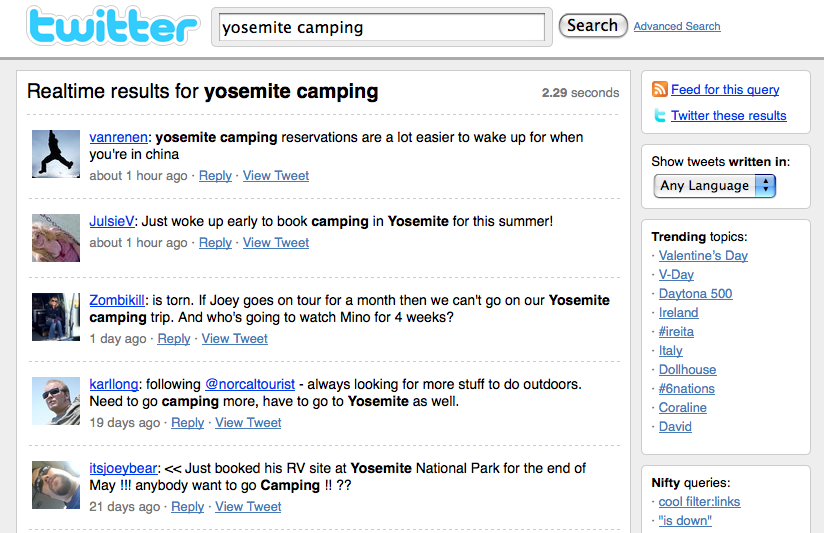
Yosemite Camping
yosemite camping twitter search

yosemite camping google search

Which of the results best satisfies the query? Without question it’s Google. Let’s try another.

Daytona 500 Pace Car
daytona 500 pace car search on twitter

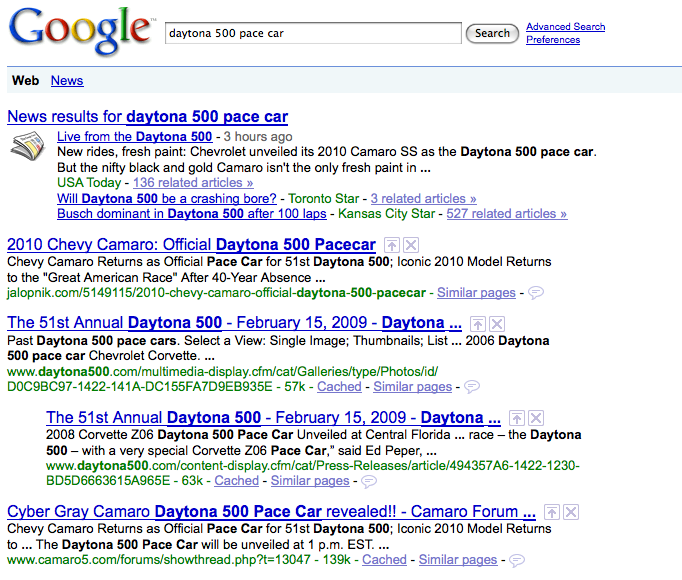
daytona 500 pace car search on google

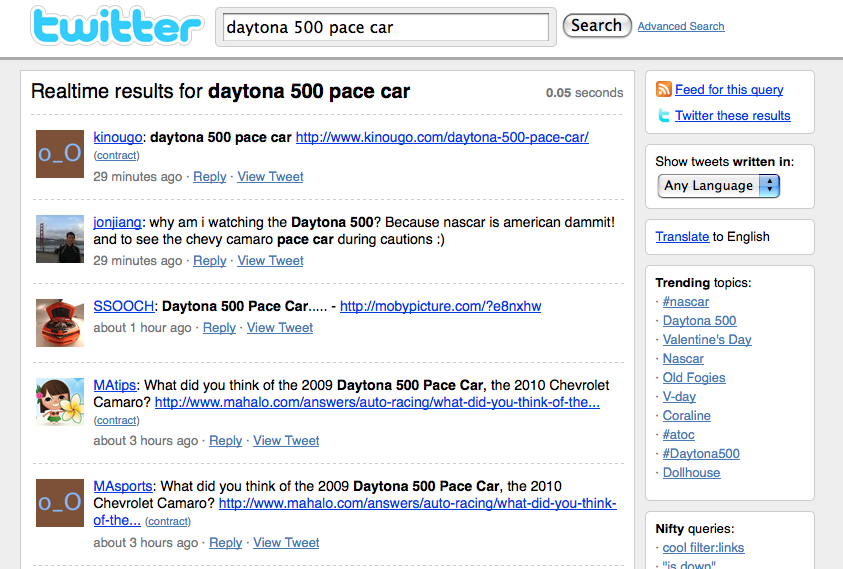
In this instance both provide the answer. The Daytona 500 Pace Car is a 2010 Chevy Camaro. The Google result tells me it’s black and gold and gives me plenty of authority sites to visit.

Twitter on the other hand doesn’t provide this level of detail. In addition, two of the five results are from Mahalo and a third is from kinougo. More on ‘him’ later. For now lets try one last search.

Crayola Factory
crayola factory search on twitter

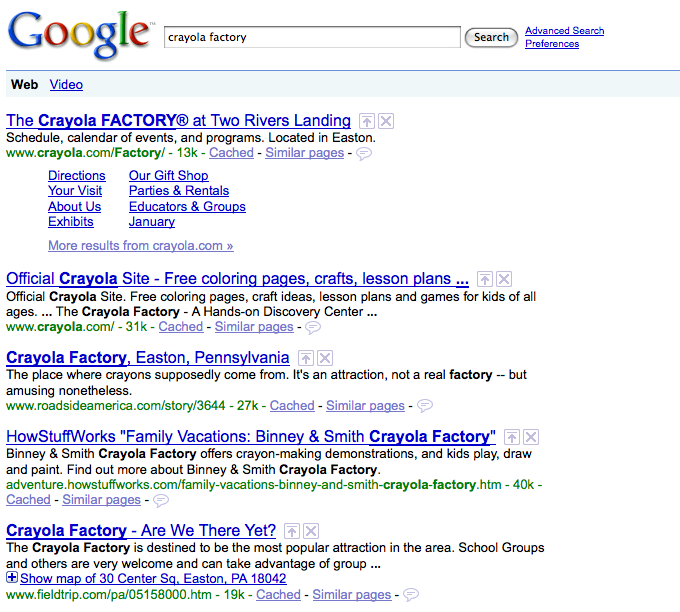
crayola factory search on google

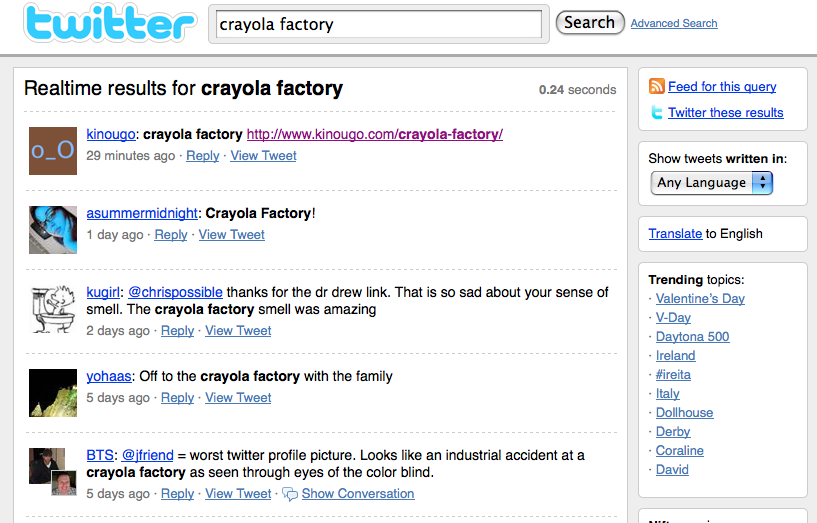
Hands down Google satisfies this query better than Twitter. The only link available is, again, from our friend kinougo. So who is kinougo?

kinougo twitter profile

Essentially auto generated Tweets based on hot searches. But where do they lead?

daytona 500 pace car on kinougo

Look at that! An API based link farm with Google AdSense as the revenue source. That looks … awful!

Twitter would have been a near complete bust if it were not for Mahalo and kinougo. Yet, these sites are simply exploiting Twitter search, not contributing to it in a natural way. I doubt the user experience on these clicks would reinforce the idea that Twitter was the place to search. Probably the exact opposite.

Recency works only for hyper real-time events: earthquakes, Presidential debates and conferences to name a few. (Sidenote: There’s this other site called FriendFeed which actually did a bang up job on real-time commentary on the Presidential debates.)

Authority is nonexistent

What makes anyone believe that the latest 5 or 10 tweets on a subject are at all authoritative! Twitter has no mechanism to determine what is the best result for a given query other than the Tweets from their users in a very short time span. Do you trust the random users of Twitter that much? I don’t and neither does Google.

The Google algorithm tries to present the most authoritative, the most right, the most useful results, not just johnny-come-lately blog posts and certainly not some 140 character missive. They might not always get it right, but they’re trying … hard.

Duplication is a problem
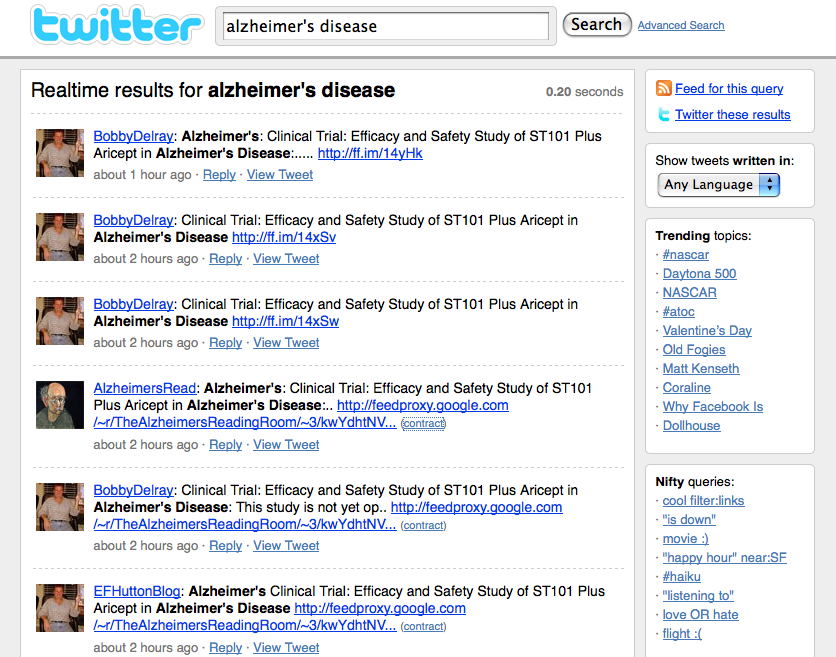
alzheimer's disease twitter search

Twitter doesn’t handle duplicate results, opening itself up for SPAM both real and unintentional. Even for the hyper real-time events how many times do you need to see the same quote over and over again?

Twitter is not a Google competitor

Relevance, authority and duplication all ensure that Twitter is not, and likely never will be, a Google competitor. At best Twitter could provide supplemental information to a real search engine. Twitter is the crawl at the bottom of a cable news channel.

“I just ate a mango” isn’t going to disrupt the search world.

The Worst Site in the Best Neighborhood

January 22 2009 // SEO // Comments Off on The Worst Site in the Best Neighborhood

You’ve heard the old real estate adage to buy the worst house in the best neighborhood. Well, the same is true on the Internet.

You want to be the worst site in the best neighborhood.

Worst House In The Best Neighborhood

Let me explain.

Google tries very hard to understand what a site is about. One of the primary ways it does this is by looking at who links to you and who you link to. These links are essentially your neighbors and collectively they make up your neighborhood.

The quality of your neighbors matters. Not so much in terms of Page Rank, though that doesn’t hurt, but by the topic of these sites. If your site is about surfing you’ll want links from surfing blogs, famous surfers, surf competition sites (like Mavericks), surf equipment retailers and even a tide table. Do this and Google will quickly understand which neighborhood you belong to and begin to rank you accordingly for relevant search terms.

But what if you get links from a Victorian antique dealer, a florist, a Bridget Fonda fan page and a Pachinko repair site. Now, perhaps all of these sites linked to you because they like surfing but … Google will be confused. (Remember, a search engine is like blind five year old.) It will have a difficult time knowing which neighborhood to put you in.

Google probably likes tract housing.

You know, the kind where all the houses in a neighborhood look nearly the same. Oh, the paint might be a bit different, and there might be three different floor plans, but the overall effect is that they’re alike. Make sure Google knows what your ‘house’ looks like so it can put you in the proper neighborhood.

This is why quality link building is so important. Because the only other way to establish yourself is through global link popularity or quantity link building.

No, I’m not telling you to aspire to be the worst.

New Kids on the Block

But when you start out you’re going to be the new site on the block. You have no ‘street cred’, no ‘Google juice’. You need to move into the best neighborhood by getting links from those sites within that neighborhood, the more authoritative and popular the better.

Over time you’ll paint the place, put in hardwood floors, remodel the kitchen, trim back the hedges and put on an addition. You’re building sweat equity and the value of your site will grow. If you’re doing it right, you won’t be the worst for long.

But in the beginning you’ll be the worst site in the best neighborhood … and that will be just fine.

Photo credit: Shilashon

Google Search Query Word Length

December 31 2008 // Humor + Technology // Comments Off on Google Search Query Word Length

How many words does it take to get to the end of a Google search query?

Tootsie Pop Owl

One

Two

Three

Four

Five

Six

Seven

Okay, I’ll spare you the tedium. The answer is 32 words!

Google Search Query Limit is 32 Words

I’m guessing this isn’t new but it just happened to catch my attention. It would have been far more interesting if they’d stopped at 42.

Yahoo Adds Ads To Alerts

December 26 2008 // Advertising + SEM // Comments Off on Yahoo Adds Ads To Alerts

Yahoo is serving ads at the top of email alerts.
Yahoo Ads In News Alerts

Most of my alerts are with Google, but a few of my legacy alerts still reside at Yahoo. So I’m not sure exactly when this began but it seems like it started as of December 1st.

Both search giants are looking for ways to sustain growth in a maturing market. Sponsored search and network search just aren’t going to move the needle in eyebrow arching ways anymore – particularly in a weak economic environment.

This is an interesting move by Yahoo in light of Google’s advertising extensions via Feedburner (FeedSense) and Google Friend Connect (FriendSense).

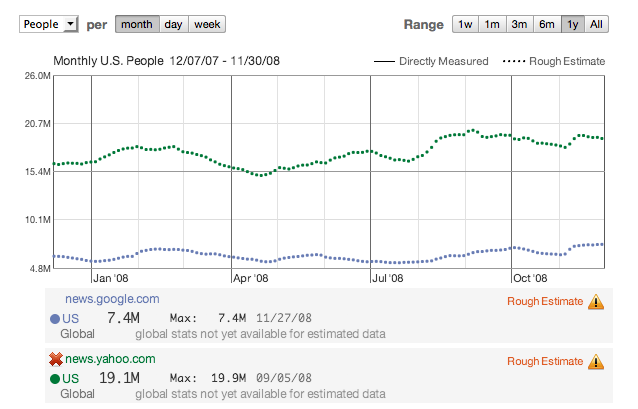
Remember, Yahoo still dominates news by a nearly 3 to 1 ratio. It’s nothing to sneeze at.

Yahoo News Versus Google News

If we use traffic as a proxy for number of alerts it’s easy to see how Yahoo could quickly increase its reach. Effectiveness, well that’s another issue.

But with this move by Yahoo, can AlertSense be far behind?

2009 Internet and Technology Predictions

December 23 2008 // Advertising + Marketing + SEM + SEO + Social Media + Technology // 9 Comments

Now is the time when bloggers go on the record with their thoughts for the year ahead. Place your bets! Stake your claim! Here’s mine.

Crystal Ball 2009 Predictions for Internet and Technology

Facebook Becomes A Portal

Realizing that social media and advertising is like oil and water, Facebook repositions itself as a portal leveraging Microsoft’s Live Search as the revenue model. This also might result in the potential acquisition of Netvibes to provide a more robust offering to compete with Yahoo!

Identity Systems Fail

Confused about the difference between OpenID, Facebook Connect and Google Friend Connect, users throw up their hands and decide not to use any of the above.

Video Advertising Succeeds

The adoption of video is surging faster than many expected. Longer formats and better quality will bring even more eyeballs who will grudgingly accept advertising.

Microformats Go Mainstream

Why they aren’t already is shocking. Nevertheless, in 2009 we’ll see microformats become a standard and search results will become far more robust as a result.

Banner CTR Becomes Obsolete

Brands will finally realize that measuring success by click through rate (CTR) isn’t working. Measurement ‘beyond clicks’ will be the new yardstick, whether that’s through new brand advertising measurement services like Vizu or through monitoring services like Brandwatch and Trackur among a gaggle of others.

RSS Adoption Spikes

Someone will (finally) figure out how to market RSS to ‘the masses’ who will grasp the sublime benefits of having content come to you instead of the other way around.

Kindle 2.0 Flops

Amid a weak economy Amazon releases the newest version of Kindle. Other readers have gained ground where Kindle has not and at the core Kindle is a solution without a problem.

Google Search Share Stalls

The move by Facebook (see above) causes a radical change in the search landscape. Microsoft passes Yahoo! for second place and talks about a Microsoft Yahoo merger are (unbearably) reignited.

FriendFeed Surpasses Twitter

FriendFeed adoption increases at an accelerated pace due to quick innovation, uncluttered design and an interface that lends itself to communication.

Someone ‘Dies’

Users reach social media overload and VCs get even more nervous about revenue creating social media shrinkage. In this instance ‘Dying’ means a company goes under or is purchased for a song. My short list includes Plurk, Twitter, Digg and Seesmic. This isn’t a reflection of the people or product but the inability to truly reach the mainstream with a service that has a profit model.

There are plenty of other things that I believe will happen in 2009, but they seem more obvious or an extension of current trends. Instead I tried to be a bit more bold, at least on a few of my predictions.

We’ll check in this time next year to see how I fared. In the meantime, feel free to comment and provide your feedback and reaction to my predictions.

Martini. Straight Up. Three Keywords.

December 09 2008 // SEM // Comments Off on Martini. Straight Up. Three Keywords.

Yesterday, Google updated the AdWords alcohol policy to loosen restrictions on hard alcohol and liqueurs.

… in response to advertiser feedback we’ve received over the years, we’ll permit the advertisement of hard alcohol and liqueurs that target the U.S.

It’s not as straight forward as the beer related policy though. You can’t outright sell Bombay Sapphire. Instead you have to play a bit of semantic dodge ball.

To comply with the updated hard alcohol and liqueurs policy, advertisers must promote the information about hard alcohol and liqueurs that their websites contain, such as recipes and brand messages.

For example, under the hard alcohol and liqueurs policy, you might market to individuals searching for helpful and relevant alcohol-related information by promoting holiday cocktail ideas or the caloric content of popular spiked beverages.

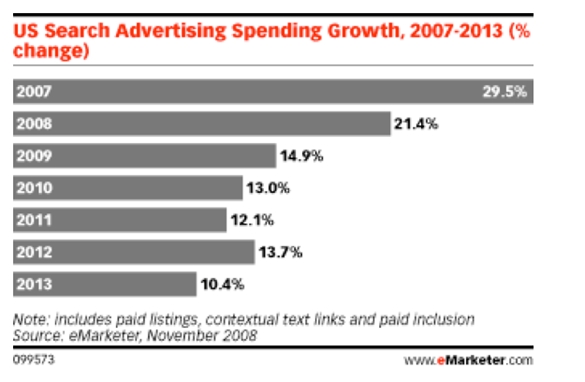
Google isn’t doing this simply to appease advertisers. Feedback wasn’t the motivating factor, not by a long shot. Google is looking to boost revenue for a maturing product in an increasingly tight economic environment. Growth in paid search is projected to slow according to eMarketer.

A recent Citi Investment Research report from Mark Mahaney had this to say after attending the Search Insider Summit.

Q1 And 2009 Could Be Materially Challenged – We sensed specific nervousness about the Q1 outlook and the possibility that Q1 could actually be the real inflection point quarter – i.e. the first negative sequential growth quarter ever for Search. We also interpret recent statements by GOOG execs and company actions as an acknowledgement of this material challenge.

As search matures, Google realizes they’ll need to do more to achieve substantial growth. Alcohol is clearly a vertical with lots of pent up ad dollars. It’s a smart move by Google.

Hey, we all might need a drink the way things are going. Google’s just making sure it cashes in when we do.

TweetSense

December 09 2008 // Advertising + Social Media // Comments Off on TweetSense

Does TweetSense make sense? And more importantly would it make cents?

Twits have been up in arms with the introduction of Twitter based ad networks like twitAD and Magpie. Magpie in particular drew a lot of coverage with notables like Mark ‘Rizzn’ Hopkins at Mashable and Michael Arrington at TechCrunch weighing in on the topic. Many claimed that it was outright spam that had no place on Twitter. Lots of huffing and stamping of feet. They’d unfollow anyone they saw using such a service!

I’m not opposed to this type of monetization if it’s implemented well.

The fact is, are you really going to notice? If you’re that attached to Twitter you probably use the service quite a bit. You follow a lot of people. Many are very active. The odds that you’re going to see an advertising tweet are quite low and if you did it would be gone from your existence in a matter of minutes.

Advertising tweets would be very ephemeral.

So, that begs the question: will these Twitter based ad networks be effective? Will people click on them enough to make it a viable advertising platform? They will if it’s done right.

Spare me the ‘nobody clicks on those things’ type of indignation. There’s this company called Google. They have these products called AdWords and AdSense. Both seem to be doing just fine even though many say they’ve never clicked on either type of ad unit.

The implementation will be paramount. They’ll fail if the ads become too frequent, overwhelming tweet streams for users. Essentially, if the noise drowns out the signal, it will fail. They’ll also fail if the ad content isn’t relevant. Viagra ad tweets mixed in with a discussion about Motrin Moms isn’t going fly.

The frequency and context of advertising tweets are critical to the success of this type of ad network. So, who is in the best position to pull this off?

Twitter!

Twitter knows your tweet velocity. Twitter has the ability to create dynamic tags for users based on keyword frequency analysis. As such, it is best placed to deliver timely and relevant tweets to their users. By doing so it would also remove the potential abuse of the service by those seeking personal, monetary gain.

Block the third party ad networks! With Twitter at the controls, the odds of success (for both users, advertisers and Twitter) go up, way up.

Twitter does need a revenue model. So why not TweetSense?

Google Taxonomic Search And SEO Affirmative Action

December 04 2008 // SEO // 4 Comments

There are rumors that Google is applying taxonomic limits to specific searches, usually surrounding products or brands.

When I first heard these rumors I dismissed the idea. Even if Google created a taxonomy of sites, I couldn’t see them using that data as part of the search algorithm. But I quickly began to see that Google likely has a robust taxonomy and could relatively easily use it as a signal within the algorithm.

Does Google have a taxonomy of websites?

Yes. It already displays this taxonomy via the AdWords placement targeting interface.

The real question is whether Google has attached a taxonomic classification to sites outside of the AdSense network? I’d guess that it may not be comprehensive, but that it includes sites that meet some quality threshold, potentially Page Rank.

Why would Google use a taxonomic signal in search?

Lets start with the idea that Google wants to ensure they deliver the best set of results to users. Would a product related SERP that contained more than five shopping comparison sites be the best result set? How about forums? Or blogs? Or retail sites?

Think about it. If you searched for ‘casio exilim’ would you want a SERP that had Walmart, Circuit City, Office Depot, Ritz Camera, Best Buy, Target and eBay? Similarly, would you want one that had PriceGrabber, BizRate, Buzzillions, Yahoo! Shopping, PriceRunner and NexTag?

I’m guessing that most of the time the natural ebb and flow of the algorithm works out and the results are a nice mixture of these different types of sites. But sometimes one type of site might be better optimized for a term and the type of taxonomic overload above might occur.

How would Google implement a taxonomic search signal?

At first the idea of using a taxonomic parameter in search sounded tough. Yet again, I quickly surmised that it might be more straightforward than I thought.

Wouldn’t you simply enter some logic that made it slightly more difficult for a site of the same taxonomic classification to rank for a query if there was already one ranked higher? The difficulty would increase based on the number of sites in the same taxonomic classification for a query. So, if two shopping comparison sites were already ranked, it would be far tougher for the third and even more so for the fourth.

It’s essentially a smoothing mechanism that gives slightly more opportunity to sites in another taxonomic classification to rank for a query that they might be shut out of otherwise.

A taxonomic limiter would be a safeguard mechanism and perhaps serve as an over-optimization trigger.

What does a taxonomic search signal mean for SEO?

A taxonomic search signal would be a bit like affirmative action for SEO, giving lesser optimized sites a leg up on the competition. It also means greater SERP volatility as sites within one taxonomic class swap positions.

For instance, two sites in the same taxonomic class could be very close and should be ranked 1st and 2nd, but because of the taxonomic limiter are ranked 1st and 5th. If the second site eclipses the first, it would immediately be ranked 1st since the limiter wouldn’t apply. Consequently, the first site would drop, likely to 4th or 5th because the limiter is now being applied.

Is Google really using a taxonomic search signal?

Maybe. While the idea makes sense, the changes some are seeing could instead be caused by one of the numerous algorithm tweaks. But the tools to measure and monitor SEO strength are getting better. Companies can monitor their rank consistently over time and identify when things go sideways. Sometimes the changes don’t make a whole lot of sense and that’s when these types of theories and rumors are born.

What do you think? Is Google using a taxonomic search signal and limiter in search results?

Does Google Have Pac-Man Fever?

December 02 2008 // Humor + SEM + SEO + Technology // 2 Comments

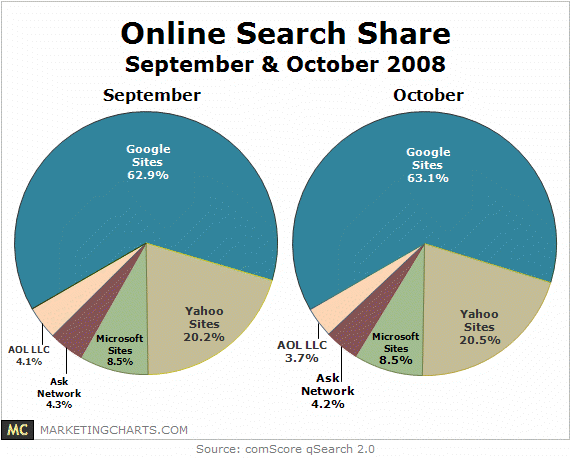
Google’s share of US searches continues to rise according to a recent comScore press release. In October 2008 Google led with 63.1% of all searches conducted. The resulting pie chart shows that Google is closing in on a Pac-Man like position in the search market.

It hasn’t been this way for that long though. Following is the historic comScore data I’ve cobbled together showing Google’s share of the search market.

October 2004: 34.8%
October 2005: 39.0%
October 2006: 45.4%
October 2007: 58.5%
October 2008: 63.1%

So, in five years the search market went from a dog fight to a laugher. If Google continues on this path the pie chart will take on true Pac-Man dimensions.

Now, I’m not sure who’s Inky, Blinky, Pinky or Clyde but Google certainly has the other search players on the run.

None of them seems to have the right medicine to reduce the Google fever that has swept the country. Acetaminophen (AOL), ibuprofen (Yahoo!), naproxen (Ask) and aspirin (MSN) have all failed to bring the temperature down. And upstart homeopathic remedies (Powerset, Cuil etc.) haven’t made a dent either.

Would mixing some of these medicines together help? Some Yahoo! and MSN with a dash of Powerset? Not likely. And in some cases mixing medicines can prove lethal.

SearchWiki Turns You Into Free Mechanical Turk

November 21 2008 // SEO + Technology // 1 Comment

Yesterday Google launched SearchWiki, a search feature that lets users customize search results by moving, deleting, adding and commenting on search results. The search algorithm will now have access to a set of aggregated human data. As I’ve written about before, the Google search algorithm will benefit from having a human feedback mechanism.

Google SearchWiki turns users into a free Mechanical Turk.

Not familiar with Amazon’s Mechanical Turk? Here’s a relevant excerpt from Wikipedia:

The Amazon Mechanical Turk (MTurk) is one of the suite of Amazon Web Services, a crowdsourcing marketplace that enables computer programs to co-ordinate the use of human intelligence to perform tasks which computers are unable to do.

Now, clearly the search algorithm is able to produce search results. However, the algorithm still isn’t very smart. SearchWiki lets the algorithm learn as humans move, delete and add results for specific search queries.

While Google clearly states that your specific changes will not be seen by others, it seems impossible to think that Google won’t use that information to influence search results over time. Not convinced? SEO by the Sea reviews a recent Google patent that points to Google’s continuing goal of leveraging more data and behavior into search results.

Google has been experimenting with something like this for some time and finally seems ready for prime time. This also means the flirtation with Digg is likely done for good unless abuse by SEO practitioners overwhelms the signal.

How do SEO gurus react to SearchWiki?

If you employ a short term chase the algorithm type of SEO you’re seeing a threat and an opportunity. The threat is that the human feedback mechanism could help to curb over-optimization and subtle gaming. However, it also provides an opportunity to create a SearchWiki army that could coordinate changes to specific search results. The worst case scenario is that people are paid to delete, add or move certain results for specific searches.

I’m not saying SearchWiki is a bad thing. But make no mistake, Google is using it as a free way to make their core product better.