— You Are At The Archives for the google Tag —

Search Pogosticking and SEO

November 14 2008 // SEO + Technology // 19 Comments

Search pogosticking is defined as going back and forth from a search engine results page (SERP) to individual search result destination sites. The behavior may indicate poor search results since the user hasn’t been satisfied by one or more of the SERP results.

Google and Yahoo are clearly using, or thinking about using, this metric as part of their search algorithm. It makes a lot of sense and could provide an important user-defined input for the algorithm as well as guard against potential over-optimization. As an aside, access to this human feedback mechanism may be one of the reasons why Google hasn’t been eager to pay a premium for Digg.

How would search pogosticking influence SEO?

A user is presented with search results based on a specific query. The engine captures what result you click on and whether you return to that SERP and click on subsequent results and/or refine your query. (They could even conceivably determine the time between each click as a proxy for satisfaction with that result. This would reduce the chances of penalizing results that did deliver value.) The information can be aggregated for each query and compared to average pogosticking behavior by SERP rank.

So, let’s say that for a specific query the engine sees that the current SERP has an abnormally high pogostick rate for the top ranked result. This information could then be fed back into the algorithm as a negative signal, thereby reducing its SERP rank in a future algorithm update. Obviously, it would have to be statistically above the average pogostick rate for that position to be flagged. However, I’m certain both Google and Yahoo have smart folks who can calculate when it reaches significance.

Does search pogosticking sound far fetched?

It shouldn’t. Do a Google search and look at the page source. You’ll see something like the following next to each search result.

onmousedown="return rwt(this,'','','res','1'

The ‘res’ likely stands for result and the next parameter is the actual rank for that result on that page. More information on this rewrite and tracking behavior can be found at searchlores and blogmal.

Even without this technical knowledge it should be obvious they’re doing something like this if they’re providing users with customized search results. I’m not sure the ability to provide custom or personalized results is the true aim, but makes the collection of this information more palatable for many users.

SEO by the Sea recently posted about this topic including a relevant pogosticking patent application by Yahoo. I recommend you read his post as well.

How can I track pogosticking?

You can’t know for sure whether a user is pogosticking. Bounce rate can sometimes be a good indication, but there are instances where query intent is satisfied and a high bounce rate is the expected result. Many Q&A sites meet this criteria.

The best course of action is to review pages with high bounce rates and make certain you’re matching query intent and delivering value to those users. Post-click SEO is going to become a larger part of the equation, bluring the line between SEO and traditional design and UI.

SEO Success By A Thousand Optimizations

November 05 2008 // SEO // 1 Comment

Google has been quoted as saying that their search algorithm takes into account over 200 signals (or variables) to determine the ranking of a page for a given query. This isn’t really news to anyone who has been paying attention but it should change how many approach search engine optimization (SEO).

Of course some of the 200 signals are weighted more heavily than others, but Google can twist the knob up or down on each of these to dial in what they believe are the most relevant results. As such, concentrating on a short list of critical search engine optimization components will only get you so far.

Don’t get me wrong, you must get the short list right, but if you stop there you’re likely going to chase the algorithm instead of ride it.

Search engine success by a thousand optimizations.

You might have heard of the saying ‘death by a thousand cuts’. The inverse is true for search engine optimization. Success can be attained through doing a lot of little things right. Use natural language to name your images. Change the anchor text or nofollow extraneous ‘see more’ links. Bold your targeted keywords within your content. The list goes on and on.

I’m often asked to provide a potential return on investment for undertaking a small SEO effort. Yet, it’s nearly impossible for me to assign that value. Will it help? Yes. How much? I don’t know. Why don’t I know? 200 signals! And it’s not just the sheer number of signals but the fact that the weighting of those signals changes.

For example, I see more and more sites abandoning meta keywords altogether. I believe this is a mistake. While the weighting for meta keywords might be very low now due to high abuse, it is still one of the signals. There remains some criteria in place for analysis. At any given time Google could determine that the proverbial ‘coast is clear’ and begin to increase the weight of meta keywords once again.

Follow blind five year old principles.

My philosophy is to treat search engines like blind five year olds. As such, I think of these 200 signals as hints that I can provide to help it make a decision. The goal is to provide the search engine with as many hints as possible, keeping in mind that they must also be good hints. (Providing a whole bunch of mediocre hints will likely have the same impact as a handful of really good ones.)

But if that five year old is putting a puzzle together I need to make sure I show it the edge pieces and flip over the pieces of, say, the Austrian Castle to make it easier. That will go a long way. But what if I can also sort out the sky from the grass and even begin to group them into different hues?

Suddenly, it’s a lot easier to complete the puzzle.

AdWords Introduces Search Partners Metrics

October 22 2008 // SEM // Comments Off on AdWords Introduces Search Partners Metrics

Last week Google rolled out new AdWords metrics that provided advertisers a look at performance on Google versus Google Search Partners. These search partners include AOL and Ask but also a group of anonymous others of varying size and quality.

Many search engine marketers have been concerned that the performance on Google’s search partners might be substantially less than those on Google itself. The mentality is understandable since Google’s Content Network has such comparably poor performance. Yes, that can be explained by the difference between passive and active searches but you can’t blame folks for being skeptical. Could Google be hiding poor performing partners by combining Google and Google Search Partners together?

The verdict? Among the accounts that I monitor and manage the results from the Search Network seem solid, which is likely why Google agreed to this level of transparency. A few campaigns index above ‘The Google’, a few index below. Perhaps it’s always been this way, or perhaps Google has quietly gone about optimizing the Search Partner Network. I’m guessing this is in response to a rising trend of advertisers who were avoiding the Search Network.

Savvy search engine marketers will turn off poorly performing Search Network campaigns, but will also opt-in to the Search Network more readily now that they have this level of detail. Since this setting is at the campaign level it may force advertisers to split or divide their campaigns to toggle appropriate ad groups in or out of the Partner Network based on performance.

The net result of this change will be more advertisers participating on the Search Network but doing so when it makes economic sense. Another potential side effect will be greater competition within the Search Partner Network which could increase CPCs and decrease volume.

The thing is, there’s still a lot we don’t know. We don’t know which partners/sites are contributing to these metrics. Sure, we get to see the aggregate data, but we don’t get anything more. So you won’t be able to selectively block ads from appearing on certain partners based on performance, whether real or perceived.

As an aside, I find it interesting that they chose to feature an account which showed a low CPC (under ten cents), but also a very low CTR (under 1%). It seems like a not-so-subtle way to show that AdWords can be inexpensive. Never mind that a low CTR contributes negatively to your ad quality score.

While I would prefer more detail, it’s a step in the right direction and gives advertisers a new way to target and optimize their programs.

Fat Finger SEO: Optimize For Misspellings

October 12 2008 // SEO // 1 Comment

Fat Finger SEONot everyone is the world’s best speller and even those that are sometimes hit the wrong key and wind up searching for a misspelled keyword. It’s human nature and there’s no reason why you shouldn’t optimize for the most common misspellings. And there’s an easy way to target these misspellings without making yourself look like a fool.

Simply create content on the topic that mentions the common misspelling. Use the misspelling in the browser title, meta description and URL. I recommend acknowledging the misspelling in the meta description (as well as in the content) to help validate their search and encourage clicks. This is important because you have a powerful competitor in Google’s Did You Mean functionality and display.

You can even dedicate an entire blog post to the misspelling if you want, like I’ve done on my Used Books Blog.

Here, I’ve created a post about used boks, acknowledging it as a common misspelling for used books. The post is focused, humorous (or so I hope) and topical.

A more straightforward approach is one used at Caring.com. In this instance, we’ve optimized for the keyword genzar a common misspelling of a cancer drug.

While it’s currently the number one search result, I’d still like to see the misspelling in a shortened browser title. I’d also note that this was a user submitted question to the site. Be sure to check your keyword and internal search reports to identify misspelling candidates.

The increase in mobile searches will likely result in more fat finger searches. So be on the lookout for this easy source of traffic. But at the same time, don’t drive yourself crazy finding and optimizing every misspelling.

Google Search Algorithm Needs Digg Tutor

October 10 2008 // SEO + Technology // 3 Comments

The Google search algorithm needs Digg. Why? It provides a human feedback mechanism that can help continuously refine Google search results. If you subscribe to my blind five year old principle, social search data would be a stream of higher intelligence that will make the algorithm smarter.

Social search results would be the algorithm’s tutor.

Predictions of SEO mayhem are simply unwarranted. Google knows that only a small portion of users would use the interface. And that’s all it wants and needs. It simply wants to augment the algorithm for the vast majority of Google searches with a human quality assurance mechanism. In some ways, it would be a volunteer version of Mechanical Turk.

Google experimented with social search earlier this year and has been in on-again off-again negotiations with Digg. Clearly, there is a build versus buy dilemma. Google built some of the infrastructure, but might be struggling with the logic and filters to prevent gaming the system.

A black hat filter is critical since Google wouldn’t want to feed the algorithm bad data. Garbage in, garbage out. But done right, social search results would help identify web spam and curtail over-optimization.

Microsoft has also been sniffing around Digg and this week launched U Rank, which is eerily similar to Google’s social search experiment. Could Microsoft leapfrog Google and begin adding an intelligent data stream into their search algorithm? I find it hard to believe, but stranger things have happened.

I do believe the U Rank test will reignite Google’s interest in the concept (if it ever really waned) and might again bring rumors of a Digg acquisition back to life.

Google Deploys Multiple Algorithms?

October 03 2008 // SEO + Technology // Comments Off on Google Deploys Multiple Algorithms?

Over the past few months it seems like Google might be experimenting with having multiple search algorithms in the field at once. We’re all well aware (or should be) of the A/B practice that Google has implemented for years. Google dances, when a major algorithm update goes live, are a normal part of SEO life.

But what if that changed?

What if Google decided to have 3 or even up to 5 search algorithms in the field at the same time. That’s what I’ve been seeing lately, though they seem to have stopped in the last week or so.

In a given hour I would see at least 3 different search results for terms related to my used books blog and those related to a number of my clients. (And yes, I had personal search off.) I’m now kicking myself for not documenting these very different search results.

This could simply indicate an accelerated testing framework for the algorithm or it could be an attempt to thwart web spam and those that try to ‘game’ the algorithm. Think about it. If there was no one dominant algorithm in the field at any given time it would become difficult to ‘game’ Google.

You might find a weakness to exploit in one algorithm but do you scale a program if it only represents 30% of the search traffic? Could Matt Cutts have found a creative way to prevent web spam?

As always there’s little concrete evidence of what is actually going on under the hood at Google. And the silo driven nature of Google’s workplace ensures that most at Google wouldn’t know either. I do find it interesting that during the same time period many search tools became inoperable. SEO Chat has the following message for a number of their tools.

Even if Google is not going to field multiple search algorithms, it seems clear that their testing mechanisms have evolved. The speed in which the algorithm evolves might be accelerating. As such, it makes it more difficult to determine when a true algorithm change has occurred.

If Google does implement a multiple algorithm strategy it would help encourage sites to focus on basic SEO principles which would wind up being good for search engines and users alike.

Chrome is about Search

September 26 2008 // Marketing + Technology // 2 Comments

Google Chrome LogoThere’s a lot of talk (very good analysis actually) about Chrome in terms of functionality and technology. Sure, what’s under the hood is interesting and I’m intrigued by the speed tests. Yet, at the end of the day, I believe Chrome is really all about search.

Let’s first look at two core components that were absent from the launch. There are no add-ons and there is no Mac version. This tells me that the competitive target is not Firefox or Safari. It tells me that Chrome is aimed at converting more WIndows/IE users to Windows/Chrome users. (Yes, yes, it has an open API but that’s different then supporting add-ons a la Firefox.)

Next let’s look at how they’re marketing Chrome.

Google Chrome is a browser that combines a minimal design with sophisticated technology to make the web faster, safer, and easier.

One box for everything
Type in the address bar and get suggestions for both search and web pages.

Thumbnails of your top sites
Access your favorite pages instantly with lightning speed from any new tab.

Shortcuts for your apps
Get desktop shortcuts to launch your favorite web applications.

Faster. Safer. Easier. One box for everything. Shortcuts. I believe the messaging is aimed not at the early adopter but at the early majority instead. While the technology is sophisticated, the end product is simplistic.

A legion of folks exist out there who don’t even know they have a choice in how they surf the Internet. People aren’t going to be easily swayed by a relatively unknown brand like Firefox. But Google? Hey now, they know Google. They trust Google. They use Google!

Sure they can import their settings, but how many of them will and how many of them even knew about their settings in the first place? Google has disrupted inertia and created an artificial switching window. During this critical time, I believe more will choose to use Google as their default search engine. There is a subtle psychological pressure exerted by using Google’s browser that will encourage users to use Google as their search engine.

One could argue that many of these same users already use Google. And that’s true. But they’re also confused about exactly what to do when they want to search or go to a website. Remember that the top search terms in August were ebay and myspace. So these people could be accidentally using IE’s default search engine from time to time.

And that’s where the omnibox (aka ‘the god box’) comes in. Chrome’s one box for everything appeals to the same user who is confused about when they search and when they type in a website address. If my supposition above is correct, then Google suddenly has far more control over searches and, even more far reaching, directing users to specific destinations.

Google Chrome is about taking more of the search market away from Microsoft and Yahoo. As such, it is one of the few Google initiatives that I believe is perfectly aligned with their core business.

Tabbed Browsing Changes Everything

September 24 2008 // Marketing + Technology // Comments Off on Tabbed Browsing Changes Everything

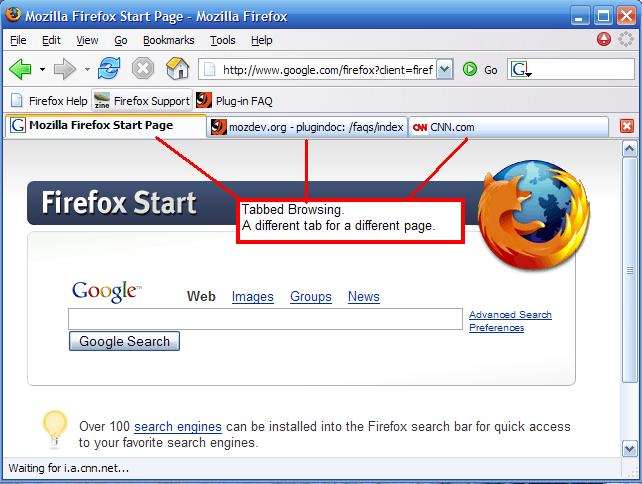
Tabbed browsing doesn’t seem to get the attention I think it deserves. Sites, strategy and brands will need to adjust as more and more of the early and late majority begin to use and understand tabbed browsing.

There was a lot of talk about how increased broadband usage would change the Internet landscape. The time it took to get from one site to the next was greatly reduced by the speed of connection. Yet, tabbed browsing takes that concept to the next level.

A 2006 article about tabbed browsing and its effect on web analytics framed the issue nicely.

Tabbed browsing has made comparing products, shopping for the right price, and researching products that much easier. For example, Chris is looking for a plasma television for his new home. He opens the browser and starts looking at ratings on Epinions. As he explores the ratings, he pops open links to pricing for a few different TVs in tabs. He decides to research a few different models on manufacturers’ sites.

The assumption is that review sites like Epinions or price comparison engines will continue to be the hub or start of any research on a product. I’m not sure this is a valid assumption. From my perspective, the de facto start to almost any (re)search for a product or service is a search engine – Google.

So what exactly does tabbed browsing mean to sites and brands?

Tabbed browsing means a greater focus on brand.

Users are going to be more apt to float from one site to the other for their purchases. The ‘switching costs’ of going from one site to the other is now virtually none. You want your site to be the first place users go or think of for your product or service. You’re also hoping that your brand is strong enough to suppress the tabbed browsing behavior.

The only way to circumvent Google is to have a site or brand that has a greater influence or mindshare for that niche. As an example, Amazon may still have the brand horse power to attract direct traffic for those looking for a book.

Strong brands don’t necessarily need to participate in shopping comparison sites since many users might simply check that brand’s offering in another tab whether or not they are displayed. Southwest airlines has largely taken this approach.

Tabbed browsing means user interfaces must be streamlined and easy.

Once you get a user to visit your site, the user interface must be incredibly easy. Confusion or roadblocks to purchase will give users time to open another tab. Whether it is to find another site with the same product or simply frustration induced ADD is immaterial. Sites must focus on making it difficult for users not to follow the appropriate conversion path. Lead generation marketers are a step ahead in figuring this out.

Tabbed browsing means sites need to invest in SEO.

If your brand isn’t strong enough to bring direct traffic the only way you can be first in the door is through search engine optimization. In addition, as users refine searches in subsequent tabs you want your site to continue to be served in the top results. Repetition will have a beneficial effect.

A new goal might be to have your site open in multiple tabs for any given user? And lets not forget that many confuse search with the address bar, pushing what could be direct traffic into searches. Weaker brands can leverage SEO against bigger brands.

Tabbed browsing means engagement is a better metric for success.

Engagement is going to become a much better metric for success since many will simply keep multiple sites open on a daily basis. I interact much more with FriendFeed but I usually still have Facebook and LinkedIn open in another tab. How this translates into online advertising is another interesting discussion.

Tabbed browsing could overwhelm users.

As people begin to use more and more tabs, it may lead to a backlash of sorts as it relates to Barry Schwartz’s The Paradox of Choice. Essentially, more choices doesn’t always lead to more purchases. In fact, in many cases it suppresses purchase behavior. This could mean a general deceleration in eCommerce growth or renewed reliance on trusted and/or known brands.

Google Chrome has upped the ante by creating a default tab page that includes your nine most visited pages. A quick survey of early adopters on FriendFeed shows the number of open tabs to be around 6 on average. I could argue for both fewer or more tabs on average for early and late majority users.

Time will tell. It is my opinion that tabbed browsing changes everything and we haven’t begun to determine how exactly it will play out.

Use the NOINDEX Tag If You ‘Blog For Yourself’

September 20 2008 // SEO // Comments Off on Use the NOINDEX Tag If You ‘Blog For Yourself’

Search Engine Optimization (SEO) seems to be a dirty word in some circles. Many seem to think it’s some vile technique that only marketers use in an effort to trick people to get to their site. (The word marketers is spoken as if they’re an unruly bunch of war criminals.) When pressed for why they don’t implement even basic SEO, many of these same people will state piously “I blog for myself!”

So I say to these people, please, use the NOINDEX Tag.

If you are blogging for yourself then there’s no real reason for you to be in Google’s search index, right? I mean, why exactly do you have a blog anyway? If you’re blogging for yourself couldn’t you just write it up in Microsoft Word, read it over again with a satisfied smile, pat yourself on the back and be happy? Tell Google and other search engines to ignore your blog and use the NOINDEX Tag.

Yes, I’m being very literal here, but it helps to make my point.

You’re not blogging only for yourself. You do want others to read what you’ve written. Not every SEO technique is something a casual blogger should employ. However, use my blind five year old principles to help implement rudimentary SEO. Not only will this help people find your content but it will likely make your content just a tad more readable and accessible.

And that is what SEO is about. It’s about making sure the people interested in your content actually find it.

Beware of MonkeyClicks

September 18 2008 // SEM + SEO // 6 Comments

When I started managing my first search engine marketing (SEM) program at Alibris I quickly found that being the first ad on a Google search result wasn’t working. It seemed a bit counter-intuitive. The volume was great but the conversion was atrocious. But I had a theory for this phenomenon that I quickly dubbed MonkeyClicks.

My MonkeyClicks theory is that a user tends to click on the first result on the page regardless of whether it really meets his or her needs. It is plain ol’ human behavior. A knee jerk reaction of sorts. So you get a tremendous amount of volume. However, that first click doesn’t always match the needs of the user and even if it does they will often return to the search results to determine whether other options exist.

If you think of this outside of the small world of search engine marketing it makes perfect sense. If I’m looking to buy a car I’m likely not going to look at the first advertisement I see and then run off and buy that car. If I’m looking to buy a new bicycle on Craigslist I’m going to look at a number of matching results, not just the first one.

This makes sense but lets back it up with some data. (I like data!) Back in 2006 AOL accidentally released a chunk of user search results. It showed that 42% of all clicks on the first page of results came from the first position. In comparison, the second position racked up a distant 12% of clicks.

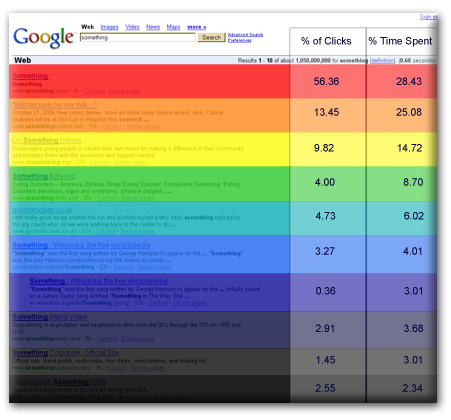
Another eye tracking study by Cornell, and reported by seoresearcher, showed the disparity in the % of clicks and % of time spent on each search result.

Google SERP Click Distribution

The ratio of clicks to time spent on the first position is a classic example of MonkeyClicks behavior. The first position garnered 56% of the clicks but only 28% of the time spent.

All of these studies are done with natural search results, but I’d argue that the paid results will look very similar. Not to mention that I’ve seen this time and again as I manage various SEM programs.

However, your mileage may vary! So don’t take my word for it, do a quick review of your own SEM program. If you’re running a Google AdWords program and Google Analytics, simply take a look at your Keyword Positions report.

And … beware of MonkeyClicks.