— You Are At The Archives for the google Tag —

Did You Mean Matt Cutts?

May 15 2009 // SEO // Comments Off on Did You Mean Matt Cutts?

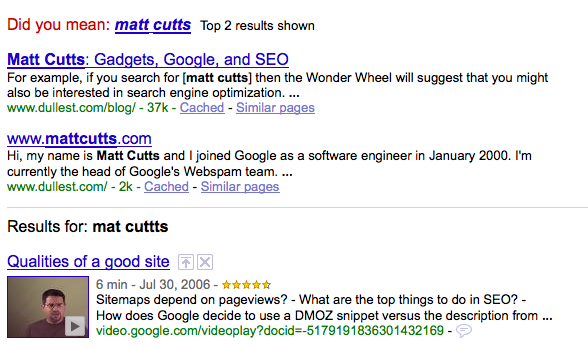
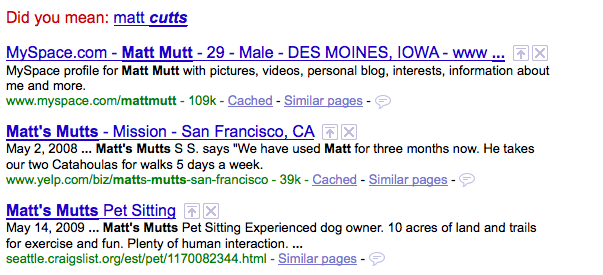
In February I wrote about Did You Mean search results appearing above normal Google search results. This differed from the presentation of just a link to the Did You Mean search results.

Did You Mean search results

Did You Mean Matt Cutts

Did You Mean search link

Did You Mean Link

While I understood the potential user benefit, from an SEO perspective, Did You Mean search results could make misspelling optimization far less attractive.

As luck would have it I was able to get an answer on this topic from Matt Cutts.

It’s about what I expected. The presentation is relatively new and is tied to an algorithm triggered by some threshold where Google expects a high degree of accuracy in the Did You Mean match. In the end, it probably does deliver value to the user.

I appreciate the response (thanks Matt) and am reminded that SEO is an ever changing endeavor.

Twitter and Google … Analytics

May 08 2009 // Analytics + Social Media + Technology // 2 Comments

Twitter is using Google Analytics

Earlier this month Twitter launched new HTML versions of their Follower and Direct Message emails. Upon clicking through one of these newly designed emails you’ll notice that the links all contain Google Analytics parameters.

Twitter and Google Analytics

For those of you without the best eyesight, the URL contains the normal utm_ parameters. In this case Twitter is using source=follow, medium=email and campaign=twitter20080331162631.

What is twitter20080331162631?

It is not a user id since a Google search for twitter20080330062631 shows results for more than one user. The first part looks like a date, but March 31, 2008 seems like an odd choice for something just released. Any ideas?

Why is Twitter using Google Analytics?

The obvious answer is Twitter wants more accurate or easily accessible metrics. But why select Google Analytics? Sure it’s free but Twitter isn’t hurting for money, are they? Twitter could use any number of other solutions.

Many believe Twitter is a Google competitor and/or acquisition target which makes using Google Analytics more intriguing.

Wouldn’t Twitter be just a little bit paranoid that Google would peek at the Google Analytics data to gain insight into their business? Sure it’s not supposed to happen but … why take the chance?

Or is Twitter using Google Analytics to provide due diligence data to Google for a potential acquisition? Google certainly wouldn’t doubt numbers generated by their own product. Is this part of the rumored negotiations taking place between Google and Twitter?

Google Killer or Google Accomplice

Outside of the conspiracy theories, Twitter’s usage of Google Analytics further cements them as the leader in the analytics space, surpassing competitors such as Omniture and Coremetrics.

PowerPoint decks at conferences are peppered with Google Analytics graphs and screen captures. In a difficult economic environment it becomes more and more difficult to rationalize using a paid product when a free product has a similar feature set.

Twitter isn’t a Google killer. Instead it’s helping Google to kill web analytics providers.

Google Reader Recommendations Gone Wild

May 04 2009 // Rant + Technology // Comments Off on Google Reader Recommendations Gone Wild

Two weeks ago I was on vacation in San Diego. Of course I took my MacBook Pro, particularly since the rental had great wifi. So I was able to check in at work, maintain my FriendFeed addiction, locate the nearest Peet’s and do research on attractions and restaurants.

Upon returning from vacation I caught up on RSS via Google Reader. In fact, I was searching for new feeds and clicked on the ‘browse for stuff’ option. Now, I can’t say Google recommendations have been that great, but it’s easy, it refreshes quickly and it has provided some decent matches.

Geolocated Google Reader Recommendations?

Google Reader Search Based Recommendations

Much to my surprise I saw a number of recommendations with a San Diego theme. Simple GeoIP was my first thought. But that didn’t explain the fact that many of the recommendations were related to San Diego and food. (Sadly, I declined these before I put two and two together and took a screen capture.) The only other food related blog I maintain is the fantastic TasteSpotting. But that’s where it starts and ends.

Then it dawned on me. I’d been searching and surfing San Diego restaurants! Sure, I used Yelp and OpenTable, but I searched Google (and Google Images) for restaurants with the best views. In addition, I would click through to the restaurant’s website to see the menu.

With a little research I confirmed that recommendations are based on Web History (emphasis is mine.)

Your recommendations list is automatically generated. It takes into account the feeds you’re already subscribed to, as well as information from your Web History, including your location. Aggregated across many users, this information can indicate which feeds are popular among people with similar interests. For instance, if a lot of people subscribe to feeds about both peanut butter and jelly, and you only subscribe to feeds about peanut butter, Reader will recommend that you try some jelly. This process is completely automated and anonymous; your personal information will be protected in accordance with our privacy policy.

Confused Google Reader Recommendations

Confused Google Reader Recommendations

The Google Reader recommendations algorithm is easily misled by a vacation or a spate of searches on a specific topic. Together, as in my case, and it’s even worse.

This isn’t a new problem.

Marketers have long had issues with this type of behavior. Buy a baby shower gift and you might suddenly be presented with a host of baby products. Get a Gilmore Girls DVD set for your mom and you wind up getting a promotion for The Sisterhood of the Traveling Pants 2!

The complexity of trying to identify and exclude these ‘non-standard’ signals often make recommendation engines ineffective or just plain wrong.

Simple Google Reader Recommendations

As tempting as it is to use web history and location to generate recommendations it might be better to simply rely on feed history and collaborative filtering of aggregated subscriptions. Just because you can doesn’t mean you should.

At a minimum, it’s time for Google Reader to turn the dial down on web history and location so recommendations don’t suffer from topical whiplash.

Longer Snippets and Meta Description Strategy

March 30 2009 // SEO // 1 Comment

Google recently announced that queries longer than three words would receive longer snippets. The theory being that the more detailed the query the more information necessary to provide context to the user.

This change comes right on the heels of research that shows that longer queries are becoming more frequent.

Do longer snippets change meta description strategy?

Probably not, but it’s a good time to review your meta description strategy.

First off, meta descriptions do matter. Even if they don’t have an impact on rank they will on your click through rate. The snippet, whether derived by Google or provided through a meta description, is where you ‘sell’ the listing.

Any PPC marketer will tell you that copy testing can have a significant impact on click through rate. The meta description is just a bigger block of copy. Use it.

Date prefix

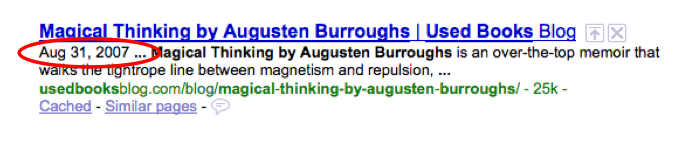
Currently, most write meta descriptions that are between 145 and 160 characters in length. However, the date prefix Google uses often interrupts a well crafted meta description. (Note that date prefixes are not searchable but are solely there as user signposts.)

You might want to think about writing shorter meta descriptions if you are consistently getting a date prefix.
date prefix meta description

The date prefix takes up 17 characters (including spaces) which means your total two line meta description should be 128 to 143 characters. For the sake of rounding go for between 130 and 140 characters.

Length or characters?

This doesn’t mean you won’t get the dreaded ellipse (…) at the end of your listing. The wrapping of a long word could push the second line beyond the max length. While we talk about characters, evidence suggests it’s about length instead. (That’s what she said!) I’ve seen 87 characters in a line, which seems impossible, but with parentheses and other thin characters … it fits.

Character length is still a good proxy until a tool delivers the ability to measure the actual length of each line of text.

New meta description tools

I’m surprised an AdWords-like tool (aka plugin) hasn’t been developed that would show what the listing would look like on Google. This wouldn’t be limited to meta description, but would provide a complete visual of your listing as it would appear on a Google SERP.

The tool would let you toggle the date prefix on or off and might even crack the length issue by determining the maximum pixel (px) line length. Just like AdWords, you’d see an example of your listing as you type. (It turns out SEOmofo has developed a SERP Snippet Optimization Tool.)

Should you write longer meta descriptions?

This assumes that Google will honor and display the full meta description provided instead of searching out relevant text on the page to match the query.

Given the opportunity, yes, I would want to control what the user reads. I want the ability to market my content the way I see fit. I think know I can do it better than Google. Here’s Exhibit A.

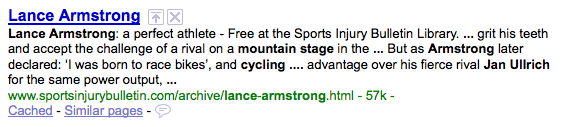
A search for ‘bicycling lance armstrong mountain stage jan ullrich’ returns this four line snippet.
Longer snippets

The longer snippet might display all of the keywords in my query but it doesn’t tell me a lot about what this page is really about. A longer meta description (even a regular one) might have done a better job.

Are longer snippets better?

Sometimes. If there’s no meta description in the first place then matching more keywords in the snippet would probably be an enhancement. If there is a meta description, I’d posit that the longer snippet degrades the experience.

The choppy nature of the snippet construction indicates that the keywords exist on the page but often fails to deliver the true context or topic of the page. A good meta description will do the latter.

Let the algorithm select the item based on the query terms but provide the human written meta description.

Will Google honor longer meta descriptions?

It doesn’t seem like Google will honor longer meta descriptions. If the longer meta description doesn’t contain the keywords from the query I’m guessing that Google will disregard the carefully crafted text and piece together its own snippet. In fact, it looks like they won’t even use the normal meta description.

But you know what they say about assuming. So I will test longer meta descriptions on this post and others and track what is displayed when searching with long queries.
Google Cache Crawl 404 Errors

March 13 2009 // Rant + SEO // 1 Comment

When is an error not really an error?

The other day Google Webmaster Tools informed one of my clients that it had found over 1,000 404 errors. Numerous Google folks (including Maile Ohye) have told me that an excess of 404s will adversely impact SEO.

Supporting this thesis and to help in tracking down these renegade links, Google has relatively new functionality that tells you what pages a 404 was linked from. Thank you Google.

Google Logo Cache

Very quickly I realized that all of the ‘linked from’ pages were cached pages. Pages with a discovery date of between four to six months ago. Internal pages. Pages that have since changed. In fact, pages that no longer have a link to the dead page.

No thank you Google.

Clearly it would have been nice if this client had 301 redirected all of these URLs. But when doing a major architecture change you’re often going to orphan a number of URLs. It happens. And if you’ve retired the links internally, and no external links existed, the pages essentially disappear.

Unless you’re crawling an out-of-date copy of the page.

Of course you can request a URL removal via Google Webmaster Tools. But am I really going to do this for 1,000 pages? It’s painful even if I can narrow it down using a directory or subdirectory.

Instead I can implement 301 redirects for the offending URLs. All for the sole purpose of ensuring that a cached crawl of internal pages doesn’t trip a 404.

Both of these options seem unnecessary.

If Google finds a 404 in a cached page why wouldn’t they seek out the original to verify that the problem currently exists? It seems like an easy business rule to implement and would likely reduce the volume of URL removal requests.

Is it that easy or am I missing something?

SEO Affirmative Action

March 07 2009 // SEO // 2 Comments

Is Google’s Vince Change SEO Affirmative Action?

Google Vince Update

The recent ‘Vince Change’ by Google has been discussed, debated and well documented by Aaron Wall. In essence, the Vince Change gave brands more trust for short queries.

At first, the Vince Change didn’t bother me too much. Change is part of the business (keeps many of us in business) and it seems a waste to get worked up by such things. But the more I thought about it the more it bugged me.

Google Taxonomic Search

Late last year I’d theorized that Google might be employing taxonomic limits to certain search results. I wrote about the topic in response to some reports of unusual SERP behavior for product searches.

The general idea surrounding taxonomic search is that Google wants an even distribution of site types on certain searches. For products you’d likely want the manufacturer as well as a few retailers, a few review sites, a few shopping comparison sites and a few discussion forums. Having the results dominated by any one type (regardless of SEO strength) would be a suboptimal user experience.

I’m a bit ambivalent on the idea of taxonomic search. It probably would provide a better user experience and it simply raises the bar for good SEO. I’m still not sure Google is doing this, but it’s more intriguing to think about with Google’s Vince Change.

Commercial Results

I kept mulling over the Vince Change, both in what it was and how it might have been implemented. Matt Cutts, whom I like a lot, provided an answer that discussed the former but not the latter.

The part that caught my attention was when Matt discussed the SERP for ‘eclipse’ and specifically his mention of “commercial results”. So is it not brand but commercial results that were impacted by the Vince Change? Is there a simple taxonomy of commercial versus non-commercial sites?

But the RankPulse results don’t really bear that out. There were plenty of other commercial sites there previously, they just didn’t have the same name recognition. I couldn’t shrug off the Vince Change.

Is trust assigned or earned?

If the Vince Change was about trust and authority, how did these brand sites receive trust and authority? Was it assigned or earned? If it was earned, how exactly was it earned? If it had been earned through SEO (backlinks, on-page optimization etc.) shouldn’t they have already been highly ranked?

I found it difficult to determine how you’d ‘turn the knob’ of trust and authority and only have it impact certain types of sites. “Certain types of sites” would lead naturally to a taxonomic structure of some sort. But that would be a transparent proxy for brand and I want to believe Matt what he says they didn’t target brands.

Instead, did Google simply assign this trust and authority? A type of SEO affirmative action. If so, based on what criteria? If it’s not ‘brand’, what is it? It doesn’t seem like traffic, nor does it seem to have roots in traditional SEO. As of SMX West it wasn’t SearchWiki data, but maybe that’s changed since. Google does move fast.

Or maybe it’s another piece of data? Advertiser saturation or CTR via DoubleClick? Could it be about money?

Why the Vince Change matters

The Vince Change seems to target very broad queries. While short queries are still a big and important part of SEO, the trend is toward longer search queries. Yet, the inability to determine how trust and authority pooled around these brands is unsettling. What prevents the same type of change to be implemented on long tail queries?

Brands should be required to earn their trust on a level playing field.

Are we … being hustled?

How To See What Googlebot Sees

March 04 2009 // SEO // 1 Comment

Use the text-only cached version of a page to see what Googlebot sees. Here’s how it works.

Let’s take a snapshot of ReadWriteWeb.

ReadWriteWeb

Next, find the page in a Google search result.

ReadWriteWeb Google Search Result

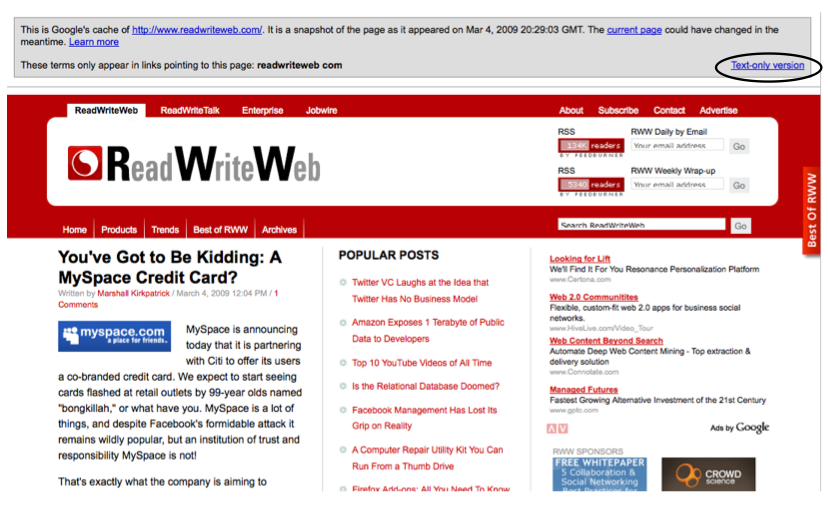
Click the cached link which brings you to the full version of the cached page. This will often be the same (Google is quick!) but it might be a slightly older version of the page.

ReadWriteWeb Google Cached

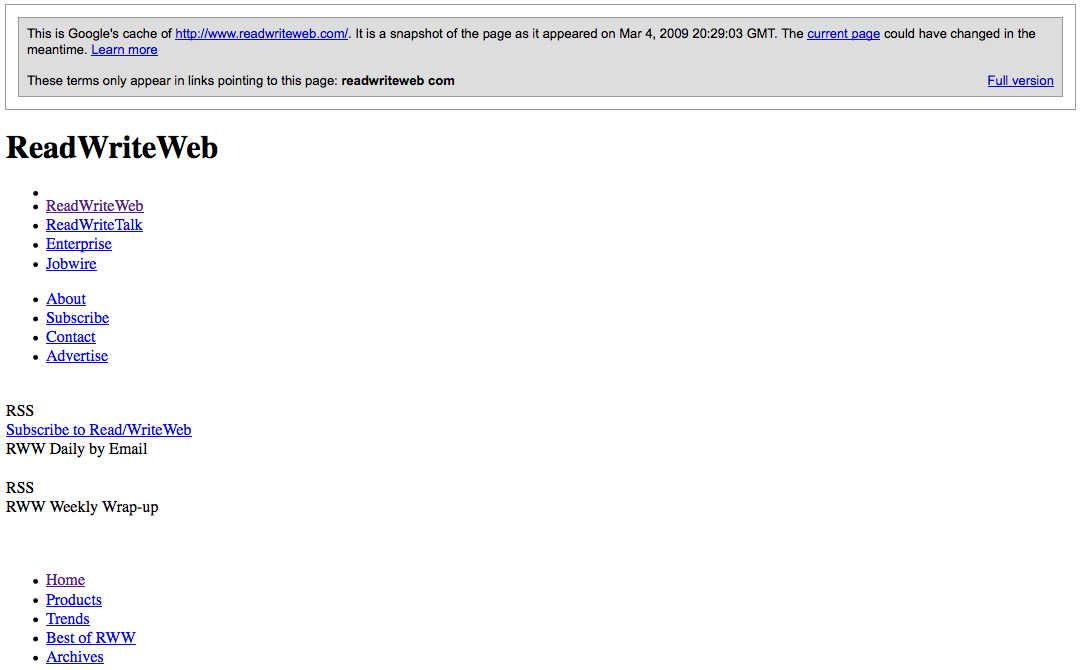
On the far right you’ll see a ‘Text-only version’ link. Click it and you’ll see what Googlebot sees.

ReadWriteWeb Google Cache Text Only Version

Googlebot doesn’t see pretty pictures, great graphic design or your spot-on color palette. This is why I tell clients to treat search engines like blind five year olds.

One of the main reasons you’ll want to do this is to ensure Googlebot sees all of your links. Those neat little drop down menus have to be done the right way. Google text-only cache is also a good way to eyeball the amount of text and number of links you have on a page. Both are important factors in good SEO.

A word of warning. This shouldn’t replace spider test tools like the aptly named SpiderTest, nor does it give a comprehensive view of what Googlebot sees. The Google text-only cache is a quick, complementary tool.

Thanks to Vanessa Fox who passed along this tip in a SMX West session.

Google Did You Mean Search Results

February 26 2009 // SEO // 1 Comment

Google is presenting two Did You Mean search results above regular search results, making misspelling optimization or fat finger SEO less effective.

used boks mispelling google search results

The result above is for used boks, a misspelling of used books. The Used Books Blog doesn’t get a ton of traffic from the term, but it’s been a steady trickle given that I’m the first result. (Take that Amazon!)

And I still might get some visits on the term, but I’d guess not nearly as much now that Google is actually presenting two Did You Mean results above the misspelled results.

I’m not sure when Google began to display Did You Mean search results, but it’s relatively new since I often use the used boks example with clients. And Google could be testing the feature, so it might disappear and revert to displaying the lone Did You Mean line at the top of the results.

In fact, there are other misspellings that don’t trigger the Did You Mean search results.

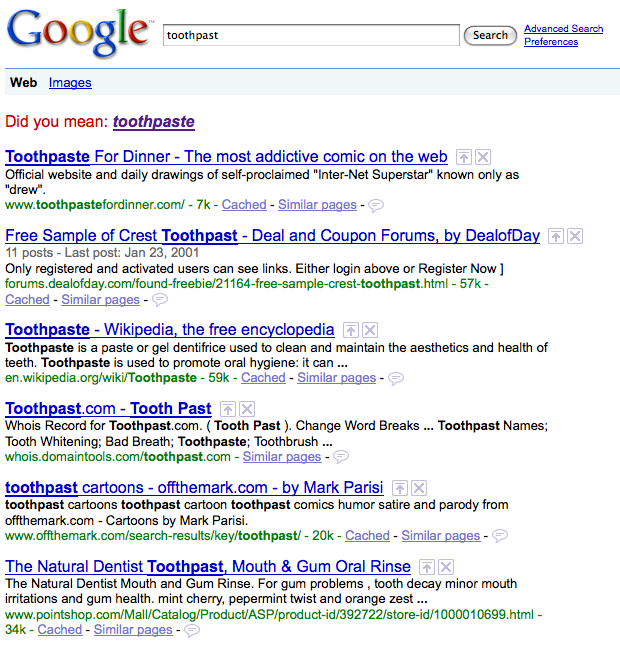
toothpast google search results

Come on! Toothpast doesn’t trigger Did You Mean search results but used boks does? At least used boks could refer to a used jersey worn by the Springboks, a successful South African rugby team nicknamed the Boks.

I’m not against the feature. In many cases it likely provides users with a better search experience. Is Google testing this new feature? Does it only present Did You Mean results on certain misspellings? If so, what’s the criteria?

I wouldn’t put misspellings near the top of my optimization list, but they are often non-competitive and with a little effort you can snag the top spot and drive qualified traffic.

Understanding Google’s new Did You Mean results could change the priority of or eliminate the need for misspelling optimization.

The Future of Search is Numbered

February 23 2009 // SEM + SEO // 2 Comments

The future of search is numbered. No, it’s not what you think. I’m not predicting the demise of search. Quite the opposite.

Instead I’m talking about two trends that could have interesting implications on how both SEO and PPC campaigns are constructed.

The number of words per query is going up

Bill Tancer, General Manager of Global Research at Hitwise, shared the following statistics during a SMX West presentation.

Number of Words per Query Going Up

The trend is clear. People are using more words in their search queries. The reasons behind the increase in words is debatable. Is it an increased comfort and savvy with search or frustration with the search results? Either way, long tail searches are on the rise and will likely trend this way for some time.

People are using numbers to reformulate queries

In a post titled Study on the Structure of Search Queries, Bill Slawski of SEO by the Sea discusses a Yahoo! research paper titled The Linguistic Structure of English Web-Search Queries (pdf). One of the findings was that people were using numbers to modify their searches.

The type of word most likely to be reformulated is “number.” Examples included changing a year (”most popular baby names 2007″ ! “most popular baby names 2008″), while others included model, version and edition numbers (”harry potter 6″ ! “harry potter 7″) most likely indicating that the user is looking at variants on a theme, or correcting their search need.

The data set for this research is from 2006. Yet, combined with the increase in words per query I’d theorize that numbers remain a powerful way to search today.

I’m the first person to warn against using yourself as an example but … I’m going to break that rule right now.

I often find myself using numbers, particularly years, when searching. If I’m doing research on a volatile topic (like SEO) I might come across ancient results from 2004. These are rarely helpful.

So I’ll begin to iterate and modify my query with years to find more relevant results. I had to do something similar when trying to cobble together Google’s share of search from October 2004 to October 2008.

Speaking of Google …

Google displays the date as a meta description prefix

Sometime last year Google began to insert a date prefix before the meta description in search results. They did this for pages in which Googlebot found a date – mostly blog posts.

meta description date prefix

I certainly noticed since some of my well crafted 150 character meta descriptions were suddenly being cut off because of the inserted date.

Why exactly would Google do this? They’ve certainly made it clear they like “fresh” content but they could present fresh content without the date. I can only surmise that Google believes users are looking for and will benefit from seeing the date.

Oddly, the date prefix does not seem to be searchable. When I search for ‘Magical Thinking by Augusten Burroughs 2007’ the same result is displayed but the visual treatment changes.

date search result without meta descripition date prefix

Once again Google tromps all over my well crafted meta description, but without the meta description date prefix. This seems to prove that the meta description date prefix isn’t searchable. But perhaps it should be.

Are you including numbers in your SEO and PPC strategies?

We know that users are using more words per query and that they’re fond of reformulating queries using numbers. This should be enough evidence to implement a robust modifier strategy, if you haven’t already.

Those who already have long tail programs should think about increasing the use of numbers as valid modifiers. As an example, wouldn’t review sites benefit from bidding on terms like ‘digital camera reviews 2009’ or ‘trek bicycle ratings 2008’?

Search (whether paid or organic) is about matching your content (or ad) to the user queries. Don’t let your programs become dated.

SearchWiki Not a Signal in Search Algorithm … Yet

February 17 2009 // SEO // 1 Comment

google top secret logo

Launched in November 2008, SearchWiki lets you move, delete, add and comment on the results of a Google search. At launch I wrote that SearchWiki turned us into mechanical turks. That’s not a bad thing since the Google algorithm needs a human tutor.

Google’s SearchWiki feature has been a lighting rod within the search industry drawing the ire of many and prompting the creation of Greasemonkey scripts to turn off SearchWiki functionality. It even spilled over into ‘mainstream’ media with TechCrunch’s Michael Arrington asking Google to shelve the new feature.

So it was no surprise that the SMX West presentation on SearchWiki was well attended and full of search engine marketers eager to learn what exactly Google was up to with SearchWiki. Corey Anderson started out by giving a short presentation, outlining the four different uses of SearchWiki.

  • Bookmarking
  • Improving proper name searches
  • Collecting information on a task
  • Refinding hard-to-find information

The presentation didn’t satisfy or answer the obvious questions. What ensued was a President George Bush type of press conference where reporters asked the same question over and over in slightly different ways and got back the same ‘no comment’ answer in return. You could come away from the SearchWiki session thinking you’d learned nothing or you could read between the lines and learn a lot.

Anderson stated that SearchWiki data wasn’t a signal in the Google search algorithm “right now”. He was, however, noticeably excited by all the data they were collecting. The task ahead was to sift through the data to determine if it could be turned into information and used as a signal.

While Anderson made it clear Google felt SearchWiki was a benefit to users on its face, there is no doubt that Google is interested in the possibility of using SearchWiki data as a search algorithm signal.

SearchWiki usage numbers were something Anderson wasn’t willing to divulge. It’s not that he didn’t know them, he just wasn’t willing or able to share them. He noted that Google was “comfortable” with SearchWiki usage. The crowd full of metric junkies let out a mirthless chuckle and groan at this ultra-fuzzy term.

Anderson did mention that they had been testing different visual treatments to boost engagement and usage of SearchWiki. Obviously you need to measure usage to determine which visual treatment is performing better than the other. Google knows, they’re just not willing to tell us “right now”.

If SearchWiki weren’t important, there wouldn’t be this deliberate and careful black hole of information. I don’t blame Google or Anderson. SearchWiki provides a very rich new stream of data. The potential for data pollution is problematic. Usage numbers only help those looking to hide unnatural edits from detection.

SearchWiki data isn’t a signal in the algorithm now, but the SMX West 2009 presentation made it crystal clear that they reserve the right to use it in the future.