— You Are At The Archives for the google Tag —

Image Based Google Shopping OneBox

September 18 2009 // SEO // 2 Comments

Starting Monday, Google began to display an image based shopping OneBox, changing the SEO landscape for any product or eCommerce related site. The shopping OneBox seems to be in high rotation, usually appears within the top three results, takes up more vertical real estate and has broad coverage over product searches.

What is a Google OneBox?

When Google wants to display information that is not exactly in the algorithm, but is related to the query, it does so through what is called a OneBox presentation. Think of it as a promotional unit.

The OneBox terminology was used by Google when the unit was first introduced and seems to have survived, at least externally. SearchEngineWatch (sorta) confirmed the OneBox terminology in an interview with Google Product Marketing Director Debbie Jaffe in 2006. (Jaffe never actually refers to it as OneBox.)

OneBox can display a variety of different information from news to weather to books to products and can be placed anywhere from the top to the bottom of a result page.

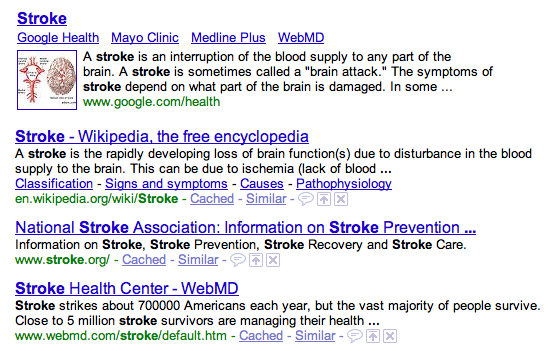
The OneBox presentation is controversial because it creates a very prominent listing that provides … cherry-picked results. As an example, Google has begun to implement a health OneBox.
Google Health OneBox

The health OneBox for the query ‘stroke’ brings Mayo Clinic, Medline Plus and WebMD to the top of the page instead of where they’d wind up under natural results. In this case WebMD would be 3rd, Medline Plus 6th and Mayo Clinic 11th.

Google Shopping OneBox

The shopping OneBox or product OneBox brings the same cherry-picking controversy to the surface. It’s exacerbated by the fact that Google Product Search essentially competes with shopping comparison engines and review sites, many of whom have spent time and effort to perform search engine optimization.

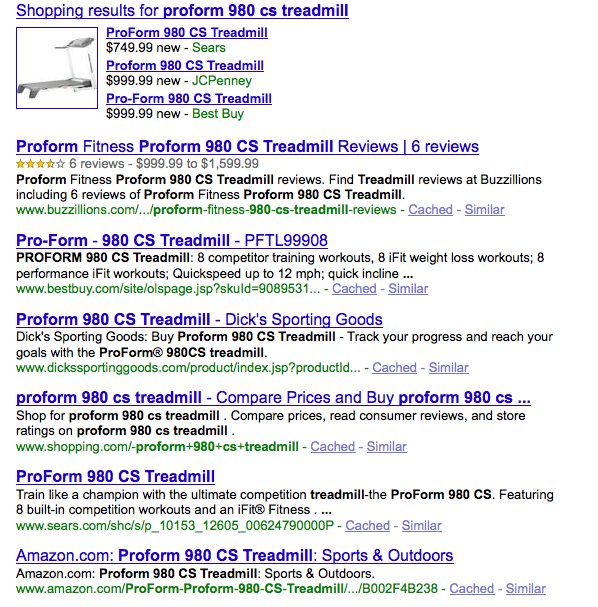
If you’re not participating in Google Product Search (aka Google Base) then you’re never going to be in the shopping OneBox. And even if you do participate, there’s no guarantee that your listing will be featured. Here’s an example of the shopping OneBox for the query ‘proform 980 cs treadmill’.
Google Shopping OneBox

Sears, JCPenney and Best Buy are all featured in the shopping OneBox. At least Sears and Best Buy have a natural listing but JCPenney has essentially circumvented normal SEO and is now a preferred result for this query.

Sites such as Buzzillions, Dick’s Sporting Goods, Shopping.com and even Amazon suddenly lose out on this query despite matching and delivering a very good experience for this product search. Even Best Buy might not be thrilled since they’d be first retailer listed and not the third if the OneBox wasn’t presented.

Today, Google is a huge part of any product based business, so changes like this will have an immediate impact on traffic and sales.

Shopping OneBox Evolution

The evolution of the shopping OneBox shows an increasing interest by Google in this vertical. First there was the old Froogle presentation.
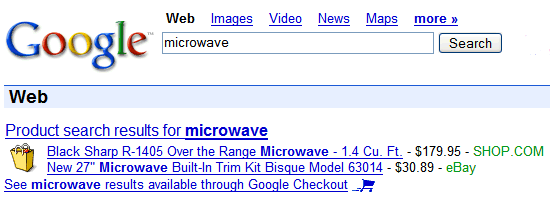
Froogle OneBox

Image from Google Operating System.

In 2008 Google experimented with a compact version with a product image.

Google Shopping OneBox 2008

Image from Google Operating System.

By early 2009 Google had reverted to a slightly less compact text version again.

Google Base Results

Image from Best Rank.

Now the shopping OneBox has a large product image and is not compact at all, taking up a tremendous amount of real estate.

Google Shopping OneBox 2009

Importance of Shopping OneBox

On September 2nd, the Google Base blog announced new features for marketplace and aggregators on Google Product Search. This is a real change from the initial launch of Google Base, where Google seemed interested in having individual sellers upload to Base and use Google Checkout on their sites – middlemen be damned!

The change in direction for Google Base coupled with the focus Bing has had on shopping seem to have accelerated Google’s interest in the vertical. They’ve been toying with it for many years but have never really made it a priority.

The new shopping OneBox indicates that might be changing.

SEO Judo

September 14 2009 // SEO // 2 Comments

SEO Judo

SEO Judo is used when you have a site or blog with content that hasn’t been optimized for search. When content isn’t created with keyword research as part of the process Google and other search engines define the relevant keywords for each page.

That’s where SEO Judo comes in handy.

What is SEO Judo?

First, let’s start with the meaning of Judo.

… it is the principle of using one’s opponent’s strength against him and adapting well to changing circumstances.

In the world of SEO the opponent is Google. Don’t misunderstand, Google isn’t evil. I don’t believe that Google has ulterior motives to each and every algorithm change. That’s not what I mean by opponent.

Instead I simply mean that when Google decides what a page is about it’s pretty difficult to change it’s mind. And the longer Google thinks a page is about a certain cluster of keywords the tougher it’ll be to convince Google otherwise.

Use Google’s Strength

Why fight Google? Instead, use their strength against them. If Google thinks a page is about a certain keyword and you’re currently ranked 5th for that term go ahead and optimize the page for that term and see if you can increase your rank and claim a greater amount of that traffic.

Sure you might look at the page and think that another keyword would be better, or you may look at a root keyword and get big saucer eyes with the amount of traffic you could get if you ranked for that term. But your opponent is strong. Very strong.

It will take a substantial effort and a fair amount of time to convince Google of new keyword targeting. Even then, you’re not guaranteed success. Instead, use SEO Judo and use Google’s momentum to reinforce what it already believes.

SEO Judo Example

Here’s an example of how to practice SEO Judo from my small Used Books Blog. In February I read and reviewed Erik Larson’s Devil and the White City. Using Google Analytics I can go and look at what keywords brought people to this page.

Devil in the White City Keywords

Even with the small volume you can quickly see a cluster of keywords around ‘devil in the white city quotes’. Performing this query on Google returns the page as the 11th result. Not bad!

Devil in the White City Quotes

In this case Google has ignored my meta description and created a snippet based on the text in the review. (More on this a bit later.) Clearly the Holy Trinity of SEO (title, meta description and URL) is not being optimized for the term ‘devil in the white city quotes’. But … it could.

Devil in the White City Quotes Optimized

With a bit of SEO Judo I can adapt to changing circumstances and use Google’s strength to my advantage. In a short amount of time I’d be a fixture on the first page for the term ‘devil in the white city quotes’.

When NOT to use SEO Judo

I wouldn’t use SEO Judo for the example I just used. Sure, I could, but to what purpose? The page doesn’t actually have any quotes from The Devil in the White City. (Thanks to the poor snippet algorithm.)

SEO isn’t just about traffic. Post Click SEO is the goal – getting the right traffic for your blog, site or business.

So only use SEO Judo if the keyword Google selects is actually good for your business. Remember, Google might be strong but it’s still not very smart.

When to use SEO Judo

SEO Judo should be used when you’ve given Google enough information to form an opinion. Google doesn’t need a whole lot, so this really means that the page must have a non-duplicative title and should have a keyword based URL.

In addition, the page must get enough SEO traffic so you can identify keyword clusters. If no one keyword phrase emerges, go back and optimize based on straight forward keyword research. If there are competing terms, you can again fall back on keyword research to select the best keyword target.

SEO Judo works best when you can create new content. Using the example above, I might change my review of Devil in the White City to include quotes, or I could create a new blog post specifically about quotes from Devil in the White City. Not only do I already understand Google’s appetite for this term, but I might finesse an indented listing by linking between the two posts.

This process is also useful if you’re pursuing a root keyword strategy. Instead of doing SEO Judo on the root keyword URL, you can use SEO Judo to create content for secondary terms that are firing on that root keyword content. This provides additional focus for the root keyword while building traffic on secondary terms.

Stop wearing yourself out trying to out-punch Google and instead use SEO Judo to throw Google to the mat.

Do AdWords Conversion Rates Vary by Position?

August 25 2009 // Advertising + Rant + SEM // 2 Comments

Last week the Google AdWords blog posted some ‘research’ conducted by Hal Varian, Chief Economist at Google, that stated that “conversion rates don’t vary much by position.”

Google Conversion Rate by Position Research

Do AdWords Conversion Rates Vary by Position?

My personal experience is that AdWords conversion rates DO vary by position. That’s not to say that I can’t be convinced otherwise, but I’ll need a lot more evidence then was provided in the blog post.

As a fundraiser many moons ago, my first instinct was to say that there would always be an inverse relationship between dollar amount and conversion rate. The lower the pledge amount, the higher the conversion rate.

Yet, I found that there wasn’t a tremendous difference between some giving levels. Conversion rates on $25 pledges weren’t substantially different from $100 pledges. However, that variance increased as you climbed up the solicitation ladder. Conversion rates for $500 pledges did vary materially from $25 pledges.

So, I’m not unwilling to be persuaded by real research and statistics that might contradict my anecdotal evidence. The problem is that the post didn’t link to the research to help validate the methodology or assumptions that led to this conclusion. Only a few variables are discussed, leaving a number of others open to interpretation or debate. It doesn’t help that one of the three links in the post goes to a 404 page.

How Did They Define Conversion?

That broken link … it was to the definition of conversion rate. Oddly, this is an important point. How did they define a conversion? Were only those conversions configured in AdWords included? Or did they pull from Analytics Goals as well? Essentially, we have no idea as to the universe of those who were included in this research, nor is there any mention as to what type of bias this might introduce.

Does the Type of Search Impact Conversion Rates?

Second, what type of searches were included? Given the differences in transactional versus informational queries one would believe that there might be a difference in conversion rates by position as well. An ad advertising a product (eCommerce or transactional) may exhibit different behavior as those advertising content (content or informational).

Does Query Length Impact Conversion Rates?

Blognation points out that an analysis of conversion by “token length” would be important.

Here’s a different way to think about the Google conversion rate data that I think would probably have a much different outcome. Do a conversion rate analysis by “token length”, which is search engine language for the number of words in a search query. If someone types in “baseball” for example, what’s the conversion rate differential between position #1 and position #10, versus a query for “buy Louisville slugger size 28 wooden baseball bat.”

I suspect that the conversion rate for the first query is going to be very low for the first position, simply because you are going to have a lot of browsers who simply click on the first ad that they see. Any browser who eventually makes it down to position #10’s result may very well have turned into an actual shopper after clicking on all the other ads. Conversely, if you already know the exact product you want – and your search query indicates that intent – you are much more likely to convert on the first ad you see that actually offers the specific product you want.

Related to this would be the conversion rate by position by match type. With so many advertisers unknowingly bidding solely on broad match, this type of analysis seems necessary and … useful!

Does CPC and Ad Category Impact Conversion Rates?

Finally, was this analysis performed to determine whether conversion rates by position remained constant depending on the average cost of the keyword? Could it not be true that different behavior could exist for a keyword with a $10 per click cost versus 10 cents?

Might different categories produce different conversion rates by position? Would the conversion rates for books, movies and music differ from long term care insurance? Could the number of competitors or volatility of a keyword impact the conversion rate by position?

Why Present AdWords Conversion Rate Research?

The presentation of this research without … the actual research makes me suspicious. What message is the AdWords team sending to advertisers? It seems to me that they’re encouraging advertisers to bid for the extra traffic received from higher ad positions. That advertisers can do so without negatively impacting their conversion rate and subsequent ROI.

Never mind that the higher CPC to achieve that extra traffic would reduce your margin. And that’s IF your conversion rate does remain the same. Should it not, you’ll pay a premium to obtain traffic that converts at a lower rate. So, who is this research advice really supposed to benefit?

Given the lack of supported evidence I can only rely on the experiences that I and my colleagues have had over numerous years. Experiential learning tells me to beware of monkey clicks, which do cause the top positions to have lower conversion rates.

I’m still willing to be convinced, but until something material is presented, this seems akin to evidence of the Loch Ness Monster. The cynic in me sees it as marketing copy meant to drive more advertiser dollars. I’d love for Google to prove me wrong.

Nofollow Change is about Usability

June 29 2009 // SEO + Web Design // 2 Comments

The SEO community was thrown into a tizzy by the announcement at SMX Advanced that Google had changed the way it dealt with nofollow links. The details were a bit fuzzy. Conjecture ran amok. Was nofollow page sculpting dead, or just crippled?

Nofollow page sculpting is dead

A post by Matt Cutts cleared up any confusion.

So what happens when you have a page with “ten PageRank points” and ten outgoing links, and five of those links are nofollowed? Let’s leave aside the decay factor to focus on the core part of the question. Originally, the five links without nofollow would have flowed two points of PageRank each (in essence, the nofollowed links didn’t count toward the denominator when dividing PageRank by the outdegree of the page). More than a year ago, Google changed how the PageRank flows so that the five links without nofollow would flow one point of PageRank each.

Lost Page Rank

The days in which you could hoard page rank or authority on a few links by nofollowing others is a thing of the past. (In fact, has been in the past for over a year!)

Instead, the page rank or authority on nofollow links is lost, falling into the equivalent of the Bermuda Triangle.

SEOmoz wrote up a great piece that illustrated this point and detailed ways in which you can continue to page sculpt without the use of nofollow. Though doing so might not be wise. Read on to find out why.

Nofollow change outrage

Many in the SEO industry became irate. They shouted and stomped their feet, decrying the whimsy of Google, who in 2005 introduced the nofollow concept, nurtured it (to a point) and changed the rules without notice.

The changing nature of SEO is what keeps most agencies, consultants and talking heads in business. If the algorithms were transparent and had been perfected then no one would need our services.

The truth is that the algorithms are a work in progress. Search Engines are like blind five year olds and, as such, are still learning. If you’re a parent, you know that as soon as you figure out how to deal with one problem your kid has moved on and given you another one to solve.

I mean, really, are you still grousing about how meta keywords are no longer important?

So why did Google make this change? Well, it wasn’t to target specific people or sites. And it wasn’t malicious or to make your life miserable. The truth is that the nofollow change is about usability and Google’s continuing efforts to make the web more useful for people.

Nofollow change is about usability

The problem with nofollow was that it didn’t allow the search engine to look at the page like a human being. If you nofollowed 20 links out of 25 on a page you were essentially telling Google that only 5 links existed.

But to a human being, all 25 links exist.

The fact that you were telling Google that those 5 links were what mattered most isn’t how a human being would interpret that page. This made Google unhappy.

Nofollow Design Guidelines

Yes, Google does have design and content guidelines.

Keep the links on a given page to a reasonable number (fewer than 100).

The nofollow change essentially means that they’re counting your nofollow links against that 100 link benchmark. Translation. Stop putting so many links on a page!

Many at Google point to Barry Schwartz’s The Paradox of Choice as a favorite in the Google Tech Talk series.

The one hour video is absolutely worth watching but, to make a long story short, more is not better because more makes it difficult for someone to make a choice.

The Paradox of Choice applies to web design and user experience too. In a time compressed society with broadband access and tabbed browsing, you have a limited amount of time to communicate what your site is about and where they should go next. Overwhelm your users and they’ll run screaming to the next tab.

Search engines are simply trying to emulate the human experience. That’s not an easy job. It’s essentially designing artificial intelligence! Remember, right now a search engine will always fail a reading comprehension test.

Instead, search engines have to model the ability of humans to parse a site. The nofollow attribute interrupted that model. It forced the search engine to see authority where a human user might not. The nofollow change removes this bias and also pushes sites to design according to that model by tossing nofollow page rank and authority into the Bermuda Triangle.

The real nofollow question

Google is serious about this mission, which is why it has begun to execute JavaScript, another favorite way to obfuscate links without using nofollow. There are still plenty of ways to hide links and sculpt your page rank or authority but it seems clear Google feels it needs to see all the links on a page to properly evaluate how it is being processed and interpreted by people.

The nofollow change is a not-so-subtle push to encourage sites to simplify. Not just so the search engine can better understand, but so people can better understand too.

The real question resulting from the nofollow change is far more thought-provoking.

How comfortable are you with Google shaping user experience?

Search Engines are Readers Too

June 11 2009 // Rant + SEO // 1 Comment

Last week David Risley wrote a blog post for Search Engine Journal that recommended that you forget all about SEO and write for readers, not search engines. His advice borders on dangerous, in part because some of it is accurate.

My recommendation is to write posts designed to help, provoke or inspire your reader.

That’s great advice. However, his definition of a reader is far too narrow.

Search Engines are Readers Too

Search Engines Are Readers Too

Future readers are searching for your content. They’re typing queries into Google right now. The search engine has read your blog and come to some conclusions about when and where to show your content.

SEO is about making it easy for the search engine to come to the right conclusions. It’s about ensuring that the content you write is displayed for the right searches.

Search engines are the gate keepers to the more than 15 billion searches performed in the US every month. They are powerful but they are not smart.

Welcome to Kindergarten

A search engine is like a blind five year old. They don’t care what your site looks like and they have the intelligence and attention span of an average five year old. This is why SEO is important and why you do need to write for search engines.

Search engine algorithms are tasked with trying to understand the value of an item of content. But they don’t really see the page and they don’t truly read the content either.

Search engines do not understand the text they are reading. You can’t sit them down after they read a blog post and ask them reading comprehension questions. They are not human, nor are they some super-advanced form of artificial intelligence.

This is why quality writing will not be enough.

Sit a five year old down in front of a Don DeLillo novel and they’ll quickly become bored and confused. The plain fact is that there are thousands of well written blogs that languish in the dark cobwebbed corners of the Internet.

Dumb and Dumber?

Dumb Down Content?

I know what you’re thinking. “Am I supposed to dumb down my writing for the lowest common denominator?” Yes and no.

Let’s cover no first. No, you should still write helpful, provoking and insightful content. It should be intelligent and have a point of view. The search engine does not require that you lose your personality.

However, that writing should be concise, well-structured and devoid of generalizations and logical assumptions. This will help all of your readers, search engines and humans alike.

So yes, you should write in such a way that, at a glance, a reader can understand and engage with your content. And to be fair, David Risley does actually provide some good direction on the structure of content and in covering the SEO Holy Trinity: Title, Meta Description and URL.

Good Writing + Social <> Links

Risley also understands that links are perhaps the most important part of SEO.

If you provide enough value, you’ll get people spreading your link across other blogs. You’ll go viral on Twitter. You’ll get people Digging your posts.

This works … for a small percentage of blogs in certain niches where the author has enormous amounts of free time. Does that sound like you? Probably not.

When was the last time you saw a serious blog post dealing with Alzheimer’s Disease reach Digg’s front page? Do you think a book review of David Mitchell’s Black Swan Green is going to get massive viral adoption on Twitter?

Rely on this technique as a way to optimize search engine traffic and you’ll be sorely disappointed. Social marketing is a piece of the puzzle but it is not a plug-and-play panacea for link building. If links were this easy to get, they wouldn’t be that important.

Search Traffic Creates Links

Get people to your blog through search engine traffic and let the same type of viral link building take place. The idea is to get your content matched to the right queries first, and not wait for social marketing to inform the search engine of your content value or for which queries it should be displayed.

Get the people who are naturally seeking out your content to do the link building. This way you are not constrained by the size of your social network, nor are you held hostage by the ephemeral ADD nature of social media.

Write for Search Engines

Write for search engines because it will benefit all of your readers. Subscribers will find more focused, accessible and valuable content that respects their time and new readers will locate your content with greater efficiency through their natural search patterns.

Writing styles adapt to their environment. Novels versus business writing. Haiku versus grant writing. So, come to to terms with the fact that good blog writing requires a different writing style. Embrace it and search engine and human readers will thank you.

Google is the 6th Ranked Search Engine

June 01 2009 // Humor + SEO // 3 Comments

Don’t believe me? Try a search for ‘search engine’ on … Google.

Google is the 6th Ranked Search Engine

That’s right, it returns Google as the 7th result and the 6th search engine. And look at the snippet! Would it kill Google to craft a decent meta description?

In some ways it’s nice to see that Google isn’t optimizing and hasn’t manually altered the results in their favor. Yet, ‘search engine’ seems like a valuable term.

Search Engine Search Volume

That’s over 4 million global monthly searches! Even on exact match you get nearly 400,000.

Yahoo seems to get it, putting themselves at the top of a ‘search engine’ query on Yahoo. I’m guessing that’s a non-algorithmic result. Sure it seems like a blatant promotion but I understand the reasoning.

Nevermind the oddity of searching for a search engine with a search engine. Search is Google’s business and, as such, it should want to be the top result for the term.

Even from a search quality perspective, are those the best results for the term ‘search engine’?

Google Synonyms

May 30 2009 // SEO // 7 Comments

Google continues to build a synonym database to help deliver the best results for user queries. It’s not the most well documented or talked about feature but understanding synonyms can help your SEO efforts.

Use Synonyms to Increase Subject Density

Traditional keyword density revolves around the optimization for a specific keyword. A page on sofas would use modifiers or keyword clusters like ‘leather sofas’, ‘sofa beds’, ‘upholstered sofas’, and ‘sofa cushions’ as a way to increase density on the root keyword.

Using synonyms you can also increase the subject density of the page through supporting keywords like ‘couches’, ‘furniture’ and ‘chairs’. (Yes, chairs is currently a synonym for sofas.)

You’re not looking to make these synonyms the primary focus or most keyword dense words. Use them as supporting keywords to help Google to better understand the subject matter of the page.

How To Find Google Synonyms

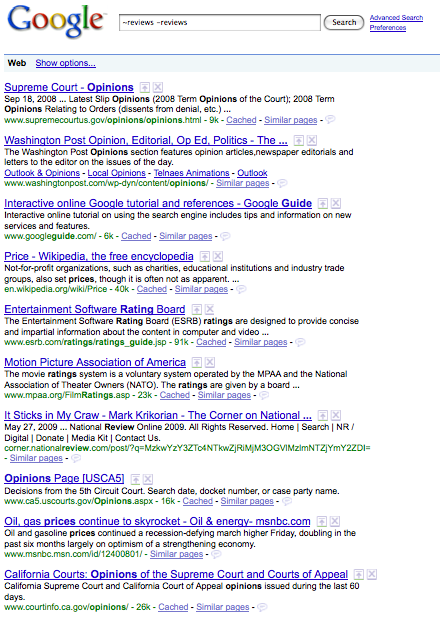
You can use the ~ operator to perform a synonym search. Coupled with a negative search for the same term and you can easily see the highlighted synonyms for that term. Here’s an example for the term ‘reviews’ (~reviews -reviews).

Google Synonyms

You’ll notice that ‘opinions’, ‘guide’, ‘rating’, and ‘prices’ are all highlighted and identified as synonyms.

There are also a few tools (here and here) that provide greater insight into synonym sets. SEO success is accomplished through doing a lot of little things right.

Synonyms are just one more way to help optimize your site and pages.

Google Suggests Ads

May 22 2009 // SEM // 1 Comment

This week Google made changes to Google Suggest (that drop down menu that provides the most likely completion for what you’ve typed) to include ads.

Similar to the navigational suggestions above, sometimes we detect that the most relevant completion for what you’re typing is an ad. When an ad is shown, we mark it with the text “Sponsored Link” and a colored background, as on the results page.

Google Suggests Ads

This isn’t surprising but it is another indication that Google is actively seeking to increase paid search clicks through other products. Yahoo! put ads in news alerts and Google already inserted ads into Feedburner (FeedSense) and likely will into Google Friend Connect (FriendSense).

Will there be any type of reporting for this placement and, if effective, could it actually garner a premium rate? Time will tell.

However, expect to see more of these ad integrations as Google looks to increase revenue and growth in paid search.

5 Reasons Why Paid Search Is Down

May 18 2009 // SEM + SEO // 5 Comments

The latest from Hitwise and Comscore show that the growth in paid search is slowing.

In the four weeks to May 9, 2009, 7.25% of search engine traffic to All Categories of websites was from paid clicks. This compares to 9.84% in the same four week period in 2008 – representing a 26% decline in the share of paid clicks.

Paid Clicks Declining

According to Comscore query volume grew 68% in the last two years while paid clicks grew only 18%. Now, lets be clear, paid clicks aren’t going down, they’re just not growing as fast.

There are a lot of theories about why paid search is sputtering. Here’s my analysis of five reasons behind the slow down.

Advertiser Decline

One theory is that the economy has forced many advertisers to abandon paid search. This is a compelling theory given the number of bankruptcies and marketing budget cuts.

Yet, nearly every survey (here, here and here) is showing that the economy has pushed more dollars online. And those online dollars were going to search – a medium giving advertisers far more control and, more importantly, providing a clear return on investment through analytics.

Search has become a near necessity these days and as the leader in search Google’s AdWords is a default part of many a marketing mix. Yet, the Google Tax has been going up.

The Google Tax? Anyone who has been advertising for more than three years can remember ten cent CPCs. CPC inflation was and still is a considerable problem. Yet we were all like frogs in a pot. The heat was turned up so slowly we didn’t really notice … until now.

Budget cutting forced companies to audit campaigns and what they found might have surprised them. The water was scalding hot!

Verdict: Probable.

Words per Query Up

The number of words per query are up and continue to rise. Many surmise that the increase in query length is directly related to less advertising coverage and fewer paid clicks. This theory presupposes that most advertisers are running sophisticated campaigns on exact match and are heavily using negative keywords.

My experience is that sophisticated campaigns are still infrequent. Most have broad match and phrase match full bore. But, for the moment, lets say this is the case for larger advertisers. That leaves all of the other advertisers who are presented with an AdWords interface that encourages broad match.

Though there is some data that shows coverage is down, I’m unsure it is related to the number of words per query. The number of broad match and phrase match advertisers simply seems too great for query length – particularly of such a small magnitude – to have had an appreciable impact.

Comscore Words Per Search

The graph is striking because of the scale. But it still amounts to a mere single digit percentage increase in words per query over two years.

Verdict: Unlikely.

Quality Score Suppression

Google has been using their Quality Score to ensure that relevant ads are presented for user queries. If Google determines your ad and landing page aren’t relevant you’ll be forced to pay more for the ad to be displayed.

The Quality Score isn’t always a reflection of reality. It is heavily influenced by the CPC your ad receives and overall account performance. Poor keyword research, account structure, copy writing and negative keywords could lead advertisers to pay more even though they have quality content.

Google’s implementation of Quality Score has weeded out poorly targeted ads. It has also increased the CPC for all advertisers. In this way, Quality Score may be contributing to the decline not through suppression but through making the Google Tax cost prohibitive.

Verdict: Possibly.

Better SEO

Search Engine Optimization (SEO) has improved. More and more sites have invested in SEO and have come to see it as a legitimate marketing strategy. ‘Why pay for it when you can get it for free?’ And that goes double when the economy hits the skids.

Search engines have also gotten better at SEO through algorithm tweaks and results presentation changes. From Yahoo’s SearchMonkey to Google’s Universal Search (local, video etc.), organic search results have become much more compelling.

What about Google’s Vince Change? The change to Google’s trust and authority algorithm resulted in top brands floating to the top of more search engine results. Could users be finding brands more often in organic search instead of clicking on branded ads?

Improving organic search has always been an odd balancing act for Google. Better search results improve retention and return rates. That means more ad impressions which should logically mean more paid clicks. But could organic search become too good and suppress paid clicks?

Verdict: Likely.

Mix-Shift of Queries

My own theory revolves around the mix of queries. What are people searching for and has that changed over time?

Look at the words per query graph again. What about those drops in December? Could commerce based queries be less diverse? We’ve already seen differences in transactional (left) versus informational (right) searches.

Transactional versus Information Query Eye tracking

In tough economic times could the shift in searches be away from transactional or product searches? Instead, are people searching for information or (low cost) entertainment online? Those areas may have less advertising coverage than traditional product queries.

As CPM rates have declined and CPCs have increased the ability for content based sites to participate in paid search may have dwindled. The economics just don’t work out nearly as often as they used to.

Is this not also reflected in the Hitwise numbers? Travel, insurance and retail are getting fewer paid clicks. Travel in particular seems transparent. In a recession fewer people are taking vacations leading to fewer paid clicks. In addition, travel agencies may pull back on paid search as a result of decreased demand.

And what about search refinements. Earlier this year I wrote about a Yahoo! study on how users were refining their queries.

Could users be refining their queries more frequently with a greater understanding that refinement will lead to better results? If so, I’d hazard that refined queries likely have a lesser chance of garnering a paid click.  These users are highly focused on the organic results to determine if their refinement was successful. This dovetails nicely with the informational search eye tracking study above.

Verdict: Probable.

Hodge Podge

Hodge Podge

In the end I’d bet it’s a little bit of everything mentioned with a dash of the unknown thrown in for good measure.

How, why and what people search coupled with the failing economy and an online advertising model in flux is going to have an impact on paid search.

Search, as a business, is still rather young. We’re all trying to learn what makes it tick and how it’s going to grow in the future.

This is what draws me to online marketing and search specifically. The answers aren’t black and white and the territory is uncharted.

And with that, what are your thoughts? What do you think of my analysis? Why do you think paid search growth is declining?

Google + Microformats = Rich Snippets

May 15 2009 // SEO + Technology // 1 Comment

Google adopts microformats. Finally.

What are microformats?

Microformats is a semantic markup that brings structure and meaning to metadata. In less technical terms it means you can tell search engines exactly what the content is versus having them guess. Google is supporting just two of the microformat standards initially – reviews and people – but seems committed to expanding their coverage in the future.

Why microformats matter

The upside to microformats is that search engines no longer have to guess. Remember, think of a search engine as a blind five year old.

A five year old may figure out that what they’re reading is a review by noticing the format or content of the text. (They can’t really ‘see’ a star rating.) A search engine might piece it together. You’d hope so but … they’ll often fail.

Microformats lets you put a big headline on the review that shouts ‘this is a review‘.

What are rich snippets?

If the search engine can understand and trust the metadata it can transform bland search results into something more robust and compelling. This is what Google calls a rich snippet.

Rich Snippets

Both Microsoft and Yahoo! adopted microformats long ago and Yahoo! has been using SearchMonkey to accelerate the display of robust search results. It was an area where I believed Yahoo! had an advantage and should have been seeking to exploit it more.

A rich snippet is far more attractive and will drive more clicks. It was rumored that Google was holding out because they didn’t want to create an inequity based on the ability to implement semantic markup.

Was Google trying to write an extraction program to interpret native code so everyone could obtain a rich snippet? Maybe they were, maybe they weren’t but they’ve clearly decided that rich snippets are important and microformats are the way to quickly deliver rich snippets in search results.

Microformats go mainstream

I’ve been a big proponent of microformats since being introduced to them by Chris Eppstein. I was so sure they’d go mainstream it was one of my 2009 Internet and Technology Predictions.

Does the adoption of microformats by Google fulfill that prediction? I think so.