— You Are At The Archives for the google Tag —

Impact of Google Instant

October 01 2010 // Analytics + SEO // 2 Comments

Everyone wants to know how Google Instant is changing search.

There’s been some great analysis on whether Google Instant has changed keyword length. While auto complete could certainly have an impact on query behavior, the impact so far seems to be negligible.

I’ve been more interested in whether Google Instant would change assessment behavior. I theorized that Google Instant might result in more clicks above the fold because users would become focused on watching – and assessing – search results as they typed.

Google Instant Rank Analysis

Each week I measure the amount of traffic produced by each rank via Google Analytics. Using this data across two large sites from different verticals, I’m able to compare traffic by rank the week prior to Google Instant’s launch versus the most recent week.

Google Instant Traffic by Rank

The distribution of traffic by rank certainly seems different. But there’s a good deal of noise in pulling this data.

First, while the volume of searches is high the number of data sources is low.

Second, the number of terms driving traffic at each rank and the query volume for those terms may have changed. (However, a quick analysis shows that the number of terms doesn’t have a bearing on the data.)

Lastly, the Google Analytics rank hack only captures a certain percentage of traffic where the ‘cd’ parameter is passed. Historically that was about 20% to 25% of search results. However, just prior to the launch of Google Instant that percentage shot up to ~40%. The subsequent weeks of decline in ‘ranked’ traffic don’t map to overall traffic patters, so I believe the amount of traffic with a ‘cd’ parameter has likely decreased.

Long story short, the variation by rank is the signal, not the actual changes in rank.

Google Instant Click Distribution

Has Google Instant changed the distribution of clicks by rank? If above the fold ranks are getting a higher distribution of clicks, SEO is not dead – its become more important than ever.

But what about the odd behavior of those with a rank of 1 or 2? Could paid search or Onebox presentations be sucking away traffic from the first and second positions?

Google Webmaster Tools should be able to provide some additional insight. Yet, as I was performing the analysis I came to realize that the search queries report in Google Webmaster Tools has less coverage (5% to 15%) then the Google Analytics rank hack (20% to 40%).

Furthermore, the coverage in Google Webmaster Tools is weighted by rank, with (far) higher visibility for higher ranks. I’m not sure analysis on lower ranks is reliable given the thin data set. However, I do see appreciable declines in CTR for both the first and second positions. This seems to support the data gleaned from Google Analytics.

Above The Fold SEO

If the distribution of clicks is changing, being above the fold could become increasingly important. Earlier this year Jakob Nielsen conducted a study that showed that users spend 80% of their time and attention above the fold.

Eye Tracking Page Distribution

Lets be clear, the prerequisite is that the user scrolls. Does Google Instant disrupt the natural inclination to scroll? I say yes, and I think the preliminary data points in that direction.

Eye tracking studies have already shown the difference in assessing informational versus transactional queries. I’d like to see these studies performed using Google Instant to determine if those patterns have changed.

Baring that, I’d like to expand my data set and appeal to others who have Google Analytics rank data to perform the same analysis. Do it yourself and post the results or send me the data and I’ll aggregate it with my current data set.

Either way, I believe it’s important to understand how search behavior may be changing and adapt accordingly.

Google Analytics Default Profile

September 24 2010 // Analytics + SEO // Comments Off on Google Analytics Default Profile

If you’ve used Google Analytics for any stretch of time, you probably have a number of different Google Analytics profiles for your website. For instance, you might should be tracking keyword rank in a Google Analytics profile.

Different profiles can be handy but often the one you use the most isn’t the default profile. Each time you log-in to Google Analytics it defaults to a profile based on an alphabetic sort. This is annoying and, sadly, Google hasn’t launched a new ‘select-as-default-profile’ feature. Instead, there’s a very simple and easy hack.

Google Analytics Default Profile Hack

First, click on Analytics Settings in your Google Analytics account.

Google Analytics Settings

From there, find the profile you want to be the default profile. Next to that profile, on the far right under the Actions column you should see an Edit option.

Edit or Delete Profile

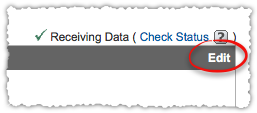
If you don’t see these actions, you don’t have the rights to make this change. Find someone with Administrator access or have them grant you that access. If you do see these actions, click Edit. Then you’ll want to edit the main website profile information. The Edit link is located at the upper right side.

Edit Google Analytics Profile

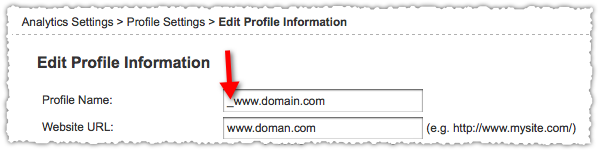
Now all you have to do is type an underscore at the beginning of your profile name. The example uses a domain entry, but it could just as easily be something like _My Website Name.

Underscore Your Profile

Then click Save and you’re done. Don’t worry, this will NOT impact the tracking on this profile. No data or history will be lost.

The underscore profile will now be the default profile since it’s first alphabetically. It’s certainly not the only way to do this, but this 1 minute hack can make your daily use of Google Analytics just a bit easier.

Facebook 2010 = Google 2003

July 03 2010 // PPC + SEO // 1 Comment

This isn’t a post about predicting the future of Facebook or taking sides in the Google v. Facebook debate. Instead, this is a warning.

Changed Traffic Conditions Ahead

Google 2003

AdWords was launched in October of 2000. In February of 2002 Google switched AdWords to a cost-per-click model. Later that same year the first Google Dance was held. By 2003, smart marketers were figuring out how to get the most out of AdWords.

Search volume continued to climb and the Google algorithm became more complex. Search engine optimization became more important and the landscape was changing … fast.

Facebook 2010

Facebook Ads launched in November of 2007. Today (figuratively, not literally) the platform seems to have hit critical mass. Thus far, most marketers have focused on engagement at the urging of the many social media experts/gurus/rock stars. “It’s about conversations” they shout.

But others are finding out how to make Facebook ads really work. Dennis Yu recently shared one of his Facebook ad secrets as well as how he’s using Facebook ads to increase Facebook fans.

In addition, Facebook has created more complexity and opportunity through the introduction of the Open Graph. Suddenly, Facebook search results can be seriously manipulated optimized. Like farms could spring up and savvy operators like Marty Weintraub will crack Facebook SEO.

Different But The Same

Google and Facebook are different, but figuring out PPC and SEO opportunities is the same. Compare the time lines above and you’ll see an eerie similarity. What I left out was that both Google and Facebook launched an advertising initiative approximately three years after launch. Am I the only one who sees the pattern?

Right now, I believe Facebook is at the same tipping point Google was in 2003. There is a tremendous opportunity for growth through experience. Jump in and start figuring it out. This is the fun part!

Those who aren’t afraid to fail are going to be the ones reaping the rewards.

Google AJAX Search Results

June 28 2010 // SEO // 2 Comments

A few months ago I wrote about how you could track keyword rank in Google Analytics. I said I’d blog about how to create ranking reports based on the new data but as I did due diligence on those reports I found something much more interesting.

AJAX Search Results Performance

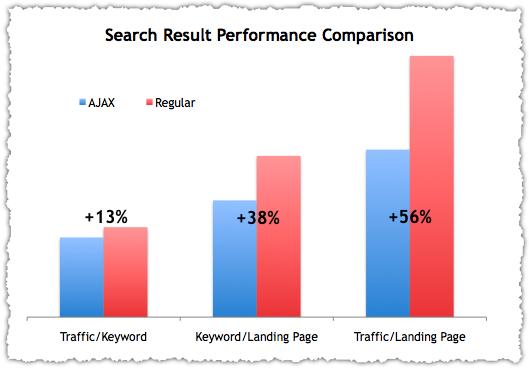
There is a profound difference in the performance of Google AJAX search results versus normal search results.
Google Search Results Comparison

Standard search results drive 13% more traffic per keyword, 38% more keywords per landing page and 56% more traffic per landing page than their AJAX counterparts.

Creating The Search Result Comparison

The Google Analytics rank hack captures a specific rank parameter present on AJAX search results. If that parameter doesn’t exist no rank is reported for that keyword. Upon implementing the GA rank hack you find that Google is serving AJAX results approximately 20% to 25% of the time. This is simply a product of looking at traffic that is reported with a rank compared to the total traffic reported in the profile.

You can also create advanced segments that include or exclude the AJAX search results by using the user defined value (Rank:) implemented in the GA rank hack. This gives you the ability to easily compare the performance of AJAX versus normal search results.

Each week I capture the amount of traffic as well as the number of keywords and landing pages that drove that traffic. I then create calculated metrics around traffic per keyword, keywords per landing page and traffic per landing page. There’s no real right or wrong number for these metrics, but it can be quite useful in trend analysis and, in this instance, for comparison analysis.

I’ve aggregated results from two large sites that come from very different verticals. Both showed similar results. I recognize that two is a small sample size so I encourage others to perform the same analysis to increase the confidence level of these results.

What’s Going On With AJAX Results?

It’s difficult to say with certainty why AJAX search results would perform so radically different than normal search results.

I first compared the Browser and OS profile for each to see if there was a distribution discrepancy. Sure enough, there is. Normal results are presented with far greater frequency (almost to exclusion) for the following:

  • Safari/Macintosh
  • Chrome/Windows
  • Firefox/Macintosh
  • Safari/iPhone
  • Safari/Android
  • Safari/iPad
  • Safari/iPod
  • Chrome/Macintosh

Yet, when I isolate Internet Explorer/Windows (sadly, the dominant combination) I see the same pattern for each result type. So while the difference in Browser and OS is interesting, it doesn’t seem to be the reason for the performance differential between AJAX and normal search results.

Could it be algorithmic? It seems far fetched to think Google would implement a different algorithm for AJAX search results. Nevertheless, lets put it down using the ‘no idea is a bad idea’ brainstorming methodology.

Perhaps it’s related to the presentation of search results. This makes a bit of sense since they are being rendered differently. But most people can’t tell the difference between the two, so I don’t think the way in which they are rendered would result in different user behavior.

But what about the intersection between algorithm and presentation? What if the implementation of Onebox, personalization or AdWords varied by type of search result? Could Google be using AJAX search results for testing purposes?

Further analysis leads me to believe this might be true.

The June Gloom Update

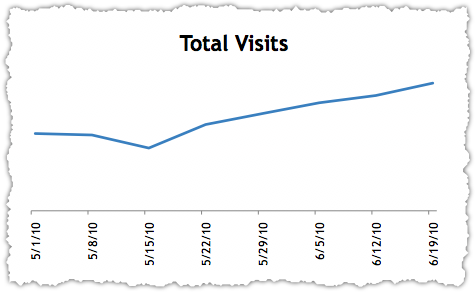
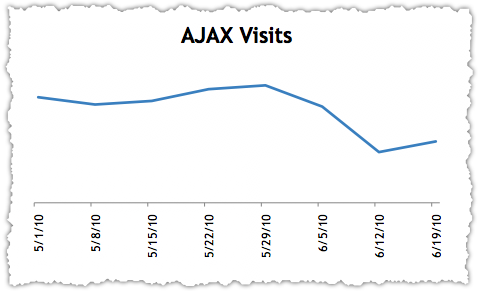
The thread of this analytic sweater began when I noted that total traffic from Google was going up but ranked traffic was going down.
Google Total Visits

Google AJAX Visits

The opposing trend lines don’t make sense. This strange trend began around June 1st which is why I call it June Gloom.

Of course, a simple explanation could be that Google was showing fewer AJAX results. So I dug further.

Ranked Traffic on Google AJAX Results

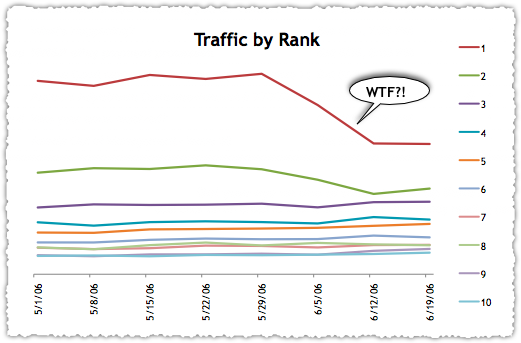
The great thing about the Google Analytics rank hack is that you can track the trend of each position.
Google AJAX Traffic by Rank

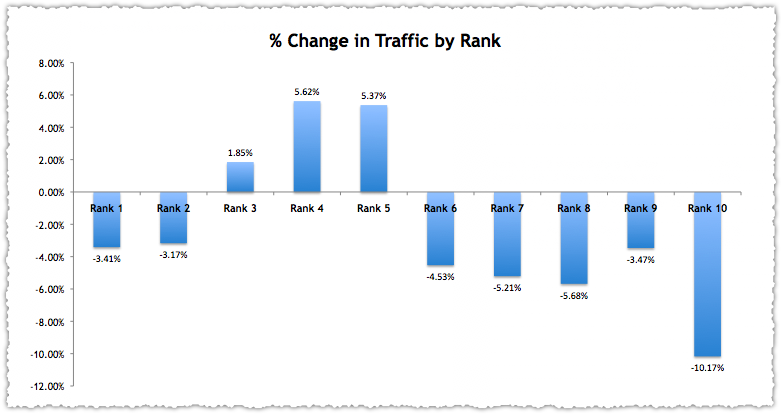
The trend for keyword rank 1 and 2 dropped dramatically (~40% and ~25% respectively) while all other ranks were flat or improved during the same period. The drop in traffic from rank 1 and rank 2 far surpassed the increases in traffic from all other ranks combined. Hence, the drop in overall AJAX results traffic.

Clearly, this same pattern is not happening with normal search results. If it was, the total traffic from Google would be going down. Instead it’s going up. This also indicates that it is not about how often AJAX search is presented.

What Caused June Gloom?

Maybe the tracking parameter is broken. It could, but that would mean that it was broken on just keywords ranked first and second, and that it was only broken on those ranks some of the time. This isn’t impossible, but it certainly seems improbable. Inspection of AJAX search results didn’t turn up any missing rank parameters.

I decided to check a handful of high volume keywords which had a number 1 ranking. An advanced segment for rank 1 can quickly identify these keywords. On both sites, the top performing keywords did not show any impact from June Gloom.

I double checked this by using the new Top Queries report in Google Webmaster Tools. Downloading and comparing the weekly data, I rounded the position number and then created a pivot table to look at impressions and clicks for keywords in the first position. There was virtually no difference in impressions, clicks or click rate pre and post June Gloom.

This doesn’t mean it’s not happening, it only means that it’s not happening on the top queries. Remember, the Top Queries report is not all inclusive and it probably draws from all results – both AJAX and standard.

If top queries were unaffected, it followed that long tail keywords were being impacted by June Gloom. This could be based on keyword volume, keyword type or number of words in the query. The latter was the easiest to test.

By using the Google Analytics API we grabbed keywords that had delivered traffic at rank 1. We used an Excel function to count the number of words and then created a pivot table showing the sum of clicks by word count. We then compared the distribution of traffic by word count in a pre and post June Gloom week. The result? The distribution was virtually the same.
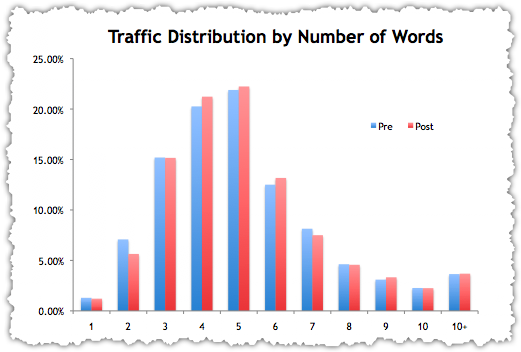
Word Count Traffic Distribution

So we can only theorize that long tail keywords based on volume or type are being impacted by June Gloom. What would do that? Greater AdWords reach? More personalization? A higher rotation of Onebox and/or 7-pack listings? Or maybe it is algorithmic. Unfortunately, we have been unable to find the smoking gun – that query or queries that present differently on each type of search result.

Or perhaps we’ve botched it – made a gross assumption or overlooked the obvious. Once again, peer review is encouraged.

Who’s this we? This is a good time to mention that my colleague Jeremy Post provided invaluable assistance in data gathering and in talking through the analysis.

June Gloom and Caffeine

These days no change in traffic can escape the Caffeine question. Strangely, there is some evidence of Caffeine in the data.

The number of landing pages driving total traffic has increased. Landing pages are up nearly 20% for standard search results and only down 3% for AJAX search results. In fact, one of the two sites saw a small increase in landing pages from AJAX results. The number of landing pages was least affected in AJAX results compared to the changes seen in traffic and keywords.

This leads me to believe that the improvements in crawl and indexation brought on by Caffeine may be adding more landing pages. However, these new landing pages haven’t yet acquired a cluster of keywords. This drives down the keywords per landing page metric. Essentially, the rate in which keywords are added is less than the rate landing pages are being added.

The difference on AJAX search results is that there were substantial keyword losses even as new landing pages were being added. June Gloom may actually have been tempered by the impact of Caffeine.

AJAX Results and June Gloom

The evidence suggests there is a difference between AJAX and normal search results. And June Gloom only serves to reinforce this theory.

SEO is supposed to be a zero sum game. One site gains traffic at the expense of another. Are other sites benefiting from AJAX results? What sites are now getting more traffic from those top two positions?

Of course, AJAX results and June Gloom could be the vehicle Google is using to test Onebox, 7-pack, personalization and universal search options. SEO is still a zero sum game … but the game board is expanding.

Are you ready?
Google’s Heisenberg Problem

June 13 2010 // SEO // 6 Comments

Google has a Heisenberg problem. In fact, all search engine algorithms likely have this problem.

Google Heisenberg Problem

The Heisenberg Uncertainty Principle

What is the Heisenberg Uncertainty Principle? The scientific version goes something like this.

The act of measuring one magnitude of a particle, be it its mass, its velocity, or its position, causes the other magnitudes to blur. This is not due to imprecise measurements. Technology is advanced enough to hypothetically yield correct measurements. The blurring of these magnitudes is a fundamental property of nature.

The quantum mechanics that go into the Heisenberg Uncertainty Principle are hard to follow. That’s probably an understatement. It is fascinating to read about the verbal jousting Heisenberg, Schrödinger and Einstein on the topic. (I’m envisioning what the discussion might look like as a series of Tweets.)

Yet, some of the mainstream interpretations you get from the Heisenberg Uncertainty Principle are “the very act of measuring something changes it” and, by proxy, that “the observer becomes part of the observed system”.

These two interpretations can be applied to Google’s observation of the Internet.

Google Changes the System

Observer from Fringe

Not only does Google observe and measure the Internet, they communicate about what they’re measuring. Perhaps quantum theorists (and those looking at comments on YouTube) would disagree with me, but the difference is also that the Internet is made up of real sentience. Because of this, the reaction to observation and measurement may be magnified and cause more ‘blur’.

In ancient SEO times, meta keywords were used in the algorithm. But the measurement of that signal caused a fundamental change in the use of meta keywords. This is a bit different than the true version of the Heisenberg Uncertainty Principle where measuring one signal would cause the others to blur. In this case, it’s the measurement of the signal that causes it and the system to blur.

Heisenberg and the Link Graph

Today the algorithm relies heavily on the link graph. Trust and authority are assigned based on the quality, quantity, location and diversity of links between sites. Google has been observing and measuring this for some time. The result? The act of linking has blurred.

The very act of measuring the link graph has changed the link graph.

In an unmeasured system, links might still be created organically and for the sole purpose of attribution or navigation. But the measured system has reacted and links are not created organically. The purpose for a link may be, in fact, to ensure measurement by the observer.

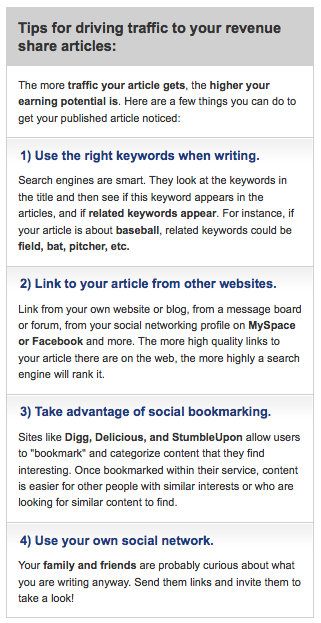
Nowhere is this more clear than Demand Media’s tips to driving traffic.

Demand Studios Traffic Tips

Clearly, the observer has become part of the observed system.

Social Search Won’t Help

There are those who believe that moving from document based measurement to people based measurement will solve algorithmic problems. I disagree.

In fact, the people web (aka social search) might be more prone to blur than the document web. Documents can’t, in and of themselves, alter their behavior. The raft of content produced won’t simply change on it’s own, people have to do that. And that’s precisely the problem with a people based algorithm.

Think links, social mentions and other Internet gestures are perverted by measurement now? Just think how they’d change if the measurement really were on people. The innate behavior of people on the web would change, as would their relation to documents. Do I have to mention Dr. House’s favorite mantra?

No, social search won’t help. Is it another signal? Sure. But it’s a signal that seems destined to produce a higher amount of blur.

Does Google Measure Blur?

Does Google have an attribute (meta data) attached to a signal that determines the rate or velocity of blur? I have no idea. But those folks at Google are pretty dang smart. And clearly something like that is going on since signals have gone in and out of favor over time.

At SMX Advanced 2010, Matt Cutts made it clear that the May Day algorithm change was made, primarily, to combat content farms. These content farms are a form of blur. The question is what type of signals did they trace the blur back to? Were they content based signals (e.g. – quality of content based on advanced natural language processing) or link based signals?

Does Google realize they are, inadvertently, part of the problem? Aaron Wall believes it’s more intentional than inadvertent in his excellent How To Fix The Broken Link Graph post.

Should Google Shut Up?

Shut Up Google

Google has always been somewhat opaque in how it discusses the algorithm and the signals that comprise it. However, they are trying to be better communicators over the last few years. Numerous blogs, videos and Webmaster Central tools all show a desire to give people better guidance.

You’ll still run into stonewalls during panel Q&A, but more information seems to be flowing out of the Googleplex. On the one hand, I very much appreciate that, but a part of me wonders if it’s a good thing.

In this case, the observer is clearly acting on the system.

Should Google tell us meta keywords are really dead? Or that they don’t process Title attributes? Or that domain diversity is really important? Sure, we’ll still have those who postulate about the ranking factors (thank you SEOMoz), but there would be a lot less consensus. It might produce less homogeneity around SEO practices, or in other words, the blur of other signals might lessen if the confidence in signal influence weren’t as clear.

It’s not that the algorithm would change, but perhaps the velocity in which a signal blurs beyond usefulness slows.

The Solution

Well, there really isn’t a solution. A search engine must observe and measure the Internet ecosystem. Acknowledging that they’re part of the system and working on ways to minimize their disturbance of the system would be a good start. Hey, perhaps Google already does this.

The number of signals (more than 200) may be a reaction to the blur produced by their measurement. More signals mean a distribution of blur? But I somehow doubt it’s as easy as a checks and balances system.

Google could maintain very different algorithms – 2 or even 3 – and randomly present them via their numerous data centers. However, they’d all have to provide a good user experience and it’s been difficult for Google to maintain just the one thus far.

I don’t have the answer, but I know that the rate in which the system blurs as a result of Google’s observation is increasing. I believe Google must account for this as they refine the algorithm.

What do you think?

Google Caffeine Is Not An Algorithm Change

February 05 2010 // SEO // Comments Off on Google Caffeine Is Not An Algorithm Change

Google Caffeine

There’s still a lot of speculation and conjecture about Google Caffeine. More than a few have analyzed and theorized based on the preview Google provided. Some have even given tips on optimizing for Caffeine. Don’t believe the hype.

The Google Caffeine Myth

Google Caffeine is not an algorithm change. That’s not to say that the results won’t change here and there, but for the most part the actual scoring is unchanged. There are no special techniques or changes needed to address Google Caffeine.

What is Google Caffeine?

Google Caffeine is a re-architect of the entire indexing system for performance. In short, Caffeine:

  • allows Google to crawl and index more pages
  • allows Google to crawl and index pages faster

The result? The indexing data fed into individual signals is more robust and updated more frequently. This might produce some slight changes to results, but only because of the change in data, not in the change in scoring.

In Google terminology, Google Caffeine increases the rate of data refreshes. I recommend you read and listen to what Matt Cutts has to say on the topic. Vanessa Fox was also a voice of reason with her Search Engine Land Google Caffeine review.

Now, in re-architecting the indexing system, not all data structures are 100% compatible. So, some tiny changes have likely been made, but they’re not meant to be algorithmic changes.

Why Ask For Caffeine Feedback?

Google provided the SEO community with access to Caffeine results and asked for feedback. This request was looked upon by many as an indication that this was an algorithm change.

In fact, this request was a type of distributed QA. The goal of the new indexing system is to increase performance but not appreciably change the algorithmic results. Letting a bunch of hyperactive SEOs into the sandbox helped them to identify any flaws to their re-architected code.

Why Re-Architect The Indexing  System?

Most seem to believe the impetus for Caffeine was around real-time search. I’m sure this was factor, but I doubt it was the primary reason. Google could have pulled off real-time search without Caffeine.

The indexing code in use was written ages ago in Internet-time. Since that time, the Internet has grown and changed dramatically. Algorithmic changes and new signals could only go so far in ensuring quality results. If the data set they were using was incomplete or ‘old’, no amount of signal tinkering would have the desired impact. It’s a simple GIGO problem.

Google needed more data to better inform the algorithm. They need to see more of the Internet. More links. More page changes. Any of you who have ego based Google Alert feeds would have noticed a substantial increase in activity over the last month. It’s not that you’re getting more popular (sorry), Google’s just indexing more and doing so faster than ever before.

Caffeine Is The Beginning

The real question should be what will Google do once Caffeine is fully implemented. Once Google gets all of this data, new patterns will emerge and algorithm changes are certain to follow.

Google 2.0

February 02 2010 // SEO + Web Design // 1 Comment

Google has recently been trying to streamline search results as the number of universal search elements grows. It’s what Marissa Mayer, VP of Search Products and User Experience, calls ‘user interface jazz’.

Solving Google’s Jazz Problem

Recent attempts to solve the jazz problem have revolved – primarily – around a left contextual navigation pane. Whether it is always exposed or only introduced when clicked, Google seems sure that this is the way to solve search overload.

But is it really?

Google and Web 2.0

Google is rooted firmly in Web 1.0. There’s (clearly) nothing wrong about that. Yet, the interface hasn’t changed all that much as the web has evolved. While Mayer acknowledges the bimodal world of screen sizes (larger desktop screens but smaller mobile interfaces), does the interface fully acknowledge and take advantage of these advancements?

The Splinternet is real and seems only to be expanding with the launch of the iPad.

New User Interfaces

Some of the most interesting new interfaces are far more visual and horizontal in nature, allowing the user to digest more information at a glance. Think about what Google search results could look like if they used an interface like Lazyfeed or the Times Skimmer.

Google 2.0

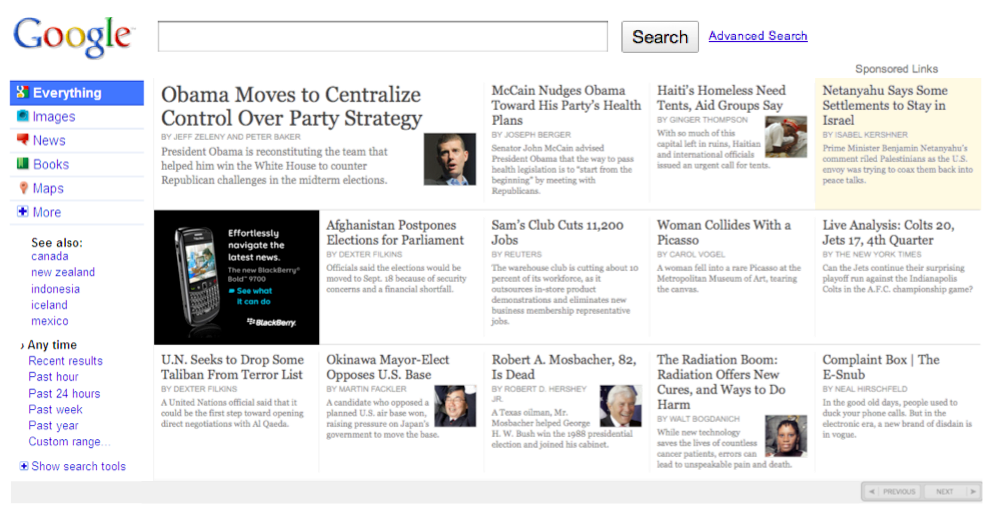
Here’s a quick Frankenstein of what Google 2.0 could look like using a bit of Google’s Jazz UI and the Times Skimmer.

Google 2.0 User Interface

One or all of these results or panes could update in real-time. Another could present a fully embedded video. Yet another could present thumbnails for image matches. The possibilities, while not endless, are numerous.

I’ve kept the left hand navigation, but you could just as easily do without it. In fact, that would better adhere to Google’s search motto: don’t make the user do something we can do for them.

Google Takes The Safe Route?

Of course, Google would need to determine how to present AdWords effectively in this environment. Perhaps the fear of disrupting AdWords revenue is why a major UI change isn’t in the cards. But this seems like a contradiction in how Google sets goals and measures success.

Achieving 65% of the impossible is better than 100% of the ordinary – Setting impossible goals and achieving part of them sets you on a completely different path than the safe route. Sometimes you can achieve the impossible in a quarter, but even when you don’t, you are on a fast track to achieving it soon. Measuring success every quarter allows for mid course corrections and setting higher goals for the next quarter.

Maybe Google has already tested radical new UI with unsatisfactory results. Or maybe Google is taking the safe route, thinking that the search interface can remain relatively static as the web transforms.

Is Google really doing enough to solve user interface jazz?

Google Brand Search Results

December 15 2009 // SEO // Comments Off on Google Brand Search Results

In late October Google launched a new type of search result for brand queries. Noted on Google Blogoscoped, a brand search result takes up an enormous amount of real estate and is composed of one regular listing and two indented listings.

When are brand search results shown?

The brand result is only triggered by certain queries. Oddly, it’s not just a brand name. Instead, it’s a brand name coupled with another keyword or keywords.

So, a search for ‘Peet’s’ will not trigger a brand result. But a search for ‘Peet’s Major Dickason’ will.

Google Brand Result

Is it really about brands?

Upon the launch of this new result it seemed like it was solely a function of what was in the domain. A search for ‘wooden bar stools’ triggered the new result.

Google Brand Result

Here, the domain of bar-stools-barstools.com triggered the new result when it matched the ‘brand + modifier’ query. A simple domain match against the keyword query, right?

Yet, when you search on this same term today you don’t get the new brand result.

Google wooden bar stools query

So what started as a simple domain match has evolved into something more refined. This isn’t capricious in nature. Google is always looking for ways to improve search quality. In this scenario they have weighted the actual brand or company site as more authoritative for a fairly large set of ‘brand + modifier’ queries.

What’s the criteria for Google brand search results?

How Google is doing this refinement is unclear. Some have surmised Google is using some sort of brand database or that it’s related to their DNS service.

I tend to believe there was some sort of initial criteria (broad in nature) for this new brand result with a built-in refinement mechanism. The refinement would be accomplished through analysis of user behavior on these results (e.g. – relative CTR and length of clicks), SearchWiki data or human editing.

User behavior might be difficult to mine since the large amount of real estate brand results take up likely make them click magnets. And click length might describe the value and quality of the site but not whether it merits the brand result presentation.

SearchWiki data and human editing are essentially the same concept, with the former being accomplished by a decentralized group of users (the proverbial cloud) and the latter being done by a centralized group of Google employees. Human editing doesn’t seem that far-fetched to me, particularly if Google used user behavior or SearchWiki data to identify domains for review. The result would be an easy and efficient review queue.

Why is Google interested in brands?

No matter how Google is doing it, the fact that they are is a signal that brands and companies provide a new proxy for trust and authority. The first step in this direction was the Vince change which unseated many highly optimized sites from root terms and replaced them with relevant brands or companies.

The current algorithm continues to struggle with trust and authority with 0ver-optimization reducing the value of on-page factors and the rise of link pollution quickly eroding the value of off-page factors.

Google brand search results show a continuing interest in moving beyond current signals to improve search quality and deliver better results. So while the new brand search result went largely unreported, it could be a harbinger of a larger algorithmic shift in 2010.

Google Search Innovation Accelerates

October 27 2009 // SEO // Comments Off on Google Search Innovation Accelerates

It’s not your imagination. Google’s rate of search innovation has accelerated. Google has marched through shopping Onebox enhancements (9/14), expanded forum listings (9/14), anchor based jump to and site links (9/25), Search Options expansion (10/1), Quick View PDFs (10/7), Twitter integration (10/21) and Social Search (10/26).

You could even include ancillary search innovations like Sidewiki (9/23) and fetch as Googlebot (10/12).

Gooogle Search

It’s been so fast that Google launched a series of weekly blog posts (This Week in Search) to keep up with the changes.

Pent Up Search Innovation?

For the past few years Google has stated in numerous venues that they didn’t particularly want to grow their share of the search market. They explained that extending their market share lead could incur the wrath of government oversight or create user backlash.

The jaded in the audience rolled their eyes and even the purists probably furrowed their brow. Sure, it makes a bit of sense but … really?

Yet, the timing of these recent search innovations is intriguing.

Bing Allows Google To Innovate

Microsoft’s latest dedication to search could be the reason for Google’s recent spate of search enhancements. Before Bing went live Google rolled out rich snippets, making Google last to the rich listings party. The preemptive move secured a certain search parity in the space.

That box checked off, Google sat back and watched as Bing innovated, advertised and finally partnered with Yahoo. Bing’s share began to inch up toward 10% and that seemed to be enough for the search behemoth to release the hounds engineers.

One gets the impression that projects that had once been stashed in a drawer were suddenly taken out, dusted off and quickly deployed.

What else does Google have in store for us?

Short Clicks versus Long Clicks

September 22 2009 // SEO // 17 Comments

Long Clicks vs Short Clicks

Google wants to see long clicks not short clicks. That’s the new SEO terminology coming from Google.

What’s a Long Click?

A long click occurs when a user performs a search, clicks through on a result and remains on that site for a long time. They don’t come back to the result set immediately to click on another result or to refine their query. In general, long clicks are a proxy for satisfaction and success.

What’s a Short Click?

A short click is the opposite of a long click. (No duh!) A short click occurs when a user performs a search, clicks through on a result and quickly comes back to the result set to click on an alternate result. In general, short clicks are a proxy for dissatisfaction and failure.

How is Google Tracking Click Length?

No, it’s not through Google Analytics. They’re not peeking at bounce rates. Instead Google is measuring pogosticking activity by leveraging their current tracking mechanisms. Remember, Google already tracks the user, the search and the result clicked. All Google needed to do was to accurately model the time dimension.

Why are Long Clicks Important?

Long clicks are important to Google because it gives them a way to measure the satisfaction of the result based on downstream behavior. Sure, a result might get a lot of clicks but did it actually satisfy the query?

Is it a success if 100 people click but 98 go back within 10 seconds? What if those 98 people all clicked on an alternate result?

Google knows that the search algorithm still isn’t that smart. It routinely makes mistakes and can often be led down the wrong path by aggressive search engine optimization. Long clicks provide a feedback mechanism, a type of human quality assurance that is lacking in the algorithm.

Long clicks are important to you because they will may help increase your SERP rank.

The chatter from Google makes me believe that it is part of the algorithm. How much it is weighted now and in the future remains to be seen. One way or the other Google is saying that longer is better.