Paid Inclusion Obscures Yahoo SEO

October 09 2008 // Marketing + SEO // 1 Comment

Yahoo’s organic search results aren’t always organic. I don’t think the average Yahoo user has any idea that many Yahoo search results are paid listings via Yahoo’s paid inclusion product, Search Submit Pro. It’s sort of like buying organic apples and finding out some of them were sprayed with pesticide.

Yet, I can see my way past the ethical minefield paid inclusion presents. There is no expressed contract that states that the organic search results are 100% organic. That’s an assumption that many users make and which Yahoo simply fails to correct. There’s no 100% organic ‘sticker’ on the Yahoo search results.

The real question for me is how paid inclusion impacts search engine optimization (SEO). “Why do I get only 5% of my organic traffic from Yahoo when they’re 20% of the search market?” This is a common refrain I hear from a rising tide of companies. There are a number of possible explanations for this discrepancy.

Sites optimize for Google and not Yahoo

Google is the force in search with a 63% market share in August 2008. For that reason, sites optimize for Google first and Yahoo a distant second. The algorithm for each is different with Google placing far more weight on off page factors like links.

In particular Google seems to have a better quality link algorithm that helps place sites in appropriate neighborhoods of knowledge. Yahoo certainly looks at links but it seems tied to link popularity and link ratio. This means you have to overwhelm Yahoo with inbound links to really have an impact.

Result: Google optimization might not help you with Yahoo.

Yahoo’s index is slow to update

There’s no question that the Yahoo index is slow to update and is less agile than Google’s index. What Google indexes and categorizes in hours could take Yahoo weeks or months. It’s not that it doesn’t get into Yahoo’s index, it’s that Yahoo doesn’t categorize it so that it can be served to users for relevant searches. In many ways it might as well not exist.

Google is also constantly tweaking the search algorithm. If you’re working in SEO you’re accustomed to the changing nature of the Google algorithm. However, It’s unclear how often Yahoo changes its algorithm, but it’s far less than Google and it’s not nearly as big a deal when they do. The Yahoo search index has calcified.

Result: It could take a long time for your efforts to pay off on Yahoo.

Paid Inclusion takes up search engine result shelf space

While there are no guarantees that paid inclusion will get you top results, it certainly takes up shelf space on search results. As more companies use paid inclusion, the number of organic search results goes down, making it more and more difficult to optimize vital keywords.

It seems logical that Yahoo, particularly in its current financial situation, would want to increase the number of paid inclusion results. As a cost per click product it would mean a greater probability of generating revenue with every search engine result page.

What’s the keyword coverage for paid inclusion? What’s the average number of paid inclusion listings to organic listings? These paid inclusion statistics aren’t available, so it’s difficult to understand the real effect of paid inclusion. Instead we can only deduce from watching our SEO efforts and tracking organic search volume.

Result: Paid inclusion might not be the culprit, but it introduces another variable that defies tracking, thus obscuring all other SEO efforts.


Google Deploys Multiple Algorithms?

October 03 2008 // SEO + Technology // Comments Off on Google Deploys Multiple Algorithms?

Over the past few months it seems like Google might be experimenting with having multiple search algorithms in the field at once. We’re all well aware (or should be) of the A/B practice that Google has implemented for years. Google dances, when a major algorithm update goes live, are a normal part of SEO life.

But what if that changed?

What if Google decided to have 3 or even up to 5 search algorithms in the field at the same time. That’s what I’ve been seeing lately, though they seem to have stopped in the last week or so.

In a given hour I would see at least 3 different search results for terms related to my used books blog and those related to a number of my clients. (And yes, I had personal search off.) I’m now kicking myself for not documenting these very different search results.

This could simply indicate an accelerated testing framework for the algorithm or it could be an attempt to thwart web spam and those that try to ‘game’ the algorithm. Think about it. If there was no one dominant algorithm in the field at any given time it would become difficult to ‘game’ Google.

You might find a weakness to exploit in one algorithm but do you scale a program if it only represents 30% of the search traffic? Could Matt Cutts have found a creative way to prevent web spam?

As always there’s little concrete evidence of what is actually going on under the hood at Google. And the silo driven nature of Google’s workplace ensures that most at Google wouldn’t know either. I do find it interesting that during the same time period many search tools became inoperable. SEO Chat has the following message for a number of their tools.

Even if Google is not going to field multiple search algorithms, it seems clear that their testing mechanisms have evolved. The speed in which the algorithm evolves might be accelerating. As such, it makes it more difficult to determine when a true algorithm change has occurred.

If Google does implement a multiple algorithm strategy it would help encourage sites to focus on basic SEO principles which would wind up being good for search engines and users alike.

AIG Irony

September 27 2008 // Economy + Humor + Rant // Comments Off on AIG Irony

Did you notice the back cover of the October 2008 Money magazine?

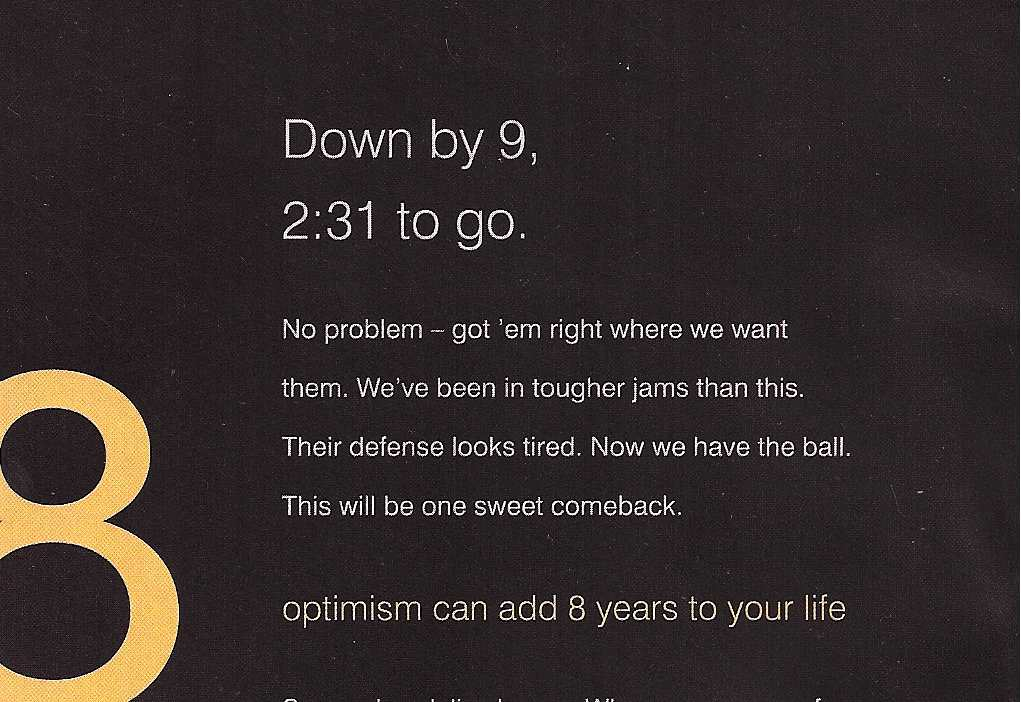
Yes, it’s an AIG ad. Here’s a close up of some of the text.

We’ve been in tougher jams than this? Apparently not.

Chrome is about Search

September 26 2008 // Marketing + Technology // 2 Comments

Google Chrome LogoThere’s a lot of talk (very good analysis actually) about Chrome in terms of functionality and technology. Sure, what’s under the hood is interesting and I’m intrigued by the speed tests. Yet, at the end of the day, I believe Chrome is really all about search.

Let’s first look at two core components that were absent from the launch. There are no add-ons and there is no Mac version. This tells me that the competitive target is not Firefox or Safari. It tells me that Chrome is aimed at converting more WIndows/IE users to Windows/Chrome users. (Yes, yes, it has an open API but that’s different then supporting add-ons a la Firefox.)

Next let’s look at how they’re marketing Chrome.

Google Chrome is a browser that combines a minimal design with sophisticated technology to make the web faster, safer, and easier.

One box for everything
Type in the address bar and get suggestions for both search and web pages.

Thumbnails of your top sites
Access your favorite pages instantly with lightning speed from any new tab.

Shortcuts for your apps
Get desktop shortcuts to launch your favorite web applications.

Faster. Safer. Easier. One box for everything. Shortcuts. I believe the messaging is aimed not at the early adopter but at the early majority instead. While the technology is sophisticated, the end product is simplistic.

A legion of folks exist out there who don’t even know they have a choice in how they surf the Internet. People aren’t going to be easily swayed by a relatively unknown brand like Firefox. But Google? Hey now, they know Google. They trust Google. They use Google!

Sure they can import their settings, but how many of them will and how many of them even knew about their settings in the first place? Google has disrupted inertia and created an artificial switching window. During this critical time, I believe more will choose to use Google as their default search engine. There is a subtle psychological pressure exerted by using Google’s browser that will encourage users to use Google as their search engine.

One could argue that many of these same users already use Google. And that’s true. But they’re also confused about exactly what to do when they want to search or go to a website. Remember that the top search terms in August were ebay and myspace. So these people could be accidentally using IE’s default search engine from time to time.

And that’s where the omnibox (aka ‘the god box’) comes in. Chrome’s one box for everything appeals to the same user who is confused about when they search and when they type in a website address. If my supposition above is correct, then Google suddenly has far more control over searches and, even more far reaching, directing users to specific destinations.

Google Chrome is about taking more of the search market away from Microsoft and Yahoo. As such, it is one of the few Google initiatives that I believe is perfectly aligned with their core business.

Tabbed Browsing Changes Everything

September 24 2008 // Marketing + Technology // Comments Off on Tabbed Browsing Changes Everything

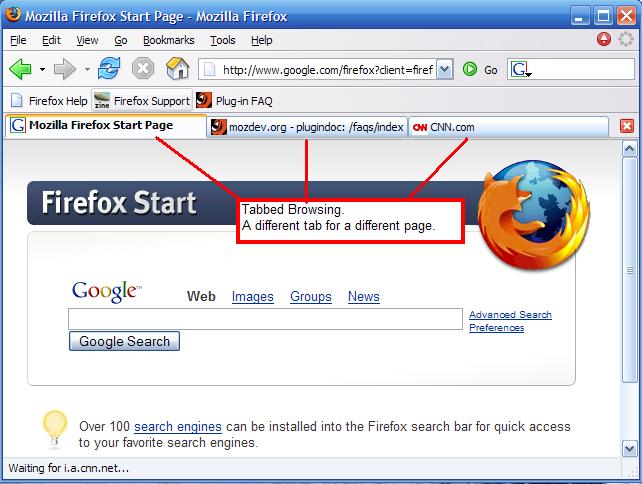
Tabbed browsing doesn’t seem to get the attention I think it deserves. Sites, strategy and brands will need to adjust as more and more of the early and late majority begin to use and understand tabbed browsing.

There was a lot of talk about how increased broadband usage would change the Internet landscape. The time it took to get from one site to the next was greatly reduced by the speed of connection. Yet, tabbed browsing takes that concept to the next level.

A 2006 article about tabbed browsing and its effect on web analytics framed the issue nicely.

Tabbed browsing has made comparing products, shopping for the right price, and researching products that much easier. For example, Chris is looking for a plasma television for his new home. He opens the browser and starts looking at ratings on Epinions. As he explores the ratings, he pops open links to pricing for a few different TVs in tabs. He decides to research a few different models on manufacturers’ sites.

The assumption is that review sites like Epinions or price comparison engines will continue to be the hub or start of any research on a product. I’m not sure this is a valid assumption. From my perspective, the de facto start to almost any (re)search for a product or service is a search engine – Google.

So what exactly does tabbed browsing mean to sites and brands?

Tabbed browsing means a greater focus on brand.

Users are going to be more apt to float from one site to the other for their purchases. The ‘switching costs’ of going from one site to the other is now virtually none. You want your site to be the first place users go or think of for your product or service. You’re also hoping that your brand is strong enough to suppress the tabbed browsing behavior.

The only way to circumvent Google is to have a site or brand that has a greater influence or mindshare for that niche. As an example, Amazon may still have the brand horse power to attract direct traffic for those looking for a book.

Strong brands don’t necessarily need to participate in shopping comparison sites since many users might simply check that brand’s offering in another tab whether or not they are displayed. Southwest airlines has largely taken this approach.

Tabbed browsing means user interfaces must be streamlined and easy.

Once you get a user to visit your site, the user interface must be incredibly easy. Confusion or roadblocks to purchase will give users time to open another tab. Whether it is to find another site with the same product or simply frustration induced ADD is immaterial. Sites must focus on making it difficult for users not to follow the appropriate conversion path. Lead generation marketers are a step ahead in figuring this out.

Tabbed browsing means sites need to invest in SEO.

If your brand isn’t strong enough to bring direct traffic the only way you can be first in the door is through search engine optimization. In addition, as users refine searches in subsequent tabs you want your site to continue to be served in the top results. Repetition will have a beneficial effect.

A new goal might be to have your site open in multiple tabs for any given user? And lets not forget that many confuse search with the address bar, pushing what could be direct traffic into searches. Weaker brands can leverage SEO against bigger brands.

Tabbed browsing means engagement is a better metric for success.

Engagement is going to become a much better metric for success since many will simply keep multiple sites open on a daily basis. I interact much more with FriendFeed but I usually still have Facebook and LinkedIn open in another tab. How this translates into online advertising is another interesting discussion.

Tabbed browsing could overwhelm users.

As people begin to use more and more tabs, it may lead to a backlash of sorts as it relates to Barry Schwartz’s The Paradox of Choice. Essentially, more choices doesn’t always lead to more purchases. In fact, in many cases it suppresses purchase behavior. This could mean a general deceleration in eCommerce growth or renewed reliance on trusted and/or known brands.

Google Chrome has upped the ante by creating a default tab page that includes your nine most visited pages. A quick survey of early adopters on FriendFeed shows the number of open tabs to be around 6 on average. I could argue for both fewer or more tabs on average for early and late majority users.

Time will tell. It is my opinion that tabbed browsing changes everything and we haven’t begun to determine how exactly it will play out.

Use Wordle as a Keyword Density Tool

September 23 2008 // SEO // 1 Comment

Keyword density is an easy way to tell search engines what your site is about. In other words, what words does the search engine find most often on your site or page or blog post. If you’re following my blind five year old principles you know how important this type of repetition is to a search engine.

There are plenty of tools you can use to figure out keyword density. However, most provide the results as a percentage which, while informative, doesn’t always help tell the whole story or provide the most impact. Instead, I suggest using Wordle.

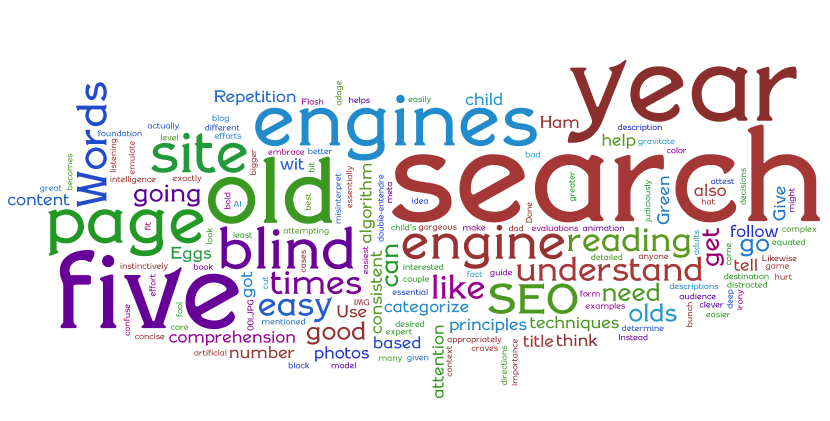
Wordle is a toy for generating “word clouds” from text that you provide. The clouds give greater prominence to words that appear more frequently in the source text. You can tweak your clouds with different fonts, layouts, and color schemes. The images you create with Wordle are yours to use however you like. You can print them out, or save them to the Wordle gallery to share with your friends.

Copying your blog post text and creating a Wordle word cloud makes it much easier to quickly determine how a search engine might interpret your content.

Once you create your Wordle word cloud you’re looking to see which words immediately jump out at you. This is what the search engine will see. It’s as easy as that.

Here’s a Wordle word cloud from my first blog post.

Here are some simple guidelines for using Wordle as a keyword density tool.

If no words immediately jump out, you’ve got a problem.

If the wrong words jump out (e.g. – your post is on ‘iPhone battery life’ and the words ‘refurbished ottoman chair’ are most prominent), you’ve got a problem.

To make it even more interesting, print out your Wordle and tape it to the wall, then take three big steps back and find out what you can still read. Once again, this is a good proxy for how your post will be received by search engines.

The visual nature of Wordle makes it easy to quickly determine if you’re on the right track. It’s not rocket science. You’re not measuring whether the density is 5% or 8%, you’re simply using the quick (and fun) visual technique to make sure you’re giving your content the best chance of being seen by interested users

It might not have been created as a keyword density tool, but Wordle is a great tool for the casual blogger who wants to do some basic search engine optimization.

Use the NOINDEX Tag If You ‘Blog For Yourself’

September 20 2008 // SEO // Comments Off on Use the NOINDEX Tag If You ‘Blog For Yourself’

Search Engine Optimization (SEO) seems to be a dirty word in some circles. Many seem to think it’s some vile technique that only marketers use in an effort to trick people to get to their site. (The word marketers is spoken as if they’re an unruly bunch of war criminals.) When pressed for why they don’t implement even basic SEO, many of these same people will state piously “I blog for myself!”

So I say to these people, please, use the NOINDEX Tag.

If you are blogging for yourself then there’s no real reason for you to be in Google’s search index, right? I mean, why exactly do you have a blog anyway? If you’re blogging for yourself couldn’t you just write it up in Microsoft Word, read it over again with a satisfied smile, pat yourself on the back and be happy? Tell Google and other search engines to ignore your blog and use the NOINDEX Tag.

Yes, I’m being very literal here, but it helps to make my point.

You’re not blogging only for yourself. You do want others to read what you’ve written. Not every SEO technique is something a casual blogger should employ. However, use my blind five year old principles to help implement rudimentary SEO. Not only will this help people find your content but it will likely make your content just a tad more readable and accessible.

And that is what SEO is about. It’s about making sure the people interested in your content actually find it.

Inspiration In My Wallet

September 19 2008 // Career + Life // Comments Off on Inspiration In My Wallet

I’m a bit of a minimalist when it comes to my wallet, never wanting to come close to having the dreaded Costanza wallet. However I carry one very important business card.

I picked up this card in a Starbucks down in Margate, NJ. I have no interest in surfing but was drawn to it for a couple of reasons. First was the superficial simplicity of a placid blue ocean as the business card’s design. The marketer in me thought that was brilliant.

The second reason was a lot deeper. I looked at this card and thought, here’s a person who’s doing exactly what they want with their life. It represented the ability to take life by the horns and steer your own course. The business was about making a living, but likely not about making a fortune. I imagined that Dominick got a lot of satisfaction out of his business.

I keep the card in my wallet to remind me that there are options. That I should pursue my passion and try not to settle.

Beware of MonkeyClicks

September 18 2008 // SEM + SEO // 6 Comments

When I started managing my first search engine marketing (SEM) program at Alibris I quickly found that being the first ad on a Google search result wasn’t working. It seemed a bit counter-intuitive. The volume was great but the conversion was atrocious. But I had a theory for this phenomenon that I quickly dubbed MonkeyClicks.

My MonkeyClicks theory is that a user tends to click on the first result on the page regardless of whether it really meets his or her needs. It is plain ol’ human behavior. A knee jerk reaction of sorts. So you get a tremendous amount of volume. However, that first click doesn’t always match the needs of the user and even if it does they will often return to the search results to determine whether other options exist.

If you think of this outside of the small world of search engine marketing it makes perfect sense. If I’m looking to buy a car I’m likely not going to look at the first advertisement I see and then run off and buy that car. If I’m looking to buy a new bicycle on Craigslist I’m going to look at a number of matching results, not just the first one.

This makes sense but lets back it up with some data. (I like data!) Back in 2006 AOL accidentally released a chunk of user search results. It showed that 42% of all clicks on the first page of results came from the first position. In comparison, the second position racked up a distant 12% of clicks.

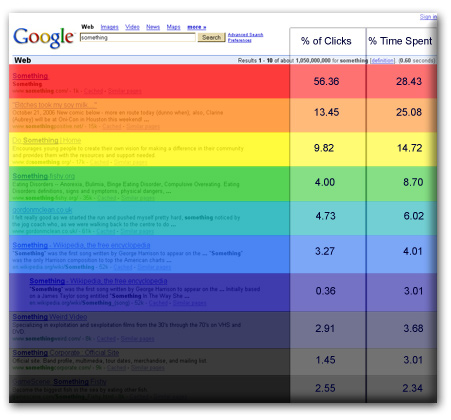
Another eye tracking study by Cornell, and reported by seoresearcher, showed the disparity in the % of clicks and % of time spent on each search result.

Google SERP Click Distribution

The ratio of clicks to time spent on the first position is a classic example of MonkeyClicks behavior. The first position garnered 56% of the clicks but only 28% of the time spent.

All of these studies are done with natural search results, but I’d argue that the paid results will look very similar. Not to mention that I’ve seen this time and again as I manage various SEM programs.

However, your mileage may vary! So don’t take my word for it, do a quick review of your own SEM program. If you’re running a Google AdWords program and Google Analytics, simply take a look at your Keyword Positions report.

And … beware of MonkeyClicks.

Search Engines Are Like Blind Five Year Olds

September 17 2008 // SEO // 28 Comments

Blind Five Year Old

I often tell people interested in search engine optimization (SEO) that the trick is to think of search engines like they’re blind five year olds. Not only does this get people’s attention (and quick) but it helps to guide and simplify many SEO decisions.

Search engines don’t care if your site is pretty. They are essentially blind and can’t rate your site based on a gorgeous color palette, stunning photos or thrilling Flash animation. I’m not saying the site shouldn’t look good, but that isn’t going to help your SEO efforts, and in some cases it will actually hurt them.

You do need to tell search engines exactly what a page is about (a couple of times) and where to go next. In short, search engines are easily distracted. Sound a bit like a five year old?

Search engines are attempting to emulate our own evaluations of a site or page. The search algorithm is a form of artificial intelligence. I’m not an AI expert, but reaching the level of a five year old for such a complex task is quite a success. So please don’t misinterpret this as a swipe at search engines.

Words are of great importance to search engines. It’s one of the easiest ways it can categorize a page. But it is not reading the page like you or I. A search engine wouldn’t score well on a reading comprehension test. Instead it’s trying to understand the page by what words are most prominent, based on the number of times a word is mentioned and the size and placement of those words.

This is, in part, how a five year old is going to categorize something they’re reading. Repetition, as any parent can attest, is essential to a child’s comprehension. Green Eggs and Ham anyone?

Green Eggs and Ham

Repetition is good for adults too. An old public speaking adage states that you need to repeat yourself at least three times since only a third of your audience is listening at any given time. In fact, most of the blind five year old principles will also help ‘real’ users better understand your site and content.

It becomes easy to come up with blind five year old examples once you embrace the idea.

A five year old will pay more attention to the title of a book and the synopsis mom or dad provides prior to reading. Done appropriately, these things provide the child an easy context. A search engine wants the same thing and craves a concise page title and seeks to compile a compelling snippet.

Search engines, like five year olds, will gravitate towards words that are bigger on the page or in bold. They’ll be equated with having greater value to the page than the smaller words. (Suspension of the blind portion of the principle is necessary here.)

Five year olds and search engines rarely understand wit or irony. That clever double-entendre you’ve used for your most recent blog post will only confuse the search engine. Use your wit, but use it judiciously and in the right places.

Give your five year old consistent easy to follow directions if you want them to get to a desired destination. Likewise, for best results, give a search engine consistent site navigation that is easy to follow.

A blind five year old will need detailed descriptions of any photos. A search engine is no different. IMG_001.JPG isn’t going to cut it.

A five year old can also, instinctively, determine if you’re ‘good’ or ‘bad’. You might fool a child with a ‘got your nose’ prank a few times, but deep down they’ve got your number. So don’t go off and try a bunch of black hat techniques in an effort to game the algorithm.

I could go on, but I think you get the point. While not all SEO techniques fit this model, blind five year old principles are the foundation of SEO and make your site and content easier to understand.

xxx-bondage.com