4400 Reasons Why Heroes Sucks

November 18 2008 // Rant + TV // 2 Comments

Why has Heroes become less and less interesting and nearly comprehensible with each successive season? The cancellation of The 4400.

The 4400 was a USA Network show that ran from 2004 to 2007. The general theme of The 4400 was the effect on society of having a small band of people with special, super powers. Sound familiar so far? Just wait!

An agency (NTAC) was formed to track down and deal with The 4400. Huh. Sort of like the Agency on Heroes.

The agents, Tom Baldwin in particular, at NTAC have close ties, even family members, who are part of The 4400. Huh. That’s sort of like Noah Bennett’s situation on Heroes isn’t it?

A schism develops within The 4400. That’s odd, isn’t that what happens on Heroes?

The 4400 create a formula that gives regular people a 50/50 chance of developing special powers. Sort of like what Mohinder is trying to do on Heroes, right?

It turns out that The 4400 have been given these powers by people in the future in hopes of avoiding a catastrophe. Heroes doesn’t have an overall theme based on changing the outcome of the future, does it? Oh yeah, it does!

One of the central characters in The 4400 is Isabelle, the offspring of two 4400s. She has incredible power, more than most other 4400s. Who does that remind you of? Wait, it’ll come to me … Peter Petrelli or maybe Sylar.

Isabelle, this seemingly unstoppable individual is stripped of all her powers. Uh, yeah, that sounds familiar. Didn’t that happen to both Peter and Sylar?

Jordan Collier, the mastermind behind The 4400 has the power to remove abilities from other 4400s. Gee, that sounds a lot like Mr. Petrelli!

I could go on, but I won’t because I think you get the picture.

Why does Heroes suck? The problem is Heroes has run out of 4400 material from which to crib and they have little idea of what to do next.

Search Pogosticking and SEO

November 14 2008 // SEO + Technology // 18 Comments

Search pogosticking is defined as going back and forth from a search engine results page (SERP) to individual search result destination sites. The behavior may indicate poor search results since the user hasn’t been satisfied by one or more of the SERP results.

Google and Yahoo are clearly using, or thinking about using, this metric as part of their search algorithm. It makes a lot of sense and could provide an important user-defined input for the algorithm as well as guard against potential over-optimization. As an aside, access to this human feedback mechanism may be one of the reasons why Google hasn’t been eager to pay a premium for Digg.

How would search pogosticking influence SEO?

A user is presented with search results based on a specific query. The engine captures what result you click on and whether you return to that SERP and click on subsequent results and/or refine your query. (They could even conceivably determine the time between each click as a proxy for satisfaction with that result. This would reduce the chances of penalizing results that did deliver value.) The information can be aggregated for each query and compared to average pogosticking behavior by SERP rank.

So, let’s say that for a specific query the engine sees that the current SERP has an abnormally high pogostick rate for the top ranked result. This information could then be fed back into the algorithm as a negative signal, thereby reducing its SERP rank in a future algorithm update. Obviously, it would have to be statistically above the average pogostick rate for that position to be flagged. However, I’m certain both Google and Yahoo have smart folks who can calculate when it reaches significance.

Does search pogosticking sound far fetched?

It shouldn’t. Do a Google search and look at the page source. You’ll see something like the following next to each search result.

onmousedown="return rwt(this,'','','res','1'

The ‘res’ likely stands for result and the next parameter is the actual rank for that result on that page. More information on this rewrite and tracking behavior can be found at searchlores and blogmal.

Even without this technical knowledge it should be obvious they’re doing something like this if they’re providing users with customized search results. I’m not sure the ability to provide custom or personalized results is the true aim, but makes the collection of this information more palatable for many users.

SEO by the Sea recently posted about this topic including a relevant pogosticking patent application by Yahoo. I recommend you read his post as well.

How can I track pogosticking?

You can’t know for sure whether a user is pogosticking. Bounce rate can sometimes be a good indication, but there are instances where query intent is satisfied and a high bounce rate is the expected result. Many Q&A sites meet this criteria.

The best course of action is to review pages with high bounce rates and make certain you’re matching query intent and delivering value to those users. Post-click SEO is going to become a larger part of the equation, bluring the line between SEO and traditional design and UI.

Are Banner Ads Dying?

November 12 2008 // Advertising + Marketing + Technology // 1 Comment

Are banner ads dying?

I remember people shouting about this during the Web 1.0 hey day and there have been plenty of folks who have since cried wolf on the topic. Each time banner ads come back from the proverbial dead, walking the Internet with zombie like efficiency. Is this time any different?

Maybe.

More and more research indicates that young users are not responding to banner advertising. But can we blame them? We’re entering an era in which a whole generation has grown up with the Internet. At an increasingly young age children begin to surf the Internet. Yet, the sites they visit often have far less clutter and advertising than the traditional site.
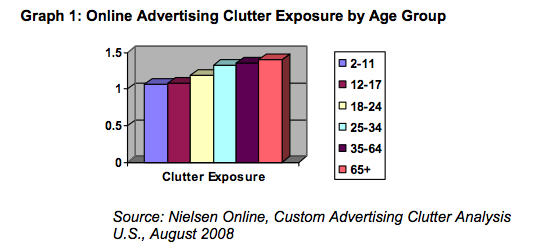
Are we creating a generation of banner intolerant Internet users?

Those of us, myself included, who came to the Internet as young adults have been exposed to a higher degree of ad clutter from the start. We’re used to it. Not only that, our context for approaching the Internet was shaped through television. Television conditioned us to expect advertising to be part of the equation.

Yet, again, this is not the case for a new generation that has grown up with TiVo and other DVR products. These services have undermined normal TV watching patterns and preconceptions. Every day more of us are conditioned to simply hit the 30 second skip button when presented with a commercial. (As an aside, thank you to Fringe for telling me how many seconds the break is going to be. That’s very handy!)

These habits are particularly important since new research indicates that the heaviest TV viewers are also the heaviest Internet users.

Are social networks part of the problem?

Yes.

Social networking is one of (if not the) largest activity for the young. Sites like Piczo, MySpace and Facebook, among others, are like the middle school and high school of the Internet. These sites are, at their core, utilitarian in nature. They’re about communicating. They’re about making ‘friends’.

Some of them do use banner ads, but more and more evidence shows a growing banner blindness on these sites. I suspect the high number of visits (for a very specific purpose) exacerbates banner blindness on social networks.

If you use CPM rates as a proxy for effectiveness then it becomes obvious that social networks are in distress.

Can we blame Twitter?

Yes.

Twitter and even my current addiction, FriendFeed, contribute to the problem by not using banner ads. They are but one more site, one more application, one more widget that is providing a valued service for … nothing. Clearly advertising isn’t the only way to monetize these sites, but by not implementing any monetization strategy they send a signal to users that they can get something for nothing.

The ‘something for nothing’ mentality makes us less tolerant of advertising. I can surf the Internet with Firefox, supercharge my blog with WordPress plugins and use Google Analytics to track metrics for a slew of client sites all … for not one penny.

This isn’t a long term problem. A type of Internet Darwinism will take place where those without a true business (aka revenue) model will either fail or try to implement some sort of real revenue strategy. In most instances, that will be advertising or subscriptions.

Will it be advertising or subscriptions?

Just before the collapse of Web 1.0, I worked at Bluelight.com, the online version of Kmart. One of their major initiatives was an ad supported free ISP. We had millions of users! The thing is, it didn’t really work. They wound up converting it to a subscription based service which was ultimately acquired by United Online

Today, we’re conditioning a generation to ignore banner and display advertising. The cat is out of the bag. The genie is out of the bottle. So even if we want to return to it as a revenue stream it is becoming an ever weaker medium. And we only have ourselves to blame.

So perhaps subscription based sites, or networks are the wave of the future. Would you pay for Twitter?

Will banner ads die?

Of course not. Banners will never completely die, but a few things will have to happen for them to rise again to feast on the glorious eyeballs of Internet users.

They’ll need to be more engaging and use rich media in more appropriate ways. More importantly, the industry will need to measure banner ads not by CTR or traditional click-based ROI but by brand measurement metrics. There are a few companies who provide this service, though my favorite is Vizu Ad Catalyst. (Disclosure: I worked at Vizu for a short time but stand by the fact they are leaders in this new field.)

The current economic climate has forced many analysts to adjust their online advertising industry forecasts, some of them twice. Yet, I’m unsure any of them are accounting for this new generation of Internet users who are blind to banners at best and intolerant of them at worst.


Lolcats and Religion: A Dissertation

November 12 2008 // Humor + Technology // 4 Comments

Department of Religious Studies

Technology and Religion RS42A

Dissertation Title: Lolcats and Religion

Prepared by: Rotit John

Supervisor: Dr. A.E. Newman

Date: October 10th, 2010

Word Count: 19,235

Lolcats and Religion: Abstract

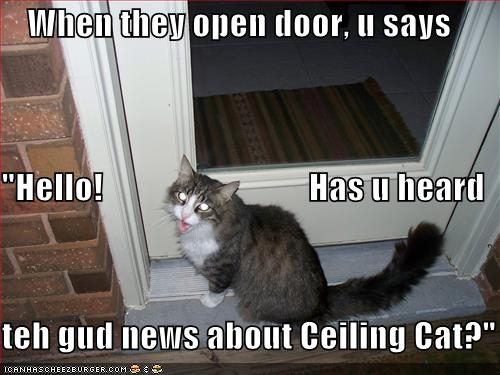
Lolcats is a popular Internet phenomenon that allows users to humorously caption pictures of cats as a way to comment on modern life. As such, it is no surprise that religion has entered this new form of expression. In this paper I explore the origins of religion in lolcats and the ways in which religion is represented through the creation of lolcats. The research is based on the analysis of lolcats and various secondary sources such as the lolcatbible. Understanding the representations of God (Ceiling Cat) and the Devil (Basement Cat) is essential in documenting the impact technology has in our changing relationship with religion.

Lolcats and Religion: References

SEO Success By A Thousand Optimizations

November 05 2008 // SEO // 1 Comment

Google has been quoted as saying that their search algorithm takes into account over 200 signals (or variables) to determine the ranking of a page for a given query. This isn’t really news to anyone who has been paying attention but it should change how many approach search engine optimization (SEO).

Of course some of the 200 signals are weighted more heavily than others, but Google can twist the knob up or down on each of these to dial in what they believe are the most relevant results. As such, concentrating on a short list of critical search engine optimization components will only get you so far.

Don’t get me wrong, you must get the short list right, but if you stop there you’re likely going to chase the algorithm instead of ride it.

Search engine success by a thousand optimizations.

You might have heard of the saying ‘death by a thousand cuts’. The inverse is true for search engine optimization. Success can be attained through doing a lot of little things right. Use natural language to name your images. Change the anchor text or nofollow extraneous ‘see more’ links. Bold your targeted keywords within your content. The list goes on and on.

I’m often asked to provide a potential return on investment for undertaking a small SEO effort. Yet, it’s nearly impossible for me to assign that value. Will it help? Yes. How much? I don’t know. Why don’t I know? 200 signals! And it’s not just the sheer number of signals but the fact that the weighting of those signals changes.

For example, I see more and more sites abandoning meta keywords altogether. I believe this is a mistake. While the weighting for meta keywords might be very low now due to high abuse, it is still one of the signals. There remains some criteria in place for analysis. At any given time Google could determine that the proverbial ‘coast is clear’ and begin to increase the weight of meta keywords once again.

Follow blind five year old principles.

My philosophy is to treat search engines like blind five year olds. As such, I think of these 200 signals as hints that I can provide to help it make a decision. The goal is to provide the search engine with as many hints as possible, keeping in mind that they must also be good hints. (Providing a whole bunch of mediocre hints will likely have the same impact as a handful of really good ones.)

But if that five year old is putting a puzzle together I need to make sure I show it the edge pieces and flip over the pieces of, say, the Austrian Castle to make it easier. That will go a long way. But what if I can also sort out the sky from the grass and even begin to group them into different hues?

Suddenly, it’s a lot easier to complete the puzzle.

Hockey Memories

October 31 2008 // Life + Sports // 2 Comments

On Tuesday I was lucky enough to see the Sharks play the Penguins. It’s the first hockey game I’ve been to in a long time and my first at the Shark Tank. I was lucky enough to sit in one of the corporate boxes, which is actually how I was first introduced to hockey in the 1980s, sitting in my Grandfather’s Superbox seats at the Spectrum in Philadelphia. The night brought back a slew of powerful and fond memories.

Superbox was great for a lot of reasons. It had a great view, you’d get the stat sheets every period and sometimes injured players would sit there during the game. It’s how I came to get autographs from Tim Kerr and Brad Marsh.

Even better, I got to see Wayne Gretzky in his prime. Not just during the regular season but also during the 1986 Stanley Cup Finals. Hoarse from screaming my Dad took Broad Street home after Game 6. Jubilant Flyer fans lined the street giving the slowly diving cars high fives as they passed.

That year I also went to Europe for a month, three weeks of which was on a bus tour filled with pleasant Canadians. Because I knew hockey I was able to flirt with a very pretty girl from Edmonton named Shelly. The last day of the tour she kissed me.

I remember going to an Eagles game one Sunday morning in 1985. Standing on a packed subway car at Fern Rock station and finding out that Pelle Lindbergh had died. First it was a murmur, then a hush fell over the car. A fan turned up his radio for the rest of us, and we all listened, shell shocked, rocking back and forth, as they described the car crash that had taken the life of such a promising goalie.

Say what you will, Philadelphia fans are passionate. We felt the loss. Deeply.

The girls at my high school were also infatuated with the Flyers and, for good or for bad, my favorite player: Peter Zezel. It got even worse when players turned up in the movie Youngblood. Hockey players were often very approachable so many girls would bring Polaroids of themselves standing with their objects of desire. How could we mere mortals compete?

Soon my Dad got season tickets and I went to more and more games, sitting in the second level, making friends with the other regulars around us. I learned all the motions the refs used to call penalties, screamed at Doug Crossman to stop watching the puck and moaned when Don Koharski made bad call after bad call or swallowed the whistle in the third period.

I recall the walk from the parking lot to the Spectrum. It was usually chilly but full of anticipation, my Dad and I trooping along with a happy plodding group of slightly inebriated fans. We usually sprinted back in an even more bracing night air, parked strategically to get out of the lot as quickly as possible and catch Gene Hart do the post game show on 610 WIP.

Then there was the 1992 All-Star game. My Dad and I went down to get a program and next to us is a familiar looking woman wearing a ‘St. James’ jersey. Who was it? Susan Saint James. Hockey fan. We forgave her for buying a Ranger jersey.

I’m still a hockey fan but just haven’t gotten around to seeing it live, which is a real shame. The energy and vibe produced by the crowd during the game is just unmatched by any sport.

The funny thing is, it felt very much the same as all those years ago. It turns out hockey fans are pretty similar, and what they do in Philadelphia they do out here in San Jose. Though with slightly less fervor.

I’m too far away to go to a lot of games but I’ll make sure I go to more from now on. In the interim, I’ve got my memories. I’ve got Ron ‘Flockey Hockey’ Flockhart and Ron Hextall.

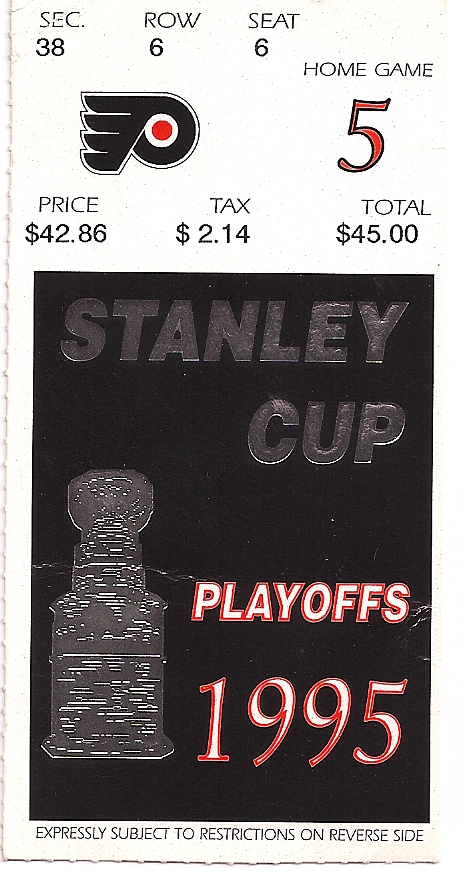
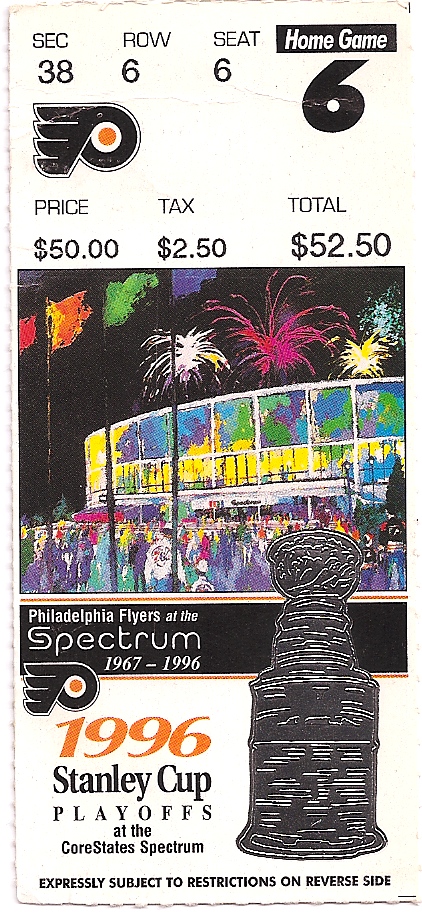
I’ve got Section 38, Row 6, Seat 6.

Five Foot Web Design

October 28 2008 // Marketing + SEO // 5 Comments

How do you make sure your message is getting across to users? Five foot web design.

Here’s how five foot web design works. Print out a nice color copy of the page in question. Tape it to the wall. Take a few steps back until you’re around … five feet away. What do you see? If you can’t make out the message then you might have a problem.

I’m no web design or user interface guru and I don’t pretend to have Jakob Nielsen’s experience or expertise. Instead I’m armed with the knowledge that you have a very short time to persuade someone to stay on a page. So don’t be coy. Don’t fill it up with a whole bunch of stuff. Keep it simple. Tell users exactly what your site or web page is about, what you want them to do and where to go next.

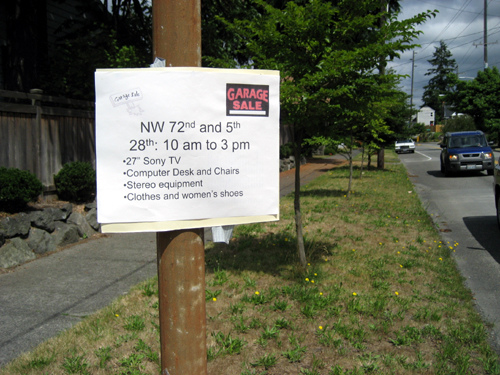
How do we get people to slow down on a street in the physical world? A sign. Let’s look at the ubiquitous yard sale sign. Which of the two signs below do you think is more effective?

No contest, right? The same rules apply on the information superhighway.

There are other real world examples that support five foot web design. My first job out of college was as an account coordinator at an ad agency. One of my tasks was writing up meeting notes. My first attempt was returned to me with more red on it than I’d seen in a long time. The message: say it with as few words as possible.

I also learned about one of their hiring techniques. Only the first page of a resume was reviewed. Any subsequent pages were thrown in the trash and never read. The lesson: brevity was and is critical, particularly in advertising.

Five foot web design simplifies your message and increases the odds that users will understand, remember and take action on that message. It will also help your search engine optimization (SEO) efforts.

The reason five foot web design supports SEO is that it forces you to use your keyword phrases prominently and to rely less on explanatory text and links. In short, it’ll help boost your keyword density.

You’ll need to use your headers wisely. Nice big H1s that don’t mince words. H2s and H3s that support your keyword(s). Strong anchor text. Judicious use of bold text. Strong call to action buttons. Keep it clean. White space is your friend.

Poker Copilot is a good example of five foot web design. Recently, they switched to much larger buttons in hopes of increasing downloads.

The spike at the end of the graph says it all. Spike is not even an adequate word here. It’s a kangaroo leap to a new level.

I also recommend the book Don’t Make Me Think by Steve Krug which presents a more detailed look at web design that dovetails nicely with five foot web design.

In lieu of additional reading, simply take a moment to step back from the computer, or roll back in your chair, and see if your site is befitting from five foot web design.

AdWords Introduces Search Partners Metrics

October 22 2008 // SEM // Comments Off on AdWords Introduces Search Partners Metrics

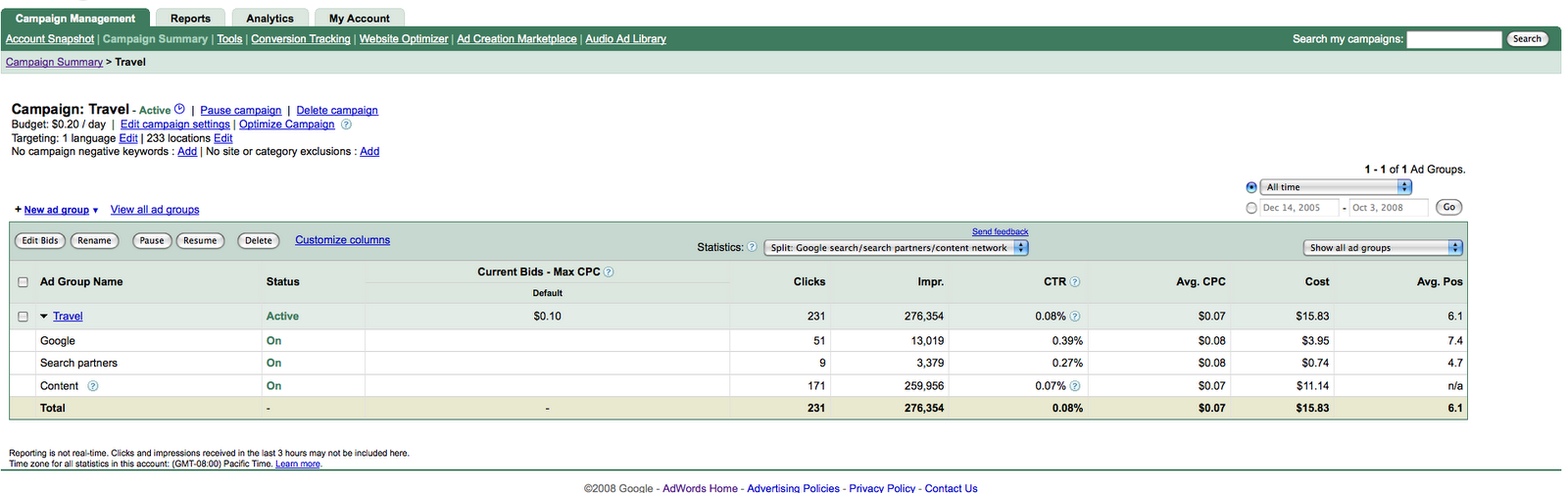
Last week Google rolled out new AdWords metrics that provided advertisers a look at performance on Google versus Google Search Partners. These search partners include AOL and Ask but also a group of anonymous others of varying size and quality.

Many search engine marketers have been concerned that the performance on Google’s search partners might be substantially less than those on Google itself. The mentality is understandable since Google’s Content Network has such comparably poor performance. Yes, that can be explained by the difference between passive and active searches but you can’t blame folks for being skeptical. Could Google be hiding poor performing partners by combining Google and Google Search Partners together?

The verdict? Among the accounts that I monitor and manage the results from the Search Network seem solid, which is likely why Google agreed to this level of transparency. A few campaigns index above ‘The Google’, a few index below. Perhaps it’s always been this way, or perhaps Google has quietly gone about optimizing the Search Partner Network. I’m guessing this is in response to a rising trend of advertisers who were avoiding the Search Network.

Savvy search engine marketers will turn off poorly performing Search Network campaigns, but will also opt-in to the Search Network more readily now that they have this level of detail. Since this setting is at the campaign level it may force advertisers to split or divide their campaigns to toggle appropriate ad groups in or out of the Partner Network based on performance.

The net result of this change will be more advertisers participating on the Search Network but doing so when it makes economic sense. Another potential side effect will be greater competition within the Search Partner Network which could increase CPCs and decrease volume.

The thing is, there’s still a lot we don’t know. We don’t know which partners/sites are contributing to these metrics. Sure, we get to see the aggregate data, but we don’t get anything more. So you won’t be able to selectively block ads from appearing on certain partners based on performance, whether real or perceived.

As an aside, I find it interesting that they chose to feature an account which showed a low CPC (under ten cents), but also a very low CTR (under 1%). It seems like a not-so-subtle way to show that AdWords can be inexpensive. Never mind that a low CTR contributes negatively to your ad quality score.

While I would prefer more detail, it’s a step in the right direction and gives advertisers a new way to target and optimize their programs.

Fat Finger SEO: Optimize For Misspellings

October 12 2008 // SEO // 1 Comment

Fat Finger SEONot everyone is the world’s best speller and even those that are sometimes hit the wrong key and wind up searching for a misspelled keyword. It’s human nature and there’s no reason why you shouldn’t optimize for the most common misspellings. And there’s an easy way to target these misspellings without making yourself look like a fool.


Simply create content on the topic that mentions the common misspelling. Use the misspelling in the browser title, meta description and URL. I recommend acknowledging the misspelling in the meta description (as well as in the content) to help validate their search and encourage clicks. This is important because you have a powerful competitor in Google’s Did You Mean functionality and display.

You can even dedicate an entire blog post to the misspelling if you want, like I’ve done on my Used Books Blog.

Here, I’ve created a post about used boks, acknowledging it as a common misspelling for used books. The post is focused, humorous (or so I hope) and topical.

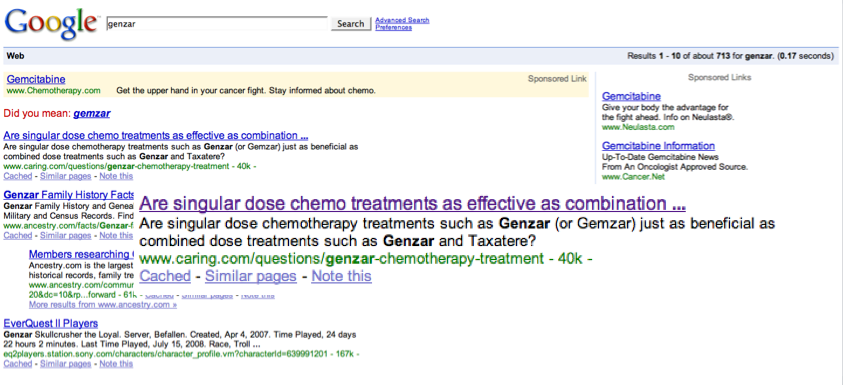
A more straightforward approach is one used at Caring.com. In this instance, we’ve optimized for the keyword genzar a common misspelling of a cancer drug.

While it’s currently the number one search result, I’d still like to see the misspelling in a shortened browser title. I’d also note that this was a user submitted question to the site. Be sure to check your keyword and internal search reports to identify misspelling candidates.

The increase in mobile searches will likely result in more fat finger searches. So be on the lookout for this easy source of traffic. But at the same time, don’t drive yourself crazy finding and optimizing every misspelling.

Google Search Algorithm Needs Digg Tutor

October 10 2008 // SEO + Technology // 3 Comments

The Google search algorithm needs Digg. Why? It provides a human feedback mechanism that can help continuously refine Google search results. If you subscribe to my blind five year old principle, social search data would be a stream of higher intelligence that will make the algorithm smarter.

Social search results would be the algorithm’s tutor.

Predictions of SEO mayhem are simply unwarranted. Google knows that only a small portion of users would use the interface. And that’s all it wants and needs. It simply wants to augment the algorithm for the vast majority of Google searches with a human quality assurance mechanism. In some ways, it would be a volunteer version of Mechanical Turk.

Google experimented with social search earlier this year and has been in on-again off-again negotiations with Digg. Clearly, there is a build versus buy dilemma. Google built some of the infrastructure, but might be struggling with the logic and filters to prevent gaming the system.

A black hat filter is critical since Google wouldn’t want to feed the algorithm bad data. Garbage in, garbage out. But done right, social search results would help identify web spam and curtail over-optimization.

Microsoft has also been sniffing around Digg and this week launched U Rank, which is eerily similar to Google’s social search experiment. Could Microsoft leapfrog Google and begin adding an intelligent data stream into their search algorithm? I find it hard to believe, but stranger things have happened.

I do believe the U Rank test will reignite Google’s interest in the concept (if it ever really waned) and might again bring rumors of a Digg acquisition back to life.

xxx-bondage.com