Google Taxonomic Search And SEO Affirmative Action

December 04 2008 // SEO // 4 Comments

There are rumors that Google is applying taxonomic limits to specific searches, usually surrounding products or brands.

When I first heard these rumors I dismissed the idea. Even if Google created a taxonomy of sites, I couldn’t see them using that data as part of the search algorithm. But I quickly began to see that Google likely has a robust taxonomy and could relatively easily use it as a signal within the algorithm.

Does Google have a taxonomy of websites?

Yes. It already displays this taxonomy via the AdWords placement targeting interface.
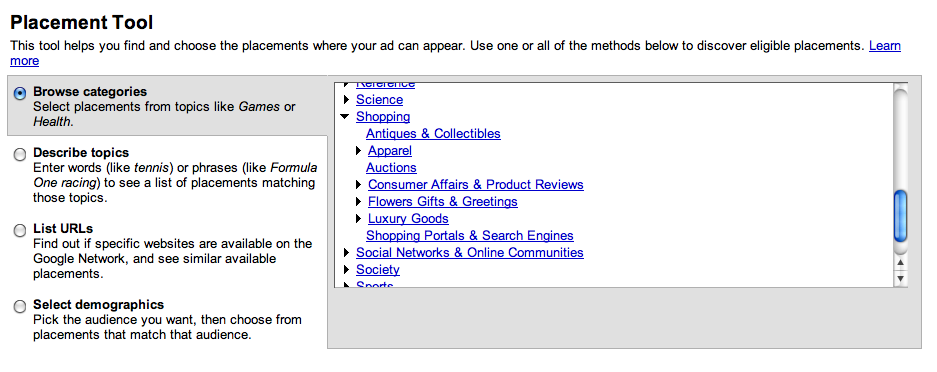
The real question is whether Google has attached a taxonomic classification to sites outside of the AdSense network? I’d guess that it may not be comprehensive, but that it includes sites that meet some quality threshold, potentially Page Rank.

Why would Google use a taxonomic signal in search?

Lets start with the idea that Google wants to ensure they deliver the best set of results to users. Would a product related SERP that contained more than five shopping comparison sites be the best result set? How about forums? Or blogs? Or retail sites?

Think about it. If you searched for ‘casio exilim’ would you want a SERP that had Walmart, Circuit City, Office Depot, Ritz Camera, Best Buy, Target and eBay? Similarly, would you want one that had PriceGrabber, BizRate, Buzzillions, Yahoo! Shopping, PriceRunner and NexTag?

I’m guessing that most of the time the natural ebb and flow of the algorithm works out and the results are a nice mixture of these different types of sites. But sometimes one type of site might be better optimized for a term and the type of taxonomic overload above might occur.

How would Google implement a taxonomic search signal?

At first the idea of using a taxonomic parameter in search sounded tough. Yet again, I quickly surmised that it might be more straightforward than I thought.

Wouldn’t you simply enter some logic that made it slightly more difficult for a site of the same taxonomic classification to rank for a query if there was already one ranked higher? The difficulty would increase based on the number of sites in the same taxonomic classification for a query. So, if two shopping comparison sites were already ranked, it would be far tougher for the third and even more so for the fourth.

It’s essentially a smoothing mechanism that gives slightly more opportunity to sites in another taxonomic classification to rank for a query that they might be shut out of otherwise.

A taxonomic limiter would be a safeguard mechanism and perhaps serve as an over-optimization trigger.

What does a taxonomic search signal mean for SEO?

A taxonomic search signal would be a bit like affirmative action for SEO, giving lesser optimized sites a leg up on the competition. It also means greater SERP volatility as sites within one taxonomic class swap positions.

For instance, two sites in the same taxonomic class could be very close and should be ranked 1st and 2nd, but because of the taxonomic limiter are ranked 1st and 5th. If the second site eclipses the first, it would immediately be ranked 1st since the limiter wouldn’t apply. Consequently, the first site would drop, likely to 4th or 5th because the limiter is now being applied.

Is Google really using a taxonomic search signal?

Maybe. While the idea makes sense, the changes some are seeing could instead be caused by one of the numerous algorithm tweaks. But the tools to measure and monitor SEO strength are getting better. Companies can monitor their rank consistently over time and identify when things go sideways. Sometimes the changes don’t make a whole lot of sense and that’s when these types of theories and rumors are born.

What do you think? Is Google using a taxonomic search signal and limiter in search results?

Forgive Me StumbleUpon For I Have Sinned

December 04 2008 // Advertising + Humor + Marketing + Technology // 1 Comment

StumbleUpon No EntryThe other day I updated my StumbleUpon toolbar (well, I was essentially forced to) and immediately couldn’t Stumble posts from this blog or my Used Books Blog. Each time I tried my Stumble just would not go through, stalling at a blank white box where the review and tagging takes place. I tried numerous times on a couple different browsers. Nothing worked.
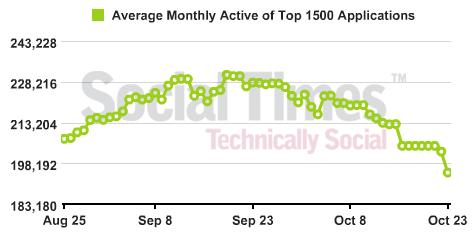
I assumed that something had gone awry with the new toolbar. I even posted a message on FriendFeed calling eBay lame. But you know the old saying about assuming, right?

I sent feedback to StumbleUpon about my problem and got a prompt reply as follows.

Hello,

Thanks for writing in.

After reviewing your account history, it appears
that you’ve repeatedly submitted content from one
or more sites in particular.

Our site software detects behavior like this to
prevent the unauthorized use of StumbleUpon to
promote a specific Web site, product or service.

This limit will likely remain in place until you
use the StumbleUpon Toolbar more frequently to
rate, review and discover Web sites that can
shared with other members.

If you’re interested in using StumbleUpon to
advertise a Web site, please look into our
Advertising program:
http://www.stumbleupon.com/ads

If you have any other questions, please review our
Terms of Service and Community Rules:

http://www.stumbleupon.com/terms/
http://www.stumbleupon.com/rules.html

Thanks for your feedback,

Oops. I admit, I’ve only been Stumbling my own sites lately. However, I think they’re pretty good so I don’t see anything too wrong with that. Also, I’m pretty transparent. I don’t have a Stumble army nor do I have multiple profiles so I can distribute my Stumbles across accounts and dodge the software.

But I get it and I’m not really complaining. It’s not what StumbleUpon is really supposed to be about. And I respect them for protecting the product and StumbleUpon business model. It also got me to Stumble again and I discovered some interesting sites and images. So … thanks for that.

My one nit would be that I had to contact support to get this information. Instead of presenting the white box of frustration I suggest that StumbleUpon simply insert the text I received into that area. Not only would I have immediately understood what was going on and not throw invective into the htmlosphere but StumbleUpon would have saved a bit of money on customer support.

Forgive me StumbleUpon for I have sinned. My penance? Stumble.

Does Google Have Pac-Man Fever?

December 02 2008 // Humor + SEM + SEO + Technology // 2 Comments

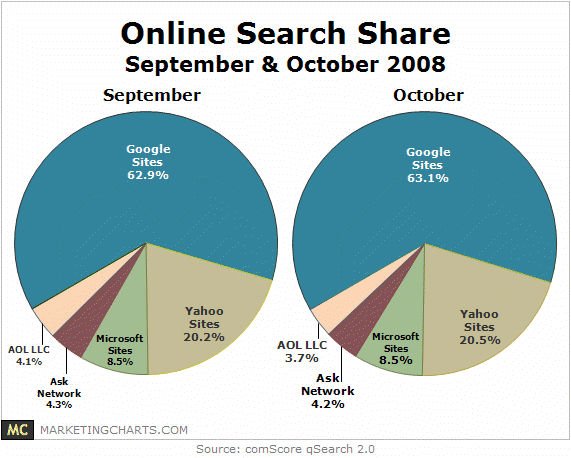
Google’s share of US searches continues to rise according to a recent comScore press release. In October 2008 Google led with 63.1% of all searches conducted. The resulting pie chart shows that Google is closing in on a Pac-Man like position in the search market.

It hasn’t been this way for that long though. Following is the historic comScore data I’ve cobbled together showing Google’s share of the search market.

October 2004: 34.8%
October 2005: 39.0%
October 2006: 45.4%
October 2007: 58.5%
October 2008: 63.1%

So, in five years the search market went from a dog fight to a laugher. If Google continues on this path the pie chart will take on true Pac-Man dimensions.

Now, I’m not sure who’s Inky, Blinky, Pinky or Clyde but Google certainly has the other search players on the run.

None of them seems to have the right medicine to reduce the Google fever that has swept the country. Acetaminophen (AOL), ibuprofen (Yahoo!), naproxen (Ask) and aspirin (MSN) have all failed to bring the temperature down. And upstart homeopathic remedies (Powerset, Cuil etc.) haven’t made a dent either.

Would mixing some of these medicines together help? Some Yahoo! and MSN with a dash of Powerset? Not likely. And in some cases mixing medicines can prove lethal.

That Guy Is Tom Wilkinson

December 02 2008 // Movies // 1 Comment

The other night I went to see Four Christmases and happened to catch a preview for Duplicity. Four Christmases was actually better than I expected and Duplicity looks like something I’d like to see. For most it might be because it stars Julia Roberts and Clive Owen. For me it’s because it co-stars Tom Wilkinson. Who you might ask? You know, that guy!

‘That guy’ is a staple of both the big and small screen. We’ve had plenty of them around and most of the time you hardly notice them. They’re sometimes known as character actors, but the good ones transcend that label. Tom Wilkinson is doing just that. He’s joining a list that includes the likes of Ned Beatty, M. Emmet Walsh and Rip Torn.

Still lost? Ned Beatty has been in Deliverance, Network, Superman and Charlie Wilson’s War. M. Emmet Walsh has been in Slap Shot, Blade Runner, Fletch and Raising Arizona. Rip Torn has been in Defending Your Life, Men In Black, The Insider and Dodgeball. Now, most of the ones I chose to highlight are the more mainstream and popular films, but all participated in a wide range of films in roles from farce to incisive drama.

These actors are the oil that make big movies hum. They’re in great scenes and share screen time with a slew of A-list stars that make the cover of People magazine. On the other hand, ‘that guy’ has a good chance of going unnoticed at the local supermarket.

So I’m in the lobby before the movie, while my wife plays the bonus game I won playing pin ball, and wander over to the big cardboard promotion for Valkyrie, the upcoming thriller starring Tom Cruise. Sure enough, standing next to Cruise on the poster is … Tom Wilkinson.

I first noticed Wilkinson in In The Bedroom, the taught suspense movie based on Killings, an Andre Dubus short story. But it’s then that you realize you’ve seen him before. Where was it!? That’s right, he was in The Full Monty … and wasn’t he in Shakespeare In Love? Yes! Oh and wow, he was even in Rush Hour.

So now you start to look for him. And he turns up in Girl with a Pearl Earring and the absolutely amazing Eternal Sunshine of the Spotless Mind. Then he’s in Batman Begins and Michael Clayton.

Yes, Tom Wilkinson has arrived as ‘that guy’.

Cyber Monday Facts and Fiction

November 26 2008 // Marketing // 1 Comment

Cyber Monday is defined as the Monday after Black Friday. It is heralded as the kick-off to the online holiday shopping season and/or the busiest day for online retailers.

What does it mean to me? Cyber Monday could be the case study for the power of marketing.

Hovercat

Cyber Monday hinges on the idea that shoppers make purchases upon returning to work on the Monday after Thanksgiving. These shoppers might be avoiding Black Friday altogether or are buying items they were unable to purchase offline. Combine this with the (once) natural day-of-week effect that shows Monday as the most trafficked day for retail and Cyber Monday seems to make a lot of sense.

In reality, Cyber Monday is a clever lie created by savvy marketers. The term was coined by Shop.org in 2005 and immediately drew media attention both good and bad. Naysayers pointed to the fact that Cyber Monday didn’t really pan out when you looked at the numbers.

But the numbers have changed in the last few years and what we’ve witnessed is the triumph of marketing.

Cyber Monday Statistics

It was widely reported in 2005 that Cyber Monday was historically only the 12th largest online shopping day of the year. Even a Shop.org study found that the busiest shopping day in 2005 was actually December 12th.

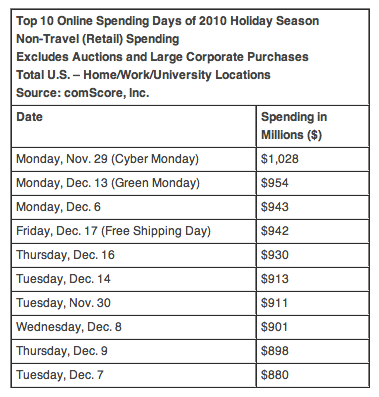
This trend continued until 2010 when Cyber Monday was the highest ranked online shopping day, raking in over one billion in sales.

2010 Top Holiday Ecommerce Days

That trend continued with Cyber Monday ranked the highest online shopping day in 2011. What’s fascinating here is that this is happening against the backdrop of some strong trends to the contrary.

Broadband adoption and fast internet connections have made the ‘wait-to-surf-at-the-office’ behavior far less powerful. And in recent years smartphones and tablets have all but erased these patterns.

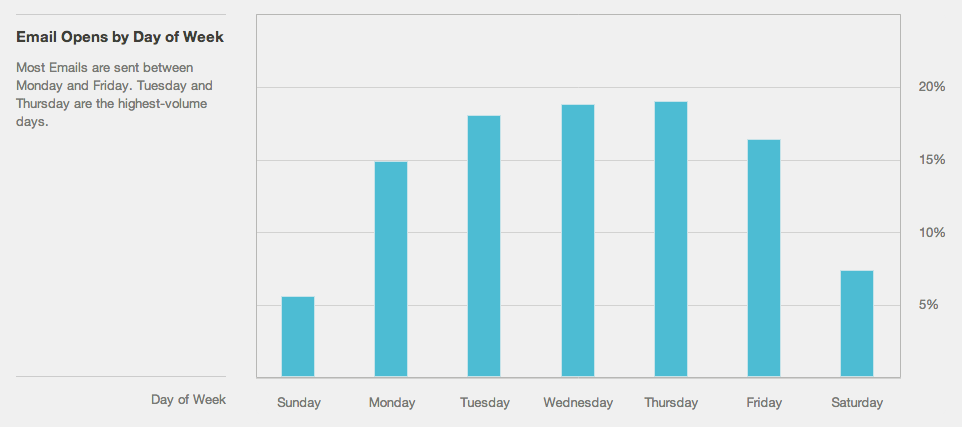
In fact, more and more retailers are finding that Monday is no longer the biggest day of the week. MailChimp Research also seems to indicate that Monday is less important than it used to be.

Day of Week Email Statistics

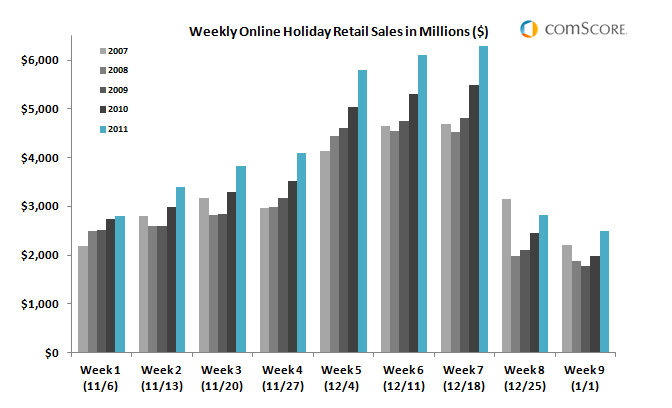
Lastly, while Cyber Monday may be the biggest day of the year it does not reside in the biggest week of the year.

eCommerce Holiday Sales Trends 2007 to 2011

So despite the bulk of the sales happening in the later weeks marketers have figured out a way to crank up the volume on Cyber Monday.

Is Black Friday really black?

Black Friday is a big shopping day for retailers. But is it the biggest day? Maybe.

Snopes has the data through 2002 which shows Black Friday ranks between the 4th and 8th biggest day of the year. Black Friday did take the top spot in 2003 and 2005 according to International Council of Shopping Centers. However, I’ve seen conflicting data from other sources.

More recent data from ShopperTrak seems to suggest that Black Friday has secured the top spot. Once again, belief in the Black Friday myth, and the marketing muscle behind it, made it real.

Seth Godin hits the nail on the head in All Marketers Are Liars.

Successful marketers don’t tell the truth. They don’t talk about features or even benefits. Instead, they tell a story. A story we want to believe.

Marketers succeed when they tell us a story that fits our worldview, a story that we intuitively embrace and the share with our friends.

Within this context, Cyber Monday is a well constructed and beautiful fiction. The knee-jerk reaction is to believe the Cyber Monday story (as well as Black Friday) and most won’t do the research to validate that belief.

TL;DR

The fact is Cyber Monday and Black Friday were both fiction, but ones that we collectively embraced (even Google). As such, our collective suspension of disbelief led both to become a reality. Marketers succeeded in telling a story that people believed. Perception became reality.

Could Zoetrope Be A SERP Tracking Tool?

November 25 2008 // SEO + Technology // Comments Off on Could Zoetrope Be A SERP Tracking Tool?

Zoetrope is a new web tool being jointly developed by Adobe and researchers at the University of Washington. The general idea is to allow users to view the Internet over time. Think of it as the Wayback Machine on steroids. Sarah Perez does a good job writing about Zoetrope in ReadWriteWeb.

Yet, it’s the following video that does the best job of explaining Zoetrope.

Could Zoetrope be used as a SERP tracking tool?

If Zoetrope could capture specific search engine results pages (SERPs), then it could be a very powerful SERP tracking tool.

Let’s say I have 10 high value keywords for which I want to be highly ranked on Google. Using Zoetrope I could conceivably capture the daily SERP for each keyword and link it to the appropriate destination page. This would allow me to see if changes to my page had any impact on SERP ranking for that keyword.

I could even create ‘lenses’ for my competitors and review how they’ve tweaked their site to help influence SERP rank. Zoetrope could provide an unparalleled level of detail and analysis for a savvy SEO practitioner.

Yet there’s a big, actually huge, ‘if‘ in the statement above. I doubt that Zoetrope is or even could capture every SERP. But that doesn’t mean there’s not a way to do this. In fact, I think it provides a pretty interesting business opportunity.

Want Zoetrope to help you track SERP for a group of keywords? Simply sign-up for a subscription and they would begin to capture the information. Toss in a 30 day free trial to get the ball rolling and I think you’d have a number of people clamoring for and using Zoetrope for SERP tracking.

I Love Firefox Metrics

November 25 2008 // Marketing + Technology // Comments Off on I Love Firefox Metrics

I’m a direct marketer at heart which means I like numbers and I absolutely love testing. The other day I found the Mozilla Blog of Metrics via a FriendFeed post by AJ Batac. The blog is subtitled ‘When in doubt, sample it out …’ and gives me yet another reason to like, perhaps even love, Firefox and Mozilla.

Mozilla is moving forward with multivariate testing but wanted to crawl before they walked. So, they conducted a simple A/B test on the call to action on their download button.

Now, I probably could have told you that ‘Download Now – Free’ would outperform ‘Try Firefox 3’ However, they admit that the test was more about validating the tool and process rather than about the actual test.

What’s exciting (to me at least) is that Mozilla is going to run these tests and (hopefully) follow a fact-based decision making process. Do any of us want to sit through another meeting where the merits of design or copy are debated endlessly? Too many organizations continue to design based on instinct, opinion and best practices instead of testing their way to success.

You and your team are not the target market, and best practices may not be best for your particular product, site or audience. What worked at your last place of business may not work again. In fact, what worked last year may not work now, which is why organizations should always re-test assumptions via challengers.

If we’ve piqued your interest, please note that we’ll soon have some exciting findings related to a currently ongoing multivariate test at the main Firefox product page (www.mozilla.com/firefox).

Yes, you’ve piqued my interest! I’ll be eager to see the results of multivariate testing and hope that Mozilla can help usher more organizations into a test-and-learn, fact-based decision making environment.

Facebook Embraces Search, Disses Apps for Brands

November 24 2008 // Advertising + Marketing // Comments Off on Facebook Embraces Search, Disses Apps for Brands

Facebook is changing as it seeks to find a sustainable revenue model. Over the last year it seems clear that Facebook is trying to make itself more relevant and attractive to brands before the sun sets on the buzz parade.

Facebook Embraces Search

Most recently Facebook added fan links to public pages, creating a tremendous density of internal links to brand and product pages. The likely goal of this change is to boost the visibility of brand pages in search results. The attention to SEO and search is an interesting change for the proponents of the walled garden.

If it works, Facebook pages could take up valuable shelf space on search engine results pages (SERPs). Brands and marketers would be wise to take advantage and spend a bit more time on a Facebook strategy aimed at acquiring fans.

And lets remember that Facebook recently integrated Microsoft Live Search into their standard search interface. If Facebook continues to integrate and highlight search, it could provide a substantial revenue stream as well as help Microsoft capture more of the search market.

Facebook Disses Apps

The major redesign implemented this year pushed a substantial number of applications out of the limelight. The redesign aimed to leverage life streaming and encourage user interaction not application interaction.

The good folks at allfacebook conducted a study that shows the impact the Facebook redesign had on applications. The more popular applications were essentially unchanged but there was a 13% to 15% drop in active users when you look beyond the top 50.

Social Advertising In Trouble

The rush to search and away from applications can be seen in the context of an anemic advertising environment. Social media advertising is quickly getting a bad reputation. Ted McConnell, general manager-interactive marketing and innovation at Procter & Gamble Co. had this to say at a November 15 forum on digital media.

What in heaven’s name made you think you could monetize the real estate in which somebody is breaking up with their girlfriend?

and …

I really don’t want to buy any more banner ads on Facebook.

The numbers don’t look good either. CPM rates on social networks are some of, if not the, lowest around. And the effectiveness, from a click measurement perspective, of these ads aren’t good. Allen Stern is conducting a Facebook ad test for his new start-up, CloudContacts. Recent tweets on performance look dismal and campaign results should be made public this week.

In the interim there are other benchmarks to review. Once again, allfacebook has done an interesting comparison of Facebook ads versus Google AdWords. The end result was a cost per lead of $0.72 using Google and $1.83 using Facebook.

Now, the comparison isn’t exactly fair since you’re matching passive (though well targeted) search versus active search. Clearly active search is far more valuable … which leads us back to Facebook’s recent focus on search. Brands understand search. They can easily measure search. Brands will spend on search.

Facebook has a huge audience but is running out of time and chances to translate that into dollars and advertising confidence.

Like Web 2.0? Thank A Marketer Today

November 21 2008 // Marketing + Technology // Comments Off on Like Web 2.0? Thank A Marketer Today

What exactly is Web 2.0? There are plenty of ways to explain it and define it, but what is it really? It’s a marketing slogan meant to attract investors, media and users back to the Internet after the dot com crash.

The inability to adequately define what Web 2.0 is a clue that it has roots in marketing. Marketers (and I’m one of them) are good at creating things that resonate without making complete sense. For instance, the phrase ‘virtually spotless’ for a dishwasher detergent seems good but upon inspection really means ‘has some spots’.

Max(x) Barry aptly skewered this situation in his book Syrup.

Pick a random chemical in your product and heavily promote its presence. When your customers see “Now wth Benzoethylhydrates!” they will assume that this is a good thing.

Even Tim Berners-Lee, Web pioneer, sees through the Web 2.0 smoke and mirrors. Ars Technica does a good job of digesting Tim Berners-Lee’s podcast text and presents the most relevant quote about his view of Web 2.0: “nobody even knows what it means”.

But that’s the brilliance of Web 2.0, it can mean whatever you really want it to mean. Want Web 2.0 to include the semantic web? Sure. Want it to be about microformats? You betcha. Want it to be about user generated content? No problemo. Want it to represent a way to use software and technology to connect people to people? Of course. Mashups? Yup. Tagging? Check. Social Media? Okay.

The mythology is that Tim O’Reilly and Dale Dougherty came up with the term at a brainstorming session at a 2003 conference. I don’t think they came up with the term, but O’Reilly created the buzz around it, promoted it and subsequently fought over it. Let’s face it, O’Reilly isn’t a slouch in the marketing department!

Don’t believe me? Well what about Dermot McCormack’s 2002 book titled Web 2.0: The Resurgence of the Internet & E-Commerce.

So instead of trying to figure out who coined the term or what it actually means, just be happy that it ushered a new influx of ideas and investment into the Internet.

Like Web 2.0? Thank your nearest marketer today.

SearchWiki Turns You Into Free Mechanical Turk

November 21 2008 // SEO + Technology // 1 Comment

Yesterday Google launched SearchWiki, a search feature that lets users customize search results by moving, deleting, adding and commenting on search results. The search algorithm will now have access to a set of aggregated human data. As I’ve written about before, the Google search algorithm will benefit from having a human feedback mechanism.

Google SearchWiki turns users into a free Mechanical Turk.

Not familiar with Amazon’s Mechanical Turk? Here’s a relevant excerpt from Wikipedia:

The Amazon Mechanical Turk (MTurk) is one of the suite of Amazon Web Services, a crowdsourcing marketplace that enables computer programs to co-ordinate the use of human intelligence to perform tasks which computers are unable to do.

Now, clearly the search algorithm is able to produce search results. However, the algorithm still isn’t very smart. SearchWiki lets the algorithm learn as humans move, delete and add results for specific search queries.

While Google clearly states that your specific changes will not be seen by others, it seems impossible to think that Google won’t use that information to influence search results over time. Not convinced? SEO by the Sea reviews a recent Google patent that points to Google’s continuing goal of leveraging more data and behavior into search results.

Google has been experimenting with something like this for some time and finally seems ready for prime time. This also means the flirtation with Digg is likely done for good unless abuse by SEO practitioners overwhelms the signal.

How do SEO gurus react to SearchWiki?

If you employ a short term chase the algorithm type of SEO you’re seeing a threat and an opportunity. The threat is that the human feedback mechanism could help to curb over-optimization and subtle gaming. However, it also provides an opportunity to create a SearchWiki army that could coordinate changes to specific search results. The worst case scenario is that people are paid to delete, add or move certain results for specific searches.

I’m not saying SearchWiki is a bad thing. But make no mistake, Google is using it as a free way to make their core product better.

xxx-bondage.com