Google Did You Mean Search Results

February 26 2009 // SEO // 1 Comment

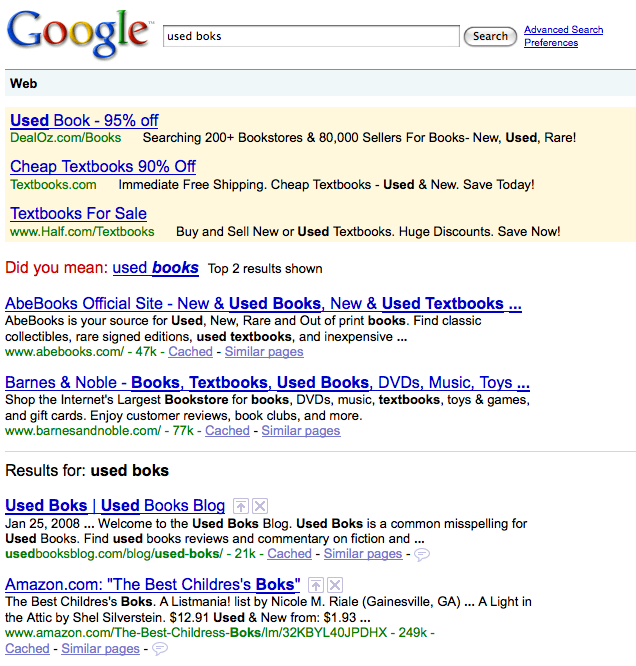
Google is presenting two Did You Mean search results above regular search results, making misspelling optimization or fat finger SEO less effective.

used boks mispelling google search results

The result above is for used boks, a misspelling of used books. The Used Books Blog doesn’t get a ton of traffic from the term, but it’s been a steady trickle given that I’m the first result. (Take that Amazon!)

And I still might get some visits on the term, but I’d guess not nearly as much now that Google is actually presenting two Did You Mean results above the misspelled results.

I’m not sure when Google began to display Did You Mean search results, but it’s relatively new since I often use the used boks example with clients. And Google could be testing the feature, so it might disappear and revert to displaying the lone Did You Mean line at the top of the results.

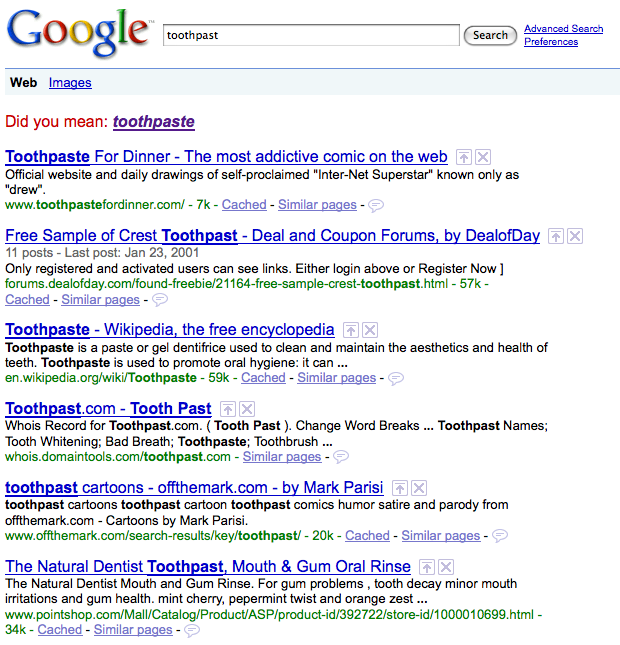
In fact, there are other misspellings that don’t trigger the Did You Mean search results.

toothpast google search results

Come on! Toothpast doesn’t trigger Did You Mean search results but used boks does? At least used boks could refer to a used jersey worn by the Springboks, a successful South African rugby team nicknamed the Boks.

I’m not against the feature. In many cases it likely provides users with a better search experience. Is Google testing this new feature? Does it only present Did You Mean results on certain misspellings? If so, what’s the criteria?

I wouldn’t put misspellings near the top of my optimization list, but they are often non-competitive and with a little effort you can snag the top spot and drive qualified traffic.

Understanding Google’s new Did You Mean results could change the priority of or eliminate the need for misspelling optimization.

The Future of Search is Numbered

February 23 2009 // SEM + SEO // 2 Comments

The future of search is numbered. No, it’s not what you think. I’m not predicting the demise of search. Quite the opposite.

Instead I’m talking about two trends that could have interesting implications on how both SEO and PPC campaigns are constructed.

The number of words per query is going up

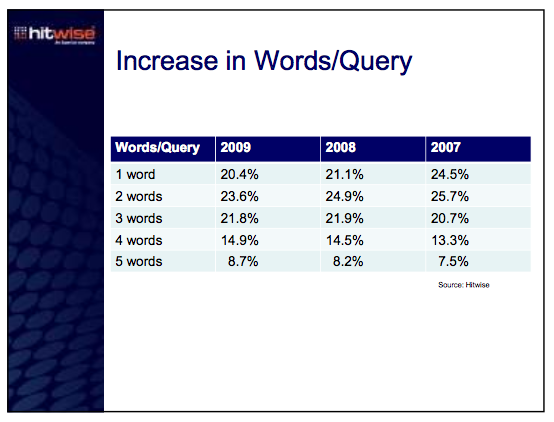
Bill Tancer, General Manager of Global Research at Hitwise, shared the following statistics during a SMX West presentation.

Number of Words per Query Going Up

The trend is clear. People are using more words in their search queries. The reasons behind the increase in words is debatable. Is it an increased comfort and savvy with search or frustration with the search results? Either way, long tail searches are on the rise and will likely trend this way for some time.

People are using numbers to reformulate queries

In a post titled Study on the Structure of Search Queries, Bill Slawski of SEO by the Sea discusses a Yahoo! research paper titled The Linguistic Structure of English Web-Search Queries (pdf). One of the findings was that people were using numbers to modify their searches.

The type of word most likely to be reformulated is “number.” Examples included changing a year (”most popular baby names 2007″ ! “most popular baby names 2008″), while others included model, version and edition numbers (”harry potter 6″ ! “harry potter 7″) most likely indicating that the user is looking at variants on a theme, or correcting their search need.

The data set for this research is from 2006. Yet, combined with the increase in words per query I’d theorize that numbers remain a powerful way to search today.

I’m the first person to warn against using yourself as an example but … I’m going to break that rule right now.

I often find myself using numbers, particularly years, when searching. If I’m doing research on a volatile topic (like SEO) I might come across ancient results from 2004. These are rarely helpful.

So I’ll begin to iterate and modify my query with years to find more relevant results. I had to do something similar when trying to cobble together Google’s share of search from October 2004 to October 2008.

Speaking of Google …

Google displays the date as a meta description prefix

Sometime last year Google began to insert a date prefix before the meta description in search results. They did this for pages in which Googlebot found a date – mostly blog posts.

meta description date prefix

I certainly noticed since some of my well crafted 150 character meta descriptions were suddenly being cut off because of the inserted date.

Why exactly would Google do this? They’ve certainly made it clear they like “fresh” content but they could present fresh content without the date. I can only surmise that Google believes users are looking for and will benefit from seeing the date.

Oddly, the date prefix does not seem to be searchable. When I search for ‘Magical Thinking by Augusten Burroughs 2007’ the same result is displayed but the visual treatment changes.

date search result without meta descripition date prefix

Once again Google tromps all over my well crafted meta description, but without the meta description date prefix. This seems to prove that the meta description date prefix isn’t searchable. But perhaps it should be.

Are you including numbers in your SEO and PPC strategies?

We know that users are using more words per query and that they’re fond of reformulating queries using numbers. This should be enough evidence to implement a robust modifier strategy, if you haven’t already.

Those who already have long tail programs should think about increasing the use of numbers as valid modifiers. As an example, wouldn’t review sites benefit from bidding on terms like ‘digital camera reviews 2009’ or ‘trek bicycle ratings 2008’?

Search (whether paid or organic) is about matching your content (or ad) to the user queries. Don’t let your programs become dated.

FriendFeed Monetization? Focus Groups.

February 19 2009 // Marketing + Social Media // Comments Off on FriendFeed Monetization? Focus Groups.

The other day Steven Hodson wrote a post on the Inquistr that opined that Twitter could generate revenue through one big focus group. I like Hodson, who also writes the thought-provoking WinExtra, but I disagreed that Twitter was the place for focus groups.

As I wrote my response as to why, I realized that FriendFeed was the ideal environment for focus groups. I could even envision a new green FriendFeed icon to denote a sponsored conversation.

FriendFeed Focus Group

FriendFeed Focus Groups

Focus groups are conversational, which is exactly where FriendFeed excels. A typical focus group will have a moderator who will pose questions and follow-up to gain additional insight into the participant’s response.

For example, a focus group moderator might ask you to tell them what animal best represents a specific car. The moderator will likely be able to understand the categorization but might want to follow-up to ensure they understand why you chose to associate, say, a Hummer with a Hippopotamus.

These focus groups are already taking place – naturally – on FriendFeed. Conversations about different cameras and different phones. Discussions about music, books and movies. Debates between Mac and Windows enthusiasts. FriendFeed fosters this type of robust interaction where details and nuances are often revealed.

What about demographics?

The part that’s missing are the demographics. It’s missing from Twitter too. Facebook seems to be banking on the demographic targeting capability. Many companies do want to ensure they have the right sample and a good cross-section of users. Perhaps FriendFeed could present a small lightbox form to users prior to commenting on a sponsored conversation?

What about psychographics?

Then again, many companies put more stock into psychographics. Who exactly are these people? What do they like? Do they travel? Where do they go out to dinner? What do they read? What are their interests? This is where FriendFeed – again – provides added value.

Moderators would have access to the feeds or lifestreams of participants. The amount of data for each participant would clearly vary depending on the number and variety of services each fed into FriendFeed. Some might be limited but others would provide bonanza of data.

Imagine Netflix, GoodReads, YouTube, Google Shared Stuff, Amazon, Last.fm, LinkedIn, Delicious and even BrightKite. Talk about building a profile on potential customers! And could FriendFeed provide an abstract of each participant? A digest profile for each participant on a sponsored conversation?

Would it be interesting for marketers to see not only what each participant fed, but what they liked as well? Or a keyword (or other) analysis on their comments? The degree of interaction, variety of content and abundance of text make FriendFeed an interesting and dynamic data hub.

The right kind of engagement

Twitter simply does not support real conversations. It was built as a status update service (and it performs that service well.) Facebook often creates conversations but those conversations are both asynchronous (wall post time lag) and seem to be less topical and more personal in nature.

FriendFeed, by comparison, is built for conversation around topical content. It fosters the exact type of engagement savvy marketers crave.

What do you think. Will we see green FriendFeed icons and sponsored conversations?

SearchWiki Not a Signal in Search Algorithm … Yet

February 17 2009 // SEO // 1 Comment

google top secret logo

Launched in November 2008, SearchWiki lets you move, delete, add and comment on the results of a Google search. At launch I wrote that SearchWiki turned us into mechanical turks. That’s not a bad thing since the Google algorithm needs a human tutor.

Google’s SearchWiki feature has been a lighting rod within the search industry drawing the ire of many and prompting the creation of Greasemonkey scripts to turn off SearchWiki functionality. It even spilled over into ‘mainstream’ media with TechCrunch’s Michael Arrington asking Google to shelve the new feature.

So it was no surprise that the SMX West presentation on SearchWiki was well attended and full of search engine marketers eager to learn what exactly Google was up to with SearchWiki. Corey Anderson started out by giving a short presentation, outlining the four different uses of SearchWiki.

  • Bookmarking
  • Improving proper name searches
  • Collecting information on a task
  • Refinding hard-to-find information

The presentation didn’t satisfy or answer the obvious questions. What ensued was a President George Bush type of press conference where reporters asked the same question over and over in slightly different ways and got back the same ‘no comment’ answer in return. You could come away from the SearchWiki session thinking you’d learned nothing or you could read between the lines and learn a lot.

Anderson stated that SearchWiki data wasn’t a signal in the Google search algorithm “right now”. He was, however, noticeably excited by all the data they were collecting. The task ahead was to sift through the data to determine if it could be turned into information and used as a signal.

While Anderson made it clear Google felt SearchWiki was a benefit to users on its face, there is no doubt that Google is interested in the possibility of using SearchWiki data as a search algorithm signal.

SearchWiki usage numbers were something Anderson wasn’t willing to divulge. It’s not that he didn’t know them, he just wasn’t willing or able to share them. He noted that Google was “comfortable” with SearchWiki usage. The crowd full of metric junkies let out a mirthless chuckle and groan at this ultra-fuzzy term.

Anderson did mention that they had been testing different visual treatments to boost engagement and usage of SearchWiki. Obviously you need to measure usage to determine which visual treatment is performing better than the other. Google knows, they’re just not willing to tell us “right now”.

If SearchWiki weren’t important, there wouldn’t be this deliberate and careful black hole of information. I don’t blame Google or Anderson. SearchWiki provides a very rich new stream of data. The potential for data pollution is problematic. Usage numbers only help those looking to hide unnatural edits from detection.

SearchWiki data isn’t a signal in the algorithm now, but the SMX West 2009 presentation made it crystal clear that they reserve the right to use it in the future.

Twitter is not a Google competitor

February 15 2009 // SEO + Social Media + Technology // 3 Comments

Twitter search is a great feature but it in no way threatens Google’s dominance in search.

Recency does not equal relevance

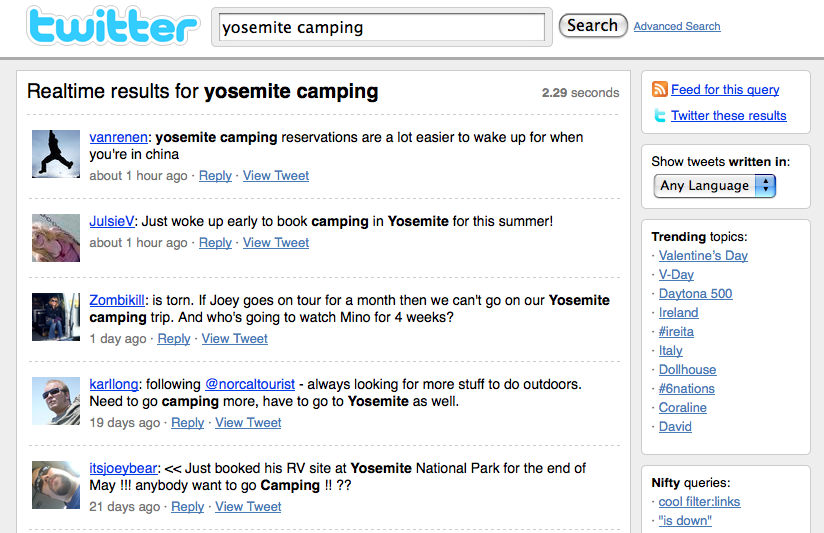
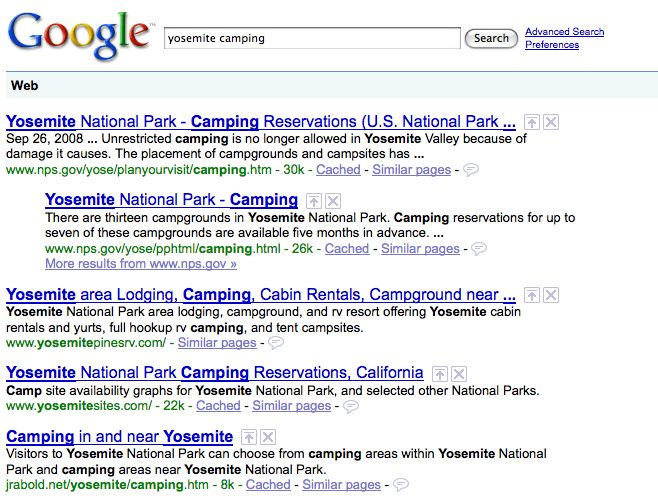
The major flaw of using Twitter as a search engine is that recent tweets on a subject do not equal relevance on that subject. This should be obvious but lets do a few searches to illustrate the point. I’ll use searches that appeared in the top 100 from the Google Hot Trends list at some point on February 15, 2009.

Yosemite Camping

yosemite camping twitter search

yosemite camping google search

Which of the results best satisfies the query? Without question it’s Google. Let’s try another.

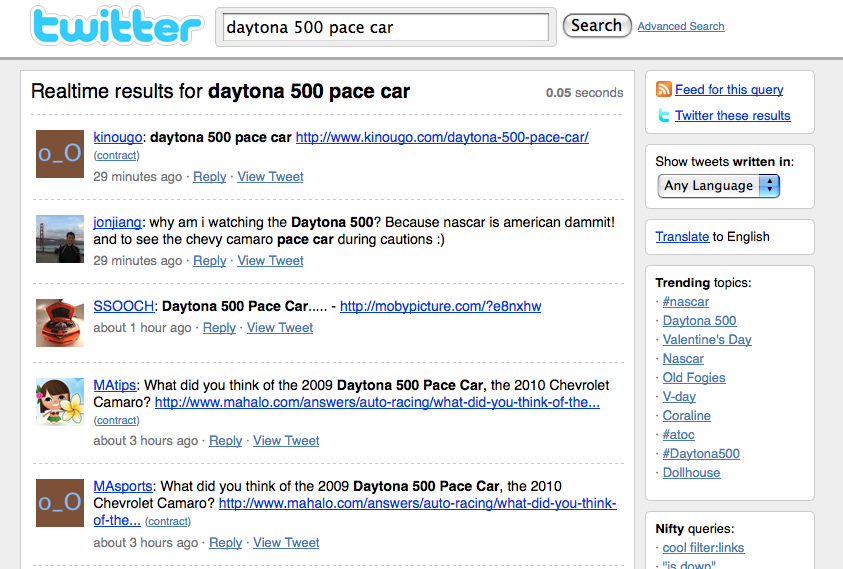
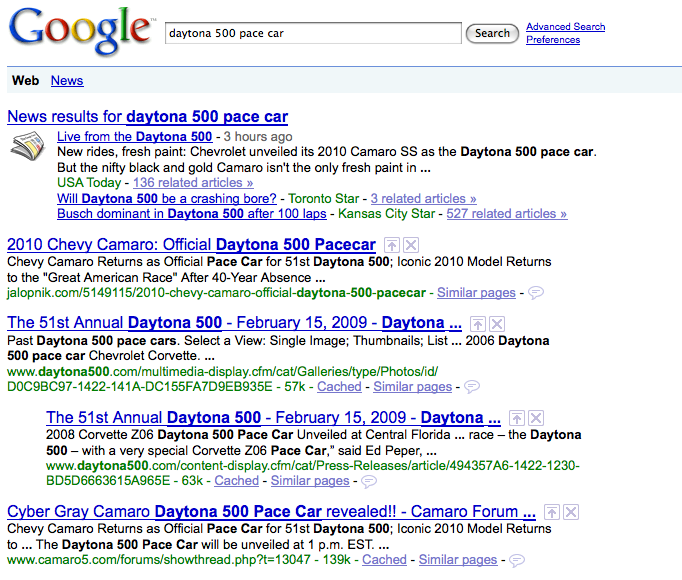
Daytona 500 Pace Car

daytona 500 pace car search on twitter

daytona 500 pace car search on google

In this instance both provide the answer. The Daytona 500 Pace Car is a 2010 Chevy Camaro. The Google result tells me it’s black and gold and gives me plenty of authority sites to visit.

Twitter on the other hand doesn’t provide this level of detail. In addition, two of the five results are from Mahalo and a third is from kinougo. More on ‘him’ later. For now lets try one last search.

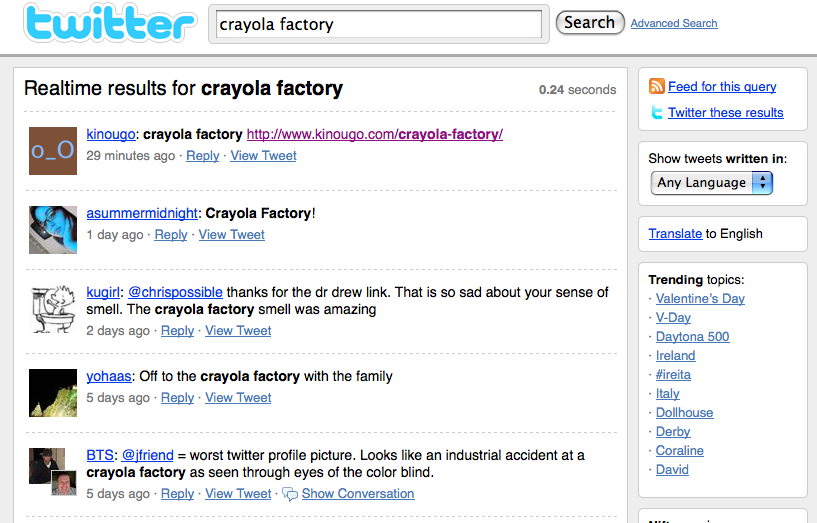
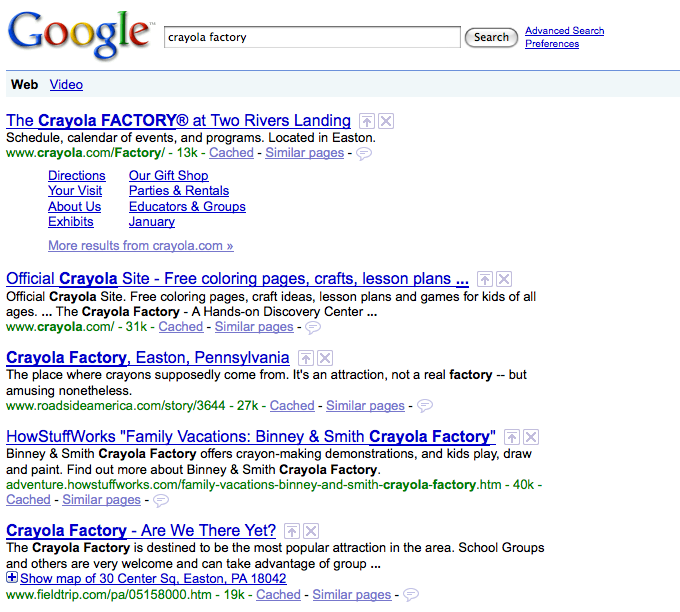
Crayola Factory

crayola factory search on twitter

crayola factory search on google

Hands down Google satisfies this query better than Twitter. The only link available is, again, from our friend kinougo. So who is kinougo?

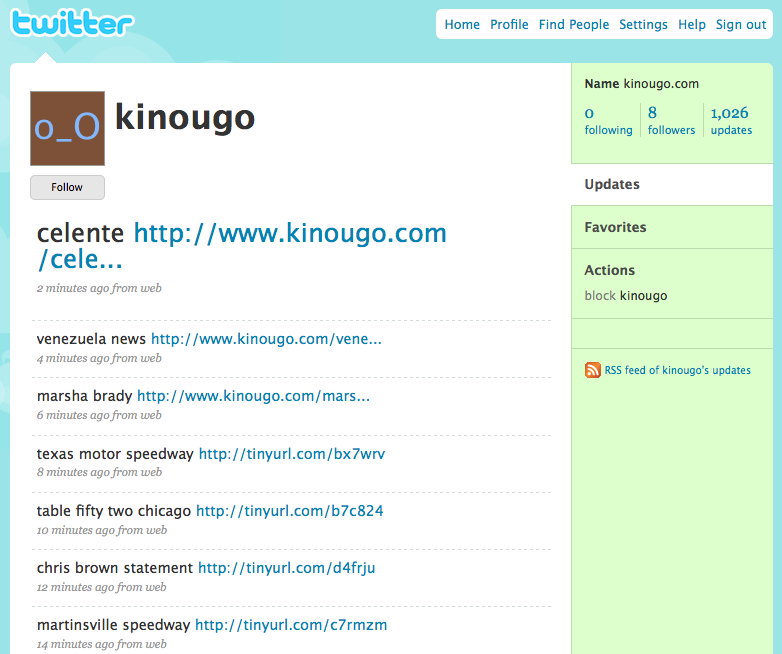
kinougo twitter profile

Essentially auto generated Tweets based on hot searches. But where do they lead?

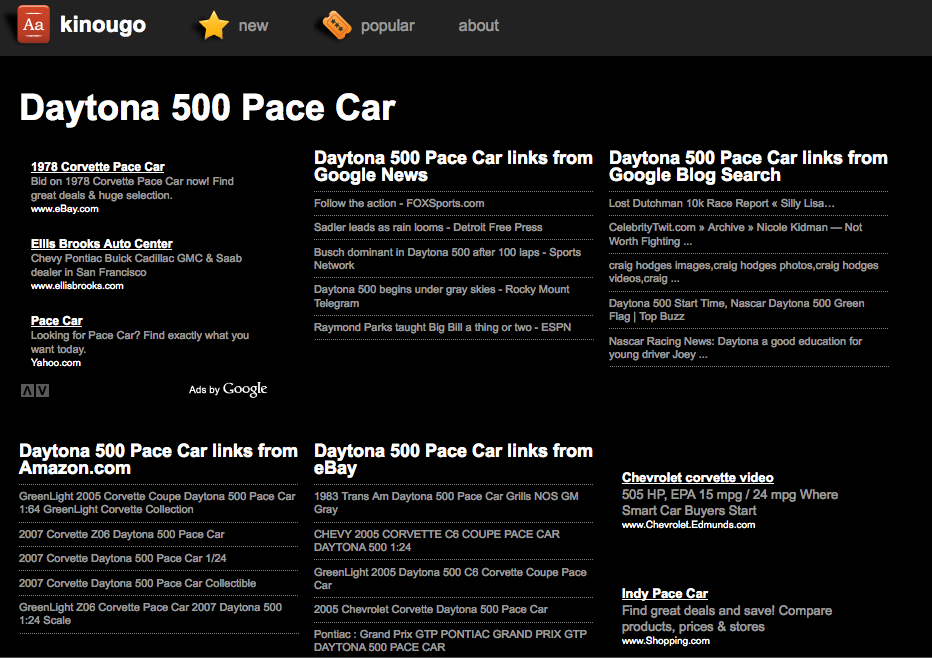
daytona 500 pace car on kinougo

Look at that! An API based link farm with Google AdSense as the revenue source. That looks … awful!

Twitter would have been a near complete bust if it were not for Mahalo and kinougo. Yet, these sites are simply exploiting Twitter search, not contributing to it in a natural way. I doubt the user experience on these clicks would reinforce the idea that Twitter was the place to search. Probably the exact opposite.

Recency works only for hyper real-time events: earthquakes, Presidential debates and conferences to name a few. (Sidenote: There’s this other site called FriendFeed which actually did a bang up job on real-time commentary on the Presidential debates.)

Authority is nonexistent

What makes anyone believe that the latest 5 or 10 tweets on a subject are at all authoritative! Twitter has no mechanism to determine what is the best result for a given query other than the Tweets from their users in a very short time span. Do you trust the random users of Twitter that much? I don’t and neither does Google.

The Google algorithm tries to present the most authoritative, the most right, the most useful results, not just johnny-come-lately blog posts and certainly not some 140 character missive. They might not always get it right, but they’re trying … hard.

Duplication is a problem

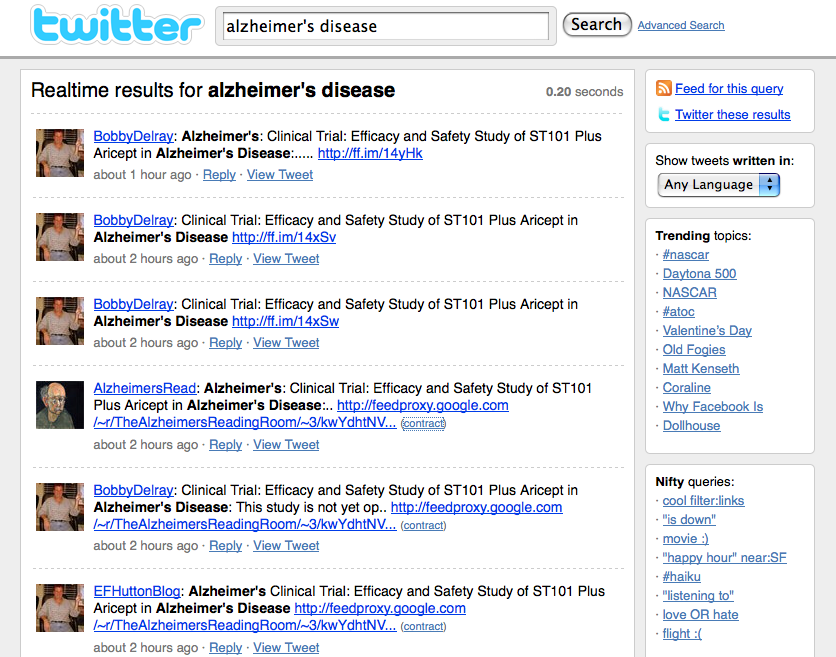
alzheimer's disease twitter search

Twitter doesn’t handle duplicate results, opening itself up for SPAM both real and unintentional. Even for the hyper real-time events how many times do you need to see the same quote over and over again?

Twitter is not a Google competitor

Relevance, authority and duplication all ensure that Twitter is not, and likely never will be, a Google competitor. At best Twitter could provide supplemental information to a real search engine. Twitter is the crawl at the bottom of a cable news channel.

“I just ate a mango” isn’t going to disrupt the search world.

9 Reasons You Should Have Been at SMX West

February 14 2009 // SEM + SEO // 1 Comment

SMX West 2009

I’m not the biggest fan of conferences. The information is often stale, vendors seem to outnumber attendees, and the speakers are cordoned off making it more like attending a guided tour at a very boring zoo.

But SMX West was different and absolutely worthwhile. Here’s why.

Big Brains

There were a lot of smart people at SMX West. Savvy search engine marketers and an accessible bunch of representatives from the major search engines. Getting to hear Vint Cerf speak was also a treat. However, upon exiting I heard someone on a cell phone talking about Cerf’s keynote. “Yeah, some guy from Google, he was pretty good.” Like I said, a lot of smart people, not all.

Big Ideas

Danny Sullivan kicked it off by asking Google to essentially blow up the black box surrounding AdWords and AdSense. Imagine going back to a transparent Overture like bidding system. Or knowing exactly what the revenue share was on AdSense.

Vint Cerf shocked everyone when he spoke about an interplanetary network which would be operational this year. But it was the idea of ‘bit rot’ that I found most interesting. How do we ensure that information from today can be read in the far future? Hey, I have some old MacPaint files still hanging around!

Finally, Matt Cutts announced a new ‘canonical’ link tag that serves as a sort of mini-301 redirect aimed at reducing the amount of duplicate content. Even better, the three major search engines have all agreed to use the new ‘canonical’ link tag.

Cloak and Dagger

Search engine representatives versus search engine marketers, some of which have used less than white hat techniques to gain traffic and rank. Panelists often seemed to be addressing Matt Cutts directly as they spoke about their techniques, looking at him for any response or reaction. This dance was, in itself, interesting to watch but it was the session about Google’s SearchWiki and Personalized Search that really seemed like something out of a Jason Bourne movie. You could learn a lot if you read between the lines.

Camaraderie

The amount of good will in the search industry is extremely high. I witnessed Michael Gray and Rae Hoffman giving constructive feedback to Corey Anderson and Bryan Horling who presented at the SearchWiki session. And those with power strips were generous and helped many to keep the juice flowing. Everyone seems to realize that this is a small ecosystem in which both sides must flourish.

Star Gazing

There were some high profile folks at SMX West. I’m not one to be bowled over by notoriety, titles or fame (hey, people are people), but it is interesting to see some of the more well known folks close up. You can’t help but smile at Rae Hoffman’s exuberance, be swayed by Rand Fishkin’s giddy passion or meet a nicer guy than Matt Cutts.

samantha fox

Answers

You get what might be the final word on topics like dashes versus underscores or relative versus absolute. And not just a whisper-down-the-lane opinion but right from the mouth of Maile Oyhe or from the seemingly tireless Vanessa Fox, who oddly and continually triggers the distracting image of Samantha Fox in my mind.

Numbers

Data jockeys galore roam the conference rooms and hallways. Numbers and statistics are often central to the presentations. Leverage the combined research power of the panelists to deliver meaningful up-to-date statistics such as the percentage of traffic that comes from being on page one or the click distribution between organic and paid on SERPs.

Access

Not the often frustrating Microsoft Office product but instead the unparalleled ability to speak with colleagues and search engine product managers and engineers. Nearly all panelists were willing to talk with folks and answer questions after their presentations, often long after they should have told people to go jump in a lake.

Now, I’m not a super social extrovert so I wasn’t chatting people up or doing the evening party circuit. But I certainly could have and might have if it hadn’t been for the nightly hour long drive home to the East Bay.

Humor and Rumor

Have you ever noticed how those two words differ by only one letter? There was quite a bit of laughter at SMX West. Danny Sullivan was consistently funny throughout. Rae and Debra Mastaler traded analogies on link building and sex.

Todd Friesen (aka oilman) was the target of a Twitter prank. And Nathan Buggia, from Microsoft, hit on both humor and rumor as he spat out one-liners sitting behind a MacBook Pro during the site review session.

For all of these reasons and more, SMX West 2009 was a great success. Make sure you’re there next year.
Call To Action Button Size and Color

February 08 2009 // eCommerce + Marketing + Web Design // 3 Comments

In December I said that testing your call to action should be at the top of your New Year’s resolution list.

On the Internet the call to action often takes the form of a button. So while words still matter, there are other dimensions to consider.

Thinking about the size, shape, color, and placement (among other characteristics), our findings indicate that future testing could reveal surprising – and positive findings – based on changes to the download button.

That’s an excerpt from a post (The Download Button Drives Downloads) on the Mozilla Blog of Metrics. By the way, they’re absolutely right.

Call To Action Button Size

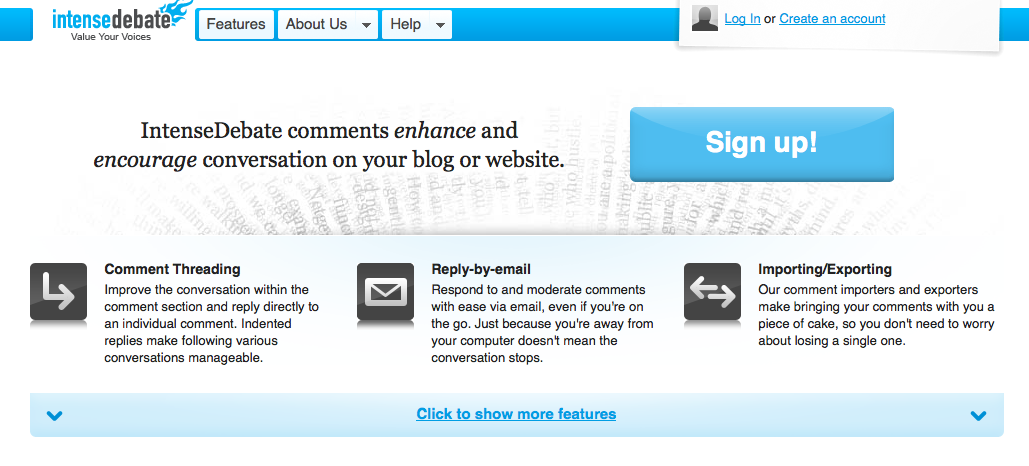
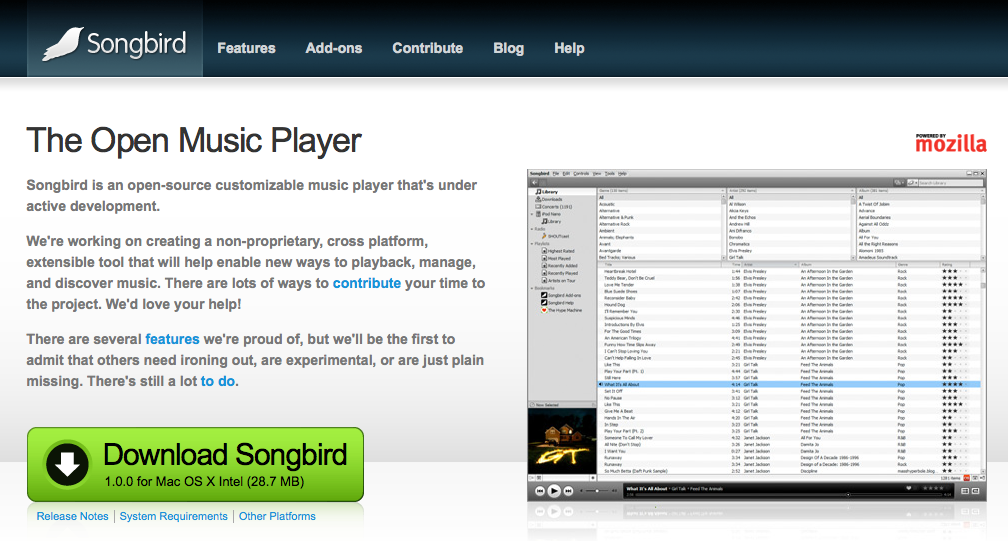
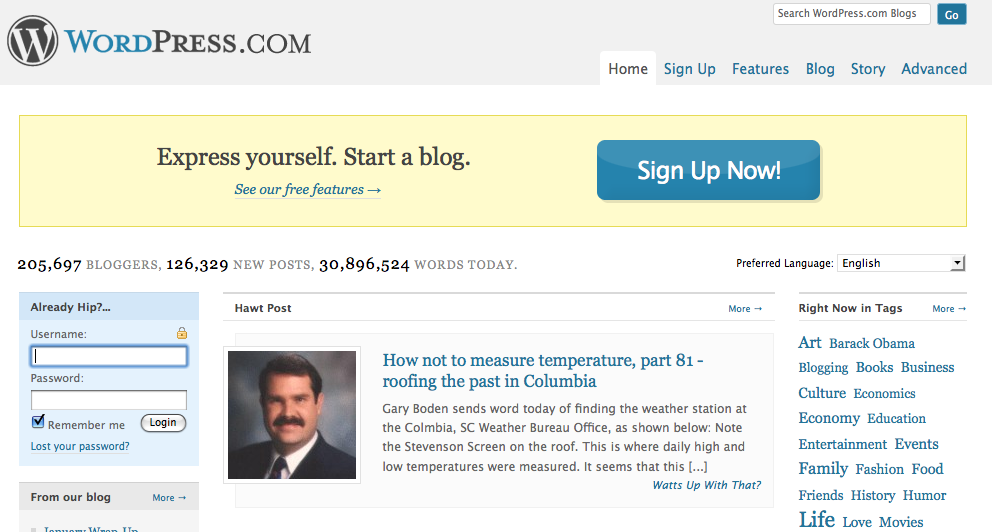
Your call to action buttons should be big and obvious. If you abide by Five Foot Web Design principles you should have no problem seeing the call to action when you take a few steps back from your monitor. If you can’t see it, your users are likely to miss it as well.

Here are a few examples of sites who got it right.

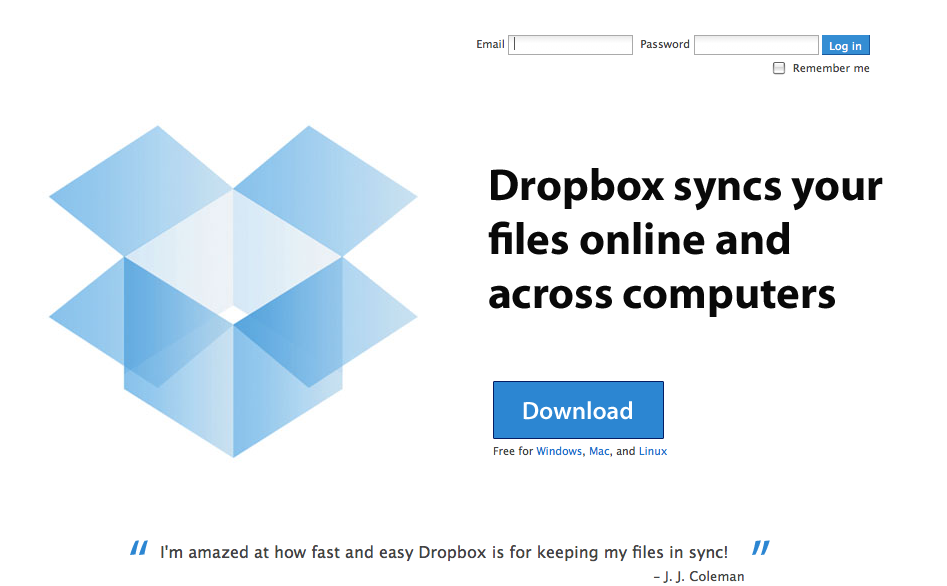
Dropbox

Dropbox Home Page

Intense Debate

Intense Debate Home Page

Songbird

Songbird Home Page

WordPress

Wordpress Home Page

Size can be relative based on the placement of the button and other design elements on the page. Your call to action button doesn’t always have to be huge but … you’re probably better off with it being bigger rather than smaller. (No jokes here please.)

Don’t be afraid to make your offer! Be confident. Not doing so is a subliminal sign to users that the product or offer isn’t valuable.

Call To Action Button Colors

Size is a relatively easy subject to tackle. The color of call to action buttons, on the other hand, is a hot topic. Jonathan Mendez (who you should be reading) touts the use of red in his 7 Rules for Landing Page Optimization.

Tell your brand team to go to hell and throw your styleguide out the window. Red buttons can by themselves raise your conversion rate. Green can be good as well but most times in our testing if color matters it is red that wins.

Not everyone agrees that red is the answer. And clearly none of the examples above took this advice to heart. Yet three out of four (Songbird being the outlier) have buttons that adhere to the site’s current styleguide and color palette. So who’s to say red wouldn’t provide a boost in conversion rate.

Why is color such a big deal?

Research reveals all human beings make a subconscious judgment about a person, environment, or item within 90 seconds of initial viewing and that between 62% and 90% of that assessment is based on color alone. [Institute for Color Research]

Each color is associated with different emotions and meanings. The ‘red’ debate revolves around whether the benefits of the color – passion, desire, excitement – outweigh the drawbacks – anger, danger and debt.

Red should be used sparingly, so as not to overwhelm users, and should also be first on your list of colors to test on your call to action button.

Lets face it. The speed of our society has accelerated and time is perhaps our most guarded resource. A site has a very short window to capture, retain and direct a user. So red doesn’t sound like a bad idea. In fact, any contrasting color might do the trick.

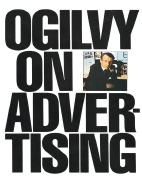
Ogilvy on Advertising

Less talked about is the color of the text on the call to action button.

David Ogilvy, often called the Father of Advertising, made black text famous in his book Ogilvy on Advertising. (Yes, the man practiced what he preached.)

Yet the overwhelming number of call to action buttons use white text on a colored background. Ogilvy would certainly have thrown a fit if he saw white text on black.

Three out of the four examples above (Songbird being the outlier again) use reversed out text. Is that a lost opportunity?

Don’t forget to try a black text version when testing your call to action button.

You’ve got nothing to lose and everything to gain by testing the words, size and color of your call to action buttons. It is one of the easiest things you can do to improve your business.

Product (Re)Placement

February 05 2009 // Advertising + Technology // Comments Off on Product (Re)Placement

The other night I fell asleep watching Blade Runner.

Before nodding off I got to see a young Edward James Olmos (a nice juxtaposition to seeing him in Battlestar Galactica) and the amazing logo laden neon skylines that serve as the back drop to the epic Philip K. Dick story.

Blade Runner Coca-Cola Logo

A lot has been made of the product placement used in Blade Runner. Not because it was the first to use it, or that it was so prominent (which it was) but because many of the advertisers fell on hard times.

Among the folklore that has grown up around the film over the years has been the belief that the film was a curse to the companies whose logos were displayed prominently as product placements in some scenes. While they were market leaders at the time, many of them experienced disastrous setbacks over the next decade and hardly exist today. [Wikipedia]

The blatant product placement, track record of the advertisers and new technology got me thinking. What happens when an advertiser or brand ceases to exist? Right now that brand will live forever on film, locked on celluloid for eternity. But does it have to be that way?

Could product replacement be a new advertising venue?

In the digital age the logo of Coca-Cola can be swapped with that of Pepsi. Atari could be replaced by Wii. A dead brand can be replaced by the new thriving brand. Science Fiction has the greatest ability to make these changes because there are no inherent problems with anachronisms.

Period pieces would probably be off-limits (e.g. – Sense and Sensibility) and modern movies would pose potential, but not unsolvable, problems. For instance, the Mellow Yellow car featured in Days of Thunder couldn’t be digitally altered to promote ROCKST★R but could to promote Mountain Dew.

It’s an intriguing idea, though I’m sure some movie purists would howl at the moon if product replacement came to fruition. Yet, the new formats in which we’re consuming media make this type of substitution seem possible.

Product placement localization seems likely too. Imagine a character drinking from a branded bottle of beer. Couldn’t that brand be altered based on localization? Bud Light in the United States, Labatt Blue in Canada, Skol in Brazil and Krombacher in Germany.

Clearly this wouldn’t always make sense and could disrupt the suspension of disbelief necessary for many films. Make no mistake, product replacement is a Pandora’s box. But imagine the additional revenue potential of selling ‘dead brand’ space in movies.

Would you be disturbed by product replacement?

Post Click SEO

January 27 2009 // Marketing + SEO // Comments Off on Post Click SEO

post click seo

Should search engine optimization professionals be more involved in post-click marketing? Yes.

SEO shouldn’t end with the click. Getting the click is half the battle. What happens after that click is just as important. Post click marketing has taken off as more and more realize the need to optimize pages and conversion paths.

SEO should be leading the charge, not taking a back seat.

Post Click SEO

Keyword targeting adjustments are the first way in which SEO can influence post click marketing. What keywords are bringing users to the page and which of those keywords is performing best from a conversion perspective?

Decisions can be made to alter the keyword targeting of the page to optimize for the better performing keyword(s). Traffic may go down but the effective yield of that traffic may go up based on the higher conversion rate.

This process might also help identify areas for new content that better meet the needs of those arriving on poorly performing keywords.

Meta descriptions and titles are extremely valuable from a post click perspective because they can set expectations and even include a call to action. Optimizing solely for the keyword or keyword phrases in the meta description might not a) encourage clicks and b) may drive unqualified clicks.

Remember, search engine marketers are constantly testing new ad copy to increase click through rates and conversion. Search engine optimizers should do the same, using the larger canvass of meta description.

The meta description can even be used for promotional purposes. Changing the meta description on a product page to include an offer of free shipping will likely increase the click yield and, if the page matches their expectation, will continue to convert effectively.

On-site optimization in the form of keyword density, headers and even bold text can all have an impact on conversion. On-site SEO is about making the page easier to understand. While the initial audience for this optimization is a search engine, those same changes help everyday readers.

A highly descriptive header will help tell both the search engine and the reader what that page is about. H2s and H3s can help further explain the topic of that page. Again, both search engines and readers benefit.

Keyword density also increases the readability of a page. Here’s an example.

The procedure was a success and fully solved the patient’s condition.

This type of sentence might appear near the end of a descriptive paragraph. The writer probably referenced the procedure and condition beforehand and believes that the reader will fill in the blanks, turn generalizations into specifics and make the mental connections needed to gain comprehension. Search engines will do none of these things.

Instead, what if the sentence read as follows.

The stomach stapling procedure was a success and fully solved the patient’s obesity condition.

Changing generalizations to specifics and filling in the mental connections we make ensure that search engines and users immediately understand the content upon scanning the page. And people are scanning pages more than ever.

Don’t make your users do the work.

Post-click marketing and SEO

Companies that seek to maximize clicks in isolation and conversion in isolation will see results.  But those results will be less than what could have been obtained. Don’t be fooled by the false positive of this silo mentality.

Search engine optimization and post-click marketing should work in tandem to get the most out of every click.

The End of Rick Rolling?

January 25 2009 // Humor + Technology // Comments Off on The End of Rick Rolling?

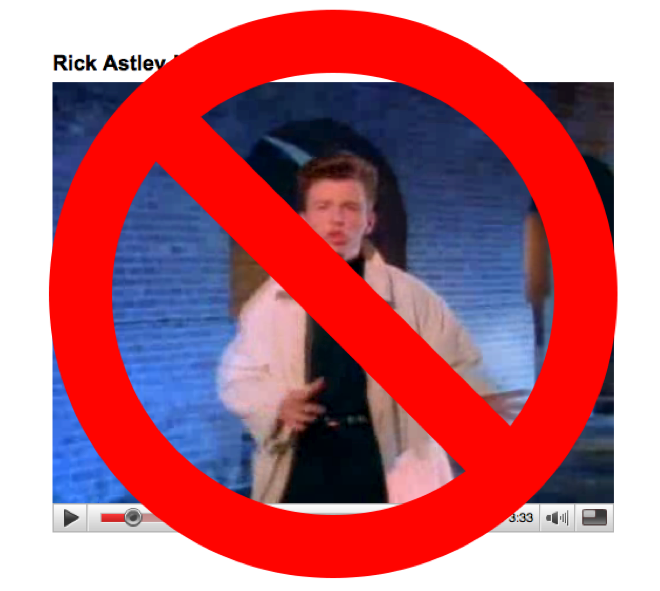
The Google team has quietly announced changes to the thumbnail selections for videos that might spell the end of the Rick Roll.

End of Rick Rolling

In December YouTube announced changes in a post titled ‘A YouTube for All of Us‘. Outside of the strange capitalization the post contained the following statements.

Improved thumbnails – To make sure your thumbnail represents your video, your choices will now be selected algorithmically. You’ll still have three thumbnails to choose from, but they will no longer be auto-generated from the 25/50/75 points in the video index.

More accurate video information – Our Community Guidelines have always prohibited folks from attempting to game view counts by entering misleading information in video descriptions, tags, titles, and other metadata.

Recently, the Google Research Blog explained a bit more about Smart Thumbnails on YouTube.

… our previous system of choosing thumbnails from the 25, 50 and 75% marks in the video, which often led to arbitrary, uninformative or sometimes even misleading images, is now a thing of the past.  When a new video comes to YouTube, we now analyze it with an algorithm whose aim is to pick a set of images that are visually representative of the content of the video.

Clearly Rick Rolling would be Exhibit A and any engineer working on a video algorithm would use Rick Rolls as a use case for development.

Is this the end of Rick Rolling? Perhaps. Or maybe it’s a continuing chess game as Rick Rollers figure out ways to beat the new thumbnail algorithm.

Never gonna give you up … never gonna …

xxx-bondage.com