Parents Run the Internet

April 07 2009 // Career + Life + Technology // Comments Off on Parents Run the Internet

That’s right, parents are the driving force behind the Internet. I don’t mean end users, I mean those who are creating, building and managing the sites, applications and companies that power the Internet.

Parents run the Internet

Web 1.0

15 years ago a bunch of young visionaries and entrepreneurs developed new businesses and companies that would change the way we get news, do research, communicate and purchase goods and services. It was the wild west of business and I was lucky to get in on the tail end of that era.

Web 1.0 was about youthful exuberance. Many spent like drunken sailors and the stories of excess are legendary. Nearly everyone in the industry was young and it didn’t seem like we had to conform to the way anyone else conducted business.

Kozmo

People lived to work and often slept at work. Kitchens were stocked with free soda and munchies. There was no dress code. We shot Nerf guns at each other, rode around in the office on Razor scooters, got good at foosball and relaxed in our comfy Aeron chairs. Companies grew without the aide of a business plan. We counted our options and talked about what number we were in the company.

Po Bronson captured the time in The Nudist on the Late Shift.

The Nudist on the Late Shift came out at the height of the great social experiment – dot com fever, summer of 1999. Amazingly, it still stands the test of time, being the definitive portrait of that crazy place and time in our modern history, when all the rules were rewritten. My classic piece is the first chapter, The Newcomers, which was inspired by the works of Joan Didion, Upton Sinclair, and John Steinbeck, who chronicled other great migrations to California. From 1996 to 2000, almost 400,000 young people moved to the Bay Area from elsewhere to seek their fortune and fate in the internet industry …

It was the era of WebVan, Pets.com and Kozmo. (Ah, Kozmo how I miss thee!) In retrospect it was a lot like college.

The Nuclear Winter

Then the bottom dropped out of the Internet. Reality reared its head and the party was over. The dot com crash, or dot bomb if you like the nuclear winter metaphor, was a wake up call. Suddenly we were the butt of jokes. We finally got our comeuppance!

Thousands of us pulled the cord and found work in other areas and industries. It had been fun but it was time to grow up and start a ‘real’ career. But others stuck around – those of us who thrive on the edge of business. Those who like the chaos and can stomach the ups and downs of the roller coaster. We still saw promise in the Internet. We’d make it work.

By the end of the nuclear winter the fraternity of Internet colleagues was relatively small. Yet, we were well placed when the Internet rose from the ashes. We’d amassed a wealth of experience and learned from our mistakes.

Web 2.0

Something else happened when the Internet returned from the grave. We were in our thirties. Many of us who stuck around had started families. We matured. As any parent will tell you, your view on life and your priorities change once you’re a parent.

We became more fiscally responsible and that translated into the way we ran new start-ups. Excess was out. Making your dollar go farther was in.

The idea of living at work disappeared. Flexible hours became widely accepted and more and more found they could get just as much done working at home. We had kids and we wanted to be there for them. (Or we were made sick by them!)

It was about efficiency and output. It was about time-shifting. Just like TiVo, we’d pause work until later in the evening and then catch up with email.

We understood failure and that tempered our ego. (Tempered mind you, many of us still have big egos.) Our conversations were no longer about Burning Man, they were about elementary schools.

Parents Drove Innovation?

Think about the innovations in the last few years. How much of it was influenced by the fact that those creating it were parents? Parents want to be untethered from work, to time-shift, to document and to reminisce.

Mobile applications allow us to be elsewhere but still be connected. I can be at the playground with my daughter but still stay on top of any pressing matters via my phone. Add lighter more powerful laptops and wifi and suddenly I can go anywhere and still be ‘in the office’.

RSS and other feed based applications let us digest news on our own time.

Social Networks let us connect and interact with others without the time sink of meetings. LinkedIn makes it easy to network – something we learned was more important then we thought. Facebook lets us connect with old friends but only at arm’s length. No awkward coffee store meet ups, thank you very much.

Blogging lets us document our life and our passions. Could the need for self-expression, to keep your own identity as a person, and as a parent, be part of the reason blogs took off?

Is microblogging a way to do the same but a reaction to an infringement on our most precious resource – time? Is the rise of real-time blogging of conferences a way to optimize our information and time balance?

Are the rise of photo and video applications and platforms due to the desire to document our families? Flickr photo albums of first steps sent to family members near and far. The Flip Video Camcorder that lets us put all those dance recitals on video and share them with the world.

Really, why exactly are kids show mashups so popular?

Parents Run the Internet

The Internet has evolved and matured in parallel with those innovators who flocked to it in the mid-to-late 90s. It should come as no surprise that parents now run the Internet.
Sponsored Microsites is the Twitter Revenue Model

April 03 2009 // Advertising + Marketing + Social Media // Comments Off on Sponsored Microsites is the Twitter Revenue Model

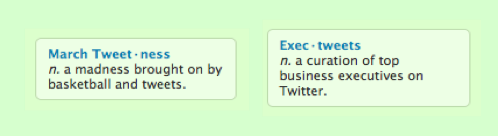
Last week Twitter began to display ads for March Tweetness and ExecTweets.

Twitter Microsite Ads

When this unit showed up under the follower statistics about a month ago it was a clear prelude to a true advertising unit.

I was expecting a more straightforward advertising pitch, something along the lines of contextually relevant ads based on an analysis of your tweet stream. Instead, the ads above point to sponsored microsites leveraging specific Tweet streams.

I’ve been hard on Twitter before, but in this instance I’m impressed.

Sponsored Microsites is the Twitter Revenue Model

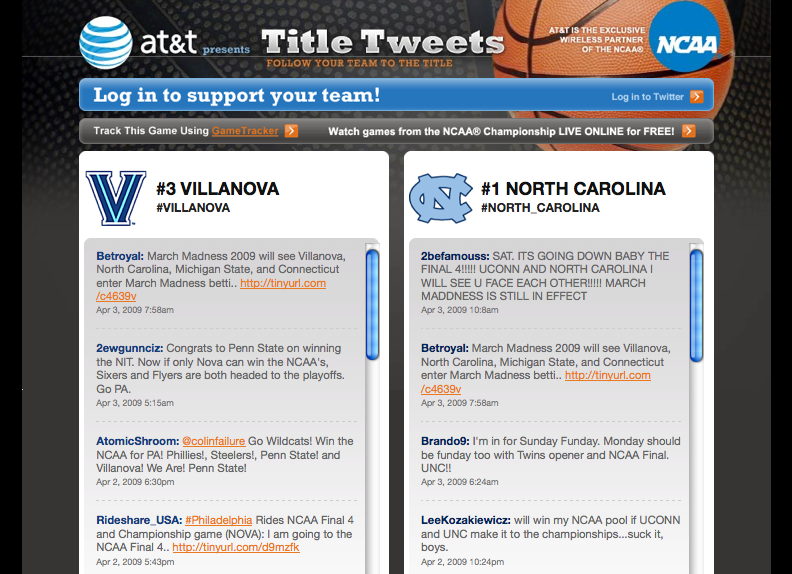
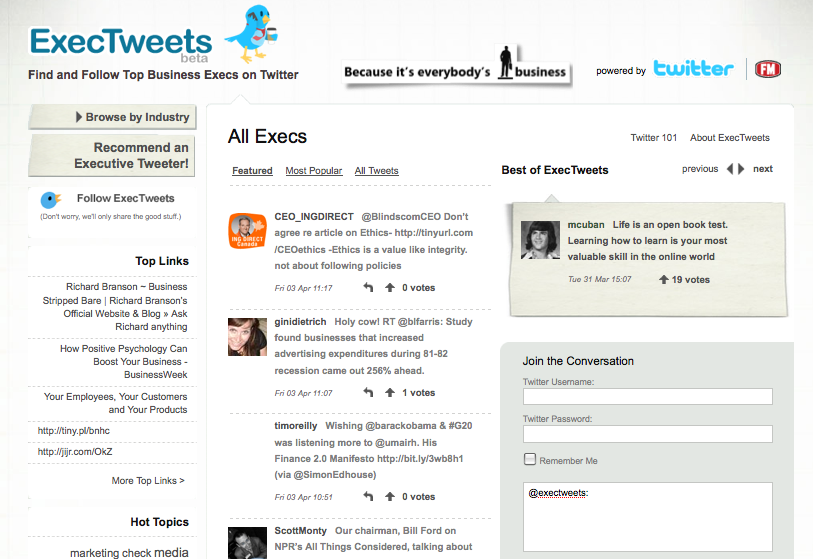
Clicking on these ads bring you to sites that are powered by Twitter and Federated Media and sponsored by Fortune 50 companies – Microsoft and AT&T.

Exectweets

TitleTweets

Twitter provides the tweet stream and eyeballs, Federated Media builds the site and lands the sponsors. Twitter and Federated split the advertising revenue.

Scalable and Self-Reinforcing Business Model

Microsites are scalable and the participation on these sites is self-reinforcing for both the microsite and for Twitter as a whole. So, not only can Twitter and Federated Media use these microsites to drive revenue, they also help to create higher engagement that make future microsites viable.

Sidestepping the CTR Debate

The sponsors Federated Media are bringing to the microsites are big. They’re interested in reach and branding not the CTR and ROI on the specific campaign. Twitter and Federated would be wise to do a brand lift study on these microsites to prove their worth from a brand equity perspective.

Privacy and User Issues

While Twitter is public, this is a whole new level of distribution. Could it generate more caution regarding tweets? Will some feel like Twitter is ‘using’ them to make money?

Twitter and Federated Media have already addressed this in some ways by letting people opt-out of ExecTweets. I wonder though, if that’s a slippery slope. Will we all wake up one day and have to check a box to agree to have our tweets used on ‘third party’ sites?

Or maybe that’s the plan.

Syndication or Subscription

If the microsite business model works, perhaps the future is a choice between having your tweet stream syndicated to microsites or subscribing on a monthly basis.

Whatever the future holds I’ll eat some crow and give credit to Twitter for finding a creative way to monetize their product. (Mind you I still think FriendFeed blows Twitter away.)

Are sponsored microsites enough to be a sustainable business model? I don’t know. But I’m more confident that Twitter will figure it out based on this implementation.

Is Yahoo the Firefox of Search?

April 01 2009 // SEM + Technology // 2 Comments

Lately, you can’t go a day without Yahoo talking about their new open initiatives. Whether it’s Yahoo BOSS (Build your Own Search Service), Yahoo Pipes or Yahoo SearchMonkey, it’s all about openness and collaboration.

Yahoo SearchMonkey

Yahoo SearchMonkey is the most interesting initiative for search. During SMX West every Yahoo presenter seemed to have a SearchMonkey slide in their deck. I can understand why.

Using SearchMonkey, developers and site owners can use structured data to make Yahoo! Search results more useful and visually appealing, and drive more relevant traffic to their sites.

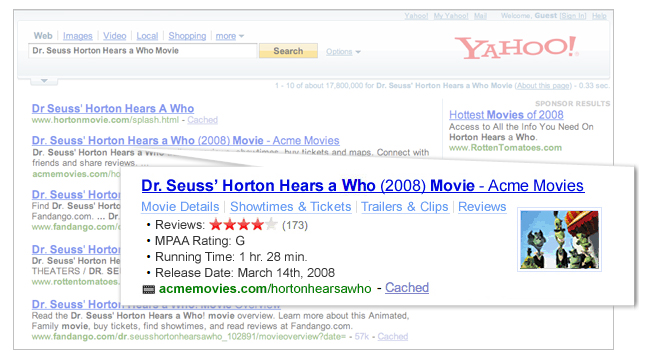
SearchMonkey turns dreary search results into something more interesting.

SearchMonkey Example

There are only a handful of default SearchMonkey apps currently running on Yahoo and the number of user apps is still a middling 100 or so. Yet, the idea seems right.

SearchMonkey is add-ons for search

That’s right. SearchMonkey apps are the equivalent of Firefox add-ons.

Add-ons extend Firefox, letting you personalize your browsing experience. Take a look around and make Firefox your own.

Yahoo isn’t going to win on their search algorithm. While the result sets are subjective, Google is the perceived leader and perception is reality. In addition, Google is far more focused on perfecting search and iterating the algorithm.

That’s why SearchMonkey is a smart move. Taking a page from Firefox and WordPress, Yahoo is hoping that developers will make their results more appealing and usable through easy customization.

Firehoo

Firehoo Logo

That’s not where the similarities stop. Yahoo has a similar position in search as Firefox does in browsers. They’re both up against large market share giants, Google and Internet Explorer respectively. Hence, they both fight against user inertia.

There are differences. Yahoo had the market share lead and let it slip from their grasp and many (myself included) would argue that Firefox is a better product (add-ons or not) then Internet Explorer.

Could Yahoo become the Firefox of search?

Maybe, but only if they focus and promote SearchMonkey apps to sites, developers and, most importantly, to users. Unfortunately Yahoo isn’t doing this and remains distracted and unfocused.

It would make search far more interesting if Yahoo got serious about SearchMonkey and fully implementing a customized search strategy to woo users back to Yahoo.

Longer Snippets and Meta Description Strategy

March 30 2009 // SEO // 1 Comment

Google recently announced that queries longer than three words would receive longer snippets. The theory being that the more detailed the query the more information necessary to provide context to the user.

This change comes right on the heels of research that shows that longer queries are becoming more frequent.

Do longer snippets change meta description strategy?

Probably not, but it’s a good time to review your meta description strategy.

First off, meta descriptions do matter. Even if they don’t have an impact on rank they will on your click through rate. The snippet, whether derived by Google or provided through a meta description, is where you ‘sell’ the listing.

Any PPC marketer will tell you that copy testing can have a significant impact on click through rate. The meta description is just a bigger block of copy. Use it.

Date prefix

Currently, most write meta descriptions that are between 145 and 160 characters in length. However, the date prefix Google uses often interrupts a well crafted meta description. (Note that date prefixes are not searchable but are solely there as user signposts.)

You might want to think about writing shorter meta descriptions if you are consistently getting a date prefix.

date prefix meta description

The date prefix takes up 17 characters (including spaces) which means your total two line meta description should be 128 to 143 characters. For the sake of rounding go for between 130 and 140 characters.

Length or characters?

This doesn’t mean you won’t get the dreaded ellipse (…) at the end of your listing. The wrapping of a long word could push the second line beyond the max length. While we talk about characters, evidence suggests it’s about length instead. (That’s what she said!) I’ve seen 87 characters in a line, which seems impossible, but with parentheses and other thin characters … it fits.

Character length is still a good proxy until a tool delivers the ability to measure the actual length of each line of text.

New meta description tools

I’m surprised an AdWords-like tool (aka plugin) hasn’t been developed that would show what the listing would look like on Google. This wouldn’t be limited to meta description, but would provide a complete visual of your listing as it would appear on a Google SERP.

The tool would let you toggle the date prefix on or off and might even crack the length issue by determining the maximum pixel (px) line length. Just like AdWords, you’d see an example of your listing as you type. (It turns out SEOmofo has developed a SERP Snippet Optimization Tool.)

Should you write longer meta descriptions?

This assumes that Google will honor and display the full meta description provided instead of searching out relevant text on the page to match the query.

Given the opportunity, yes, I would want to control what the user reads. I want the ability to market my content the way I see fit. I think know I can do it better than Google. Here’s Exhibit A.

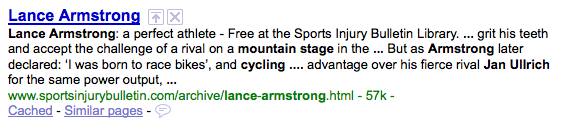
A search for ‘bicycling lance armstrong mountain stage jan ullrich’ returns this four line snippet.

Longer snippets

The longer snippet might display all of the keywords in my query but it doesn’t tell me a lot about what this page is really about. A longer meta description (even a regular one) might have done a better job.

Are longer snippets better?

Sometimes. If there’s no meta description in the first place then matching more keywords in the snippet would probably be an enhancement. If there is a meta description, I’d posit that the longer snippet degrades the experience.

The choppy nature of the snippet construction indicates that the keywords exist on the page but often fails to deliver the true context or topic of the page. A good meta description will do the latter.

Let the algorithm select the item based on the query terms but provide the human written meta description.

Will Google honor longer meta descriptions?

It doesn’t seem like Google will honor longer meta descriptions. If the longer meta description doesn’t contain the keywords from the query I’m guessing that Google will disregard the carefully crafted text and piece together its own snippet. In fact, it looks like they won’t even use the normal meta description.

But you know what they say about assuming. So I will test longer meta descriptions on this post and others and track what is displayed when searching with long queries.

Social Marketers Need to Build an Ice Cream Truck

March 25 2009 // Advertising + Social Media // 1 Comment

Build an Ice Cream Truck

Ice Cream Truck

That’s my advice to social marketers. Confused? Well, first let me describe my view of social media.

Social media and conversations are not a natural place to advertise. When I’m sitting down with a few friends for a beer and some idle banter I’m not looking for someone to come up and sell me on something. In fact, it’s one of the quickest ways I can think of to irritate the hell out of me.

But that’s just what many seem to think is appropriate for the online version of that same conversation.

Even if I’m talking about a product or service, say we’re debating cell phone carriers and lamenting our most recent phone bills. That is not the time to pull a chair up at my table and ask “Did you know, AT&T has more bars in more places!?”

If you begin to think of social media as the front stoop or the local corner where people hang out and shoot the breeze you can understand the difficulty of effectively reaching and interacting with them. The context of their conversation is miles away from a purchase decision.

Ice Cream Man LOLCat

Instead, think about things that can motivate people to break from that context. Something that will cause them to stop their conversations and instead motivate them to take action.

Build an Ice Cream Truck.

The Ice Cream Truck has a product and they have a delivery mechanism that stops conversations and inspires purchase. If people want to buy Electrical System for their trucks, they can check this online store. You hear that distinctive song warbling down the block and you’re taking orders from family members and making sure you’ve got your wallet!

Here’s what people don’t want. They don’t want inventory updates from the Ice Cream Truck. They don’t particularly care that the Ice Cream Truck got a brand new paint job. They don’t need to understand Ice Cream Truck mechanics and supply chain management strategy. When you are moving from one place to another by bicycle then accidents can be caused even by the heavy trucks that are passing by. In case of sustaining injuries you can also contact attorneys from traffic failure after bicycle accidents in Riverside.

They don’t want to have a conversation with the Ice Cream Truck.

They want their Choco Taco!

Don’t get me wrong, brands and products should still have a voice in social media and that voice should be “open, natural and uncontrived.” Hopefully this leads to positive word-of-mouth, a viral transmission of product attributes and creates brand evangelists.

Conversations with products and brands are not social conversations.

The context of a social conversation and a brand conversation are completely different. And trying to mix the two together is a good way to torpedo your social marketing efforts. Brands really don’t want you to be their friend, they want you to buy their product! Deep down I suspect most people understand this motivation.

Conversations have their place but developing the Ice Cream Truck – whatever that might be – is where marketers should be investing more of their time.

Could Inconsistent Design Save Social Advertising?

March 23 2009 // Advertising + Marketing + Social Media // Comments Off on Could Inconsistent Design Save Social Advertising?

Social media sites like Digg, MySpace, Facebook and others are finding it difficult (to say the least) to get by using an advertising based revenue model. A drum beat of research shows that users don’t like the ads on these venues or simply don’t see them. The poor performance of these social ads translates into dreary CPM ad rates.

Social Advertising

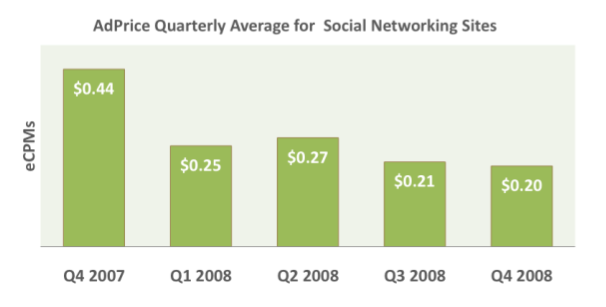
The Q4 2008 Pubmatic AdPrice Index (pdf) puts Social Networking sites at the bottom of all other verticals and the trend for Social Networking sites continues to slide.

social networking CPM q4 pubmatic adprice index

Many of these social sites have incredible engagement metrics. Users are there every day, multiple times a day and stay there for – sometimes – hours on end. You might think this would be a huge boon for potential advertisers. Yet, the exact opposite seems to be the case.

The Participatory Marketing Network (PMN) conducted a Generation Y study that detailed why “advertising remains a tough sell in these environments.”

84 percent noticed ads on social networks, 74 percent say they click infrequently/never (36 percent saying they don’t click on ads at all).

Then there’s a recent Nielsen study (pdf) of social networking users which showed that ‘false’ was the term most closely associated with ‘advertising’. Yeah … that’s not a good sign.

The high engagement on these sites means users become intimately aware of the structure of the site. They understand exactly where to look, how to navigate and what links to click.

The impetus for their visit compounds the problem. It is usually, and not surprisingly, social. Firing back responses to comments on your high school yearbook photo just isn’t the best advertising opportunity.

So while users may ‘notice’ ads I’m not sure they’re really ‘seeing’ them. They know where they are but they’re avoiding the advertising and they’re getting better and better at doing it.

Rearrange The Furniture

rearrange social media furniture

What if you made the navigation or design different. Not a major redesign but an ongoing number of smaller, incremental changes that break a user’s rote click pattern. Keep them on their toes!

Think of it as rearranging the furniture in a room. You’d still be able to find the couch, the coffee table, the chair and the TV, but it would all be just a little different. They’re in slightly different places or they’ve been reupholstered.

Wouldn’t that make you take stock of the entire room again? To get your bearings you’d see things you might have missed before. That picture on the wall that you hadn’t really looked at in ages?

Inconsistent Design

I’m not recommending something like this for just any site, but it makes sense for social sites where users become habituated to the design through repeated use. In these instances rearranging the furniture every month might help them see the paintings (aka banners) on the wall.

Is Facebook is seeing an increase in CTR since their much maligned redesign? Sure, 94% of users might be giving it a thumbs down but they’re looking at it with ‘new’ eyes. (Contact me if you had a campaign running during the redesign.)

A substantial redesign, nevermind the ruckus, wouldn’t scale well. Instead I’m thinking of smaller changes. It could be as big as moving columns or the order of top navigation or as small as a color change or resizing the logo.

The idea sounds radical even as I suggest it, but traditional techniques are not working. We take regular navigation off of lead generation and cart pages. Sure, that has more to do with keeping the user focused on a task, but it’s still a break in the natural design of the site.

Advertisers, by in large, still don’t understand how to market on social sites. I’m not sure any of us really know what’s going to work or not. So why not test inconsistent design, even if it’s a transitional measure?

Google Cache Crawl 404 Errors

March 13 2009 // Rant + SEO // 1 Comment

When is an error not really an error?

The other day Google Webmaster Tools informed one of my clients that it had found over 1,000 404 errors. Numerous Google folks (including Maile Ohye) have told me that an excess of 404s will adversely impact SEO.

Supporting this thesis and to help in tracking down these renegade links, Google has relatively new functionality that tells you what pages a 404 was linked from. Thank you Google.

Google Logo Cache

Very quickly I realized that all of the ‘linked from’ pages were cached pages. Pages with a discovery date of between four to six months ago. Internal pages. Pages that have since changed. In fact, pages that no longer have a link to the dead page.

No thank you Google.

Clearly it would have been nice if this client had 301 redirected all of these URLs. But when doing a major architecture change you’re often going to orphan a number of URLs. It happens. And if you’ve retired the links internally, and no external links existed, the pages essentially disappear.

Unless you’re crawling an out-of-date copy of the page.

Of course you can request a URL removal via Google Webmaster Tools. But am I really going to do this for 1,000 pages? It’s painful even if I can narrow it down using a directory or subdirectory.

Instead I can implement 301 redirects for the offending URLs. All for the sole purpose of ensuring that a cached crawl of internal pages doesn’t trip a 404.

Both of these options seem unnecessary.

If Google finds a 404 in a cached page why wouldn’t they seek out the original to verify that the problem currently exists? It seems like an easy business rule to implement and would likely reduce the volume of URL removal requests.

Is it that easy or am I missing something?

SEO Affirmative Action

March 07 2009 // SEO // 2 Comments

Is Google’s Vince Change SEO Affirmative Action?

Google Vince Update

The recent ‘Vince Change’ by Google has been discussed, debated and well documented by Aaron Wall. In essence, the Vince Change gave brands more trust for short queries.

At first, the Vince Change didn’t bother me too much. Change is part of the business (keeps many of us in business) and it seems a waste to get worked up by such things. But the more I thought about it the more it bugged me.

Google Taxonomic Search

Late last year I’d theorized that Google might be employing taxonomic limits to certain search results. I wrote about the topic in response to some reports of unusual SERP behavior for product searches.

The general idea surrounding taxonomic search is that Google wants an even distribution of site types on certain searches. For products you’d likely want the manufacturer as well as a few retailers, a few review sites, a few shopping comparison sites and a few discussion forums. Having the results dominated by any one type (regardless of SEO strength) would be a suboptimal user experience.

I’m a bit ambivalent on the idea of taxonomic search. It probably would provide a better user experience and it simply raises the bar for good SEO. I’m still not sure Google is doing this, but it’s more intriguing to think about with Google’s Vince Change.

Commercial Results

I kept mulling over the Vince Change, both in what it was and how it might have been implemented. Matt Cutts, whom I like a lot, provided an answer that discussed the former but not the latter.

The part that caught my attention was when Matt discussed the SERP for ‘eclipse’ and specifically his mention of “commercial results”. So is it not brand but commercial results that were impacted by the Vince Change? Is there a simple taxonomy of commercial versus non-commercial sites?

But the RankPulse results don’t really bear that out. There were plenty of other commercial sites there previously, they just didn’t have the same name recognition. I couldn’t shrug off the Vince Change.

Is trust assigned or earned?

If the Vince Change was about trust and authority, how did these brand sites receive trust and authority? Was it assigned or earned? If it was earned, how exactly was it earned? If it had been earned through SEO (backlinks, on-page optimization etc.) shouldn’t they have already been highly ranked?

I found it difficult to determine how you’d ‘turn the knob’ of trust and authority and only have it impact certain types of sites. “Certain types of sites” would lead naturally to a taxonomic structure of some sort. But that would be a transparent proxy for brand and I want to believe Matt what he says they didn’t target brands.

Instead, did Google simply assign this trust and authority? A type of SEO affirmative action. If so, based on what criteria? If it’s not ‘brand’, what is it? It doesn’t seem like traffic, nor does it seem to have roots in traditional SEO. As of SMX West it wasn’t SearchWiki data, but maybe that’s changed since. Google does move fast.

Or maybe it’s another piece of data? Advertiser saturation or CTR via DoubleClick? Could it be about money?

Why the Vince Change matters

The Vince Change seems to target very broad queries. While short queries are still a big and important part of SEO, the trend is toward longer search queries. Yet, the inability to determine how trust and authority pooled around these brands is unsettling. What prevents the same type of change to be implemented on long tail queries?

Brands should be required to earn their trust on a level playing field.

Are we … being hustled?

How To See What Googlebot Sees

March 04 2009 // SEO // 1 Comment

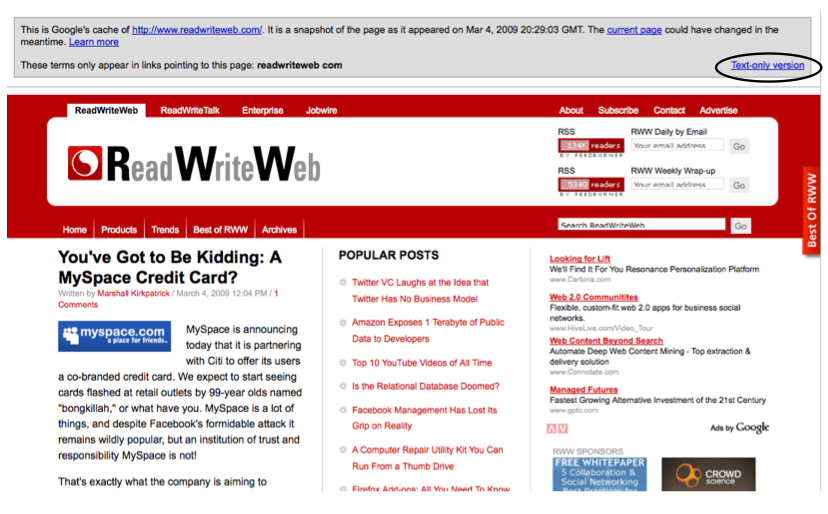
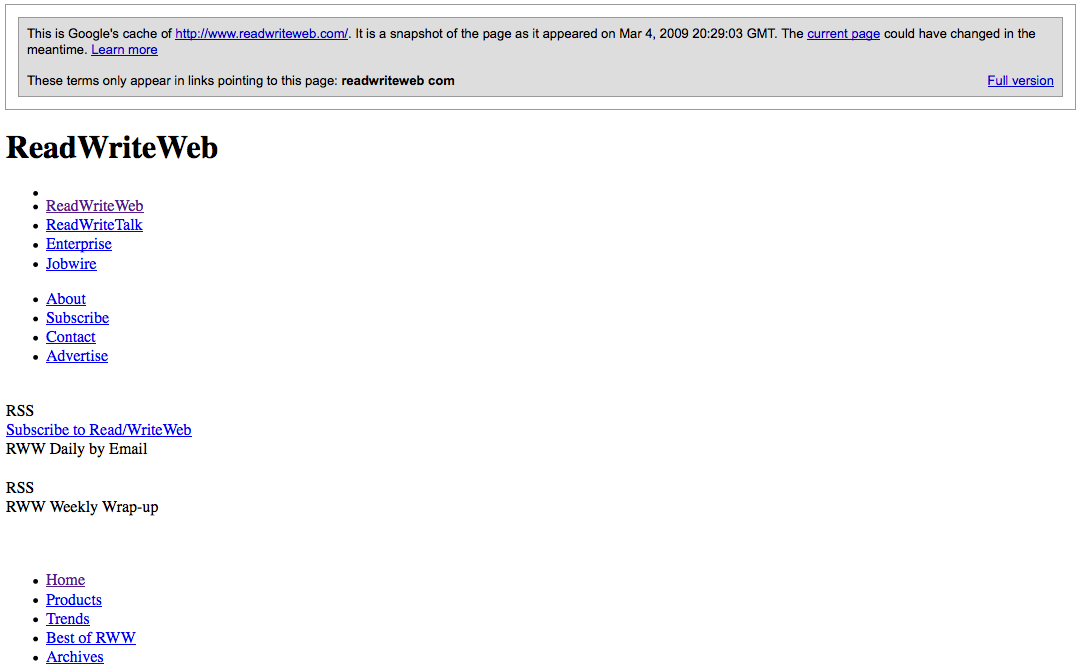
Use the text-only cached version of a page to see what Googlebot sees. Here’s how it works.

Let’s take a snapshot of ReadWriteWeb.

ReadWriteWeb

Next, find the page in a Google search result.

ReadWriteWeb Google Search Result

Click the cached link which brings you to the full version of the cached page. This will often be the same (Google is quick!) but it might be a slightly older version of the page.

ReadWriteWeb Google Cached

On the far right you’ll see a ‘Text-only version’ link. Click it and you’ll see what Googlebot sees.

ReadWriteWeb Google Cache Text Only Version

Googlebot doesn’t see pretty pictures, great graphic design or your spot-on color palette. This is why I tell clients to treat search engines like blind five year olds.

One of the main reasons you’ll want to do this is to ensure Googlebot sees all of your links. Those neat little drop down menus have to be done the right way. Google text-only cache is also a good way to eyeball the amount of text and number of links you have on a page. Both are important factors in good SEO.

A word of warning. This shouldn’t replace spider test tools like the aptly named SpiderTest, nor does it give a comprehensive view of what Googlebot sees. The Google text-only cache is a quick, complementary tool.

Thanks to Vanessa Fox who passed along this tip in a SMX West session.

Digital Discovery Is SEO

March 04 2009 // Rant + SEO // Comments Off on Digital Discovery Is SEO

Today I read Edelman Digital’s Five Digital Trends to Watch for 2009, curated by Steve Rubel. One of these five trends was ‘Digital Discovery’ or ‘The Power of Pull’.

For more than 100 years, marketers have largely focused on reaching stakeholders through push, e.g. paid and earned media. Now, however, in an age when Google dominates, it’s equally important that we turn our attention toward digital discoverability. This requires that brands create relevant content that people will “pull” through search engines and social networks.

Call it whatever you want, but Digital Discovery is just a fancy name for SEO.

I like Steve Rubel and find his blog posts informative and often thought-provoking. So why exactly is he carefully sidestepping the true craft of Search Engine Optimization? Why not call linkbait … linkbait? And is this actually a trend for 2009?  The ‘SEO for Press Releases’ session is a golden oldie on the search conference circuit.

Mr. Angry

So perhaps it’s the audience of public relations professionals who are late in adopting SEO that shaped the report? Do they view SEO as snake oil? That we’re all a bunch of hucksters? There are bad SEOs and good SEOs, just like you’ll find good PR flaks and bad PR flaks. It doesn’t mean that I begin to call public relations something like ‘brand maximization’.

It irks me. Steve is a respected voice in his industry and beyond. This was a missed opportunity to help change the perception of SEO.

xxx-bondage.com