— You Are At The Archives for the twitter Tag —

How To Get Your Twitter Replies Via RSS

January 02 2009 // Social Media + Technology // Comments Off on How To Get Your Twitter Replies Via RSS

Twitter Replies Via RSS

Here’s a simple way to get your Twitter replies delivered to you via RSS.

  • From your Twitter home page, scroll down to the bottom and click on Search
  • Search for your replies using @[your username] (for me that would be @ajkohn)
  • Select the ‘Feed for this query’ link on the top right hand side of the search results page

That’s it. Your Twitter replies will now be delivered to you via RSS in your favorite reader.

Proof Twitter Is Not Mainstream

December 30 2008 // Social Media // 1 Comment

Has Twitter gone mainstream? Sure it’s gaining in popularity, but mainstream? I think not. Mainstream is defined as follows:

The prevailing current of thought, influence, or activity. The people or things representing the most common or generally accepted ideas and styles in a society, art form, etc.

At most you could quantify Twitter as mainstream for a subgroup of Internet users. But why quibble when I have real data. Here are the results of a Vizu Answers poll I conducted on December 29, 2008 across 286 websites.

Do You Use Twitter Poll

The results show that 1 in 5 use Twitter while a full half of respondents didn’t even recognize Twitter.

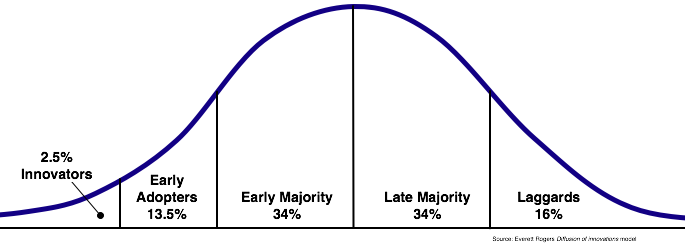
Twitter is not mainstream. So, what is it? I think it makes sense to measure Twitter using the Everett Rogers Diffusion of Innovation.

Rogers proposes that adopters of any new innovation or idea can be categorized as innovators (2.5%), early adopters (13.5%), early majority (34%), late majority (34%) and laggards (16%), based on the mathematically-based Bell curve.

Rogers Diffusion of Innovation

Using this measurement and the poll data (20%) we see that Twitter is entering the Early Majority, which is likely why the buzz quotient for Twitter has increased of late. Twitter will need to make its way through the Early Majority to the Late Majority before it truly becomes mainstream.

Of course you could argue the merits of the data. But this was an Internet poll which means it likely under reports Laggards. You might also point to the figures recently released in Hubspot’s State of the Twittersphere.

The growth is impressive. But I’d point out that Twitter users often maintain more than one account. Here’s an unscientific FriendFeed poll that, at the time of writing, indicates that Twitter users maintain an average of 1.5 accounts.

So lets wait to annoint Twitter as mainstream and instead see how it evolves and innovates in 2009.

2009 Internet and Technology Predictions

December 23 2008 // Advertising + Marketing + SEM + SEO + Social Media + Technology // 9 Comments

Now is the time when bloggers go on the record with their thoughts for the year ahead. Place your bets! Stake your claim! Here’s mine.

Crystal Ball 2009 Predictions for Internet and Technology

Facebook Becomes A Portal

Realizing that social media and advertising is like oil and water, Facebook repositions itself as a portal leveraging Microsoft’s Live Search as the revenue model. This also might result in the potential acquisition of Netvibes to provide a more robust offering to compete with Yahoo!

Identity Systems Fail

Confused about the difference between OpenID, Facebook Connect and Google Friend Connect, users throw up their hands and decide not to use any of the above.

Video Advertising Succeeds

The adoption of video is surging faster than many expected. Longer formats and better quality will bring even more eyeballs who will grudgingly accept advertising.

Microformats Go Mainstream

Why they aren’t already is shocking. Nevertheless, in 2009 we’ll see microformats become a standard and search results will become far more robust as a result.

Banner CTR Becomes Obsolete

Brands will finally realize that measuring success by click through rate (CTR) isn’t working. Measurement ‘beyond clicks’ will be the new yardstick, whether that’s through new brand advertising measurement services like Vizu or through monitoring services like Brandwatch and Trackur among a gaggle of others.

RSS Adoption Spikes

Someone will (finally) figure out how to market RSS to ‘the masses’ who will grasp the sublime benefits of having content come to you instead of the other way around.

Kindle 2.0 Flops

Amid a weak economy Amazon releases the newest version of Kindle. Other readers have gained ground where Kindle has not and at the core Kindle is a solution without a problem.

Google Search Share Stalls

The move by Facebook (see above) causes a radical change in the search landscape. Microsoft passes Yahoo! for second place and talks about a Microsoft Yahoo merger are (unbearably) reignited.

FriendFeed Surpasses Twitter

FriendFeed adoption increases at an accelerated pace due to quick innovation, uncluttered design and an interface that lends itself to communication.

Someone ‘Dies’

Users reach social media overload and VCs get even more nervous about revenue creating social media shrinkage. In this instance ‘Dying’ means a company goes under or is purchased for a song. My short list includes Plurk, Twitter, Digg and Seesmic. This isn’t a reflection of the people or product but the inability to truly reach the mainstream with a service that has a profit model.

There are plenty of other things that I believe will happen in 2009, but they seem more obvious or an extension of current trends. Instead I tried to be a bit more bold, at least on a few of my predictions.

We’ll check in this time next year to see how I fared. In the meantime, feel free to comment and provide your feedback and reaction to my predictions.

Twitter In The ER

December 13 2008 // Life + Social Media // Comments Off on Twitter In The ER

It’s no secret that I’m not the biggest Twitter fan. But yesterday, we had to take my daughter to the ER to get IV fluids. She couldn’t keep anything down, even water, and having been born with just one kidney we’re always vigilant about her hydration.

During this gut-wrenching time (there’s no comparison to worrying about the health of your child), Twitter let me keep my family and friends updated without stepping out of the room or disturbing anyone. It served a very valuable function, something it hadn’t done for me previously. Oh, Twitter had been interesting, informative and sometimes fun, but never valuable.

Twitter is increasingly being used as a news service – whether it’s reports of an earthquake, opinions on Presidential debates or first-hand accounts from the Mumbai attacks. In this instance, I was simply using Twitter for my own personal crisis. Micronews.

I wasn’t expecting a dialog, though I got some very kind replies. (Thank you!) And that might be the reason why Twitter continues to do well. The expectation of dialog or replies is still low. When you shout into a canyon you’re pleasantly surprised when you hear someone, other than your own echo, reply.

Maybe this isn’t the big epiphany for you as it was for me. But it makes me think that Twitter can be more than just a promotional megaphone or “I just ate a mango” navel gazing. I also thought of new features I might want, like the ability to Tweet to a subset of my followers.

Hopefully my followers on both Twitter and FriendFeed don’t mind my tangent into personal chatter. (No Qwitters yet.) And I’m certainly hoping I don’t have to take advantage of this particular use of Twitter any time soon. But it’s nice to know it’s there.

Thank you Twitter.

TweetSense

December 09 2008 // Advertising + Social Media // Comments Off on TweetSense

Does TweetSense make sense? And more importantly would it make cents?

Twits have been up in arms with the introduction of Twitter based ad networks like twitAD and Magpie. Magpie in particular drew a lot of coverage with notables like Mark ‘Rizzn’ Hopkins at Mashable and Michael Arrington at TechCrunch weighing in on the topic. Many claimed that it was outright spam that had no place on Twitter. Lots of huffing and stamping of feet. They’d unfollow anyone they saw using such a service!

I’m not opposed to this type of monetization if it’s implemented well.

The fact is, are you really going to notice? If you’re that attached to Twitter you probably use the service quite a bit. You follow a lot of people. Many are very active. The odds that you’re going to see an advertising tweet are quite low and if you did it would be gone from your existence in a matter of minutes.

Advertising tweets would be very ephemeral.

So, that begs the question: will these Twitter based ad networks be effective? Will people click on them enough to make it a viable advertising platform? They will if it’s done right.

Spare me the ‘nobody clicks on those things’ type of indignation. There’s this company called Google. They have these products called AdWords and AdSense. Both seem to be doing just fine even though many say they’ve never clicked on either type of ad unit.

The implementation will be paramount. They’ll fail if the ads become too frequent, overwhelming tweet streams for users. Essentially, if the noise drowns out the signal, it will fail. They’ll also fail if the ad content isn’t relevant. Viagra ad tweets mixed in with a discussion about Motrin Moms isn’t going fly.

The frequency and context of advertising tweets are critical to the success of this type of ad network. So, who is in the best position to pull this off?

Twitter!

Twitter knows your tweet velocity. Twitter has the ability to create dynamic tags for users based on keyword frequency analysis. As such, it is best placed to deliver timely and relevant tweets to their users. By doing so it would also remove the potential abuse of the service by those seeking personal, monetary gain.

Block the third party ad networks! With Twitter at the controls, the odds of success (for both users, advertisers and Twitter) go up, way up.

Twitter does need a revenue model. So why not TweetSense?

How Not To Use Twitter

December 07 2008 // Humor + Rant + Social Media + Technology // Comments Off on How Not To Use Twitter

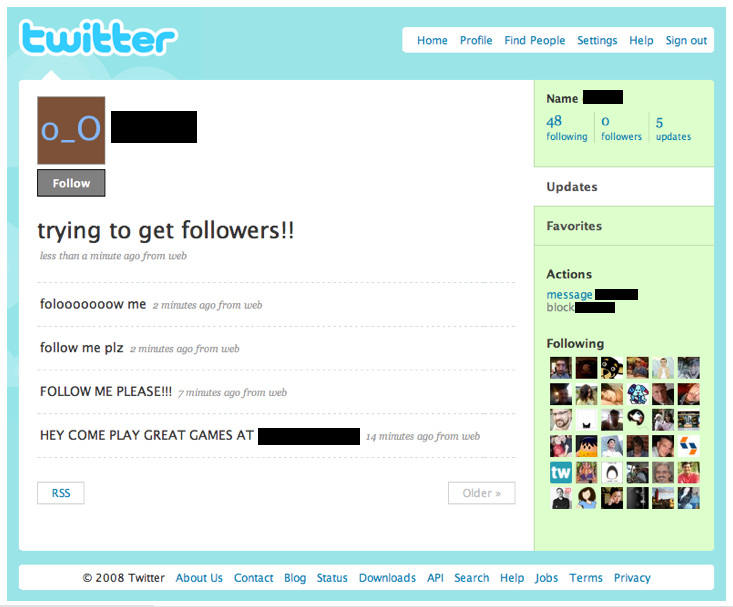
I’m still trying to find how to get the most out of Twitter. (I get far more from FriendFeed.) But here’s an easy example of how not to use Twitter.

The level of noise on Twitter seems high. Ditto the number who feel it’s an obligation to follow back. Or perhaps this is just what increased usage gets you?

Are Banner Ads Dying?

November 12 2008 // Advertising + Marketing + Technology // 1 Comment

Are banner ads dying?

I remember people shouting about this during the Web 1.0 hey day and there have been plenty of folks who have since cried wolf on the topic. Each time banner ads come back from the proverbial dead, walking the Internet with zombie like efficiency. Is this time any different?

Maybe.

More and more research indicates that young users are not responding to banner advertising. But can we blame them? We’re entering an era in which a whole generation has grown up with the Internet. At an increasingly young age children begin to surf the Internet. Yet, the sites they visit often have far less clutter and advertising than the traditional site.
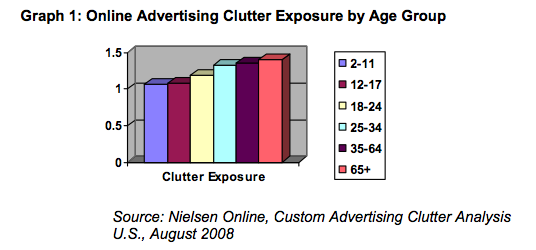
Are we creating a generation of banner intolerant Internet users?

Those of us, myself included, who came to the Internet as young adults have been exposed to a higher degree of ad clutter from the start. We’re used to it. Not only that, our context for approaching the Internet was shaped through television. Television conditioned us to expect advertising to be part of the equation.

Yet, again, this is not the case for a new generation that has grown up with TiVo and other DVR products. These services have undermined normal TV watching patterns and preconceptions. Every day more of us are conditioned to simply hit the 30 second skip button when presented with a commercial. (As an aside, thank you to Fringe for telling me how many seconds the break is going to be. That’s very handy!)

These habits are particularly important since new research indicates that the heaviest TV viewers are also the heaviest Internet users.

Are social networks part of the problem?

Yes.

Social networking is one of (if not the) largest activity for the young. Sites like Piczo, MySpace and Facebook, among others, are like the middle school and high school of the Internet. These sites are, at their core, utilitarian in nature. They’re about communicating. They’re about making ‘friends’.

Some of them do use banner ads, but more and more evidence shows a growing banner blindness on these sites. I suspect the high number of visits (for a very specific purpose) exacerbates banner blindness on social networks.

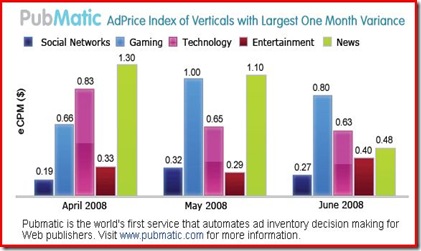
If you use CPM rates as a proxy for effectiveness then it becomes obvious that social networks are in distress.
Can we blame Twitter?

Yes.

Twitter and even my current addiction, FriendFeed, contribute to the problem by not using banner ads. They are but one more site, one more application, one more widget that is providing a valued service for … nothing. Clearly advertising isn’t the only way to monetize these sites, but by not implementing any monetization strategy they send a signal to users that they can get something for nothing.

The ‘something for nothing’ mentality makes us less tolerant of advertising. I can surf the Internet with Firefox, supercharge my blog with WordPress plugins and use Google Analytics to track metrics for a slew of client sites all … for not one penny.

This isn’t a long term problem. A type of Internet Darwinism will take place where those without a true business (aka revenue) model will either fail or try to implement some sort of real revenue strategy. In most instances, that will be advertising or subscriptions.

Will it be advertising or subscriptions?

Just before the collapse of Web 1.0, I worked at Bluelight.com, the online version of Kmart. One of their major initiatives was an ad supported free ISP. We had millions of users! The thing is, it didn’t really work. They wound up converting it to a subscription based service which was ultimately acquired by United Online

Today, we’re conditioning a generation to ignore banner and display advertising. The cat is out of the bag. The genie is out of the bottle. So even if we want to return to it as a revenue stream it is becoming an ever weaker medium. And we only have ourselves to blame.

So perhaps subscription based sites, or networks are the wave of the future. Would you pay for Twitter?

Will banner ads die?

Of course not. Banners will never completely die, but a few things will have to happen for them to rise again to feast on the glorious eyeballs of Internet users.

They’ll need to be more engaging and use rich media in more appropriate ways. More importantly, the industry will need to measure banner ads not by CTR or traditional click-based ROI but by brand measurement metrics. There are a few companies who provide this service, though my favorite is Vizu Ad Catalyst. (Disclosure: I worked at Vizu for a short time but stand by the fact they are leaders in this new field.)

The current economic climate has forced many analysts to adjust their online advertising industry forecasts, some of them twice. Yet, I’m unsure any of them are accounting for this new generation of Internet users who are blind to banners at best and intolerant of them at worst.