— You Are At The Archives for the twitter Tag —

Twitter Makes Lists … Competitive

November 01 2009 // Social Media // 8 Comments

Twitter finally got around to launching lists and immediately created a whole new competitive mania that may render them useless.

Listed

Twitter Listed Metric

By simply showing Listed as a major metric Twitter encourages comparisons. Listed will be the new Followers. We’ll see Followers to Listed ratios cranked out by the companies who traffic in these sorts of meta data measures of authority and influence.

Instead of using lists to help users manage the stream of data, they’ve turned them into a competition.

Following Twitter Lists

The ability to follow lists also creates competition. Which SEO list is best? Who’s Ruby Rock Stars list should you follow? Lists allow users to segment, but how many instances are you really going to follow? Does it help me to follow 25 instances of an SEO list? Probably not.

Suddenly a person’s lists are going to have an attached Followers metric. You could argue that the number of Followers helps define comparative quality, but that hasn’t worked for users has it? So why would it work for lists?

My motivation for creating a list isn’t to attract followers, it’s to help me turn data into information.

Twitter Lists Do Not Equal Authority or Influence

The impetus for creating a list is for the user to manage their data flow. (Or it should be!) Using a data segmentation taxonomy as a proxy to show authority just doesn’t compute. The motivation is not to grant authority to those on a list, but to simply shape data.

Lists is a grouping, but it assigns no weight to an individual within that group. We all know people who are ubiquitous but might not be well regarded. Nevertheless you’d likely put them on a topical list.

Volume is essentially what Listed measures. People with varied interests will be added to many lists. People who have played the Followers game will be added to many lists. Quantity wins, not quality.

Furthermore, once people understand that lists are the new Followers you’ll have people asking to be added to lists, trading list additions and new accounts will spring up for the sole purpose of getting users on the ‘right’ lists. It’s an obvious gaming nightmare.

Twitter Lists Don’t Define You

There’s an offhand defense of lists I’m hearing many employ: “lists show how others think of you.”

Who cares! Guess what, I stopped caring about that my sophomore year in high school. But isn’t that the DNA of Twitter? A navel-gazing popularity contest that somehow is supposed to validate value and contribution.

Thanks but no thanks.

The Real Problem with Lists

The idea behind lists seems to be around user discovery.

Twitter Lists

It’s supposed to help you find “interesting accounts.” But lists (of any kind) don’t effectively do this because people are multi-faceted.

I have a varying level of expertise and contribution in many fields. My inclusion on Danny Sullivan’s Search Marketing list is nice, but will people following that list get value from my bicycling and book related tweets?

Lists give you a complete timeline for a group of people to whom someone has assigned a certain user defined attribute. It doesn’t mean you’re going to actually get content matching that user defined attribute. This mismatch makes it difficult to find ‘interesting accounts’.

Lists are simply a blunt instrument in the transformation of data into information.
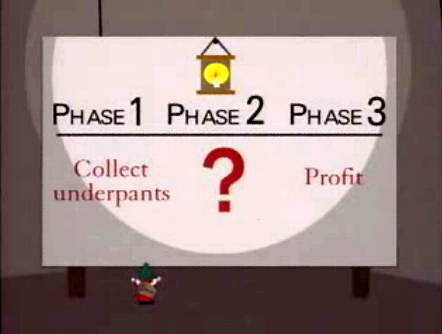
Twitter is the Underpants Gnomes of the Internet

October 29 2009 // Rant + Social Media // 3 Comments

The other day I read Steven Hodson’s Shooting At Bubbles post regarding Twitter 2.0. And it finally dawned on me!

Twitter is the Underpants Gnomes of the Internet

If you’re not familiar with the Underpants Gnomes, they were featured in a South Park episode in which the Gnomes devised an … interesting business plan.

underpants gnomes

Replace underpants with users (or VC cash) and you’ve got Twitter. Oh, sure they’ve alluded to some sort of business plan, but even as recently as a few weeks ago Evan Williams wasn’t willing to divulge a real revenue model despite John Battelle’s prodding.

I remember the Web 1.0 days of grow fast, grab market share and monetize later. Only a few survived this kowabunga style of business.

But who knows, maybe Twitter can turn underpants into profit.

Sponsored Tweets are Robocalls

July 14 2009 // Advertising + Marketing + Rant + Social Media // 2 Comments

Paid Tweets

One of the great things about our new information culture is how disparate sources coalesce into something meaningful. Last week I read a Fortune magazine article on Marc Andreessen, news about IZEA’s Sponsored Tweets and research on the impact social media has on brands and eCommerce. When I put these pieces together the picture is of a powerful locomotive hurtling toward a creaky bridge.

Social Media and the Telephone

The telephone is a social platform. You call family and friends to talk about things from the trivial to the serious. If you know a person’s phone number you can call them. At some point, marketers figured out that they too could call you, so long as they had your phone number. Phone numbers weren’t hard to find.

This didn’t sit too well with most people. They didn’t want some stranger calling right at dinner trying to sell them something. The thing was, enough people actually did respond to these calls and telemarketing flourished. It was a lot more effective than direct mail.

Over time, more and more people became irate. Laws were passed so that you could opt-out of these unwanted calls. But there were loopholes. Giant gaping loopholes. Any company you had a ‘prior relationship’ with could still call you unless explicitly told otherwise.

You might have bought from them before, maybe even kept an eye out for coupons, but you didn’t want them to ring you up whenever they pleased.

Now replace phone number with user name. This story has already been written.

Sponsored Tweets and Telemarketing

Sponsored Tweets will not work like telemarketing. The reason why telemarketing works is because you can engage in a dialog. A good telemarketer changes their approach based on the subtle feedback they’re getting from the prospect. And they’ll certainly use every objection as an opportunity. I know a bit about this since I ran telemarketing programs for nearly five years.

The problem with Sponsored Tweets is that the lack of dialog. One way communication isn’t nearly as effective. It’s the reason why telemarketing beats direct mail. No, Sponsored Tweets are not like telemarketing.

Sponsored Tweets are Robocalls

Paid Tweets

You’ve probably received a robocall.

Robocall is American pejorative jargon for an automated telemarketing phone call that uses both a computerized autodialer and a computer-delivered recorded message.

I’m guessing you’ve gotten one during the election season or, most recently, from some company trying to sell you an auto warranty extension. You don’t like them.

Getting a robocall from Martin Sheen is the same as getting a Sponsored Tweet from a celebrity.

Context Shifting and Social Marketing

Marc Andreessen believes that advertising can be an effective part of social interactions.

He tells me Facebook “will be bigger than Apple” and declares that the social-networking company will become the mass-market window to the web, much as Google has been for the past six or seven years. Twitter, so far criticized for having no way to make real money, will get advertisers to pay to reach people as they are sending messages about the sponsor’s products.

The real issue here is context switching, a term my Caring.com engineers introduced to me. The general idea is that if you’re thinking in one way (about one thing) it takes some time and effort to stop and think about something else. The context of your attention has changed.

This is why I believe social marketers need to build an ice cream truck. They need to deliver something that forces people to shift their context.

The example of Google actually supports the idea of context switching. Eyetracking studies have shown substantial differences in how people scan results for transaction based queries (left) versus information based queries (right).
Google Query Types

All searches are not created equal. The intent of that query, of that action, defines the context.

Social Marketing’s Creaky Bridge

Others, like Andreessen, seem to believe that context is homogeneous and can be blended. That social messages and product based messages can live side by side. That as you’re telling someone about the cool new things your iPhone does that you’ll enjoy a message from Palm trying to persuade you that the Pre is the way to go.

… an overwhelming 96% of employed consumers say their opinion of a product brand does not change if that brand has no presence on a social networking site … In fact, just 12% of respondents say their opinion of a brand actually changes if that brand maintains a significant social networking presence and only 11% of social networkers report following any major brand through a social networking site.

This is but one of numerous datapoints that illustrates that creaky bridge I mentioned at the beginning of this post. The locomotive of social marketing continues to thunder down the tracks, ignoring the flashing yellow signals at their own peril.

Friend Is a Four Letter Word

June 22 2009 // Life + Rant + Social Media // 1 Comment

Technology now provides a level of connection that was unheard of just a scant twenty years ago. The cell phone, the Internet and the marriage of the two in smart phones (BlackBerry, iPhone etc.) have rapidly increased our ability to stay in touch. But who are we staying in touch with exactly? Do we have the time for all these people, and do we short-change family in the process?

Friend Is a Four Letter Word

Friend Overload

Automated report emails from work, status updates from Facebook friends you never really talk to and follower notifications that often wind up being spam consistently interrupt your weekend like a toddler tugging at the edge of your shirt.

Don’t get me wrong, there are times when getting an important email while you’re on the go can make a real difference. But most of the time it could have waited until the next day, never mind another hour.

More and more we’re getting messages from online friends: Facebook updates, Twitter followers and FriendFeed subscribers. I get a lot out of my social network, which is nearly all on FriendFeed. There are a slew of people I now count as friends through my FriendFeed experience.

Yet, should I be using my time to chat with them when I could be spending more time with my family, or visiting with friends? To be clear, I’m not saying I’m quitting FriendFeed (far from it!) I’m simply working through how to best use my time in relation to all the ‘friendships’ new technology has enabled.

Technology allows us to keep in touch with more people. But should we? Are these quality interactions? Voyeurism friendships (or those people with whom you’re connected via a social network but rarely interact with online and never speak or meet with offline) take up time, energy and emotion that might be better spent elsewhere.

The First Social Network

And it’s not just about the time devoted to these voyeurism friendships. Technology makes it possible to disrupt real friendships with these voyeuristic updates. Even worse, they might make you inattentive to your first social network: family.

The Annenberg Center for the Digital Future at the University of Southern California is reporting this week that 28 percent of Americans it interviewed last year said they have been spending less time with members of their households. That’s nearly triple the 11 percent who said that in 2006.

Each Saturday morning I take my four year old daughter to dance class. Parents stand outside and watch through a massive window. I bring my BlackBerry with me, but I am very rarely on it and try not to use it at all.

Instead I want to watch my daughter, react to her wave, thumbs up, wink or smile. I want to be present! Because all too often there’s a parent there, head down, tapping away on an iPhone or BlackBerry, oblivious to what’s going on with their child.

I wonder how many children are competing for time and attention with the tiny people living in that smart phone. I can’t believe it feels very good.

Friend Overload

How do these voyeurism friends stack up against other friends or family? I’m a firm believer in Dunbar’s number – the maximum number of healthy social relationships a person can maintain at any one time. Dunbar’s number is approximately 150. The question is, do these voyeurism friends count against this number?

I’m beginning to suspect they do.

You might not think they do, but they’re taking up social and emotional space. You are inserting a random piece of information about a person into your memory. A person who you went to high school with – not really a friend then or now – just got back from a trip to New Orleans. You can’t turn that information off. It’s been received and transmitted to your brain, mixed up with other random facts like song lyrics or television commercials from your childhood.

Whether you like it or not your brain is processing this stuff. You can begin to think about why Dunbar’s number makes sense in this context. As your brain is trying to sort, track and shelve data on more and more people it becomes far more difficult to maintain. You can’t crack the case and stick in more RAM.

Friend Turnover

At some point, you’re only storing a very small amount of data on a slew of people, which makes those relationships tenuous as best. The issue here is that you’re threatening the strength of all your relationships as you expand your reach. You might try to store more about ‘good’ friends and family, but I’m not sure we’re wired that way.

There’s a reason why you lose touch with friends. They aren’t really friends (anymore) and you don’t want to clutter your head with irrelevant data. You outgrow friends. Recent research suggests that you replace half of your friends every 7 years.

I question whether technology is inhibiting the natural shedding of friends necessary for us to move on, to establish new friends and evolve as a person.

The Future of Friends

I’m writing about this, in part, because I don’t know the answer and am struggling with the topic. I’m on FriendFeed constantly, sometimes when I could (perhaps should) be spending time with my wife and daughter.

I’ve taken steps to address this disconnect. I attended the FriendFeed open house so I could actually meet some of the people to whom I’ve been chatting – something that goes against my natural introverted nature.

And I’ve walked away from the computer – completely – to spend more time with family. We walked the Golden Gate Bridge together and explored the California Academy of Sciences.

Time and attention are in short supply in our accelerated society. Sometimes you need to remind yourself about what’s really important.

Twitter and Google … Analytics

May 08 2009 // Analytics + Social Media + Technology // 2 Comments

Twitter is using Google Analytics

Earlier this month Twitter launched new HTML versions of their Follower and Direct Message emails. Upon clicking through one of these newly designed emails you’ll notice that the links all contain Google Analytics parameters.

Twitter and Google Analytics

For those of you without the best eyesight, the URL contains the normal utm_ parameters. In this case Twitter is using source=follow, medium=email and campaign=twitter20080331162631.

What is twitter20080331162631?

It is not a user id since a Google search for twitter20080330062631 shows results for more than one user. The first part looks like a date, but March 31, 2008 seems like an odd choice for something just released. Any ideas?

Why is Twitter using Google Analytics?

The obvious answer is Twitter wants more accurate or easily accessible metrics. But why select Google Analytics? Sure it’s free but Twitter isn’t hurting for money, are they? Twitter could use any number of other solutions.

Many believe Twitter is a Google competitor and/or acquisition target which makes using Google Analytics more intriguing.

Wouldn’t Twitter be just a little bit paranoid that Google would peek at the Google Analytics data to gain insight into their business? Sure it’s not supposed to happen but … why take the chance?

Or is Twitter using Google Analytics to provide due diligence data to Google for a potential acquisition? Google certainly wouldn’t doubt numbers generated by their own product. Is this part of the rumored negotiations taking place between Google and Twitter?

Google Killer or Google Accomplice

Outside of the conspiracy theories, Twitter’s usage of Google Analytics further cements them as the leader in the analytics space, surpassing competitors such as Omniture and Coremetrics.

PowerPoint decks at conferences are peppered with Google Analytics graphs and screen captures. In a difficult economic environment it becomes more and more difficult to rationalize using a paid product when a free product has a similar feature set.

Twitter isn’t a Google killer. Instead it’s helping Google to kill web analytics providers.

Soylent Green is Filters

May 01 2009 // Social Media // 5 Comments

If you’re familiar with the science fiction classic you know the phrase is actually Soylent Green is People. With some substitution logic the equation boils down to the following:

People = Filters

soylent green are filters

Everyone is looking for technology that will help them filter the amazing amount of data that pours in through social sites like Twitter and FriendFeed. Yet many overlook the first and best filter – people.

The people you follow on Twitter and those you subscribe to on FriendFeed remain the most powerful filter you have at your disposal.

Follow Abuse

On Twitter you’ll have a dreadful time finding anything useful if you’re following a lot of people. Even if they’re all tweeting high value material (which is unlikely) you’ll miss a lot of it. In addition, a fair portion of it will likely be repetitive.

Twitter search isn’t much help and hashtags are a useful but flawed solution. I don’t rely on Twitter to get my information so I break my own rules here.

Subscribe Abuse

On FriendFeed the people you subscribe to are even more important because of the Friend of a Friend (FoaF) feature. I see people I am not subscribed to through the Likes and Comments of my subscriptions. I believe FoaF is the most valuable feature on FriendFeed.

I let Robert Scoble, Louis Gray, Rob Diana, Mike Fruchter, Thomas Hawk, Chris Baskind, Ken Sheppardson, Mike “Glemak” Dunn, FFing Enigma (aka Tina), Cee Bee and others bring great people into my feed.

There are many people who I regularly enjoy to whom I’m not subscribed. This isn’t because I don’t appreciate them, but because I see their contributions regularly as it is. My subscriptions are not always based on my appreciation of their content (though that helps) but often their ability to find and filter content.

I don’t use subscriptions as a form of popularity.

The Hard Truth

Some people have great content, but they’re not always the best filter of content. Some people have a lot of content but not all of it might be interesting – to me at least. So I experiment. I subscribe judiciously and see what it does to my worldview.

I currently keep my subscription count close to Dunbar’s number so my interaction on FriendFeed is truly social and not asocial.

Beyond People

FriendFeed has done a very good job of providing additional ways to filter the enormous amount of data available. Their list functionality can be used to apply additional subscriptions to a particular area. So, I could have a list of SEO gurus, another of economics folks and another of bicycling enthusiasts.

The most recent upgrade also included powerful saved search functionality, giving us yet another way to digest the data and turn it into information. This is particularly important because you get the information you want, instead of all the data from someone you’ve put into a list.

I’m a prime example of this problem. I feed a good deal of SEO, marketing and advertising material. Yet, I also feed books, bicycling, economics, art, humor and the dreaded lolcats. People rarely fit into neat tidy boxes.

People First

Even with all these great new tools the first, best line of filtering is people. It’s the way we’ll survive the social media chaos.

Soylent Green is People.

Asocial Media

April 17 2009 // Social Media // 2 Comments

Get Twitter Followers Fast

Asocial Media is on the rise

Asocial is defined by The Free Dictionary as follows:

1. Not social: “Bears are asocial, secretive animals” David Graber.
2. Avoiding or averse to the society of others; not sociable: “It’s not that you’re so asocial, but a man who likes people doesn’t wind up in the Antarctic” Saul Bellow.
3. Unable or unwilling to conform to normal standards of social behavior; antisocial: “crime, riots, drug use and other asocial behavior” Derek Shearer.
4. Inconsiderate of others; self-centered.

Twitter races and other follower incentives fall outside of ‘normal standards of social behavior’ and, more importantly, are obviously ‘self-centered’ in nature.

Twitter Races are Asocial

Tracy Flick

The Internati is buzzing about the race to 1,000,000 Twitter followers. CNN versus Ashton Kutcher. And now Oprah is entering the race. OMG!

I don’t care and neither should you.

Popularity is fleeting and is not social. You do not have a relationship with these people. Ashton Kutcher does not know who you are. Oprah isn’t going to reply to your tweet. You’re simply feeding their ego and business.

Dunbar’s Number

British anthropologist Robin Dunbar theorizes that humans have a limit of approximately 150 social relationships. Wikipedia defines Dunbar’s number as follows:

Dunbar’s number is a theoretical cognitive limit to the number of people with whom one can maintain stable social relationships. These are relationships in which an individual knows who each person is, and how each person relates to every other person.

I’d argue that social networking expands this limit to some degree. However, the foundation of the research is still valid. Even 1,000 ‘friends’ surpasses the limit where you’re engaging in social relationships.

Followers are not Social

Think about the term ‘followers’ for a minute. Has it sunk in? The definition of follower is:

1. One who subscribes to the teachings or methods of another; an adherent: a follower of Gandhi.
2. A servant; a subordinate.
3. A fan; an enthusiast.
4. One that imitates or copies another: A successful marketing campaign will have many followers.
5. A machine element moved by another machine element.

It’s a one way street. It’s a simple form of worship. There’s no relationship. There’s no social.

Twitter Bribes

So if it’s not social, what is it? It’s marketing. This can be seen even in the way in which people are trying to obtain followers.

Bribe your way to Twitter followers

Providing incentives to obtain followers is on the rise. Giving out a new iPhone or a free copy of some report or other bribes seem to be par for the course lately.

Again, this isn’t social. It’s marketing. It’s business. Oddly, it’s pretty bad business too. Any savvy marketer knows that ‘customers’ you acquire through sweepstakes and contests are of low quality.

Self-Centered Media

If we return to the definition of asocial and use the last entry we get to the heart of the matter. (Hat tip to Graham Greene.) It’s about ego, about self-promotion and about self-affirmation. There’s nothing wrong with this but it’s not particularly social and it’s not spawning the conversations so often heralded as the next big thing.

In the end, is quantity mutually exclusive from social?

Sponsored Microsites is the Twitter Revenue Model

April 03 2009 // Advertising + Marketing + Social Media // Comments Off on Sponsored Microsites is the Twitter Revenue Model

Last week Twitter began to display ads for March Tweetness and ExecTweets.

Twitter Microsite Ads

When this unit showed up under the follower statistics about a month ago it was a clear prelude to a true advertising unit.

I was expecting a more straightforward advertising pitch, something along the lines of contextually relevant ads based on an analysis of your tweet stream. Instead, the ads above point to sponsored microsites leveraging specific Tweet streams.

I’ve been hard on Twitter before, but in this instance I’m impressed.

Sponsored Microsites is the Twitter Revenue Model

Clicking on these ads bring you to sites that are powered by Twitter and Federated Media and sponsored by Fortune 50 companies – Microsoft and AT&T.

Exectweets

TitleTweets

Twitter provides the tweet stream and eyeballs, Federated Media builds the site and lands the sponsors. Twitter and Federated split the advertising revenue.

Scalable and Self-Reinforcing Business Model

Microsites are scalable and the participation on these sites is self-reinforcing for both the microsite and for Twitter as a whole. So, not only can Twitter and Federated Media use these microsites to drive revenue, they also help to create higher engagement that make future microsites viable.

Sidestepping the CTR Debate

The sponsors Federated Media are bringing to the microsites are big. They’re interested in reach and branding not the CTR and ROI on the specific campaign. Twitter and Federated would be wise to do a brand lift study on these microsites to prove their worth from a brand equity perspective.

Privacy and User Issues

While Twitter is public, this is a whole new level of distribution. Could it generate more caution regarding tweets? Will some feel like Twitter is ‘using’ them to make money?

Twitter and Federated Media have already addressed this in some ways by letting people opt-out of ExecTweets. I wonder though, if that’s a slippery slope. Will we all wake up one day and have to check a box to agree to have our tweets used on ‘third party’ sites?

Or maybe that’s the plan.

Syndication or Subscription

If the microsite business model works, perhaps the future is a choice between having your tweet stream syndicated to microsites or subscribing on a monthly basis.

Whatever the future holds I’ll eat some crow and give credit to Twitter for finding a creative way to monetize their product. (Mind you I still think FriendFeed blows Twitter away.)

Are sponsored microsites enough to be a sustainable business model? I don’t know. But I’m more confident that Twitter will figure it out based on this implementation.

FriendFeed Monetization? Focus Groups.

February 19 2009 // Marketing + Social Media // Comments Off on FriendFeed Monetization? Focus Groups.

The other day Steven Hodson wrote a post on the Inquistr that opined that Twitter could generate revenue through one big focus group. I like Hodson, who also writes the thought-provoking WinExtra, but I disagreed that Twitter was the place for focus groups.

As I wrote my response as to why, I realized that FriendFeed was the ideal environment for focus groups. I could even envision a new green FriendFeed icon to denote a sponsored conversation.

FriendFeed Focus Group

FriendFeed Focus Groups

Focus groups are conversational, which is exactly where FriendFeed excels. A typical focus group will have a moderator who will pose questions and follow-up to gain additional insight into the participant’s response.

For example, a focus group moderator might ask you to tell them what animal best represents a specific car. The moderator will likely be able to understand the categorization but might want to follow-up to ensure they understand why you chose to associate, say, a Hummer with a Hippopotamus.

These focus groups are already taking place – naturally – on FriendFeed. Conversations about different cameras and different phones. Discussions about music, books and movies. Debates between Mac and Windows enthusiasts. FriendFeed fosters this type of robust interaction where details and nuances are often revealed.

What about demographics?

The part that’s missing are the demographics. It’s missing from Twitter too. Facebook seems to be banking on the demographic targeting capability. Many companies do want to ensure they have the right sample and a good cross-section of users. Perhaps FriendFeed could present a small lightbox form to users prior to commenting on a sponsored conversation?

What about psychographics?

Then again, many companies put more stock into psychographics. Who exactly are these people? What do they like? Do they travel? Where do they go out to dinner? What do they read? What are their interests? This is where FriendFeed – again – provides added value.

Moderators would have access to the feeds or lifestreams of participants. The amount of data for each participant would clearly vary depending on the number and variety of services each fed into FriendFeed. Some might be limited but others would provide bonanza of data.

Imagine Netflix, GoodReads, YouTube, Google Shared Stuff, Amazon, Last.fm, LinkedIn, Delicious and even BrightKite. Talk about building a profile on potential customers! And could FriendFeed provide an abstract of each participant? A digest profile for each participant on a sponsored conversation?

Would it be interesting for marketers to see not only what each participant fed, but what they liked as well? Or a keyword (or other) analysis on their comments? The degree of interaction, variety of content and abundance of text make FriendFeed an interesting and dynamic data hub.

The right kind of engagement

Twitter simply does not support real conversations. It was built as a status update service (and it performs that service well.) Facebook often creates conversations but those conversations are both asynchronous (wall post time lag) and seem to be less topical and more personal in nature.

FriendFeed, by comparison, is built for conversation around topical content. It fosters the exact type of engagement savvy marketers crave.

What do you think. Will we see green FriendFeed icons and sponsored conversations?

Twitter is not a Google competitor

February 15 2009 // SEO + Social Media + Technology // 3 Comments

Twitter search is a great feature but it in no way threatens Google’s dominance in search.

Recency does not equal relevance

The major flaw of using Twitter as a search engine is that recent tweets on a subject do not equal relevance on that subject. This should be obvious but lets do a few searches to illustrate the point. I’ll use searches that appeared in the top 100 from the Google Hot Trends list at some point on February 15, 2009.

Yosemite Camping

yosemite camping twitter search

yosemite camping google search

Which of the results best satisfies the query? Without question it’s Google. Let’s try another.

Daytona 500 Pace Car

daytona 500 pace car search on twitter

daytona 500 pace car search on google

In this instance both provide the answer. The Daytona 500 Pace Car is a 2010 Chevy Camaro. The Google result tells me it’s black and gold and gives me plenty of authority sites to visit.

Twitter on the other hand doesn’t provide this level of detail. In addition, two of the five results are from Mahalo and a third is from kinougo. More on ‘him’ later. For now lets try one last search.

Crayola Factory

crayola factory search on twitter

crayola factory search on google

Hands down Google satisfies this query better than Twitter. The only link available is, again, from our friend kinougo. So who is kinougo?

kinougo twitter profile

Essentially auto generated Tweets based on hot searches. But where do they lead?

daytona 500 pace car on kinougo

Look at that! An API based link farm with Google AdSense as the revenue source. That looks … awful!

Twitter would have been a near complete bust if it were not for Mahalo and kinougo. Yet, these sites are simply exploiting Twitter search, not contributing to it in a natural way. I doubt the user experience on these clicks would reinforce the idea that Twitter was the place to search. Probably the exact opposite.

Recency works only for hyper real-time events: earthquakes, Presidential debates and conferences to name a few. (Sidenote: There’s this other site called FriendFeed which actually did a bang up job on real-time commentary on the Presidential debates.)

Authority is nonexistent

What makes anyone believe that the latest 5 or 10 tweets on a subject are at all authoritative! Twitter has no mechanism to determine what is the best result for a given query other than the Tweets from their users in a very short time span. Do you trust the random users of Twitter that much? I don’t and neither does Google.

The Google algorithm tries to present the most authoritative, the most right, the most useful results, not just johnny-come-lately blog posts and certainly not some 140 character missive. They might not always get it right, but they’re trying … hard.

Duplication is a problem

alzheimer's disease twitter search

Twitter doesn’t handle duplicate results, opening itself up for SPAM both real and unintentional. Even for the hyper real-time events how many times do you need to see the same quote over and over again?

Twitter is not a Google competitor

Relevance, authority and duplication all ensure that Twitter is not, and likely never will be, a Google competitor. At best Twitter could provide supplemental information to a real search engine. Twitter is the crawl at the bottom of a cable news channel.

“I just ate a mango” isn’t going to disrupt the search world.