— You Are At The Archives for the Social Media Tag —

Should You Submit Your Own Content To Social Sites?

January 15 2009 // Marketing + Social Media // Comments Off on Should You Submit Your Own Content To Social Sites?

Is it ethical to submit your own content to social sites?

Should you Digg your own blog post? Should you bookmark it on Delicious? How about Stumbling it too? (If you can.)

promote your own content on social sites

My answer? Yes.

If you’re not confident enough to promote your own content, why would others do it for you? Sure, in a perfect world you want others to get the ball rolling but inertia remains high. In this instance, don’t rely on the kindness of strangers.

Remember, you’re not trying to game the system. You simply want to give your content the best chance to find an audience. Would you exclude your content from being indexed by Google? Heck no!

Would you refrain from Tweeting about a new blog post or exclude your own blog from your FriendFeed? Of course not!

Again, what happens to your content once it is submitted is out of your control. It could sit there in a corner doing nothing or it might find an audience who likes and shares it with friends. But it’s up to you to ensure it’s there in the first place.

Submitting versus spamming

Moderation in all things. Don’t go overboard. If you’re cranking out a lot of content, not all of it might be worthy of being submitted to every site. Pick your spots. Learn what works best on Reddit versus Digg. Figure out what content is most interesting to those using StumbleUpon.

Your personal brand will suffer if you are labeled a spammer, so don’t over submit your content.

Self submission increases content quality

Before you submit your own content, ask yourself if it is really worth submitting. If you hesitate that should tell you something. Again, you must be confident, and proud, of your content to submit it to social sites.

Use self submission as a filter to make your content better. It’ll help you deliver more value to readers and increase the chances of natural social media adoption.

No one likes a know it all

For best results you should participate on these sites. Not only will you better understand them but you can help and promote others. After all, these are social sites. Take as little as 15 minutes out of each day to promote recent posts by your favorite blogs or newly discovered websites.

Only promoting your own content makes you look selfish, vain, condescending and insecure all at the same time. But never promoting your own content might make you invisible.

FriendFeed Improvements Begin With You

January 09 2009 // Social Media // Comments Off on FriendFeed Improvements Begin With You

Recently there has been a slew of well intentioned people offering their opinions on how to improve FriendFeed. From Robert Scoble to Louis Gray to Joshua Porter, they’ve all had interesting ideas which led to a massive FriendFeed meta discussion. Finally, FriendFeed founder Paul Buchheit, in his nice way, came out and told everyone to just chill out.
FriendFeed Time Machine

What Paul and the FriendFeed crew really need to do is invent a time machine so the impatient early adopter crowd can skip the slow but natural adoption curve of a product.

I’m not saying FriendFeed is perfect. There are a lot of good suggestions out there and I could offer my own but will save that for another day.

It’s the speed in which people are willing to claim failure which is troubling. And the mindset of many seems to be that FriendFeed is broken. That it doesn’t work like Twitter. That it’s too complicated. That it doesn’t work like Google Reader. That there’s too much information. That it sucks traffic away from blogs. That the new user experience is broken and scaring people off. The the signal to noise ratio is out of whack. That it needs Track to survive. On and on and on.

It may take some time for people to ‘get’ FriendFeed. Even those using it will endlessly debate exactly what it is and why they find it useful. And to be honest I’m doing the same thing right now. So instead of lamenting about what it isn’t I’m going to talk about what FriendFeed does right and what it means to me (YMMV).

FriendFeed connects me to people right away

Unlike other services, I can subscribe or connect to a group of people immediately upon signing up. My friends don’t have to be FriendFeed users. (Most still aren’t.)  And as soon as I subscribe to a few of these recommended people I get to see activity and lots of it. Instant gratification!

The arguments around who is being recommended (e.g. – ‘A-List’ individuals) seem to have died down. ‘A-List’ users help in a few ways. It shows that the service is being used by influential people and some of their feeds provide great activity that instantly showcase the value of FriendFeed.

Could the recommended list be better? Maybe. But it terms of showcasing what FriendFeed delivers, I think it does that extremely well.

Friend of a Friend helps me find new people

This is perhaps the best feature on FriendFeed because you get to see things you might not have otherwise. It’s a passive way of delivering exploratory information to users. It’s using your friends as the filter! And isn’t this the next thing? Getting down to networks we trust? Why let an algorithm try to determine what is relevant when you can use humans instead?

Removing the Friend of a Friend feature would cause FriendFeed to wither and die as more users simply sealed themselves into their own tiny echo chambers. While the intent of these folks may be to reduce the ‘noise’ they wind up drowning themselves out. (Think of it as getting the microphone too close to the speaker, causing the high-pitched feedback screech that makes your ears bleed.)

In the end, entropy will take over. With nothing new entering that universe, you’ll find less and less value.

Hide reduces ‘noise’

Use the hide feature. It’s your friend. Maybe your best friend. You might argue that the act of hiding shows that there is too much noise. To some extent that is true but lets think about this in a different way. Do you like every episode of a certain TV show? Do you like every book an author puts out? Do you agree with everything your favorite blogger posts? Heck, do you even like everything that your spouse or significant other likes?

Not only are we different but we’re multi-faceted. That’s not a bad thing! The hide feature stops you from throwing out the baby with the bath water. Hide can be used surgically to remove a specific service, without likes or comments, from an individual person. Or you can hide a whole service if you find it is never contributing any value.

Blocking defeats spammers

I don’t block people who actually contribute to discussions even if I don’t agree with their views. However, those who are abusive or fully interrupt the value of my stream will be blocked. The real benefit of blocking on FriendFeed is that it is viral. The community is quick to identify spammers and in short order, minutes sometimes, spammers are rendered invisible or removed.

This is not the case on other networks and has become an increasing problem on Twitter.

Duplicate detection was a huge improvement

When we talk about noise, one of my biggest complaints had been the fact that the same story could show up multiple times in your feed at the same time. That was noise. Sure enough, FriendFeed was able to solve this issue.

There’s a subtle difference here. Duplicative information provides little to no extra value. (All it tells me is that the item is popular.) In my opinion, that is the definition of noise in this context.

Information deemed less relevant or random in nature is not noise but instead simply a different vector of data – a piece of the puzzle that may or may not add value.

Random does not mean irrelevant

Lets stay with the puzzle theme for a second because it speaks to the new ways in which I think people will understand their world. FriendFeed provides a very rich stream of information from people you value. (I should add here that FriendFeed is not the place to friend blindly. Be selective.)

Thinking that you can put all the pieces of the puzzle together all at once isn’t going to happen. You’re going to get the edges done first and then you might work on a particular area that has a distinctive color. Then you’ll work out from there. It is not a linear process.

So, you may pick up a piece and find that it doesn’t fit anywhere. That doesn’t mean it doesn’t belong in the puzzle, it simply means it’s not yet ready to fit. So what you perceive as noise simply might be a piece that doesn’t yet fit in your puzzle. But if you throw it away, you might never complete the puzzle.

The random nature of your feed (often perceived as noise) may actually be something to preserve. Jonathan Mendez has a great post regarding the optimization of randomness. There are a few parts from his post that I believe can be leveraged into the discussion of noise versus signal.

The sense of discovery fulfills a basic human need. We achieve further fulfillment from enlightening others to our discoveries. … Randomness helps us discover. It can create interest. It can lead to intent.

He uses music as one of his examples though he misses what I feel is the most obvious one – the shuffle feature on iPods.

How many times do you achieve an epiphany about something you’re working on by doing something else or talking to someone outside of your industry?

FriendFeed is a massive information hub

FriendFeed is the 90s science-fiction version of the data flow that Gibson and Stephenson among others talked about.

It will take time for people to figure out exactly how they can plug in to this new resource. But I believe more and more will change their behavior to best take advantage of this font of information. Lets remember, there were plenty of people who thought it was overwhelming to be reachable all the time (aka – cell phones.)

But our attitudes changed and we adapted our behavior.

Comments provide insight

FriendFeed is a great place for discussions. The comments are often where you’ll find some of the best thinking and writing. FriendFeed is a massive information hub because it is annotated by others to provide greater context and analysis. Comments allow the crowd sourcing of knowledge that transform mere data into information.

Informational osmosis is a reality

In college I made sure that I attended my classes because I found that even if I sat there barely awake, the information being discussed all sunk in on some level. Weeks later cramming for a test I could access some of this information that had seeped into my brain … simply by being there and letting the words wash over me.

Embrace the ‘noise’ and let your brain find the patterns. Give FriendFeed time and see what finally emerges.

Perhaps the biggest improvement to FriendFeed is … us.
How To Get Your Twitter Replies Via RSS

January 02 2009 // Social Media + Technology // Comments Off on How To Get Your Twitter Replies Via RSS

Twitter Replies Via RSS

Here’s a simple way to get your Twitter replies delivered to you via RSS.

  • From your Twitter home page, scroll down to the bottom and click on Search
  • Search for your replies using @[your username] (for me that would be @ajkohn)
  • Select the ‘Feed for this query’ link on the top right hand side of the search results page

That’s it. Your Twitter replies will now be delivered to you via RSS in your favorite reader.

Proof Twitter Is Not Mainstream

December 30 2008 // Social Media // 1 Comment

Has Twitter gone mainstream? Sure it’s gaining in popularity, but mainstream? I think not. Mainstream is defined as follows:

The prevailing current of thought, influence, or activity. The people or things representing the most common or generally accepted ideas and styles in a society, art form, etc.

At most you could quantify Twitter as mainstream for a subgroup of Internet users. But why quibble when I have real data. Here are the results of a Vizu Answers poll I conducted on December 29, 2008 across 286 websites.

Do You Use Twitter Poll

The results show that 1 in 5 use Twitter while a full half of respondents didn’t even recognize Twitter.

Twitter is not mainstream. So, what is it? I think it makes sense to measure Twitter using the Everett Rogers Diffusion of Innovation.

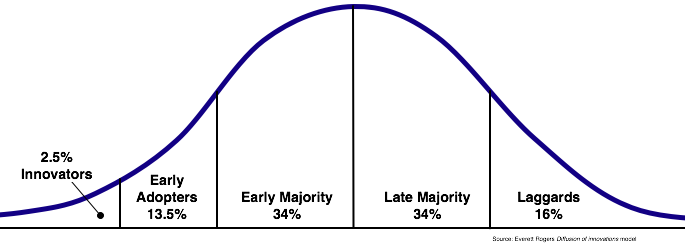
Rogers proposes that adopters of any new innovation or idea can be categorized as innovators (2.5%), early adopters (13.5%), early majority (34%), late majority (34%) and laggards (16%), based on the mathematically-based Bell curve.

Rogers Diffusion of Innovation

Using this measurement and the poll data (20%) we see that Twitter is entering the Early Majority, which is likely why the buzz quotient for Twitter has increased of late. Twitter will need to make its way through the Early Majority to the Late Majority before it truly becomes mainstream.

Of course you could argue the merits of the data. But this was an Internet poll which means it likely under reports Laggards. You might also point to the figures recently released in Hubspot’s State of the Twittersphere.

The growth is impressive. But I’d point out that Twitter users often maintain more than one account. Here’s an unscientific FriendFeed poll that, at the time of writing, indicates that Twitter users maintain an average of 1.5 accounts.

So lets wait to annoint Twitter as mainstream and instead see how it evolves and innovates in 2009.

Twitter In The ER

December 13 2008 // Life + Social Media // Comments Off on Twitter In The ER

It’s no secret that I’m not the biggest Twitter fan. But yesterday, we had to take my daughter to the ER to get IV fluids. She couldn’t keep anything down, even water, and having been born with just one kidney we’re always vigilant about her hydration.

During this gut-wrenching time (there’s no comparison to worrying about the health of your child), Twitter let me keep my family and friends updated without stepping out of the room or disturbing anyone. It served a very valuable function, something it hadn’t done for me previously. Oh, Twitter had been interesting, informative and sometimes fun, but never valuable.

Twitter is increasingly being used as a news service – whether it’s reports of an earthquake, opinions on Presidential debates or first-hand accounts from the Mumbai attacks. In this instance, I was simply using Twitter for my own personal crisis. Micronews.

I wasn’t expecting a dialog, though I got some very kind replies. (Thank you!) And that might be the reason why Twitter continues to do well. The expectation of dialog or replies is still low. When you shout into a canyon you’re pleasantly surprised when you hear someone, other than your own echo, reply.

Maybe this isn’t the big epiphany for you as it was for me. But it makes me think that Twitter can be more than just a promotional megaphone or “I just ate a mango” navel gazing. I also thought of new features I might want, like the ability to Tweet to a subset of my followers.

Hopefully my followers on both Twitter and FriendFeed don’t mind my tangent into personal chatter. (No Qwitters yet.) And I’m certainly hoping I don’t have to take advantage of this particular use of Twitter any time soon. But it’s nice to know it’s there.

Thank you Twitter.

TweetSense

December 09 2008 // Advertising + Social Media // Comments Off on TweetSense

Does TweetSense make sense? And more importantly would it make cents?

Twits have been up in arms with the introduction of Twitter based ad networks like twitAD and Magpie. Magpie in particular drew a lot of coverage with notables like Mark ‘Rizzn’ Hopkins at Mashable and Michael Arrington at TechCrunch weighing in on the topic. Many claimed that it was outright spam that had no place on Twitter. Lots of huffing and stamping of feet. They’d unfollow anyone they saw using such a service!

I’m not opposed to this type of monetization if it’s implemented well.

The fact is, are you really going to notice? If you’re that attached to Twitter you probably use the service quite a bit. You follow a lot of people. Many are very active. The odds that you’re going to see an advertising tweet are quite low and if you did it would be gone from your existence in a matter of minutes.

Advertising tweets would be very ephemeral.

So, that begs the question: will these Twitter based ad networks be effective? Will people click on them enough to make it a viable advertising platform? They will if it’s done right.

Spare me the ‘nobody clicks on those things’ type of indignation. There’s this company called Google. They have these products called AdWords and AdSense. Both seem to be doing just fine even though many say they’ve never clicked on either type of ad unit.

The implementation will be paramount. They’ll fail if the ads become too frequent, overwhelming tweet streams for users. Essentially, if the noise drowns out the signal, it will fail. They’ll also fail if the ad content isn’t relevant. Viagra ad tweets mixed in with a discussion about Motrin Moms isn’t going fly.

The frequency and context of advertising tweets are critical to the success of this type of ad network. So, who is in the best position to pull this off?

Twitter!

Twitter knows your tweet velocity. Twitter has the ability to create dynamic tags for users based on keyword frequency analysis. As such, it is best placed to deliver timely and relevant tweets to their users. By doing so it would also remove the potential abuse of the service by those seeking personal, monetary gain.

Block the third party ad networks! With Twitter at the controls, the odds of success (for both users, advertisers and Twitter) go up, way up.

Twitter does need a revenue model. So why not TweetSense?

How Not To Use Twitter

December 07 2008 // Humor + Rant + Social Media + Technology // Comments Off on How Not To Use Twitter

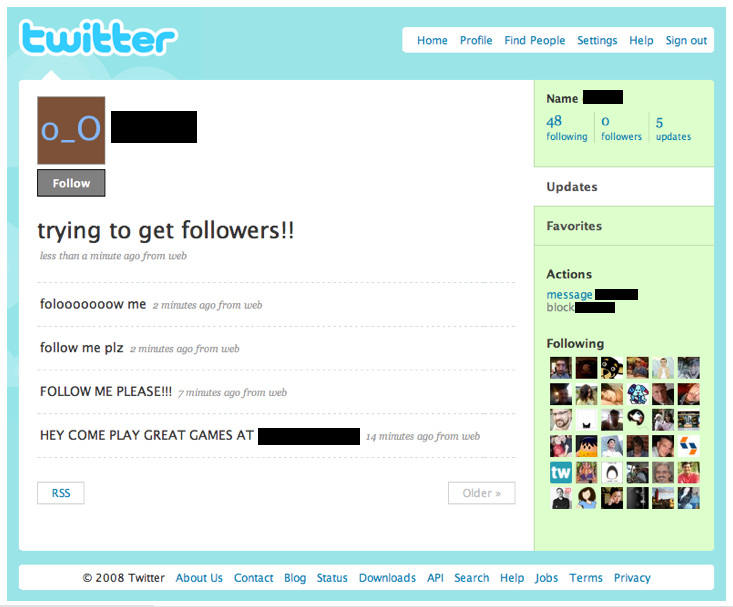
I’m still trying to find how to get the most out of Twitter. (I get far more from FriendFeed.) But here’s an easy example of how not to use Twitter.

The level of noise on Twitter seems high. Ditto the number who feel it’s an obligation to follow back. Or perhaps this is just what increased usage gets you?

Wikipedia Flirts With Disaster

December 05 2008 // Technology // Comments Off on Wikipedia Flirts With Disaster

Wikipedia has secured a $890,000 grant from Stanton Foundation to make the editing process more user-friendly. At first glance this seems innocuous, but it has the potential to ruin Wikipedia.

“Wikipedia attracts writers who have a moderate-to-high level of technical understanding, but it excludes lots of smart, knowledgeable people who are less tech-centric,” Sue Gardner, the Wikimedia Foundation’s executive director, said in a statement Wednesday.

Ms. Gardner is right. But it also excludes the ubiquitous trolls and troglodytes who inhabit the comment space on social networks and forums. Ever peek at the comments on YouTube? Yeah, not the type you want editing material on Wikipedia.

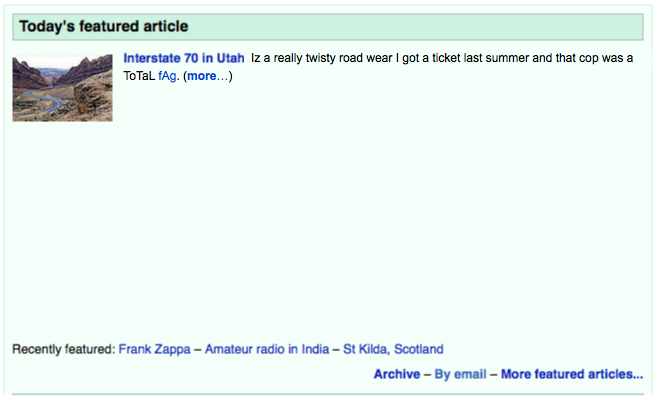
Here’s today’s featured article on Wikipedia.

Now imagine that the monkeys have overwhelmed the safeguards through new user-friendly editing.

Sure it’s an exaggeration but the fact remains that Wikipedia is inviting more people into the editing process. They don’t get to choose just the smart people.

The current editing environment actually provides a filter via the technical and code obstacles. It’s a screening process that, while somewhat biased, helps keep the monkey masses out. Might it not be easier to provide tutorials for the ‘smart’ people who are motivated to contribute to Wikipedia?

User-friendly editing is a can of worms, a Pandora’s box. Wikipedia should be careful for what it wishes.