— You Are At The Archives for the Marketing Tag —

Like Web 2.0? Thank A Marketer Today

November 21 2008 // Marketing + Technology // Comments Off on Like Web 2.0? Thank A Marketer Today

What exactly is Web 2.0? There are plenty of ways to explain it and define it, but what is it really? It’s a marketing slogan meant to attract investors, media and users back to the Internet after the dot com crash.

The inability to adequately define what Web 2.0 is a clue that it has roots in marketing. Marketers (and I’m one of them) are good at creating things that resonate without making complete sense. For instance, the phrase ‘virtually spotless’ for a dishwasher detergent seems good but upon inspection really means ‘has some spots’.

Max(x) Barry aptly skewered this situation in his book Syrup.

Pick a random chemical in your product and heavily promote its presence. When your customers see “Now wth Benzoethylhydrates!” they will assume that this is a good thing.

Even Tim Berners-Lee, Web pioneer, sees through the Web 2.0 smoke and mirrors. Ars Technica does a good job of digesting Tim Berners-Lee’s podcast text and presents the most relevant quote about his view of Web 2.0: “nobody even knows what it means”.

But that’s the brilliance of Web 2.0, it can mean whatever you really want it to mean. Want Web 2.0 to include the semantic web? Sure. Want it to be about microformats? You betcha. Want it to be about user generated content? No problemo. Want it to represent a way to use software and technology to connect people to people? Of course. Mashups? Yup. Tagging? Check. Social Media? Okay.
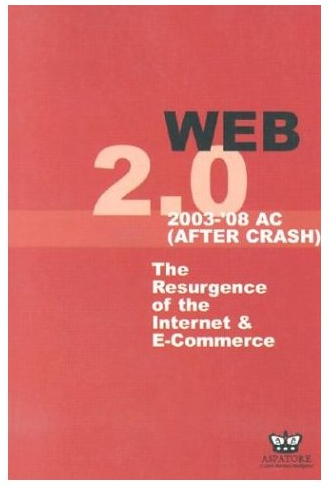
The mythology is that Tim O’Reilly and Dale Dougherty came up with the term at a brainstorming session at a 2003 conference. I don’t think they came up with the term, but O’Reilly created the buzz around it, promoted it and subsequently fought over it. Let’s face it, O’Reilly isn’t a slouch in the marketing department!

Don’t believe me? Well what about Dermot McCormack’s 2002 book titled Web 2.0: The Resurgence of the Internet & E-Commerce.

So instead of trying to figure out who coined the term or what it actually means, just be happy that it ushered a new influx of ideas and investment into the Internet.

Like Web 2.0? Thank your nearest marketer today.

Five Foot Web Design

October 28 2008 // Marketing + SEO // 5 Comments

How do you make sure your message is getting across to users? Five foot web design.

Here’s how five foot web design works. Print out a nice color copy of the page in question. Tape it to the wall. Take a few steps back until you’re around … five feet away. What do you see? If you can’t make out the message then you might have a problem.

I’m no web design or user interface guru and I don’t pretend to have Jakob Nielsen’s experience or expertise. Instead I’m armed with the knowledge that you have a very short time to persuade someone to stay on a page. So don’t be coy. Don’t fill it up with a whole bunch of stuff. Keep it simple. Tell users exactly what your site or web page is about, what you want them to do and where to go next.

How do we get people to slow down on a street in the physical world? A sign. Let’s look at the ubiquitous yard sale sign. Which of the two signs below do you think is more effective?

No contest, right? The same rules apply on the information superhighway.

There are other real world examples that support five foot web design. My first job out of college was as an account coordinator at an ad agency. One of my tasks was writing up meeting notes. My first attempt was returned to me with more red on it than I’d seen in a long time. The message: say it with as few words as possible.

I also learned about one of their hiring techniques. Only the first page of a resume was reviewed. Any subsequent pages were thrown in the trash and never read. The lesson: brevity was and is critical, particularly in advertising.

Five foot web design simplifies your message and increases the odds that users will understand, remember and take action on that message. It will also help your search engine optimization (SEO) efforts.

The reason five foot web design supports SEO is that it forces you to use your keyword phrases prominently and to rely less on explanatory text and links. In short, it’ll help boost your keyword density.

You’ll need to use your headers wisely. Nice big H1s that don’t mince words. H2s and H3s that support your keyword(s). Strong anchor text. Judicious use of bold text. Strong call to action buttons. Keep it clean. White space is your friend.

Poker Copilot is a good example of five foot web design. Recently, they switched to much larger buttons in hopes of increasing downloads.

The spike at the end of the graph says it all. Spike is not even an adequate word here. It’s a kangaroo leap to a new level.

I also recommend the book Don’t Make Me Think by Steve Krug which presents a more detailed look at web design that dovetails nicely with five foot web design.

In lieu of additional reading, simply take a moment to step back from the computer, or roll back in your chair, and see if your site is befitting from five foot web design.