— You Are At The Archives for the Marketing Tag —

Sponsored Tweets are Robocalls

July 14 2009 // Advertising + Marketing + Rant + Social Media // 2 Comments

Paid Tweets

One of the great things about our new information culture is how disparate sources coalesce into something meaningful. Last week I read a Fortune magazine article on Marc Andreessen, news about IZEA’s Sponsored Tweets and research on the impact social media has on brands and eCommerce. When I put these pieces together the picture is of a powerful locomotive hurtling toward a creaky bridge.

Social Media and the Telephone

The telephone is a social platform. You call family and friends to talk about things from the trivial to the serious. If you know a person’s phone number you can call them. At some point, marketers figured out that they too could call you, so long as they had your phone number. Phone numbers weren’t hard to find.

This didn’t sit too well with most people. They didn’t want some stranger calling right at dinner trying to sell them something. The thing was, enough people actually did respond to these calls and telemarketing flourished. It was a lot more effective than direct mail.

Over time, more and more people became irate. Laws were passed so that you could opt-out of these unwanted calls. But there were loopholes. Giant gaping loopholes. Any company you had a ‘prior relationship’ with could still call you unless explicitly told otherwise.

You might have bought from them before, maybe even kept an eye out for coupons, but you didn’t want them to ring you up whenever they pleased.

Now replace phone number with user name. This story has already been written.

Sponsored Tweets and Telemarketing

Sponsored Tweets will not work like telemarketing. The reason why telemarketing works is because you can engage in a dialog. A good telemarketer changes their approach based on the subtle feedback they’re getting from the prospect. And they’ll certainly use every objection as an opportunity. I know a bit about this since I ran telemarketing programs for nearly five years.

The problem with Sponsored Tweets is that the lack of dialog. One way communication isn’t nearly as effective. It’s the reason why telemarketing beats direct mail. No, Sponsored Tweets are not like telemarketing.

Sponsored Tweets are Robocalls

Paid Tweets

You’ve probably received a robocall.

Robocall is American pejorative jargon for an automated telemarketing phone call that uses both a computerized autodialer and a computer-delivered recorded message.

I’m guessing you’ve gotten one during the election season or, most recently, from some company trying to sell you an auto warranty extension. You don’t like them.

Getting a robocall from Martin Sheen is the same as getting a Sponsored Tweet from a celebrity.

Context Shifting and Social Marketing

Marc Andreessen believes that advertising can be an effective part of social interactions.

He tells me Facebook “will be bigger than Apple” and declares that the social-networking company will become the mass-market window to the web, much as Google has been for the past six or seven years. Twitter, so far criticized for having no way to make real money, will get advertisers to pay to reach people as they are sending messages about the sponsor’s products.

The real issue here is context switching, a term my Caring.com engineers introduced to me. The general idea is that if you’re thinking in one way (about one thing) it takes some time and effort to stop and think about something else. The context of your attention has changed.

This is why I believe social marketers need to build an ice cream truck. They need to deliver something that forces people to shift their context.

The example of Google actually supports the idea of context switching. Eyetracking studies have shown substantial differences in how people scan results for transaction based queries (left) versus information based queries (right).
Google Query Types

All searches are not created equal. The intent of that query, of that action, defines the context.

Social Marketing’s Creaky Bridge

Others, like Andreessen, seem to believe that context is homogeneous and can be blended. That social messages and product based messages can live side by side. That as you’re telling someone about the cool new things your iPhone does that you’ll enjoy a message from Palm trying to persuade you that the Pre is the way to go.

… an overwhelming 96% of employed consumers say their opinion of a product brand does not change if that brand has no presence on a social networking site … In fact, just 12% of respondents say their opinion of a brand actually changes if that brand maintains a significant social networking presence and only 11% of social networkers report following any major brand through a social networking site.

This is but one of numerous datapoints that illustrates that creaky bridge I mentioned at the beginning of this post. The locomotive of social marketing continues to thunder down the tracks, ignoring the flashing yellow signals at their own peril.

The Problem with RSS is Marketing

May 12 2009 // Marketing + Technology // 5 Comments

RSS is Dead

That’s the recent proclamation from Steve Gillmor.

It’s time to get completely off RSS and switch to Twitter. RSS just doesn’t cut it anymore.

Twitter? You mean the platform that has no real grouping function, no trust algorithm, limited information storage and a massive repetition problem? Good luck with that.

RSS is Fuel

RSS is the snow pack for the river that is the real time web

If you view the real time web as the ‘river’ of news, then RSS is the snow pack at the top of the mountain. A poor snow pack results in a drought. Without RSS the real time web would be a very different place.

RSS is the foundation of the real time web. RSS allows us to track, consume and share our passions. This is what makes the real time web work. Each person contributes a little bit of their universe to the whole. Give a little, take a little.

If the rate of how much people ‘gave’ declined you’d have less and less to take. Those not ‘giving’ at all are the parasites of the real time web.

RSS is Plumbing

The RSS debate is filled with many who claim RSS is nothing but plumbing. That it doesn’t matter if you think it’s dead or not because it’s built into so many features and products.

It’s this type of talk that has retarded the growth and adoption of RSS.

Of course RSS is plumbing but it is not just plumbing. You get to lay a lot more pipe if you can communicate how great the houses are going to look. It’s time to stop this counterproductive infighting.

RSS is Alive (but not kicking)

The drumbeat of surveys and metrics around RSS adoption are all negative. Forrester reported consumer adoption of RSS was a low 11%. A December 2007 survey for the Canadian government also showed RSS as the least recognized Web 2.0 application.

RSS Awareness

I’m not the biggest Forrester fan, but they did show some insight in their executive summary.

If marketers expect to reach a critical mass of consumers by using content syndication, then they must take on the burden of education.

I’m not sure I’d call it education exactly. I think of it as translation marketing.

Nothing needs to be complicated. People by nature are simple. We like simple things. Confusion might be fun in a mystery movie or a game of Cluedo. But when it comes to businesses marketing to us, confusion just turns us off you and onto your competitors.

My reference to translation marketing is made possible by RSS. There’s no way I’d have this information available to me – right now – if I’d relied on other methods of information consumption.

RSS is TiVo

TiVo Logo

Yeah, I said it. RSS readers are like TiVo. I get the content I want and get to consume it on my own schedule. RSS subscriptions are simply TiVo Season Passes. As such, the content can be grouped by genre and date. Recommendations are based on my subscriptions and behavior.

Nearly every person I introduce to RSS falls in love with it after they use it and understand how much time it saves them. I admit, I was a late RSS adopter in the scheme of things. I didn’t fully grok RSS for a while and then … it clicked. It’s a familiar refrain for RSS users … and TiVo subscribers.

TiVo has done the hard work of training people on a new method of media consumption. RSS simply needs to piggy back on this effort.

RSS is Netflix

Another media consumption disruptor is Netflix. They too have done some of the heavy lifting in training consumers on this new paradigm.

You don’t need to go somewhere to obtain your movies. The movies come to you.

You don’t have to watch them in a specified time frame, you can keep them for as long as you like.

RSS Usability

A number of smart people have pointed to the fact that RSS still has usability issues. Current RSS readers aren’t the most intuitive products on the block. I won’t argue that point. Readers could be a lot better.

I support advances in RSS usability since it would make marketing RSS easier. Yet, even without usability improvements, marketing could turn the tide.

Better RSS marketing would mean more users which would lead to renewed interest in RSS usability advances. It’s a bit like the chicken and the egg debate.

RSS Expectations

Brand promise. Part of marketing is building the expectations for the product. A number of people feel guilt about unread RSS items.

RSS readers encourage you to oversubscribe to news. Every time you encounter an interesting new blog post, you’ve got an incentive to sign up to all the posts from that blog—after all, you don’t want to miss anything.

RSS is not about real time. It is the fuel for real time. RSS is about time shifting your content consumption.

Do you stress about having 5 episodes of 24 queued up ready to watch? I sure hope not.

And 20 unwatched episodes of a show may tell you you’re just not interested in that show. Use your unread counts as a way to prune your subscriptions. It’s a signal!

Usability may help some of these people but abuse of any product is going to lead to substandard results.

RSS Enemies

The definition of old media is going to change rapidly. Email, ad networks and – potentially – content publishers may seek to undermine RSS adoption. Some sites may rebel by not offering an RSS option should RSS really take off and visits and page views decline. The chance of this happening has been reduced with the advent of FeedSense – advertising units within feeds.

RSS marketing will encounter these enemies. They will not go quietly into that good night.

RSS Marketing

RSS needs proper marketing. All the technical babble needs to be translated into something consumers can relate to and recognize. Use ‘On Demand’ or ‘Season Pass’ or any other verbiage that better connects the dots for consumers.

Why doesn’t Google white label Google Reader? Wouldn’t that create an incentive for sites to convert them to a branded reader? So, no matter what feeds you were reading you had the brand in front of you at all times?

At the cross section of usability and marketing, why can’t I be prompted to subscribe to a blog when I’m bookmarking it to Delicious or giving it a Thumbs Up via StumbleUpon?

RSS is Dead

RSS is dead

RSS is dead. Not the product but the brand. It’s time to let go of the acronym, stop squabbling and figure out how to translate and market this great functionality.

Social Marketers Need to Build an Ice Cream Truck

March 25 2009 // Advertising + Social Media // 1 Comment

Build an Ice Cream Truck

Ice Cream Truck

That’s my advice to social marketers. Confused? Well, first let me describe my view of social media.

Social media and conversations are not a natural place to advertise. When I’m sitting down with a few friends for a beer and some idle banter I’m not looking for someone to come up and sell me on something. In fact, it’s one of the quickest ways I can think of to irritate the hell out of me.

But that’s just what many seem to think is appropriate for the online version of that same conversation.

Even if I’m talking about a product or service, say we’re debating cell phone carriers and lamenting our most recent phone bills. That is not the time to pull a chair up at my table and ask “Did you know, AT&T has more bars in more places!?”

If you begin to think of social media as the front stoop or the local corner where people hang out and shoot the breeze you can understand the difficulty of effectively reaching and interacting with them. The context of their conversation is miles away from a purchase decision.

Ice Cream Man LOLCat

Instead, think about things that can motivate people to break from that context. Something that will cause them to stop their conversations and instead motivate them to take action.

Build an Ice Cream Truck.

The Ice Cream Truck has a product and they have a delivery mechanism that stops conversations and inspires purchase. You hear that distinctive song warbling down the block and you’re taking orders from family members and making sure you’ve got your wallet!

Here’s what people don’t want. They don’t want inventory updates from the Ice Cream Truck. They don’t particularly care that the Ice Cream Truck got a brand new paint job. They don’t need to understand Ice Cream Truck mechanics and supply chain management strategy.

They don’t want to have a conversation with the Ice Cream Truck.

They want their Choco Taco!

Don’t get me wrong, brands and products should still have a voice in social media and that voice should be “open, natural and uncontrived.” Hopefully this leads to positive word-of-mouth, a viral transmission of product attributes and creates brand evangelists.

Conversations with products and brands are not social conversations.

The context of a social conversation and a brand conversation are completely different. And trying to mix the two together is a good way to torpedo your social marketing efforts. Brands really don’t want you to be their friend, they want you to buy their product! Deep down I suspect most people understand this motivation.

Conversations have their place but developing the Ice Cream Truck – whatever that might be – is where marketers should be investing more of their time.

FriendFeed Monetization? Focus Groups.

February 19 2009 // Marketing + Social Media // Comments Off on FriendFeed Monetization? Focus Groups.

The other day Steven Hodson wrote a post on the Inquistr that opined that Twitter could generate revenue through one big focus group. I like Hodson, who also writes the thought-provoking WinExtra, but I disagreed that Twitter was the place for focus groups.

As I wrote my response as to why, I realized that FriendFeed was the ideal environment for focus groups. I could even envision a new green FriendFeed icon to denote a sponsored conversation.

FriendFeed Focus Group

FriendFeed Focus Groups

Focus groups are conversational, which is exactly where FriendFeed excels. A typical focus group will have a moderator who will pose questions and follow-up to gain additional insight into the participant’s response.

For example, a focus group moderator might ask you to tell them what animal best represents a specific car. The moderator will likely be able to understand the categorization but might want to follow-up to ensure they understand why you chose to associate, say, a Hummer with a Hippopotamus.

These focus groups are already taking place – naturally – on FriendFeed. Conversations about different cameras and different phones. Discussions about music, books and movies. Debates between Mac and Windows enthusiasts. FriendFeed fosters this type of robust interaction where details and nuances are often revealed.

What about demographics?

The part that’s missing are the demographics. It’s missing from Twitter too. Facebook seems to be banking on the demographic targeting capability. Many companies do want to ensure they have the right sample and a good cross-section of users. Perhaps FriendFeed could present a small lightbox form to users prior to commenting on a sponsored conversation?

What about psychographics?

Then again, many companies put more stock into psychographics. Who exactly are these people? What do they like? Do they travel? Where do they go out to dinner? What do they read? What are their interests? This is where FriendFeed – again – provides added value.

Moderators would have access to the feeds or lifestreams of participants. The amount of data for each participant would clearly vary depending on the number and variety of services each fed into FriendFeed. Some might be limited but others would provide bonanza of data.

Imagine Netflix, GoodReads, YouTube, Google Shared Stuff, Amazon, Last.fm, LinkedIn, Delicious and even BrightKite. Talk about building a profile on potential customers! And could FriendFeed provide an abstract of each participant? A digest profile for each participant on a sponsored conversation?

Would it be interesting for marketers to see not only what each participant fed, but what they liked as well? Or a keyword (or other) analysis on their comments? The degree of interaction, variety of content and abundance of text make FriendFeed an interesting and dynamic data hub.

The right kind of engagement

Twitter simply does not support real conversations. It was built as a status update service (and it performs that service well.) Facebook often creates conversations but those conversations are both asynchronous (wall post time lag) and seem to be less topical and more personal in nature.

FriendFeed, by comparison, is built for conversation around topical content. It fosters the exact type of engagement savvy marketers crave.

What do you think. Will we see green FriendFeed icons and sponsored conversations?

Should You Submit Your Own Content To Social Sites?

January 15 2009 // Marketing + Social Media // Comments Off on Should You Submit Your Own Content To Social Sites?

Is it ethical to submit your own content to social sites?

Should you Digg your own blog post? Should you bookmark it on Delicious? How about Stumbling it too? (If you can.)

promote your own content on social sites

My answer? Yes.

If you’re not confident enough to promote your own content, why would others do it for you? Sure, in a perfect world you want others to get the ball rolling but inertia remains high. In this instance, don’t rely on the kindness of strangers.

Remember, you’re not trying to game the system. You simply want to give your content the best chance to find an audience. Would you exclude your content from being indexed by Google? Heck no!

Would you refrain from Tweeting about a new blog post or exclude your own blog from your FriendFeed? Of course not!

Again, what happens to your content once it is submitted is out of your control. It could sit there in a corner doing nothing or it might find an audience who likes and shares it with friends. But it’s up to you to ensure it’s there in the first place.

Submitting versus spamming

Moderation in all things. Don’t go overboard. If you’re cranking out a lot of content, not all of it might be worthy of being submitted to every site. Pick your spots. Learn what works best on Reddit versus Digg. Figure out what content is most interesting to those using StumbleUpon.

Your personal brand will suffer if you are labeled a spammer, so don’t over submit your content.

Self submission increases content quality

Before you submit your own content, ask yourself if it is really worth submitting. If you hesitate that should tell you something. Again, you must be confident, and proud, of your content to submit it to social sites.

Use self submission as a filter to make your content better. It’ll help you deliver more value to readers and increase the chances of natural social media adoption.

No one likes a know it all

For best results you should participate on these sites. Not only will you better understand them but you can help and promote others. After all, these are social sites. Take as little as 15 minutes out of each day to promote recent posts by your favorite blogs or newly discovered websites.

Only promoting your own content makes you look selfish, vain, condescending and insecure all at the same time. But never promoting your own content might make you invisible.

eCommerce and RSS

January 11 2009 // eCommerce + Marketing + Technology // 1 Comment

Are eCommerce sites overlooking RSS?

RSS still hasn’t hit the mainstream, but could eCommerce sites help drive RSS adoption and at the same time increase the effectiveness and reduce the costs of their communications with customers? Yes!

Too many eCommerce sites seem to believe that the only place for RSS exists if they have their own blog. And lets face it, many don’t have the bandwidth to produce a decent blog. It’s a resource drain and one that many find hard to explain during budget meetings.

Yet, most eCommerce sites already have blogs, they just don’t know it. They’re called newsletters. So the time and effort argument is irrelevant.

Why push newsletters via RSS?

Most eCommerce sites use email as their primary method of communication. Yet, email has three big (and growing) drawbacks: deliverability, over saturation and cost.

Deliverability issues persist as email finds its way into spam folders or bounces due to changed email addresses. A 2007 Internet Retailer survey indicated that only 40% of respondents experienced 90%+ deliverability. And a 2008 Return Path report showed commercial deliverability at 88%.

Just like the old direct mail world, people move … a lot. Here’s the data from Jupiter Research (2008) and Return Path (2007) respectively.

17% of Americans create a new email address every 6 months

30% of subscribers change email addresses annually

Part of the deliverability problem is over saturation. Email marketers have overused the medium, flooding mailboxes to the point where users feel overwhelmed. The result has been a steady decline in open rates, from nearly 40% in 2003 to 13% in 2008.

eMarketer Email Marketing Open Rates 2007-2008

Many eCommerce sites have increased the frequency of email to respond to declining open rates. The open rate might be low on each email but if you send six emails a month your total open rate might wind up being pretty good.

Yet, there is incremental cost associated with this increased volume. Not only that but it contributes to the over saturation problem which negatively impacts open rate and effectiveness. It’s a vicious and costly cycle in which eCommerce sites wind up paying more for less.

The advantages of RSS

RSS solves most, if not all, of the deliverability problem. There is no spam filter or black list. I’d also argue that you’re less likely to switch readers than email addresses, thus reducing the churn rate of your subscriber base.

Email has become unncessarily intrusive and ephemeral. An email will be pushed ‘below the fold’ of a person’s inbox with greater speed as the volume of email a person receives increases. The adage ‘out of sight, out of mind’ is apt in this instance.

Over saturation might be an issue in RSS but the format is a more ‘on demand’ type of solution. TV networks are starting to understand this, that forcing people to watch their show at 8pm on Thursday might not be optimal. Similarly, RSS allows subscribers to engage with your content on their own terms.

Subscribers will still get an inbound notification that new content has arrived, so you’ll still see an immediate (though perhaps less pronounced) traffic surge. And the content will have a longer life due to increased delivery and visibility in the reader.

Did I mention RSS would be radically cheaper than email? Leaps and bounds cheaper really.

But didn’t eCommerce already try RSS?

Yes and no. When RSS first arrived on the scene there was a big ruckus about how RSS could replace email. The problem was marketers didn’t have a clue how to really make that happen. Most didn’t even use RSS and found it confusing at best.

I speak from experience. I was smack dab in the middle of it all as Director of Marketing at Alibris. I sensed that it had potential but I didn’t fully grok RSS until later on, after I’d left the eCommerce space.

The topic was a blip on the radar at conferences and no one really wanted to upset the applecart. Email was a solid performer and search was the shiny new channel.

So any attempts made in those years were premature and uninformed for the most part.

Why could RSS succeed this time?

If eCommerce sites began to understand that RSS could help them achieve their goals they could be a force of change for the technology. RSS needs to be relaunched, rebranded or both. Who better to do that then those in the business of selling.

In addition, the reader market has matured and stabilized. I see no reason why Google wouldn’t want to partner with major retailers and offer their customers an easy (perhaps cobranded) way to start using RSS using Google Reader.

Finally, RSS can be used more creatively by eCommerce sites. In a tough economy, why not let users select products and create a price watch feed? Or let users subscribe to reviews of a product to help them through the sales cycle?

Email versus RSS

email vs rss

The revenue stream from email has obscured the growing cost of the channel. I don’t know of a single eCommerce retailer who really ‘likes’ their email service provider. The time and money dedicated to producing and sending email seems to grow and not shrink.

Yet, instead of looking at new ways to communicate with customers many simply look to ‘fix’ email or find another service provider. Deliverability in particular has given rise to a number of new businesses. That should be a clear signal for change.

I’m not saying eCommerce should abandon email, but the ones who figure out RSS will have a marked advantage.

Call To Action. Read Now.

December 29 2008 // Marketing // 1 Comment

Read Now Call To Action Button

Test your call to action if you want to succeed in 2009.

Sure, you can work on your site design. Describe your product in new and better ways. Add testimonials. Get yourself a Twitter account. Try out a video tutorial. There are plenty of other things you can do in the quest for better conversion.

But testing your call to action should be at the top of your New Year’s resolution list.

The BusinessDirectory defines call to action as follows:

Words that urge the reader, listener, or viewer of a sales promotion message to take an immediate action, such as “Write Now,” “Call Now,” or (on Internet) “Click Here.” A retail advertisement or commercial without a call-to-action is considered incomplete and ineffective.

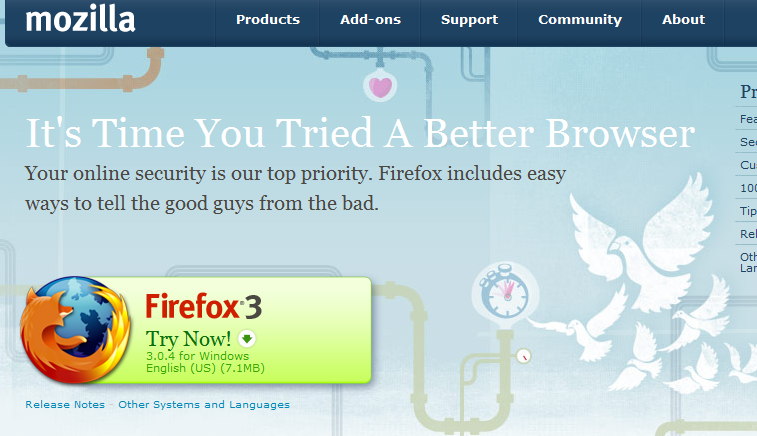
The Firefox team has been doing some testing and revealed the results in a post aptly titled The Download Button Drives Downloads. Using multivariate testing on the main Firefox product page, they found 4 of the 16 different variations performed significantly worse than the control or existing page.

The common thread among these four poor performers? The call to action on the download button. The four laggards used ‘Try Now’ while other variations used ‘Download’ and ‘Free Download’.

Firefox Try Now Call To Action Test

Words matter!

A call to action should be active, short and easy to understand. Simply tell them what you want them to do. Some are uncomfortable with this concept, thinking it’s a bit overkill. But it works. Keep it concrete and simple. Let natural consumer behavior take over.

Don’t get sucked into the idea that you or those you know won’t respond to this type of call to action. You’re wrong. You are not the target market and you likely have responded but simply don’t remember. The act of not remembering is, in some ways, the measure of success for a call to action.

Email marketers understand (or should) the power of subject lines. In the past I’ve seen a dramatic lift by simply inserting the call to action ‘open now’ at the beginning of the subject line. Sure it sounds a bit crass, but 10%+ lift can’t be ignored. And I doubt those people recall the overt ‘open now’ call to action.

Further evidence comes from a 2004 Advertising.com research study that analyzed the impact of various design elements in over 10 million impressions served for three unique advertisers.

Of the tested design elements, call-to-action had the greatest impact on performance — with Advertiser A experiencing an 85 percent lift in revenue earned per thousand impressions, or RPM, for banners with a call-to-action over those without. It was not surprising to find that the presence of a call-to-action impacted performance; however, the significant lift in RPM substantiates the importance of strong call-to-action messaging in banner ads.

In the web world the call to action is generally a button. In future posts I’ll discuss the importance and impact of size, color and placement on the call to action button.

Subscribe now to make sure you don’t miss these future installments. (See what I just did there?)

Forgive Me StumbleUpon For I Have Sinned

December 04 2008 // Advertising + Humor + Marketing + Technology // 1 Comment

StumbleUpon No EntryThe other day I updated my StumbleUpon toolbar (well, I was essentially forced to) and immediately couldn’t Stumble posts from this blog or my Used Books Blog. Each time I tried my Stumble just would not go through, stalling at a blank white box where the review and tagging takes place. I tried numerous times on a couple different browsers. Nothing worked.

I assumed that something had gone awry with the new toolbar. I even posted a message on FriendFeed calling eBay lame. But you know the old saying about assuming, right?

I sent feedback to StumbleUpon about my problem and got a prompt reply as follows.

Hello,

Thanks for writing in.

After reviewing your account history, it appears
that you’ve repeatedly submitted content from one
or more sites in particular.

Our site software detects behavior like this to
prevent the unauthorized use of StumbleUpon to
promote a specific Web site, product or service.

This limit will likely remain in place until you
use the StumbleUpon Toolbar more frequently to
rate, review and discover Web sites that can
shared with other members.

If you’re interested in using StumbleUpon to
advertise a Web site, please look into our
Advertising program:
http://www.stumbleupon.com/ads

If you have any other questions, please review our
Terms of Service and Community Rules:

http://www.stumbleupon.com/terms/
http://www.stumbleupon.com/rules.html

Thanks for your feedback,

Oops. I admit, I’ve only been Stumbling my own sites lately. However, I think they’re pretty good so I don’t see anything too wrong with that. Also, I’m pretty transparent. I don’t have a Stumble army nor do I have multiple profiles so I can distribute my Stumbles across accounts and dodge the software.

But I get it and I’m not really complaining. It’s not what StumbleUpon is really supposed to be about. And I respect them for protecting the product and StumbleUpon business model. It also got me to Stumble again and I discovered some interesting sites and images. So … thanks for that.

My one nit would be that I had to contact support to get this information. Instead of presenting the white box of frustration I suggest that StumbleUpon simply insert the text I received into that area. Not only would I have immediately understood what was going on and not throw invective into the htmlosphere but StumbleUpon would have saved a bit of money on customer support.

Forgive me StumbleUpon for I have sinned. My penance? Stumble.

Cyber Monday Facts and Fiction

November 26 2008 // Marketing // 1 Comment

Cyber Monday is defined as the Monday after Black Friday. It is heralded as the kick-off to the online holiday shopping season and/or the busiest day for online retailers.

What does it mean to me? Cyber Monday could be the case study for the power of marketing.

Hovercat

Cyber Monday hinges on the idea that shoppers make purchases upon returning to work on the Monday after Thanksgiving. These shoppers might be avoiding Black Friday altogether or are buying items they were unable to purchase offline. Combine this with the (once) natural day-of-week effect that shows Monday as the most trafficked day for retail and Cyber Monday seems to make a lot of sense.

In reality, Cyber Monday is a clever lie created by savvy marketers. The term was coined by Shop.org in 2005 and immediately drew media attention both good and bad. Naysayers pointed to the fact that Cyber Monday didn’t really pan out when you looked at the numbers.

But the numbers have changed in the last few years and what we’ve witnessed is the triumph of marketing.

Cyber Monday Statistics

It was widely reported in 2005 that Cyber Monday was historically only the 12th largest online shopping day of the year. Even a Shop.org study found that the busiest shopping day in 2005 was actually December 12th.

This trend continued until 2010 when Cyber Monday was the highest ranked online shopping day, raking in over one billion in sales.

2010 Top Holiday Ecommerce Days

That trend continued with Cyber Monday ranked the highest online shopping day in 2011. What’s fascinating here is that this is happening against the backdrop of some strong trends to the contrary.

Broadband adoption and fast internet connections have made the ‘wait-to-surf-at-the-office’ behavior far less powerful. And in recent years smartphones and tablets have all but erased these patterns.

In fact, more and more retailers are finding that Monday is no longer the biggest day of the week. MailChimp Research also seems to indicate that Monday is less important than it used to be.

Day of Week Email Statistics

Lastly, while Cyber Monday may be the biggest day of the year it does not reside in the biggest week of the year.

eCommerce Holiday Sales Trends 2007 to 2011

So despite the bulk of the sales happening in the later weeks marketers have figured out a way to crank up the volume on Cyber Monday.

Is Black Friday really black?

Black Friday is a big shopping day for retailers. But is it the biggest day? Maybe.

Snopes has the data through 2002 which shows Black Friday ranks between the 4th and 8th biggest day of the year. Black Friday did take the top spot in 2003 and 2005 according to International Council of Shopping Centers. However, I’ve seen conflicting data from other sources.

More recent data from ShopperTrak seems to suggest that Black Friday has secured the top spot. Once again, belief in the Black Friday myth, and the marketing muscle behind it, made it real.

Seth Godin hits the nail on the head in All Marketers Are Liars.

Successful marketers don’t tell the truth. They don’t talk about features or even benefits. Instead, they tell a story. A story we want to believe.

Marketers succeed when they tell us a story that fits our worldview, a story that we intuitively embrace and the share with our friends.

Within this context, Cyber Monday is a well constructed and beautiful fiction. The knee-jerk reaction is to believe the Cyber Monday story (as well as Black Friday) and most won’t do the research to validate that belief.

TL;DR

The fact is Cyber Monday and Black Friday were both fiction, but ones that we collectively embraced (even Google). As such, our collective suspension of disbelief led both to become a reality. Marketers succeeded in telling a story that people believed. Perception became reality.

Facebook Embraces Search, Disses Apps for Brands

November 24 2008 // Advertising + Marketing // Comments Off on Facebook Embraces Search, Disses Apps for Brands

Facebook is changing as it seeks to find a sustainable revenue model. Over the last year it seems clear that Facebook is trying to make itself more relevant and attractive to brands before the sun sets on the buzz parade.

Facebook Embraces Search

Most recently Facebook added fan links to public pages, creating a tremendous density of internal links to brand and product pages. The likely goal of this change is to boost the visibility of brand pages in search results. The attention to SEO and search is an interesting change for the proponents of the walled garden.

If it works, Facebook pages could take up valuable shelf space on search engine results pages (SERPs). Brands and marketers would be wise to take advantage and spend a bit more time on a Facebook strategy aimed at acquiring fans.

And lets remember that Facebook recently integrated Microsoft Live Search into their standard search interface. If Facebook continues to integrate and highlight search, it could provide a substantial revenue stream as well as help Microsoft capture more of the search market.

Facebook Disses Apps

The major redesign implemented this year pushed a substantial number of applications out of the limelight. The redesign aimed to leverage life streaming and encourage user interaction not application interaction.

The good folks at allfacebook conducted a study that shows the impact the Facebook redesign had on applications. The more popular applications were essentially unchanged but there was a 13% to 15% drop in active users when you look beyond the top 50.

Social Advertising In Trouble

The rush to search and away from applications can be seen in the context of an anemic advertising environment. Social media advertising is quickly getting a bad reputation. Ted McConnell, general manager-interactive marketing and innovation at Procter & Gamble Co. had this to say at a November 15 forum on digital media.

What in heaven’s name made you think you could monetize the real estate in which somebody is breaking up with their girlfriend?

and …

I really don’t want to buy any more banner ads on Facebook.

The numbers don’t look good either. CPM rates on social networks are some of, if not the, lowest around. And the effectiveness, from a click measurement perspective, of these ads aren’t good. Allen Stern is conducting a Facebook ad test for his new start-up, CloudContacts. Recent tweets on performance look dismal and campaign results should be made public this week.

In the interim there are other benchmarks to review. Once again, allfacebook has done an interesting comparison of Facebook ads versus Google AdWords. The end result was a cost per lead of $0.72 using Google and $1.83 using Facebook.

Now, the comparison isn’t exactly fair since you’re matching passive (though well targeted) search versus active search. Clearly active search is far more valuable … which leads us back to Facebook’s recent focus on search. Brands understand search. They can easily measure search. Brands will spend on search.

Facebook has a huge audience but is running out of time and chances to translate that into dollars and advertising confidence.