
Test your call to action if you want to succeed in 2009.
Sure, you can work on your site design. Describe your product in new and better ways. Add testimonials. Get yourself a Twitter account. Try out a video tutorial. There are plenty of other things you can do in the quest for better conversion.
But testing your call to action should be at the top of your New Year’s resolution list.
The BusinessDirectory defines call to action as follows:
Words that urge the reader, listener, or viewer of a sales promotion message to take an immediate action, such as “Write Now,” “Call Now,” or (on Internet) “Click Here.” A retail advertisement or commercial without a call-to-action is considered incomplete and ineffective.
The Firefox team has been doing some testing and revealed the results in a post aptly titled The Download Button Drives Downloads. Using multivariate testing on the main Firefox product page, they found 4 of the 16 different variations performed significantly worse than the control or existing page.
The common thread among these four poor performers? The call to action on the download button. The four laggards used ‘Try Now’ while other variations used ‘Download’ and ‘Free Download’.
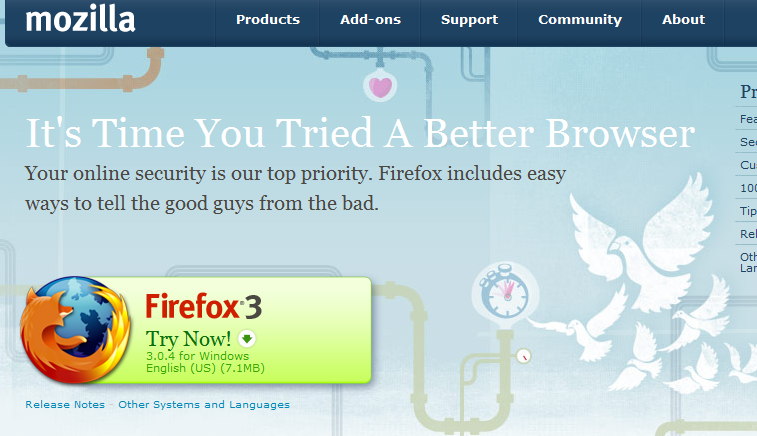
Words matter!
A call to action should be active, short and easy to understand. Simply tell them what you want them to do. Some are uncomfortable with this concept, thinking it’s a bit overkill. But it works. Keep it concrete and simple. Let natural consumer behavior take over.
Don’t get sucked into the idea that you or those you know won’t respond to this type of call to action. You’re wrong. You are not the target market and you likely have responded but simply don’t remember. The act of not remembering is, in some ways, the measure of success for a call to action.
Email marketers understand (or should) the power of subject lines. In the past I’ve seen a dramatic lift by simply inserting the call to action ‘open now’ at the beginning of the subject line. Sure it sounds a bit crass, but 10%+ lift can’t be ignored. And I doubt those people recall the overt ‘open now’ call to action.
Further evidence comes from a 2004 Advertising.com research study that analyzed the impact of various design elements in over 10 million impressions served for three unique advertisers.
Of the tested design elements, call-to-action had the greatest impact on performance — with Advertiser A experiencing an 85 percent lift in revenue earned per thousand impressions, or RPM, for banners with a call-to-action over those without. It was not surprising to find that the presence of a call-to-action impacted performance; however, the significant lift in RPM substantiates the importance of strong call-to-action messaging in banner ads.
In the web world the call to action is generally a button. In future posts I’ll discuss the importance and impact of size, color and placement on the call to action button.
Subscribe now to make sure you don’t miss these future installments. (See what I just did there?)


