— You Are At The Archives for the Technology Tag —

2010 Internet, SEO and Technology Predictions

January 03 2010 // Advertising + Marketing + SEO + Social Media + Technology // 5 Comments

As we begin 2010, it’s time for me to go on the record with some predictions. A review of my 2009 predictions shows a few hits, a couple of half-credits and a few more misses. Then again, many of my predictions were pretty bold.
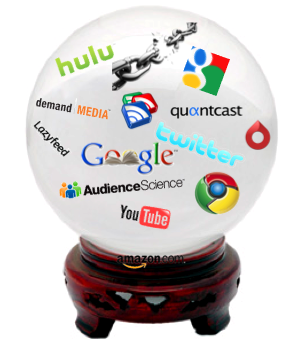
2010 Technology Predictions

This year is no different.

The Link Bubble Pops

At some point in 2010, the link bubble will pop. Google will be forced to address rising link abuse and neutralize billions of links. This will be the largest change in the Google algorithm in many years, disrupting individual SEO strategies as well as larger link based models such as Demand Media.

Twitter Finds a Revenue Model

As 2010 wears on Twitter will find and announce a revenue model. I don’t know what it will be and I’m unsure it will work, but I can’t see Twitter waving their hands for yet another year. Time to walk the walk Twitter.

Google Search Interface Changes

We’ve already seen the search mode test that should help users navigate and refine search results. However, I suspect this is just the beginning and not the end. The rapid rate of iteration by the Google team makes me believe we could see something as radical as LazyFeed’s new UI or the New York Times Skimmer.

Behavioral Targeting Accelerates

Government and privacy groups continue to rage against behavioral targeting (BT), seeing it as some Orwellian advertising machine hell bent on destroying the world. Yet, behavioral targeting works and savvy marketers will win against these largely ineffectual groups and general consumer apathy. Ask people if they want targeted ads and they say no, show them targeted ads and they click.

Google Launches gBooks

The settlement between Google, the Authors Guild and the Association of American Publishers will (finally) be granted final approval and then the fireworks will really start. That’s right, the settlement brouhaha was the warm up act. Look for Google to launch an iTunes like store (aka gBooks) that will be the latest in the least talked about war on the Internet: Google vs. Amazon.

RSS Reader Usage Surges

What, isn’t RSS dead? Well, Marshall Kirkpatrick doesn’t seem to think so and Louis Gray doesn’t either. I’ll side with Marshall and Louis on this one. While I still believe marketing is the biggest problem surrounding RSS readers, advancements like LazyFeed and Fever make me think the product could also advance. I’m still waiting for Google to provide their reader as a while label solution for eTailers fed up with email overhead.

Transparent Traffic Measurement Arrives

Publishers and advertisers are tired of ballpark figures or trends which are directionally accurate. Between Google Analytics and Quantcast people now expect a certain level of specificity. Even comScore is transitioning to beacon based measurement. Panel based traffic measurement will recede, replaced by transparent beacon based measurement … and there was much rejoicing.

Video Turns a Profit

Online video adoption rates have soared and more and more premium content is readily available. Early adopters bemoan the influx of advertising units, trying to convince themselves and others that people won’t put up with it. But they will. Like it or not, the vast majority of people are used to this form of advertising and this is the year it pays off.

Chrome Grabs 15% of Browser Market

Depending on who you believe, Chrome has already surpassed Safari. And this was before Chrome was available for Mac. That alone isn’t going to get Chrome to 15%. But you recall the Google ‘What’s a Browser?‘ video, right? Google will disrupt browser inertia through a combination of user disorientation and brand equity. Look for increased advertising and bundling of Chrome in 2010.

Real Time Search Jumps the Shark

2009 was, in many ways, the year of real time search. It was the brand new shiny toy for the Internati. Nearly everyone I meet thinks real time search is transformational. But is it really?

A Jonathan Mendez post titled Misguided Notions: A Study of Value Creation in Real-Time Search challenges this assumption. A recent QuadsZilla post also exposes a real time search vulnerability. The limited query set and influx of spam will reduce real time search to an interesting, though still valuable, add-on. The Internati? They’ll find something else shiny.

Product (Re)Placement

February 05 2009 // Advertising + Technology // Comments Off on Product (Re)Placement

The other night I fell asleep watching Blade Runner.

Before nodding off I got to see a young Edward James Olmos (a nice juxtaposition to seeing him in Battlestar Galactica) and the amazing logo laden neon skylines that serve as the back drop to the epic Philip K. Dick story.

Blade Runner Coca-Cola Logo

A lot has been made of the product placement used in Blade Runner. Not because it was the first to use it, or that it was so prominent (which it was) but because many of the advertisers fell on hard times.

Among the folklore that has grown up around the film over the years has been the belief that the film was a curse to the companies whose logos were displayed prominently as product placements in some scenes. While they were market leaders at the time, many of them experienced disastrous setbacks over the next decade and hardly exist today. [Wikipedia]

The blatant product placement, track record of the advertisers and new technology got me thinking. What happens when an advertiser or brand ceases to exist? Right now that brand will live forever on film, locked on celluloid for eternity. But does it have to be that way?

Could product replacement be a new advertising venue?

In the digital age the logo of Coca-Cola can be swapped with that of Pepsi. Atari could be replaced by Wii. A dead brand can be replaced by the new thriving brand. Science Fiction has the greatest ability to make these changes because there are no inherent problems with anachronisms.

Period pieces would probably be off-limits (e.g. – Sense and Sensibility) and modern movies would pose potential, but not unsolvable, problems. For instance, the Mellow Yellow car featured in Days of Thunder couldn’t be digitally altered to promote ROCKSTā˜…R but could to promote Mountain Dew.

It’s an intriguing idea, though I’m sure some movie purists would howl at the moon if product replacement came to fruition. Yet, the new formats in which we’re consuming media make this type of substitution seem possible.

Product placement localization seems likely too. Imagine a character drinking from a branded bottle of beer. Couldn’t that brand be altered based on localization? Bud Light in the United States, Labatt Blue in Canada, Skol in Brazil and Krombacher in Germany.

Clearly this wouldn’t always make sense and could disrupt the suspension of disbelief necessary for many films. Make no mistake, product replacement is a Pandora’s box. But imagine the additional revenue potential of selling ‘dead brand’ space in movies.

Would you be disturbed by product replacement?

Could Zoetrope Be A SERP Tracking Tool?

November 25 2008 // SEO + Technology // Comments Off on Could Zoetrope Be A SERP Tracking Tool?

Zoetrope is a new web tool being jointly developed by Adobe and researchers at the University of Washington. The general idea is to allow users to view the Internet over time. Think of it as the Wayback Machine on steroids. Sarah Perez does a good job writing about Zoetrope in ReadWriteWeb.

Yet, it’s the following video that does the best job of explaining Zoetrope.

Could Zoetrope be used as a SERP tracking tool?

If Zoetrope could capture specific search engine results pages (SERPs), then it could be a very powerful SERP tracking tool.

Let’s say I have 10 high value keywords for which I want to be highly ranked on Google. Using Zoetrope I could conceivably capture the daily SERP for each keyword and link it to the appropriate destination page. This would allow me to see if changes to my page had any impact on SERP ranking for that keyword.

I could even create ‘lenses’ for my competitors and review how they’ve tweaked their site to help influence SERP rank. Zoetrope could provide an unparalleled level of detail and analysis for a savvy SEO practitioner.

Yet there’s a big, actually huge, ‘if‘ in the statement above. I doubt that Zoetrope is or even could capture every SERP. But that doesn’t mean there’s not a way to do this. In fact, I think it provides a pretty interesting business opportunity.

Want Zoetrope to help you track SERP for a group of keywords? Simply sign-up for a subscription and they would begin to capture the information. Toss in a 30 day free trial to get the ball rolling and I think you’d have a number of people clamoring for and using Zoetrope for SERP tracking.

Lolcats and Religion: A Dissertation

November 12 2008 // Humor + Technology // 4 Comments

Department of Religious Studies

Technology and Religion RS42A

Dissertation Title: Lolcats and Religion

Prepared by: Rotit John

Supervisor: Dr. A.E. Newman

Date: October 10th, 2010

Word Count: 19,235

Lolcats and Religion: Abstract

Lolcats is a popular Internet phenomenon that allows users to humorously caption pictures of cats as a way to comment on modern life. As such, it is no surprise that religion has entered this new form of expression. In this paper I explore the origins of religion in lolcats and the ways in which religion is represented through the creation of lolcats. The research is based on the analysis of lolcats and various secondary sources such as the lolcatbible. Understanding the representations of God (Ceiling Cat) and the Devil (Basement Cat) is essential in documenting the impact technology has in our changing relationship with religion.

Lolcats and Religion: References