— You Are At The Archives for the SERP Tag —

Google Taxonomic Search And SEO Affirmative Action

December 04 2008 // SEO // 4 Comments

There are rumors that Google is applying taxonomic limits to specific searches, usually surrounding products or brands.

When I first heard these rumors I dismissed the idea. Even if Google created a taxonomy of sites, I couldn’t see them using that data as part of the search algorithm. But I quickly began to see that Google likely has a robust taxonomy and could relatively easily use it as a signal within the algorithm.

Does Google have a taxonomy of websites?

Yes. It already displays this taxonomy via the AdWords placement targeting interface.

The real question is whether Google has attached a taxonomic classification to sites outside of the AdSense network? I’d guess that it may not be comprehensive, but that it includes sites that meet some quality threshold, potentially Page Rank.

Why would Google use a taxonomic signal in search?

Lets start with the idea that Google wants to ensure they deliver the best set of results to users. Would a product related SERP that contained more than five shopping comparison sites be the best result set? How about forums? Or blogs? Or retail sites?

Think about it. If you searched for ‘casio exilim’ would you want a SERP that had Walmart, Circuit City, Office Depot, Ritz Camera, Best Buy, Target and eBay? Similarly, would you want one that had PriceGrabber, BizRate, Buzzillions, Yahoo! Shopping, PriceRunner and NexTag?

I’m guessing that most of the time the natural ebb and flow of the algorithm works out and the results are a nice mixture of these different types of sites. But sometimes one type of site might be better optimized for a term and the type of taxonomic overload above might occur.

How would Google implement a taxonomic search signal?

At first the idea of using a taxonomic parameter in search sounded tough. Yet again, I quickly surmised that it might be more straightforward than I thought.

Wouldn’t you simply enter some logic that made it slightly more difficult for a site of the same taxonomic classification to rank for a query if there was already one ranked higher? The difficulty would increase based on the number of sites in the same taxonomic classification for a query. So, if two shopping comparison sites were already ranked, it would be far tougher for the third and even more so for the fourth.

It’s essentially a smoothing mechanism that gives slightly more opportunity to sites in another taxonomic classification to rank for a query that they might be shut out of otherwise.

A taxonomic limiter would be a safeguard mechanism and perhaps serve as an over-optimization trigger.

What does a taxonomic search signal mean for SEO?

A taxonomic search signal would be a bit like affirmative action for SEO, giving lesser optimized sites a leg up on the competition. It also means greater SERP volatility as sites within one taxonomic class swap positions.

For instance, two sites in the same taxonomic class could be very close and should be ranked 1st and 2nd, but because of the taxonomic limiter are ranked 1st and 5th. If the second site eclipses the first, it would immediately be ranked 1st since the limiter wouldn’t apply. Consequently, the first site would drop, likely to 4th or 5th because the limiter is now being applied.

Is Google really using a taxonomic search signal?

Maybe. While the idea makes sense, the changes some are seeing could instead be caused by one of the numerous algorithm tweaks. But the tools to measure and monitor SEO strength are getting better. Companies can monitor their rank consistently over time and identify when things go sideways. Sometimes the changes don’t make a whole lot of sense and that’s when these types of theories and rumors are born.

What do you think? Is Google using a taxonomic search signal and limiter in search results?

Could Zoetrope Be A SERP Tracking Tool?

November 25 2008 // SEO + Technology // Comments Off on Could Zoetrope Be A SERP Tracking Tool?

Zoetrope is a new web tool being jointly developed by Adobe and researchers at the University of Washington. The general idea is to allow users to view the Internet over time. Think of it as the Wayback Machine on steroids. Sarah Perez does a good job writing about Zoetrope in ReadWriteWeb.

Yet, it’s the following video that does the best job of explaining Zoetrope.

Could Zoetrope be used as a SERP tracking tool?

If Zoetrope could capture specific search engine results pages (SERPs), then it could be a very powerful SERP tracking tool.

Let’s say I have 10 high value keywords for which I want to be highly ranked on Google. Using Zoetrope I could conceivably capture the daily SERP for each keyword and link it to the appropriate destination page. This would allow me to see if changes to my page had any impact on SERP ranking for that keyword.

I could even create ‘lenses’ for my competitors and review how they’ve tweaked their site to help influence SERP rank. Zoetrope could provide an unparalleled level of detail and analysis for a savvy SEO practitioner.

Yet there’s a big, actually huge, ‘if‘ in the statement above. I doubt that Zoetrope is or even could capture every SERP. But that doesn’t mean there’s not a way to do this. In fact, I think it provides a pretty interesting business opportunity.

Want Zoetrope to help you track SERP for a group of keywords? Simply sign-up for a subscription and they would begin to capture the information. Toss in a 30 day free trial to get the ball rolling and I think you’d have a number of people clamoring for and using Zoetrope for SERP tracking.

Search Pogosticking and SEO

November 14 2008 // SEO + Technology // 18 Comments

Search pogosticking is defined as going back and forth from a search engine results page (SERP) to individual search result destination sites. The behavior may indicate poor search results since the user hasn’t been satisfied by one or more of the SERP results.

Google and Yahoo are clearly using, or thinking about using, this metric as part of their search algorithm. It makes a lot of sense and could provide an important user-defined input for the algorithm as well as guard against potential over-optimization. As an aside, access to this human feedback mechanism may be one of the reasons why Google hasn’t been eager to pay a premium for Digg.

How would search pogosticking influence SEO?

A user is presented with search results based on a specific query. The engine captures what result you click on and whether you return to that SERP and click on subsequent results and/or refine your query. (They could even conceivably determine the time between each click as a proxy for satisfaction with that result. This would reduce the chances of penalizing results that did deliver value.) The information can be aggregated for each query and compared to average pogosticking behavior by SERP rank.

So, let’s say that for a specific query the engine sees that the current SERP has an abnormally high pogostick rate for the top ranked result. This information could then be fed back into the algorithm as a negative signal, thereby reducing its SERP rank in a future algorithm update. Obviously, it would have to be statistically above the average pogostick rate for that position to be flagged. However, I’m certain both Google and Yahoo have smart folks who can calculate when it reaches significance.

Does search pogosticking sound far fetched?

It shouldn’t. Do a Google search and look at the page source. You’ll see something like the following next to each search result.

onmousedown="return rwt(this,'','','res','1'

The ‘res’ likely stands for result and the next parameter is the actual rank for that result on that page. More information on this rewrite and tracking behavior can be found at searchlores and blogmal.

Even without this technical knowledge it should be obvious they’re doing something like this if they’re providing users with customized search results. I’m not sure the ability to provide custom or personalized results is the true aim, but makes the collection of this information more palatable for many users.

SEO by the Sea recently posted about this topic including a relevant pogosticking patent application by Yahoo. I recommend you read his post as well.

How can I track pogosticking?

You can’t know for sure whether a user is pogosticking. Bounce rate can sometimes be a good indication, but there are instances where query intent is satisfied and a high bounce rate is the expected result. Many Q&A sites meet this criteria.

The best course of action is to review pages with high bounce rates and make certain you’re matching query intent and delivering value to those users. Post-click SEO is going to become a larger part of the equation, bluring the line between SEO and traditional design and UI.

Beware of MonkeyClicks

September 18 2008 // SEM + SEO // 6 Comments

When I started managing my first search engine marketing (SEM) program at Alibris I quickly found that being the first ad on a Google search result wasn’t working. It seemed a bit counter-intuitive. The volume was great but the conversion was atrocious. But I had a theory for this phenomenon that I quickly dubbed MonkeyClicks.

My MonkeyClicks theory is that a user tends to click on the first result on the page regardless of whether it really meets his or her needs. It is plain ol’ human behavior. A knee jerk reaction of sorts. So you get a tremendous amount of volume. However, that first click doesn’t always match the needs of the user and even if it does they will often return to the search results to determine whether other options exist.

If you think of this outside of the small world of search engine marketing it makes perfect sense. If I’m looking to buy a car I’m likely not going to look at the first advertisement I see and then run off and buy that car. If I’m looking to buy a new bicycle on Craigslist I’m going to look at a number of matching results, not just the first one.

This makes sense but lets back it up with some data. (I like data!) Back in 2006 AOL accidentally released a chunk of user search results. It showed that 42% of all clicks on the first page of results came from the first position. In comparison, the second position racked up a distant 12% of clicks.

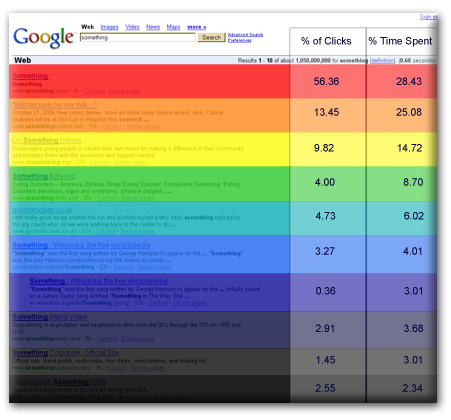
Another eye tracking study by Cornell, and reported by seoresearcher, showed the disparity in the % of clicks and % of time spent on each search result.

Google SERP Click Distribution

The ratio of clicks to time spent on the first position is a classic example of MonkeyClicks behavior. The first position garnered 56% of the clicks but only 28% of the time spent.

All of these studies are done with natural search results, but I’d argue that the paid results will look very similar. Not to mention that I’ve seen this time and again as I manage various SEM programs.

However, your mileage may vary! So don’t take my word for it, do a quick review of your own SEM program. If you’re running a Google AdWords program and Google Analytics, simply take a look at your Keyword Positions report.

And … beware of MonkeyClicks.