— You Are At The Archives for the rss Tag —

The Problem with RSS is Marketing

May 12 2009 // Marketing + Technology // 5 Comments

RSS is Dead

That’s the recent proclamation from Steve Gillmor.

It’s time to get completely off RSS and switch to Twitter. RSS just doesn’t cut it anymore.

Twitter? You mean the platform that has no real grouping function, no trust algorithm, limited information storage and a massive repetition problem? Good luck with that.

RSS is Fuel

RSS is the snow pack for the river that is the real time web

If you view the real time web as the ‘river’ of news, then RSS is the snow pack at the top of the mountain. A poor snow pack results in a drought. Without RSS the real time web would be a very different place.

RSS is the foundation of the real time web. RSS allows us to track, consume and share our passions. This is what makes the real time web work. Each person contributes a little bit of their universe to the whole. Give a little, take a little.

If the rate of how much people ‘gave’ declined you’d have less and less to take. Those not ‘giving’ at all are the parasites of the real time web.

RSS is Plumbing

The RSS debate is filled with many who claim RSS is nothing but plumbing. That it doesn’t matter if you think it’s dead or not because it’s built into so many features and products.

It’s this type of talk that has retarded the growth and adoption of RSS.

Of course RSS is plumbing but it is not just plumbing. You get to lay a lot more pipe if you can communicate how great the houses are going to look. It’s time to stop this counterproductive infighting.

RSS is Alive (but not kicking)

The drumbeat of surveys and metrics around RSS adoption are all negative. Forrester reported consumer adoption of RSS was a low 11%. A December 2007 survey for the Canadian government also showed RSS as the least recognized Web 2.0 application.
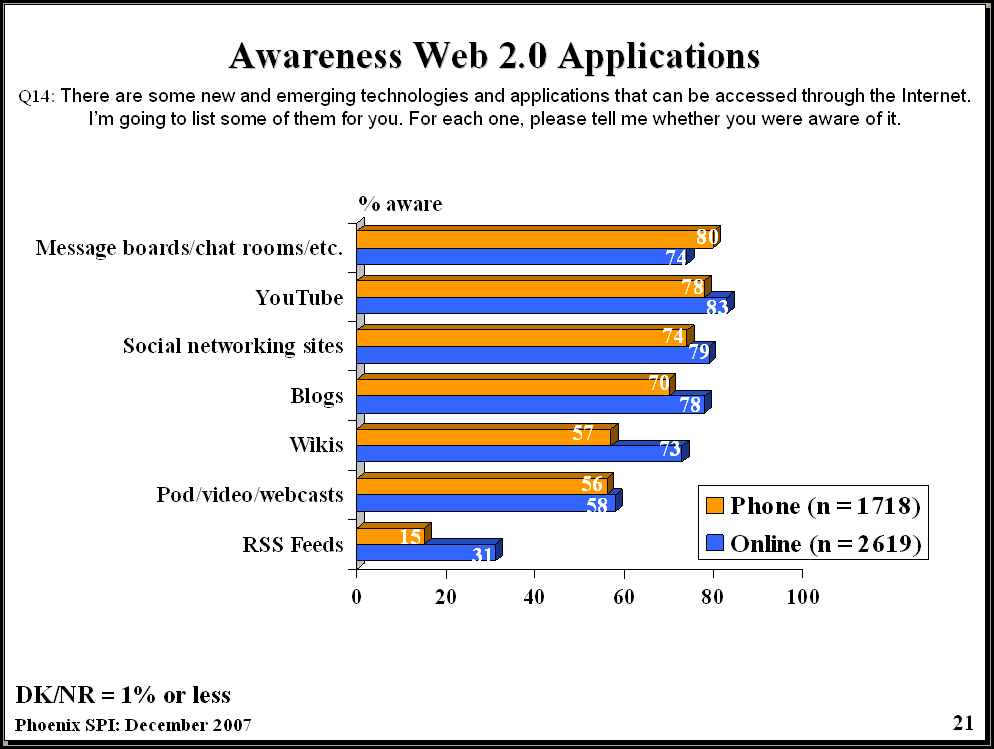
RSS Awareness

I’m not the biggest Forrester fan, but they did show some insight in their executive summary.

If marketers expect to reach a critical mass of consumers by using content syndication, then they must take on the burden of education.

I’m not sure I’d call it education exactly. I think of it as translation marketing.

Nothing needs to be complicated. People by nature are simple. We like simple things. Confusion might be fun in a mystery movie or a game of Cluedo. But when it comes to businesses marketing to us, confusion just turns us off you and onto your competitors.

My reference to translation marketing is made possible by RSS. There’s no way I’d have this information available to me – right now – if I’d relied on other methods of information consumption.

RSS is TiVo
TiVo Logo

Yeah, I said it. RSS readers are like TiVo. I get the content I want and get to consume it on my own schedule. RSS subscriptions are simply TiVo Season Passes. As such, the content can be grouped by genre and date. Recommendations are based on my subscriptions and behavior.

Nearly every person I introduce to RSS falls in love with it after they use it and understand how much time it saves them. I admit, I was a late RSS adopter in the scheme of things. I didn’t fully grok RSS for a while and then … it clicked. It’s a familiar refrain for RSS users … and TiVo subscribers.

TiVo has done the hard work of training people on a new method of media consumption. RSS simply needs to piggy back on this effort.

RSS is Netflix

Another media consumption disruptor is Netflix. They too have done some of the heavy lifting in training consumers on this new paradigm.

You don’t need to go somewhere to obtain your movies. The movies come to you.

You don’t have to watch them in a specified time frame, you can keep them for as long as you like.

RSS Usability

A number of smart people have pointed to the fact that RSS still has usability issues. Current RSS readers aren’t the most intuitive products on the block. I won’t argue that point. Readers could be a lot better.

I support advances in RSS usability since it would make marketing RSS easier. Yet, even without usability improvements, marketing could turn the tide.

Better RSS marketing would mean more users which would lead to renewed interest in RSS usability advances. It’s a bit like the chicken and the egg debate.

RSS Expectations

Brand promise. Part of marketing is building the expectations for the product. A number of people feel guilt about unread RSS items.

RSS readers encourage you to oversubscribe to news. Every time you encounter an interesting new blog post, you’ve got an incentive to sign up to all the posts from that blog—after all, you don’t want to miss anything.

RSS is not about real time. It is the fuel for real time. RSS is about time shifting your content consumption.

Do you stress about having 5 episodes of 24 queued up ready to watch? I sure hope not.

And 20 unwatched episodes of a show may tell you you’re just not interested in that show. Use your unread counts as a way to prune your subscriptions. It’s a signal!

Usability may help some of these people but abuse of any product is going to lead to substandard results.

RSS Enemies

The definition of old media is going to change rapidly. Email, ad networks and – potentially – content publishers may seek to undermine RSS adoption. Some sites may rebel by not offering an RSS option should RSS really take off and visits and page views decline. The chance of this happening has been reduced with the advent of FeedSense – advertising units within feeds.

RSS marketing will encounter these enemies. They will not go quietly into that good night.

RSS Marketing

RSS needs proper marketing. All the technical babble needs to be translated into something consumers can relate to and recognize. Use ‘On Demand’ or ‘Season Pass’ or any other verbiage that better connects the dots for consumers.

Why doesn’t Google white label Google Reader? Wouldn’t that create an incentive for sites to convert them to a branded reader? So, no matter what feeds you were reading you had the brand in front of you at all times?

At the cross section of usability and marketing, why can’t I be prompted to subscribe to a blog when I’m bookmarking it to Delicious or giving it a Thumbs Up via StumbleUpon?

RSS is Dead

RSS is dead

RSS is dead. Not the product but the brand. It’s time to let go of the acronym, stop squabbling and figure out how to translate and market this great functionality.

Google Reader Recommendations Gone Wild

May 04 2009 // Rant + Technology // Comments Off on Google Reader Recommendations Gone Wild

Two weeks ago I was on vacation in San Diego. Of course I took my MacBook Pro, particularly since the rental had great wifi. So I was able to check in at work, maintain my FriendFeed addiction, locate the nearest Peet’s and do research on attractions and restaurants.

Upon returning from vacation I caught up on RSS via Google Reader. In fact, I was searching for new feeds and clicked on the ‘browse for stuff’ option. Now, I can’t say Google recommendations have been that great, but it’s easy, it refreshes quickly and it has provided some decent matches.

Geolocated Google Reader Recommendations?

Google Reader Search Based Recommendations

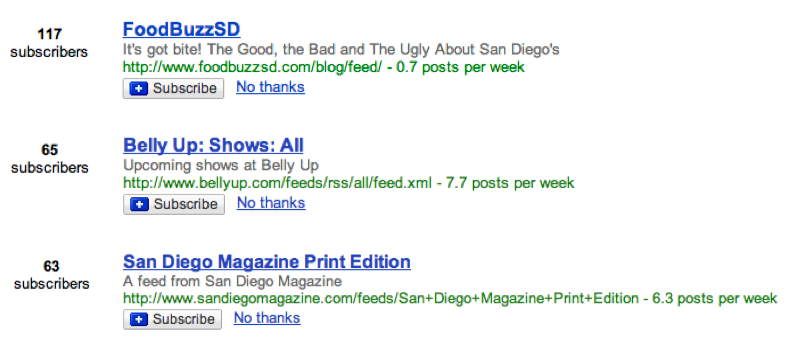
Much to my surprise I saw a number of recommendations with a San Diego theme. Simple GeoIP was my first thought. But that didn’t explain the fact that many of the recommendations were related to San Diego and food. (Sadly, I declined these before I put two and two together and took a screen capture.) The only other food related blog I maintain is the fantastic TasteSpotting. But that’s where it starts and ends.

Then it dawned on me. I’d been searching and surfing San Diego restaurants! Sure, I used Yelp and OpenTable, but I searched Google (and Google Images) for restaurants with the best views. In addition, I would click through to the restaurant’s website to see the menu.

With a little research I confirmed that recommendations are based on Web History (emphasis is mine.)

Your recommendations list is automatically generated. It takes into account the feeds you’re already subscribed to, as well as information from your Web History, including your location. Aggregated across many users, this information can indicate which feeds are popular among people with similar interests. For instance, if a lot of people subscribe to feeds about both peanut butter and jelly, and you only subscribe to feeds about peanut butter, Reader will recommend that you try some jelly. This process is completely automated and anonymous; your personal information will be protected in accordance with our privacy policy.

Confused Google Reader Recommendations

Confused Google Reader Recommendations

The Google Reader recommendations algorithm is easily misled by a vacation or a spate of searches on a specific topic. Together, as in my case, and it’s even worse.

This isn’t a new problem.

Marketers have long had issues with this type of behavior. Buy a baby shower gift and you might suddenly be presented with a host of baby products. Get a Gilmore Girls DVD set for your mom and you wind up getting a promotion for The Sisterhood of the Traveling Pants 2!

The complexity of trying to identify and exclude these ‘non-standard’ signals often make recommendation engines ineffective or just plain wrong.

Simple Google Reader Recommendations

As tempting as it is to use web history and location to generate recommendations it might be better to simply rely on feed history and collaborative filtering of aggregated subscriptions. Just because you can doesn’t mean you should.

At a minimum, it’s time for Google Reader to turn the dial down on web history and location so recommendations don’t suffer from topical whiplash.

eCommerce and RSS

January 11 2009 // eCommerce + Marketing + Technology // 1 Comment

Are eCommerce sites overlooking RSS?

RSS still hasn’t hit the mainstream, but could eCommerce sites help drive RSS adoption and at the same time increase the effectiveness and reduce the costs of their communications with customers? Yes!

Too many eCommerce sites seem to believe that the only place for RSS exists if they have their own blog. And lets face it, many don’t have the bandwidth to produce a decent blog. It’s a resource drain and one that many find hard to explain during budget meetings.

Yet, most eCommerce sites already have blogs, they just don’t know it. They’re called newsletters. So the time and effort argument is irrelevant.

Why push newsletters via RSS?

Most eCommerce sites use email as their primary method of communication. Yet, email has three big (and growing) drawbacks: deliverability, over saturation and cost.

Deliverability issues persist as email finds its way into spam folders or bounces due to changed email addresses. A 2007 Internet Retailer survey indicated that only 40% of respondents experienced 90%+ deliverability. And a 2008 Return Path report showed commercial deliverability at 88%.

Just like the old direct mail world, people move … a lot. Here’s the data from Jupiter Research (2008) and Return Path (2007) respectively.

17% of Americans create a new email address every 6 months

30% of subscribers change email addresses annually

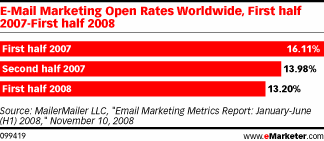
Part of the deliverability problem is over saturation. Email marketers have overused the medium, flooding mailboxes to the point where users feel overwhelmed. The result has been a steady decline in open rates, from nearly 40% in 2003 to 13% in 2008.

eMarketer Email Marketing Open Rates 2007-2008

Many eCommerce sites have increased the frequency of email to respond to declining open rates. The open rate might be low on each email but if you send six emails a month your total open rate might wind up being pretty good.

Yet, there is incremental cost associated with this increased volume. Not only that but it contributes to the over saturation problem which negatively impacts open rate and effectiveness. It’s a vicious and costly cycle in which eCommerce sites wind up paying more for less.

The advantages of RSS

RSS solves most, if not all, of the deliverability problem. There is no spam filter or black list. I’d also argue that you’re less likely to switch readers than email addresses, thus reducing the churn rate of your subscriber base.

Email has become unncessarily intrusive and ephemeral. An email will be pushed ‘below the fold’ of a person’s inbox with greater speed as the volume of email a person receives increases. The adage ‘out of sight, out of mind’ is apt in this instance.

Over saturation might be an issue in RSS but the format is a more ‘on demand’ type of solution. TV networks are starting to understand this, that forcing people to watch their show at 8pm on Thursday might not be optimal. Similarly, RSS allows subscribers to engage with your content on their own terms.

Subscribers will still get an inbound notification that new content has arrived, so you’ll still see an immediate (though perhaps less pronounced) traffic surge. And the content will have a longer life due to increased delivery and visibility in the reader.

Did I mention RSS would be radically cheaper than email? Leaps and bounds cheaper really.

But didn’t eCommerce already try RSS?

Yes and no. When RSS first arrived on the scene there was a big ruckus about how RSS could replace email. The problem was marketers didn’t have a clue how to really make that happen. Most didn’t even use RSS and found it confusing at best.

I speak from experience. I was smack dab in the middle of it all as Director of Marketing at Alibris. I sensed that it had potential but I didn’t fully grok RSS until later on, after I’d left the eCommerce space.

The topic was a blip on the radar at conferences and no one really wanted to upset the applecart. Email was a solid performer and search was the shiny new channel.

So any attempts made in those years were premature and uninformed for the most part.

Why could RSS succeed this time?

If eCommerce sites began to understand that RSS could help them achieve their goals they could be a force of change for the technology. RSS needs to be relaunched, rebranded or both. Who better to do that then those in the business of selling.

In addition, the reader market has matured and stabilized. I see no reason why Google wouldn’t want to partner with major retailers and offer their customers an easy (perhaps cobranded) way to start using RSS using Google Reader.

Finally, RSS can be used more creatively by eCommerce sites. In a tough economy, why not let users select products and create a price watch feed? Or let users subscribe to reviews of a product to help them through the sales cycle?

Email versus RSS

email vs rss

The revenue stream from email has obscured the growing cost of the channel. I don’t know of a single eCommerce retailer who really ‘likes’ their email service provider. The time and money dedicated to producing and sending email seems to grow and not shrink.

Yet, instead of looking at new ways to communicate with customers many simply look to ‘fix’ email or find another service provider. Deliverability in particular has given rise to a number of new businesses. That should be a clear signal for change.

I’m not saying eCommerce should abandon email, but the ones who figure out RSS will have a marked advantage.

How To Get Your Twitter Replies Via RSS

January 02 2009 // Social Media + Technology // Comments Off on How To Get Your Twitter Replies Via RSS

Twitter Replies Via RSS

Here’s a simple way to get your Twitter replies delivered to you via RSS.

  • From your Twitter home page, scroll down to the bottom and click on Search
  • Search for your replies using @[your username] (for me that would be @ajkohn)
  • Select the ‘Feed for this query’ link on the top right hand side of the search results page

That’s it. Your Twitter replies will now be delivered to you via RSS in your favorite reader.

2009 Internet and Technology Predictions

December 23 2008 // Advertising + Marketing + SEM + SEO + Social Media + Technology // 9 Comments

Now is the time when bloggers go on the record with their thoughts for the year ahead. Place your bets! Stake your claim! Here’s mine.

Crystal Ball 2009 Predictions for Internet and Technology

Facebook Becomes A Portal

Realizing that social media and advertising is like oil and water, Facebook repositions itself as a portal leveraging Microsoft’s Live Search as the revenue model. This also might result in the potential acquisition of Netvibes to provide a more robust offering to compete with Yahoo!

Identity Systems Fail

Confused about the difference between OpenID, Facebook Connect and Google Friend Connect, users throw up their hands and decide not to use any of the above.

Video Advertising Succeeds

The adoption of video is surging faster than many expected. Longer formats and better quality will bring even more eyeballs who will grudgingly accept advertising.

Microformats Go Mainstream

Why they aren’t already is shocking. Nevertheless, in 2009 we’ll see microformats become a standard and search results will become far more robust as a result.

Banner CTR Becomes Obsolete

Brands will finally realize that measuring success by click through rate (CTR) isn’t working. Measurement ‘beyond clicks’ will be the new yardstick, whether that’s through new brand advertising measurement services like Vizu or through monitoring services like Brandwatch and Trackur among a gaggle of others.

RSS Adoption Spikes

Someone will (finally) figure out how to market RSS to ‘the masses’ who will grasp the sublime benefits of having content come to you instead of the other way around.

Kindle 2.0 Flops

Amid a weak economy Amazon releases the newest version of Kindle. Other readers have gained ground where Kindle has not and at the core Kindle is a solution without a problem.

Google Search Share Stalls

The move by Facebook (see above) causes a radical change in the search landscape. Microsoft passes Yahoo! for second place and talks about a Microsoft Yahoo merger are (unbearably) reignited.

FriendFeed Surpasses Twitter

FriendFeed adoption increases at an accelerated pace due to quick innovation, uncluttered design and an interface that lends itself to communication.

Someone ‘Dies’

Users reach social media overload and VCs get even more nervous about revenue creating social media shrinkage. In this instance ‘Dying’ means a company goes under or is purchased for a song. My short list includes Plurk, Twitter, Digg and Seesmic. This isn’t a reflection of the people or product but the inability to truly reach the mainstream with a service that has a profit model.

There are plenty of other things that I believe will happen in 2009, but they seem more obvious or an extension of current trends. Instead I tried to be a bit more bold, at least on a few of my predictions.

We’ll check in this time next year to see how I fared. In the meantime, feel free to comment and provide your feedback and reaction to my predictions.