— You Are At The Archives for the meta description Tag —

Longer Snippets and Meta Description Strategy

March 30 2009 // SEO // 1 Comment

Google recently announced that queries longer than three words would receive longer snippets. The theory being that the more detailed the query the more information necessary to provide context to the user.

This change comes right on the heels of research that shows that longer queries are becoming more frequent.

Do longer snippets change meta description strategy?

Probably not, but it’s a good time to review your meta description strategy.

First off, meta descriptions do matter. Even if they don’t have an impact on rank they will on your click through rate. The snippet, whether derived by Google or provided through a meta description, is where you ‘sell’ the listing.

Any PPC marketer will tell you that copy testing can have a significant impact on click through rate. The meta description is just a bigger block of copy. Use it.

Date prefix

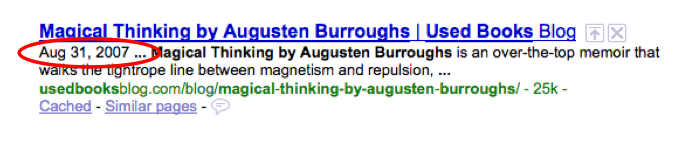
Currently, most write meta descriptions that are between 145 and 160 characters in length. However, the date prefix Google uses often interrupts a well crafted meta description. (Note that date prefixes are not searchable but are solely there as user signposts.)

You might want to think about writing shorter meta descriptions if you are consistently getting a date prefix.
date prefix meta description

The date prefix takes up 17 characters (including spaces) which means your total two line meta description should be 128 to 143 characters. For the sake of rounding go for between 130 and 140 characters.

Length or characters?

This doesn’t mean you won’t get the dreaded ellipse (…) at the end of your listing. The wrapping of a long word could push the second line beyond the max length. While we talk about characters, evidence suggests it’s about length instead. (That’s what she said!) I’ve seen 87 characters in a line, which seems impossible, but with parentheses and other thin characters … it fits.

Character length is still a good proxy until a tool delivers the ability to measure the actual length of each line of text.

New meta description tools

I’m surprised an AdWords-like tool (aka plugin) hasn’t been developed that would show what the listing would look like on Google. This wouldn’t be limited to meta description, but would provide a complete visual of your listing as it would appear on a Google SERP.

The tool would let you toggle the date prefix on or off and might even crack the length issue by determining the maximum pixel (px) line length. Just like AdWords, you’d see an example of your listing as you type. (It turns out SEOmofo has developed a SERP Snippet Optimization Tool.)

Should you write longer meta descriptions?

This assumes that Google will honor and display the full meta description provided instead of searching out relevant text on the page to match the query.

Given the opportunity, yes, I would want to control what the user reads. I want the ability to market my content the way I see fit. I think know I can do it better than Google. Here’s Exhibit A.

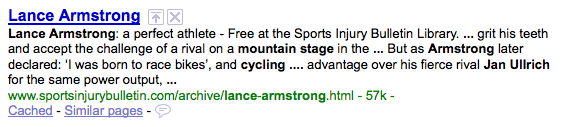
A search for ‘bicycling lance armstrong mountain stage jan ullrich’ returns this four line snippet.
Longer snippets

The longer snippet might display all of the keywords in my query but it doesn’t tell me a lot about what this page is really about. A longer meta description (even a regular one) might have done a better job.

Are longer snippets better?

Sometimes. If there’s no meta description in the first place then matching more keywords in the snippet would probably be an enhancement. If there is a meta description, I’d posit that the longer snippet degrades the experience.

The choppy nature of the snippet construction indicates that the keywords exist on the page but often fails to deliver the true context or topic of the page. A good meta description will do the latter.

Let the algorithm select the item based on the query terms but provide the human written meta description.

Will Google honor longer meta descriptions?

It doesn’t seem like Google will honor longer meta descriptions. If the longer meta description doesn’t contain the keywords from the query I’m guessing that Google will disregard the carefully crafted text and piece together its own snippet. In fact, it looks like they won’t even use the normal meta description.

But you know what they say about assuming. So I will test longer meta descriptions on this post and others and track what is displayed when searching with long queries.

The Future of Search is Numbered

February 23 2009 // SEM + SEO // 2 Comments

The future of search is numbered. No, it’s not what you think. I’m not predicting the demise of search. Quite the opposite.

Instead I’m talking about two trends that could have interesting implications on how both SEO and PPC campaigns are constructed.

The number of words per query is going up

Bill Tancer, General Manager of Global Research at Hitwise, shared the following statistics during a SMX West presentation.

Number of Words per Query Going Up

The trend is clear. People are using more words in their search queries. The reasons behind the increase in words is debatable. Is it an increased comfort and savvy with search or frustration with the search results? Either way, long tail searches are on the rise and will likely trend this way for some time.

People are using numbers to reformulate queries

In a post titled Study on the Structure of Search Queries, Bill Slawski of SEO by the Sea discusses a Yahoo! research paper titled The Linguistic Structure of English Web-Search Queries (pdf). One of the findings was that people were using numbers to modify their searches.

The type of word most likely to be reformulated is “number.” Examples included changing a year (”most popular baby names 2007″ ! “most popular baby names 2008″), while others included model, version and edition numbers (”harry potter 6″ ! “harry potter 7″) most likely indicating that the user is looking at variants on a theme, or correcting their search need.

The data set for this research is from 2006. Yet, combined with the increase in words per query I’d theorize that numbers remain a powerful way to search today.

I’m the first person to warn against using yourself as an example but … I’m going to break that rule right now.

I often find myself using numbers, particularly years, when searching. If I’m doing research on a volatile topic (like SEO) I might come across ancient results from 2004. These are rarely helpful.

So I’ll begin to iterate and modify my query with years to find more relevant results. I had to do something similar when trying to cobble together Google’s share of search from October 2004 to October 2008.

Speaking of Google …

Google displays the date as a meta description prefix

Sometime last year Google began to insert a date prefix before the meta description in search results. They did this for pages in which Googlebot found a date – mostly blog posts.

meta description date prefix

I certainly noticed since some of my well crafted 150 character meta descriptions were suddenly being cut off because of the inserted date.

Why exactly would Google do this? They’ve certainly made it clear they like “fresh” content but they could present fresh content without the date. I can only surmise that Google believes users are looking for and will benefit from seeing the date.

Oddly, the date prefix does not seem to be searchable. When I search for ‘Magical Thinking by Augusten Burroughs 2007’ the same result is displayed but the visual treatment changes.

date search result without meta descripition date prefix

Once again Google tromps all over my well crafted meta description, but without the meta description date prefix. This seems to prove that the meta description date prefix isn’t searchable. But perhaps it should be.

Are you including numbers in your SEO and PPC strategies?

We know that users are using more words per query and that they’re fond of reformulating queries using numbers. This should be enough evidence to implement a robust modifier strategy, if you haven’t already.

Those who already have long tail programs should think about increasing the use of numbers as valid modifiers. As an example, wouldn’t review sites benefit from bidding on terms like ‘digital camera reviews 2009’ or ‘trek bicycle ratings 2008’?

Search (whether paid or organic) is about matching your content (or ad) to the user queries. Don’t let your programs become dated.

Post Click SEO

January 27 2009 // Marketing + SEO // Comments Off on Post Click SEO

post click seo

Should search engine optimization professionals be more involved in post-click marketing? Yes.

SEO shouldn’t end with the click. Getting the click is half the battle. What happens after that click is just as important. Post click marketing has taken off as more and more realize the need to optimize pages and conversion paths.

SEO should be leading the charge, not taking a back seat.

Post Click SEO

Keyword targeting adjustments are the first way in which SEO can influence post click marketing. What keywords are bringing users to the page and which of those keywords is performing best from a conversion perspective?

Decisions can be made to alter the keyword targeting of the page to optimize for the better performing keyword(s). Traffic may go down but the effective yield of that traffic may go up based on the higher conversion rate.

This process might also help identify areas for new content that better meet the needs of those arriving on poorly performing keywords.

Meta descriptions and titles are extremely valuable from a post click perspective because they can set expectations and even include a call to action. Optimizing solely for the keyword or keyword phrases in the meta description might not a) encourage clicks and b) may drive unqualified clicks.

Remember, search engine marketers are constantly testing new ad copy to increase click through rates and conversion. Search engine optimizers should do the same, using the larger canvass of meta description.

The meta description can even be used for promotional purposes. Changing the meta description on a product page to include an offer of free shipping will likely increase the click yield and, if the page matches their expectation, will continue to convert effectively.

On-site optimization in the form of keyword density, headers and even bold text can all have an impact on conversion. On-site SEO is about making the page easier to understand. While the initial audience for this optimization is a search engine, those same changes help everyday readers.

A highly descriptive header will help tell both the search engine and the reader what that page is about. H2s and H3s can help further explain the topic of that page. Again, both search engines and readers benefit.

Keyword density also increases the readability of a page. Here’s an example.

The procedure was a success and fully solved the patient’s condition.

This type of sentence might appear near the end of a descriptive paragraph. The writer probably referenced the procedure and condition beforehand and believes that the reader will fill in the blanks, turn generalizations into specifics and make the mental connections needed to gain comprehension. Search engines will do none of these things.

Instead, what if the sentence read as follows.

The stomach stapling procedure was a success and fully solved the patient’s obesity condition.

Changing generalizations to specifics and filling in the mental connections we make ensure that search engines and users immediately understand the content upon scanning the page. And people are scanning pages more than ever.

Don’t make your users do the work.

Post-click marketing and SEO

Companies that seek to maximize clicks in isolation and conversion in isolation will see results.  But those results will be less than what could have been obtained. Don’t be fooled by the false positive of this silo mentality.

Search engine optimization and post-click marketing should work in tandem to get the most out of every click.

SEO Holy Trinity

January 06 2009 // SEO // 3 Comments

SEO Holy Trinity

The SEO Holy Trinity. In the name of the Title, and of the URL and of the Meta Description.

If you’re just getting started with search engine optimization (SEO) you must get these three things right. Here’s the Blind Five Year Old explanation on why these three elements are critical to your SEO success.

Title

A search engine walks into a library. No, it’s not the set-up line to a joke. It’s an analogy for how a search engine will look for content. Everyone likes new content, even search engines, so it’ll walk straight over to the new releases section.

Now, remember, a search engine is like a five year old. So when it wanders over to the new releases you need to make sure it can understand what your page is about. The title is the best way to communicate what your post or page is about.

A five year old will probably not care who wrote the book, so don’t put your name, company or blog at the beginning of the title. If you have it at all, put it last.

Frog and Toad Are Friends

A five year old isn’t going to get your clever double entendre or understand irony. Keep that stuff in the body of your content and use your title like you would for a children’s book. For example, what do you think Frog and Toad Are Friends is about?  Yeah, probably about a frog and a toad who are friends. Bottom line – keep it simple.

Keep it brief. Search engines, like most five year olds, have a short attention span. It’s not that they can’t read all the words, but Google is only going to display 65 characters to people looking for your content. So keep it under that limit. If you’re using your brand at the end of the title, you can go just past the 65 character limit and thus sacrifice the brand name to the HTML ether.

URL

Lets extend the library analogy above. You can think of the URL as the spine of the book. A search engine will have less of a chance of understanding what that book (your page or post) is about if you don’t have a descriptive URL.

Dewey Decimal Sticker Example

Imagine if all a search engine saw on the spine of your page was a dewey decimal classification sticker. Here’s are some examples of what that might look like on your site:

http://www.domain.com/p=124

http://www.domain.com/viewDocument.aspx?d=903

Now, if you were a high-functioning adult you might be able to interpret that to get what it means, or you might find your way to the card catalog to do further research on what it meant.

But search engines are like five year olds!

They’re not going to do that. They aren’t going to understand it and they’re not going to take the time to investigate or research. The search engine will simply move on to something that looks more interesting and is easier to understand.

Instead, use your title (minus your brand name if you’re using that) as your URL. Simply use hyphens between each word and you’ve created a URL that a five year old will understand.

If you can, don’t bury the page in lots of directories. Make your URL as flat as possible while retaining the context. For instance, which of the two URLs below is easier to understand at a glance?

http://www.domain.com/toys/non-electronic/animals/stuffed/bears/brown/paddington.htm

http://www.domain.com/toys/paddington-bear-stuffed-animal.htm

In a pinch you can take out words that don’t contribute additional meaning. So, you could drop ‘the’ or ‘and’ in many cases to make the URL even more concise.

Meta Description

You might have read elsewhere that meta description doesn’t matter. Don’t believe it for a second! Meta description is important because it’s your chance to market your content.

Lets, again, use the library analogy. Readers might scan the book title. It tells them a little bit about what the content of the book. Okay, it’s about a toad and a frog who are friends but … what do they do? The meta description is the blurb on the back of the book that tells you more.

The meta description is the place to entice people to click on the search result. You might get ranked well for a term, but the next step is to get them to click. Sure, you have a much better chance based on your rank, but the text you use in the meta description does matter.

Try to get your keyword phrase in there, twice if at all possible. Why? Because Google will bold the search terms in your result. The bold styling reinforces that they’ve gotten the correct result and draws the eye to that listing.

So put something in there that tells them they want to come to your page. Make it exciting or interesting. Tell them what they’ll gain from visiting your page. Sell your content.

Putting It All Together

So here’s what the SEO Holy Trinity winds up looking like in Google.
SEO Holy Trinity Example

This page or post was optimized for the phrases ‘2009 Internet Predictions’ and ‘2009 Technology Predictions‘. (I could have done a post for each one to be even more focused but … time is not infinite!) Do the searches for yourself and see how I rank.

Now this isn’t the end of SEO. You’ll need to do more to achieve high rankings and traffic. But the SEO Holy Trinity is the base that you must have to ensure success.

In the name of the Title, and of the URL and of the Meta Description.