— You Are At The Archives for the matt cutts Tag —

Pipes versus Dashes

September 28 2009 // SEO // 1 Comment

Pipes versus Dashes

At SMX West 2009 Bruce Clay stated that Yahoo! didn’t ‘like’ pipes. I’m a big fan of pipes so I made a beeline for the Yahoo! representative at the show and he was nonplussed. He saw no reason why Yahoo! would treat pipes any different than dashes.

pipes vs dashes

What are pipes and dashes?

I’m talking about the delimiter used in the title tag, which ultimately shows up as the first line in your search engine result. The two most frequently used title tag delimiters are pipes and dashes.

Are pipes better than dashes?

So, it seemed like Yahoo! had no preference but what about Google? I asked Matt Cutts and got the following video reply. (Thanks Matt.)

The answer seems to be the same. Google most likely handles pipes the same way it does dashes.

Do users prefer dashes or pipes?

Matt brings up an interesting point surrounding click through rates on pipes versus dashes. And maybe that’s what Bruce was referring to – a study of click through behavior, specifically on Yahoo!

The real problem is you can’t really do an A/B test like you can on AdWords. But wouldn’t that be an incredible tool Google could provide through … say, Webmaster Tools! Because what you’d really want to do is take the same URL and send half of the traffic to one treatment and half to another.

In the interim I suppose you could conduct an eye tracking study. But Matt’s probably right, there’s likely little to no difference. Until then you can feel safe using both pipes or dashes for your title optimization.
Did You Mean Matt Cutts?

May 15 2009 // SEO // Comments Off on Did You Mean Matt Cutts?

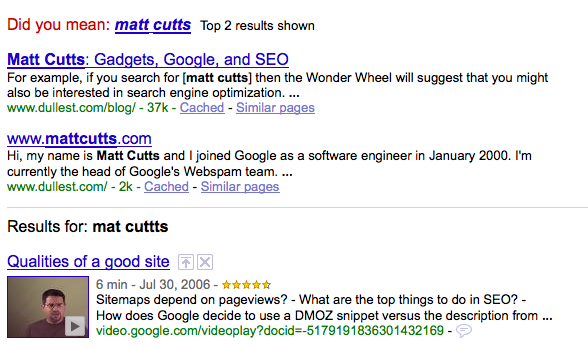
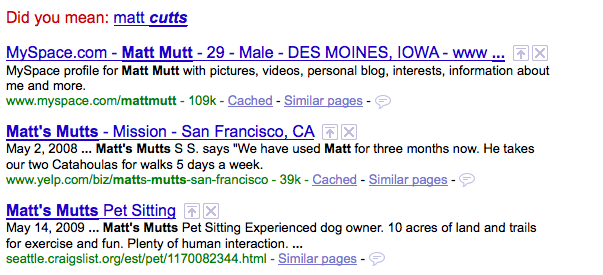
In February I wrote about Did You Mean search results appearing above normal Google search results. This differed from the presentation of just a link to the Did You Mean search results.

Did You Mean search results

Did You Mean Matt Cutts

Did You Mean search link

Did You Mean Link

While I understood the potential user benefit, from an SEO perspective, Did You Mean search results could make misspelling optimization far less attractive.

As luck would have it I was able to get an answer on this topic from Matt Cutts.

It’s about what I expected. The presentation is relatively new and is tied to an algorithm triggered by some threshold where Google expects a high degree of accuracy in the Did You Mean match. In the end, it probably does deliver value to the user.

I appreciate the response (thanks Matt) and am reminded that SEO is an ever changing endeavor.

SEO 101: Dashes or Underscores?

April 23 2009 // SEO // 6 Comments

One of the first things someone new to search engine optimization (SEO) will ask is whether it’s better to use dashes or underscores in URLs.

dashes or underscores

Dashes or Underscores?

The short answer is: dashes.

Read on if you’re interested in why and some history behind the topic.

Back in 2005, Matt Cutts wrote about dashes versus underscores. At that time he recommended dashes.

… if you have a url like word1_word2, Google will only return that page if the user searches for word1_word2 (which almost never happens). If you have a url like word1-word2, that page can be returned for the searches word1, word2, and even “word1 word2″. That’s why I would always choose dashes instead of underscores.

To make it even more plain, the underscore joins the words together while the dash separates the words.

this_is_one_word

this-is-multiple-words

At WordCamp 2007 Cutts was reported to say that Google was going to begin treating underscores as separators. But Cutts clarified what he said in a follow-up blog post.

… I didn’t quite say that in the talk. I said that we had someone looking at that now. So I wouldn’t consider it a completely done deal at this point. But note that I also said if you’d already made your site with underscores, it probably wasn’t worth trying to migrate all your urls over to dashes. If you’re starting fresh, I’d still pick dashes.

This made it seem like Google might be working on a solution to the underscore issue which impacted a number of blogging platforms and other developers who use underscores out of habit.

The WordCamp talk clouded the topic and confused many. Some, despite the clarification, thought dashes and underscores were interchangeable. Others figured the fix was right around the corner, so it was safe to begin using dashes and underscores interchangeably. They were wrong.

At SMX West 2009 I sat in on two sessions in which the dashes versus underscores topic, yet again, surfaced. In both instances the panel unanimously recommended dashes. In fact, Maile Ohye’s presentation in the Technical SEO session included a slide in which the dash or hyphen was a recommended best practice.

Stephan Spencer got it straight from the horse’s mouth.

When I spoke to Matt in February at SMX West, he confirmed that underscores were NOT treated as word separators. According to Matt, this change is still in their queue but unlikely to happen before summer. My interpretation: don’t hold your breath, it’s between summer and never.

I concur with Stephan on this one, in part because I think Google has better and more interesting projects in the queue.

In the meantime …

Use dashes.