— You Are At The Archives for the keyword density Tag —

Does Keyword Density Matter?

October 26 2009 // SEO // 3 Comments

Search Engine Optimization (SEO) is filled with passionate debate. One such debate is the validity of keyword density as an SEO strategy.

keyword density

Keyword Density is Dead

The well respected SEOmoz says keyword density is a myth.

A complete myth as an algorithmic component, keyword density nonetheless pervades even very sharp SEO minds. While it’s true that more usage of a keyword term/phrase can potentially improve targeting/ranking, there’s no doubt that keyword density has never been the formula by which this relevance was measured.

Yet, looking at their 2009 Search Engine Ranking Factors report you’ll note that keyword density does appear as a factor. In addition, you’ll see factors such as using the keyword in the first 50-100 words of text and keyword repetition in the text.

So, what’s going on?

Keyword Targeting Matters

keyword targeting

Keyword targeting helps a search engine understand what a page is about.

There is a fringe element who would have you believe that unique content is enough. They assume that the search engine will understand the content as written, no keyword targeting required.

But how does a search engine understand content? A search engine doesn’t read the text on the page like you or I. They’ll always fail a reading comprehension test. No, search engines have to assess and understand content in a mathematical way.

Keyword Targeting Strategies

While search engines use a mathematical approach to understanding text, they try to emulate human reading behavior. The use of the keyword in the title tag is important, just as the title of a book is important. Imagine the confusion of an organic chemistry textbook titled ‘Sunshine Boogie’.

The use of the keyword in the H1 tag is essentially a chapter heading. Headers are usually the biggest text on the page and size matters since it conveys the relative importance of text on the page. To a lesser extent, any emphasized text (bold, italics) may also provide a clue to search engines as to comparative relevance.

Using the keyword as the first word in the title as well as the H1 and in the first 50-100 words of text points to a bias toward natural left to right reading. What’s on the left – first or early on – is most important.

And then there’s the repetitive use of the keyword in the text. If you’re reading a chapter on the history of the Crusades you’re likely to see the word ‘crusades’ quite a bit. A blog post on Twitter is going to have the word ‘Twitter’ repeated numerous times. The repetition helps to define the topic of that content.

Keyword Targeting Measurement

Search engines may use a number of different methodologies to extract meaning and determine keyword targeting. Proximity, distribution and co-location have been around for ages. I understand linearization, tokenization, filtration and stemming and grok lexicographic analysis. Yet, I’m not sure to what extent search engines really use any of these methodologies.

I’m particularly suspect of linearization since Google has indicated it can distinguish and weight text and links by where they reside on the page.

But enough about the search engine, how does the every day person measure keyword targeting?

You’ve written a new piece of content – an article or blog post. You know what it’s supposed to be about, but did you stray too far from your original keyword target? You know you’re supposed to use the keyword a number of times but did you use the keyword enough?

Long Live Keyword Density

Like it or not the easiest way to determine if you used the keyword enough times is … keyword density. When I use keyword density I’m looking at the percentage and frequency of that keyword compared to other non-stop words. Usually I’m not even looking at numbers but instead use Wordle for visual keyword density.

Remember, you’re not using keyword density in a vacuum!

Getting the keyword density from 4% to 5% probably won’t do squat. And keyword density isn’t going to matter if you simply stuff the keywords into an incoherent, keyword bloated final paragraph.

But if you have 5 or 6 keywords with the same general density, or if your target keyword has a density of under 1% you’ve got some problems. The search engine will be confused. It might figure it out (with or without additional SEO help), but why take the chance when you have full control over this part of the optimization!

If a number of keywords have the same density, which can happen when you have a very long piece of content, you can choose to target the ‘right’ keyword. Or you may come to the conclusion that the content covers too many topics and should be split (or paginated) into smaller, more focused articles.

If the keyword density is low, it’s a reminder to review your writing to look for dreaded pronouns, to make sure you’re using the keyword in the first and last paragraphs and to remove any leaps in logic.

Keyword density isn’t about density it’s about enforcing proper keyword targeting.

Keyword Density and Readability

Research shows that people scan web content. They very rarely read word by word. People are in a hurry and our broadband tabbed browser environment allows us to go even faster than before.

Steve Krug’s Don’t Make Me Think! has this to say about scanning content.

The net effect is a lot like Gary Larson’s classic Far Side cartoon about the difference between what we say to dogs and what they hear. In the cartoon, the dog (named Ginger) appears to be listening intently as her owner gives her a serious talking-to about staying out of the garbage. But from the dog’s point of view, all he’s saying is “blah blah GINGER blah blah blah blah GINGER blah blah blah.”
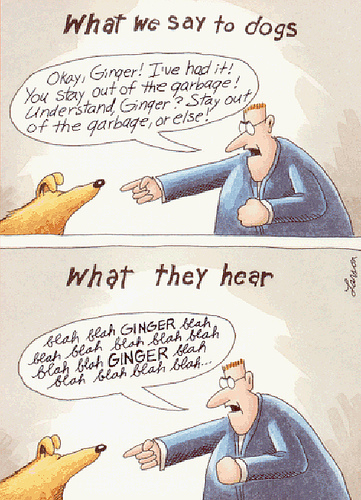
gary larson on keyword density

So, when someone comes to a piece of content, you need them to instantly understand what it’s about. Sure, a big H1 with the keyword goes a long way but if they’re scanning the text, you’ll want that keyword to show up numerous times. Don’t make them search for Ginger.

Keyword repetition helps the user make a conscious determination that the content is about that keyword. Unconsciously you’re bouncing a keyword rich visual image off the user’s retina. In a five second test environment, that type of visual osmosis might count for something.

Is it a stretch to think that keyword density might help users read content? No.

The real myth is that keyword density degrades content, when in fact it often does the opposite. Well written keyword dense text is generally easier to read.

Why Keyword Density Matters

Keyword density matters because it is an easy measure for keyword repetition and helps users access and engage in your content. It is not the biggest ranking factor (by a country mile), but keyword density is completely in your control and is one of the building blocks upon which other techniques are balanced.

Keyword density isn’t about hitting a certain percentage, it’s about ensuring that your content is highly focused and easy to read.
Google Synonyms

May 30 2009 // SEO // 7 Comments

Google continues to build a synonym database to help deliver the best results for user queries. It’s not the most well documented or talked about feature but understanding synonyms can help your SEO efforts.

Use Synonyms to Increase Subject Density

Traditional keyword density revolves around the optimization for a specific keyword. A page on sofas would use modifiers or keyword clusters like ‘leather sofas’, ‘sofa beds’, ‘upholstered sofas’, and ‘sofa cushions’ as a way to increase density on the root keyword.

Using synonyms you can also increase the subject density of the page through supporting keywords like ‘couches’, ‘furniture’ and ‘chairs’. (Yes, chairs is currently a synonym for sofas.)

You’re not looking to make these synonyms the primary focus or most keyword dense words. Use them as supporting keywords to help Google to better understand the subject matter of the page.

How To Find Google Synonyms

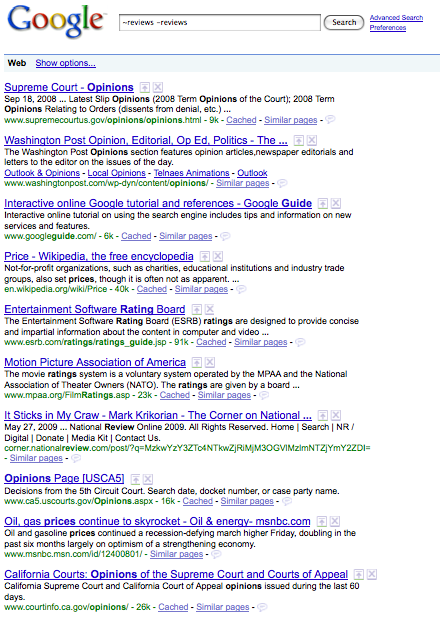
You can use the ~ operator to perform a synonym search. Coupled with a negative search for the same term and you can easily see the highlighted synonyms for that term. Here’s an example for the term ‘reviews’ (~reviews -reviews).

Google Synonyms

You’ll notice that ‘opinions’, ‘guide’, ‘rating’, and ‘prices’ are all highlighted and identified as synonyms.

There are also a few tools (here and here) that provide greater insight into synonym sets. SEO success is accomplished through doing a lot of little things right.

Synonyms are just one more way to help optimize your site and pages.

Post Click SEO

January 27 2009 // Marketing + SEO // Comments Off on Post Click SEO

post click seo

Should search engine optimization professionals be more involved in post-click marketing? Yes.

SEO shouldn’t end with the click. Getting the click is half the battle. What happens after that click is just as important. Post click marketing has taken off as more and more realize the need to optimize pages and conversion paths.

SEO should be leading the charge, not taking a back seat.

Post Click SEO

Keyword targeting adjustments are the first way in which SEO can influence post click marketing. What keywords are bringing users to the page and which of those keywords is performing best from a conversion perspective?

Decisions can be made to alter the keyword targeting of the page to optimize for the better performing keyword(s). Traffic may go down but the effective yield of that traffic may go up based on the higher conversion rate.

This process might also help identify areas for new content that better meet the needs of those arriving on poorly performing keywords.

Meta descriptions and titles are extremely valuable from a post click perspective because they can set expectations and even include a call to action. Optimizing solely for the keyword or keyword phrases in the meta description might not a) encourage clicks and b) may drive unqualified clicks.

Remember, search engine marketers are constantly testing new ad copy to increase click through rates and conversion. Search engine optimizers should do the same, using the larger canvass of meta description.

The meta description can even be used for promotional purposes. Changing the meta description on a product page to include an offer of free shipping will likely increase the click yield and, if the page matches their expectation, will continue to convert effectively.

On-site optimization in the form of keyword density, headers and even bold text can all have an impact on conversion. On-site SEO is about making the page easier to understand. While the initial audience for this optimization is a search engine, those same changes help everyday readers.

A highly descriptive header will help tell both the search engine and the reader what that page is about. H2s and H3s can help further explain the topic of that page. Again, both search engines and readers benefit.

Keyword density also increases the readability of a page. Here’s an example.

The procedure was a success and fully solved the patient’s condition.

This type of sentence might appear near the end of a descriptive paragraph. The writer probably referenced the procedure and condition beforehand and believes that the reader will fill in the blanks, turn generalizations into specifics and make the mental connections needed to gain comprehension. Search engines will do none of these things.

Instead, what if the sentence read as follows.

The stomach stapling procedure was a success and fully solved the patient’s obesity condition.

Changing generalizations to specifics and filling in the mental connections we make ensure that search engines and users immediately understand the content upon scanning the page. And people are scanning pages more than ever.

Don’t make your users do the work.

Post-click marketing and SEO

Companies that seek to maximize clicks in isolation and conversion in isolation will see results.  But those results will be less than what could have been obtained. Don’t be fooled by the false positive of this silo mentality.

Search engine optimization and post-click marketing should work in tandem to get the most out of every click.

Use Wordle as a Keyword Density Tool

September 23 2008 // SEO // 1 Comment

Keyword density is an easy way to tell search engines what your site is about. In other words, what words does the search engine find most often on your site or page or blog post. If you’re following my blind five year old principles you know how important this type of repetition is to a search engine.

There are plenty of tools you can use to figure out keyword density. However, most provide the results as a percentage which, while informative, doesn’t always help tell the whole story or provide the most impact. Instead, I suggest using Wordle.

Wordle is a toy for generating “word clouds” from text that you provide. The clouds give greater prominence to words that appear more frequently in the source text. You can tweak your clouds with different fonts, layouts, and color schemes. The images you create with Wordle are yours to use however you like. You can print them out, or save them to the Wordle gallery to share with your friends.

Copying your blog post text and creating a Wordle word cloud makes it much easier to quickly determine how a search engine might interpret your content.

Once you create your Wordle word cloud you’re looking to see which words immediately jump out at you. This is what the search engine will see. It’s as easy as that.

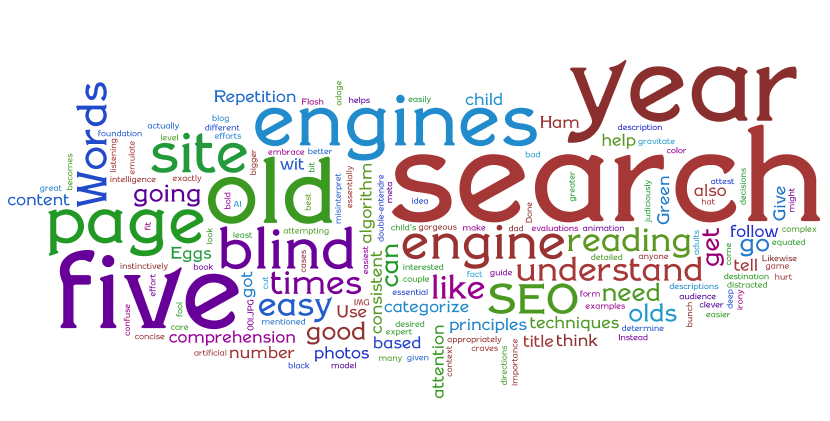
Here’s a Wordle word cloud from my first blog post.

Here are some simple guidelines for using Wordle as a keyword density tool.

If no words immediately jump out, you’ve got a problem.

If the wrong words jump out (e.g. – your post is on ‘iPhone battery life’ and the words ‘refurbished ottoman chair’ are most prominent), you’ve got a problem.

To make it even more interesting, print out your Wordle and tape it to the wall, then take three big steps back and find out what you can still read. Once again, this is a good proxy for how your post will be received by search engines.

The visual nature of Wordle makes it easy to quickly determine if you’re on the right track. It’s not rocket science. You’re not measuring whether the density is 5% or 8%, you’re simply using the quick (and fun) visual technique to make sure you’re giving your content the best chance of being seen by interested users

It might not have been created as a keyword density tool, but Wordle is a great tool for the casual blogger who wants to do some basic search engine optimization.

Search Engines Are Like Blind Five Year Olds

September 17 2008 // SEO // 28 Comments

Blind Five Year Old

I often tell people interested in search engine optimization (SEO) that the trick is to think of search engines like they’re blind five year olds. Not only does this get people’s attention (and quick) but it helps to guide and simplify many SEO decisions.

Search engines don’t care if your site is pretty. They are essentially blind and can’t rate your site based on a gorgeous color palette, stunning photos or thrilling Flash animation. I’m not saying the site shouldn’t look good, but that isn’t going to help your SEO efforts, and in some cases it will actually hurt them.

You do need to tell search engines exactly what a page is about (a couple of times) and where to go next. In short, search engines are easily distracted. Sound a bit like a five year old?

Search engines are attempting to emulate our own evaluations of a site or page. The search algorithm is a form of artificial intelligence. I’m not an AI expert, but reaching the level of a five year old for such a complex task is quite a success. So please don’t misinterpret this as a swipe at search engines.

Words are of great importance to search engines. It’s one of the easiest ways it can categorize a page. But it is not reading the page like you or I. A search engine wouldn’t score well on a reading comprehension test. Instead it’s trying to understand the page by what words are most prominent, based on the number of times a word is mentioned and the size and placement of those words.

This is, in part, how a five year old is going to categorize something they’re reading. Repetition, as any parent can attest, is essential to a child’s comprehension. Green Eggs and Ham anyone?

Green Eggs and Ham

Repetition is good for adults too. An old public speaking adage states that you need to repeat yourself at least three times since only a third of your audience is listening at any given time. In fact, most of the blind five year old principles will also help ‘real’ users better understand your site and content.

It becomes easy to come up with blind five year old examples once you embrace the idea.

A five year old will pay more attention to the title of a book and the synopsis mom or dad provides prior to reading. Done appropriately, these things provide the child an easy context. A search engine wants the same thing and craves a concise page title and seeks to compile a compelling snippet.

Search engines, like five year olds, will gravitate towards words that are bigger on the page or in bold. They’ll be equated with having greater value to the page than the smaller words. (Suspension of the blind portion of the principle is necessary here.)

Five year olds and search engines rarely understand wit or irony. That clever double-entendre you’ve used for your most recent blog post will only confuse the search engine. Use your wit, but use it judiciously and in the right places.

Give your five year old consistent easy to follow directions if you want them to get to a desired destination. Likewise, for best results, give a search engine consistent site navigation that is easy to follow.

A blind five year old will need detailed descriptions of any photos. A search engine is no different. IMG_001.JPG isn’t going to cut it.

A five year old can also, instinctively, determine if you’re ‘good’ or ‘bad’. You might fool a child with a ‘got your nose’ prank a few times, but deep down they’ve got your number. So don’t go off and try a bunch of black hat techniques in an effort to game the algorithm.

I could go on, but I think you get the point. While not all SEO techniques fit this model, blind five year old principles are the foundation of SEO and make your site and content easier to understand.