— You Are At The Archives for the friendfeed Tag —

Friend Is a Four Letter Word

June 22 2009 // Life + Rant + Social Media // 1 Comment

Technology now provides a level of connection that was unheard of just a scant twenty years ago. The cell phone, the Internet and the marriage of the two in smart phones (BlackBerry, iPhone etc.) have rapidly increased our ability to stay in touch. But who are we staying in touch with exactly? Do we have the time for all these people, and do we short-change family in the process?

Friend Is a Four Letter Word

Friend Overload

Automated report emails from work, status updates from Facebook friends you never really talk to and follower notifications that often wind up being spam consistently interrupt your weekend like a toddler tugging at the edge of your shirt.

Don’t get me wrong, there are times when getting an important email while you’re on the go can make a real difference. But most of the time it could have waited until the next day, never mind another hour.

More and more we’re getting messages from online friends: Facebook updates, Twitter followers and FriendFeed subscribers. I get a lot out of my social network, which is nearly all on FriendFeed. There are a slew of people I now count as friends through my FriendFeed experience.

Yet, should I be using my time to chat with them when I could be spending more time with my family, or visiting with friends? To be clear, I’m not saying I’m quitting FriendFeed (far from it!) I’m simply working through how to best use my time in relation to all the ‘friendships’ new technology has enabled.

Technology allows us to keep in touch with more people. But should we? Are these quality interactions? Voyeurism friendships (or those people with whom you’re connected via a social network but rarely interact with online and never speak or meet with offline) take up time, energy and emotion that might be better spent elsewhere.

The First Social Network

And it’s not just about the time devoted to these voyeurism friendships. Technology makes it possible to disrupt real friendships with these voyeuristic updates. Even worse, they might make you inattentive to your first social network: family.

The Annenberg Center for the Digital Future at the University of Southern California is reporting this week that 28 percent of Americans it interviewed last year said they have been spending less time with members of their households. That’s nearly triple the 11 percent who said that in 2006.

Each Saturday morning I take my four year old daughter to dance class. Parents stand outside and watch through a massive window. I bring my BlackBerry with me, but I am very rarely on it and try not to use it at all.

Instead I want to watch my daughter, react to her wave, thumbs up, wink or smile. I want to be present! Because all too often there’s a parent there, head down, tapping away on an iPhone or BlackBerry, oblivious to what’s going on with their child.

I wonder how many children are competing for time and attention with the tiny people living in that smart phone. I can’t believe it feels very good.

Friend Overload

How do these voyeurism friends stack up against other friends or family? I’m a firm believer in Dunbar’s number – the maximum number of healthy social relationships a person can maintain at any one time. Dunbar’s number is approximately 150. The question is, do these voyeurism friends count against this number?

I’m beginning to suspect they do.

You might not think they do, but they’re taking up social and emotional space. You are inserting a random piece of information about a person into your memory. A person who you went to high school with – not really a friend then or now – just got back from a trip to New Orleans. You can’t turn that information off. It’s been received and transmitted to your brain, mixed up with other random facts like song lyrics or television commercials from your childhood.

Whether you like it or not your brain is processing this stuff. You can begin to think about why Dunbar’s number makes sense in this context. As your brain is trying to sort, track and shelve data on more and more people it becomes far more difficult to maintain. You can’t crack the case and stick in more RAM.

Friend Turnover

At some point, you’re only storing a very small amount of data on a slew of people, which makes those relationships tenuous as best. The issue here is that you’re threatening the strength of all your relationships as you expand your reach. You might try to store more about ‘good’ friends and family, but I’m not sure we’re wired that way.

There’s a reason why you lose touch with friends. They aren’t really friends (anymore) and you don’t want to clutter your head with irrelevant data. You outgrow friends. Recent research suggests that you replace half of your friends every 7 years.

I question whether technology is inhibiting the natural shedding of friends necessary for us to move on, to establish new friends and evolve as a person.

The Future of Friends

I’m writing about this, in part, because I don’t know the answer and am struggling with the topic. I’m on FriendFeed constantly, sometimes when I could (perhaps should) be spending time with my wife and daughter.

I’ve taken steps to address this disconnect. I attended the FriendFeed open house so I could actually meet some of the people to whom I’ve been chatting – something that goes against my natural introverted nature.

And I’ve walked away from the computer – completely – to spend more time with family. We walked the Golden Gate Bridge together and explored the California Academy of Sciences.

Time and attention are in short supply in our accelerated society. Sometimes you need to remind yourself about what’s really important.

Soylent Green is Filters

May 01 2009 // Social Media // 5 Comments

If you’re familiar with the science fiction classic you know the phrase is actually Soylent Green is People. With some substitution logic the equation boils down to the following:

People = Filters

soylent green are filters

Everyone is looking for technology that will help them filter the amazing amount of data that pours in through social sites like Twitter and FriendFeed. Yet many overlook the first and best filter – people.

The people you follow on Twitter and those you subscribe to on FriendFeed remain the most powerful filter you have at your disposal.

Follow Abuse

On Twitter you’ll have a dreadful time finding anything useful if you’re following a lot of people. Even if they’re all tweeting high value material (which is unlikely) you’ll miss a lot of it. In addition, a fair portion of it will likely be repetitive.

Twitter search isn’t much help and hashtags are a useful but flawed solution. I don’t rely on Twitter to get my information so I break my own rules here.

Subscribe Abuse

On FriendFeed the people you subscribe to are even more important because of the Friend of a Friend (FoaF) feature. I see people I am not subscribed to through the Likes and Comments of my subscriptions. I believe FoaF is the most valuable feature on FriendFeed.

I let Robert Scoble, Louis Gray, Rob Diana, Mike Fruchter, Thomas Hawk, Chris Baskind, Ken Sheppardson, Mike “Glemak” Dunn, FFing Enigma (aka Tina), Cee Bee and others bring great people into my feed.

There are many people who I regularly enjoy to whom I’m not subscribed. This isn’t because I don’t appreciate them, but because I see their contributions regularly as it is. My subscriptions are not always based on my appreciation of their content (though that helps) but often their ability to find and filter content.

I don’t use subscriptions as a form of popularity.

The Hard Truth

Some people have great content, but they’re not always the best filter of content. Some people have a lot of content but not all of it might be interesting – to me at least. So I experiment. I subscribe judiciously and see what it does to my worldview.

I currently keep my subscription count close to Dunbar’s number so my interaction on FriendFeed is truly social and not asocial.

Beyond People

FriendFeed has done a very good job of providing additional ways to filter the enormous amount of data available. Their list functionality can be used to apply additional subscriptions to a particular area. So, I could have a list of SEO gurus, another of economics folks and another of bicycling enthusiasts.

The most recent upgrade also included powerful saved search functionality, giving us yet another way to digest the data and turn it into information. This is particularly important because you get the information you want, instead of all the data from someone you’ve put into a list.

I’m a prime example of this problem. I feed a good deal of SEO, marketing and advertising material. Yet, I also feed books, bicycling, economics, art, humor and the dreaded lolcats. People rarely fit into neat tidy boxes.

People First

Even with all these great new tools the first, best line of filtering is people. It’s the way we’ll survive the social media chaos.

Soylent Green is People.

FriendFeed Monetization? Focus Groups.

February 19 2009 // Marketing + Social Media // Comments Off on FriendFeed Monetization? Focus Groups.

The other day Steven Hodson wrote a post on the Inquistr that opined that Twitter could generate revenue through one big focus group. I like Hodson, who also writes the thought-provoking WinExtra, but I disagreed that Twitter was the place for focus groups.

As I wrote my response as to why, I realized that FriendFeed was the ideal environment for focus groups. I could even envision a new green FriendFeed icon to denote a sponsored conversation.

FriendFeed Focus Group

FriendFeed Focus Groups

Focus groups are conversational, which is exactly where FriendFeed excels. A typical focus group will have a moderator who will pose questions and follow-up to gain additional insight into the participant’s response.

For example, a focus group moderator might ask you to tell them what animal best represents a specific car. The moderator will likely be able to understand the categorization but might want to follow-up to ensure they understand why you chose to associate, say, a Hummer with a Hippopotamus.

These focus groups are already taking place – naturally – on FriendFeed. Conversations about different cameras and different phones. Discussions about music, books and movies. Debates between Mac and Windows enthusiasts. FriendFeed fosters this type of robust interaction where details and nuances are often revealed.

What about demographics?

The part that’s missing are the demographics. It’s missing from Twitter too. Facebook seems to be banking on the demographic targeting capability. Many companies do want to ensure they have the right sample and a good cross-section of users. Perhaps FriendFeed could present a small lightbox form to users prior to commenting on a sponsored conversation?

What about psychographics?

Then again, many companies put more stock into psychographics. Who exactly are these people? What do they like? Do they travel? Where do they go out to dinner? What do they read? What are their interests? This is where FriendFeed – again – provides added value.

Moderators would have access to the feeds or lifestreams of participants. The amount of data for each participant would clearly vary depending on the number and variety of services each fed into FriendFeed. Some might be limited but others would provide bonanza of data.

Imagine Netflix, GoodReads, YouTube, Google Shared Stuff, Amazon, Last.fm, LinkedIn, Delicious and even BrightKite. Talk about building a profile on potential customers! And could FriendFeed provide an abstract of each participant? A digest profile for each participant on a sponsored conversation?

Would it be interesting for marketers to see not only what each participant fed, but what they liked as well? Or a keyword (or other) analysis on their comments? The degree of interaction, variety of content and abundance of text make FriendFeed an interesting and dynamic data hub.

The right kind of engagement

Twitter simply does not support real conversations. It was built as a status update service (and it performs that service well.) Facebook often creates conversations but those conversations are both asynchronous (wall post time lag) and seem to be less topical and more personal in nature.

FriendFeed, by comparison, is built for conversation around topical content. It fosters the exact type of engagement savvy marketers crave.

What do you think. Will we see green FriendFeed icons and sponsored conversations?

FriendFeed Improvements Begin With You

January 09 2009 // Social Media // Comments Off on FriendFeed Improvements Begin With You

Recently there has been a slew of well intentioned people offering their opinions on how to improve FriendFeed. From Robert Scoble to Louis Gray to Joshua Porter, they’ve all had interesting ideas which led to a massive FriendFeed meta discussion. Finally, FriendFeed founder Paul Buchheit, in his nice way, came out and told everyone to just chill out.
FriendFeed Time Machine

What Paul and the FriendFeed crew really need to do is invent a time machine so the impatient early adopter crowd can skip the slow but natural adoption curve of a product.

I’m not saying FriendFeed is perfect. There are a lot of good suggestions out there and I could offer my own but will save that for another day.

It’s the speed in which people are willing to claim failure which is troubling. And the mindset of many seems to be that FriendFeed is broken. That it doesn’t work like Twitter. That it’s too complicated. That it doesn’t work like Google Reader. That there’s too much information. That it sucks traffic away from blogs. That the new user experience is broken and scaring people off. The the signal to noise ratio is out of whack. That it needs Track to survive. On and on and on.

It may take some time for people to ‘get’ FriendFeed. Even those using it will endlessly debate exactly what it is and why they find it useful. And to be honest I’m doing the same thing right now. So instead of lamenting about what it isn’t I’m going to talk about what FriendFeed does right and what it means to me (YMMV).

FriendFeed connects me to people right away

Unlike other services, I can subscribe or connect to a group of people immediately upon signing up. My friends don’t have to be FriendFeed users. (Most still aren’t.)  And as soon as I subscribe to a few of these recommended people I get to see activity and lots of it. Instant gratification!

The arguments around who is being recommended (e.g. – ‘A-List’ individuals) seem to have died down. ‘A-List’ users help in a few ways. It shows that the service is being used by influential people and some of their feeds provide great activity that instantly showcase the value of FriendFeed.

Could the recommended list be better? Maybe. But it terms of showcasing what FriendFeed delivers, I think it does that extremely well.

Friend of a Friend helps me find new people

This is perhaps the best feature on FriendFeed because you get to see things you might not have otherwise. It’s a passive way of delivering exploratory information to users. It’s using your friends as the filter! And isn’t this the next thing? Getting down to networks we trust? Why let an algorithm try to determine what is relevant when you can use humans instead?

Removing the Friend of a Friend feature would cause FriendFeed to wither and die as more users simply sealed themselves into their own tiny echo chambers. While the intent of these folks may be to reduce the ‘noise’ they wind up drowning themselves out. (Think of it as getting the microphone too close to the speaker, causing the high-pitched feedback screech that makes your ears bleed.)

In the end, entropy will take over. With nothing new entering that universe, you’ll find less and less value.

Hide reduces ‘noise’

Use the hide feature. It’s your friend. Maybe your best friend. You might argue that the act of hiding shows that there is too much noise. To some extent that is true but lets think about this in a different way. Do you like every episode of a certain TV show? Do you like every book an author puts out? Do you agree with everything your favorite blogger posts? Heck, do you even like everything that your spouse or significant other likes?

Not only are we different but we’re multi-faceted. That’s not a bad thing! The hide feature stops you from throwing out the baby with the bath water. Hide can be used surgically to remove a specific service, without likes or comments, from an individual person. Or you can hide a whole service if you find it is never contributing any value.

Blocking defeats spammers

I don’t block people who actually contribute to discussions even if I don’t agree with their views. However, those who are abusive or fully interrupt the value of my stream will be blocked. The real benefit of blocking on FriendFeed is that it is viral. The community is quick to identify spammers and in short order, minutes sometimes, spammers are rendered invisible or removed.

This is not the case on other networks and has become an increasing problem on Twitter.

Duplicate detection was a huge improvement

When we talk about noise, one of my biggest complaints had been the fact that the same story could show up multiple times in your feed at the same time. That was noise. Sure enough, FriendFeed was able to solve this issue.

There’s a subtle difference here. Duplicative information provides little to no extra value. (All it tells me is that the item is popular.) In my opinion, that is the definition of noise in this context.

Information deemed less relevant or random in nature is not noise but instead simply a different vector of data – a piece of the puzzle that may or may not add value.

Random does not mean irrelevant

Lets stay with the puzzle theme for a second because it speaks to the new ways in which I think people will understand their world. FriendFeed provides a very rich stream of information from people you value. (I should add here that FriendFeed is not the place to friend blindly. Be selective.)

Thinking that you can put all the pieces of the puzzle together all at once isn’t going to happen. You’re going to get the edges done first and then you might work on a particular area that has a distinctive color. Then you’ll work out from there. It is not a linear process.

So, you may pick up a piece and find that it doesn’t fit anywhere. That doesn’t mean it doesn’t belong in the puzzle, it simply means it’s not yet ready to fit. So what you perceive as noise simply might be a piece that doesn’t yet fit in your puzzle. But if you throw it away, you might never complete the puzzle.

The random nature of your feed (often perceived as noise) may actually be something to preserve. Jonathan Mendez has a great post regarding the optimization of randomness. There are a few parts from his post that I believe can be leveraged into the discussion of noise versus signal.

The sense of discovery fulfills a basic human need. We achieve further fulfillment from enlightening others to our discoveries. … Randomness helps us discover. It can create interest. It can lead to intent.

He uses music as one of his examples though he misses what I feel is the most obvious one – the shuffle feature on iPods.

How many times do you achieve an epiphany about something you’re working on by doing something else or talking to someone outside of your industry?

FriendFeed is a massive information hub

FriendFeed is the 90s science-fiction version of the data flow that Gibson and Stephenson among others talked about.

It will take time for people to figure out exactly how they can plug in to this new resource. But I believe more and more will change their behavior to best take advantage of this font of information. Lets remember, there were plenty of people who thought it was overwhelming to be reachable all the time (aka – cell phones.)

But our attitudes changed and we adapted our behavior.

Comments provide insight

FriendFeed is a great place for discussions. The comments are often where you’ll find some of the best thinking and writing. FriendFeed is a massive information hub because it is annotated by others to provide greater context and analysis. Comments allow the crowd sourcing of knowledge that transform mere data into information.

Informational osmosis is a reality

In college I made sure that I attended my classes because I found that even if I sat there barely awake, the information being discussed all sunk in on some level. Weeks later cramming for a test I could access some of this information that had seeped into my brain … simply by being there and letting the words wash over me.

Embrace the ‘noise’ and let your brain find the patterns. Give FriendFeed time and see what finally emerges.

Perhaps the biggest improvement to FriendFeed is … us.

Proof Twitter Is Not Mainstream

December 30 2008 // Social Media // 1 Comment

Has Twitter gone mainstream? Sure it’s gaining in popularity, but mainstream? I think not. Mainstream is defined as follows:

The prevailing current of thought, influence, or activity. The people or things representing the most common or generally accepted ideas and styles in a society, art form, etc.

At most you could quantify Twitter as mainstream for a subgroup of Internet users. But why quibble when I have real data. Here are the results of a Vizu Answers poll I conducted on December 29, 2008 across 286 websites.

Do You Use Twitter Poll

The results show that 1 in 5 use Twitter while a full half of respondents didn’t even recognize Twitter.

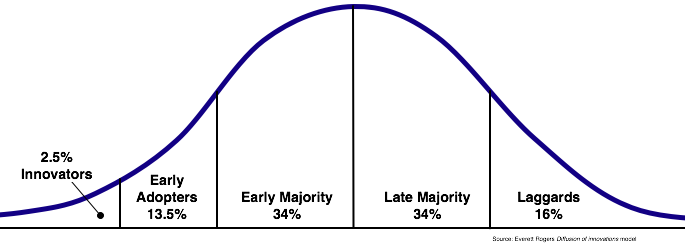
Twitter is not mainstream. So, what is it? I think it makes sense to measure Twitter using the Everett Rogers Diffusion of Innovation.

Rogers proposes that adopters of any new innovation or idea can be categorized as innovators (2.5%), early adopters (13.5%), early majority (34%), late majority (34%) and laggards (16%), based on the mathematically-based Bell curve.

Rogers Diffusion of Innovation

Using this measurement and the poll data (20%) we see that Twitter is entering the Early Majority, which is likely why the buzz quotient for Twitter has increased of late. Twitter will need to make its way through the Early Majority to the Late Majority before it truly becomes mainstream.

Of course you could argue the merits of the data. But this was an Internet poll which means it likely under reports Laggards. You might also point to the figures recently released in Hubspot’s State of the Twittersphere.

The growth is impressive. But I’d point out that Twitter users often maintain more than one account. Here’s an unscientific FriendFeed poll that, at the time of writing, indicates that Twitter users maintain an average of 1.5 accounts.

So lets wait to annoint Twitter as mainstream and instead see how it evolves and innovates in 2009.

2009 Internet and Technology Predictions

December 23 2008 // Advertising + Marketing + SEM + SEO + Social Media + Technology // 9 Comments

Now is the time when bloggers go on the record with their thoughts for the year ahead. Place your bets! Stake your claim! Here’s mine.

Crystal Ball 2009 Predictions for Internet and Technology

Facebook Becomes A Portal

Realizing that social media and advertising is like oil and water, Facebook repositions itself as a portal leveraging Microsoft’s Live Search as the revenue model. This also might result in the potential acquisition of Netvibes to provide a more robust offering to compete with Yahoo!

Identity Systems Fail

Confused about the difference between OpenID, Facebook Connect and Google Friend Connect, users throw up their hands and decide not to use any of the above.

Video Advertising Succeeds

The adoption of video is surging faster than many expected. Longer formats and better quality will bring even more eyeballs who will grudgingly accept advertising.

Microformats Go Mainstream

Why they aren’t already is shocking. Nevertheless, in 2009 we’ll see microformats become a standard and search results will become far more robust as a result.

Banner CTR Becomes Obsolete

Brands will finally realize that measuring success by click through rate (CTR) isn’t working. Measurement ‘beyond clicks’ will be the new yardstick, whether that’s through new brand advertising measurement services like Vizu or through monitoring services like Brandwatch and Trackur among a gaggle of others.

RSS Adoption Spikes

Someone will (finally) figure out how to market RSS to ‘the masses’ who will grasp the sublime benefits of having content come to you instead of the other way around.

Kindle 2.0 Flops

Amid a weak economy Amazon releases the newest version of Kindle. Other readers have gained ground where Kindle has not and at the core Kindle is a solution without a problem.

Google Search Share Stalls

The move by Facebook (see above) causes a radical change in the search landscape. Microsoft passes Yahoo! for second place and talks about a Microsoft Yahoo merger are (unbearably) reignited.

FriendFeed Surpasses Twitter

FriendFeed adoption increases at an accelerated pace due to quick innovation, uncluttered design and an interface that lends itself to communication.

Someone ‘Dies’

Users reach social media overload and VCs get even more nervous about revenue creating social media shrinkage. In this instance ‘Dying’ means a company goes under or is purchased for a song. My short list includes Plurk, Twitter, Digg and Seesmic. This isn’t a reflection of the people or product but the inability to truly reach the mainstream with a service that has a profit model.

There are plenty of other things that I believe will happen in 2009, but they seem more obvious or an extension of current trends. Instead I tried to be a bit more bold, at least on a few of my predictions.

We’ll check in this time next year to see how I fared. In the meantime, feel free to comment and provide your feedback and reaction to my predictions.

Are Banner Ads Dying?

November 12 2008 // Advertising + Marketing + Technology // 1 Comment

Are banner ads dying?

I remember people shouting about this during the Web 1.0 hey day and there have been plenty of folks who have since cried wolf on the topic. Each time banner ads come back from the proverbial dead, walking the Internet with zombie like efficiency. Is this time any different?

Maybe.

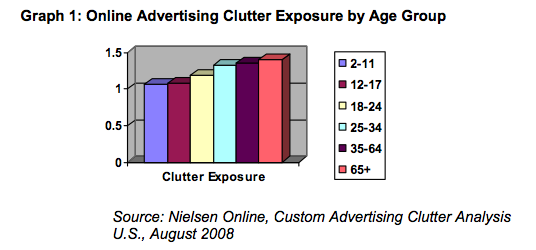
More and more research indicates that young users are not responding to banner advertising. But can we blame them? We’re entering an era in which a whole generation has grown up with the Internet. At an increasingly young age children begin to surf the Internet. Yet, the sites they visit often have far less clutter and advertising than the traditional site.

Are we creating a generation of banner intolerant Internet users?

Those of us, myself included, who came to the Internet as young adults have been exposed to a higher degree of ad clutter from the start. We’re used to it. Not only that, our context for approaching the Internet was shaped through television. Television conditioned us to expect advertising to be part of the equation.

Yet, again, this is not the case for a new generation that has grown up with TiVo and other DVR products. These services have undermined normal TV watching patterns and preconceptions. Every day more of us are conditioned to simply hit the 30 second skip button when presented with a commercial. (As an aside, thank you to Fringe for telling me how many seconds the break is going to be. That’s very handy!)

These habits are particularly important since new research indicates that the heaviest TV viewers are also the heaviest Internet users.

Are social networks part of the problem?

Yes.

Social networking is one of (if not the) largest activity for the young. Sites like Piczo, MySpace and Facebook, among others, are like the middle school and high school of the Internet. These sites are, at their core, utilitarian in nature. They’re about communicating. They’re about making ‘friends’.

Some of them do use banner ads, but more and more evidence shows a growing banner blindness on these sites. I suspect the high number of visits (for a very specific purpose) exacerbates banner blindness on social networks.

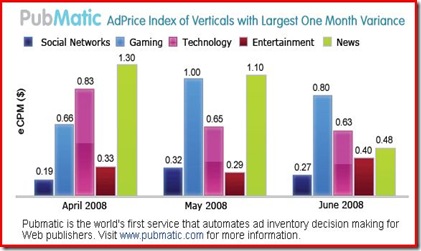
If you use CPM rates as a proxy for effectiveness then it becomes obvious that social networks are in distress.

Can we blame Twitter?

Yes.

Twitter and even my current addiction, FriendFeed, contribute to the problem by not using banner ads. They are but one more site, one more application, one more widget that is providing a valued service for … nothing. Clearly advertising isn’t the only way to monetize these sites, but by not implementing any monetization strategy they send a signal to users that they can get something for nothing.

The ‘something for nothing’ mentality makes us less tolerant of advertising. I can surf the Internet with Firefox, supercharge my blog with WordPress plugins and use Google Analytics to track metrics for a slew of client sites all … for not one penny.

This isn’t a long term problem. A type of Internet Darwinism will take place where those without a true business (aka revenue) model will either fail or try to implement some sort of real revenue strategy. In most instances, that will be advertising or subscriptions.

Will it be advertising or subscriptions?

Just before the collapse of Web 1.0, I worked at Bluelight.com, the online version of Kmart. One of their major initiatives was an ad supported free ISP. We had millions of users! The thing is, it didn’t really work. They wound up converting it to a subscription based service which was ultimately acquired by United Online

Today, we’re conditioning a generation to ignore banner and display advertising. The cat is out of the bag. The genie is out of the bottle. So even if we want to return to it as a revenue stream it is becoming an ever weaker medium. And we only have ourselves to blame.

So perhaps subscription based sites, or networks are the wave of the future. Would you pay for Twitter?

Will banner ads die?

Of course not. Banners will never completely die, but a few things will have to happen for them to rise again to feast on the glorious eyeballs of Internet users.

They’ll need to be more engaging and use rich media in more appropriate ways. More importantly, the industry will need to measure banner ads not by CTR or traditional click-based ROI but by brand measurement metrics. There are a few companies who provide this service, though my favorite is Vizu Ad Catalyst. (Disclosure: I worked at Vizu for a short time but stand by the fact they are leaders in this new field.)

The current economic climate has forced many analysts to adjust their online advertising industry forecasts, some of them twice. Yet, I’m unsure any of them are accounting for this new generation of Internet users who are blind to banners at best and intolerant of them at worst.