— You Are At The Archives for the facebook Tag —

Facebook Questions Forces The Question

August 03 2010 // SEO + Social Media // Comments Off on Facebook Questions Forces The Question

Facebook Questions

Facebook recently launched their new Q&A product, aptly named Facebook Questions.

The Q&A space is white hot right now, in large part because of the SEO potential of the content. Q&A, if done correctly, creates highly focused long tail content that gets gobbled up by search engines. Look no further than Demand Media’s eHow as an example.

But is that what Facebook has in mind for Questions?

Facebook Questions Not Crawlable

Search Engine Land reported that Facebook Questions could not be crawled by search engines, and that Facebook has no plans to change that policy. The news was surprising, resurfacing the notion of the walled garden and sending mixed signals on Facebook’s strategy.

Facebook Search Powers Questions

In the first few days after launch Facebook search would force users into Questions whenever a search started with the five Ws or one H. Facebook search results would shift to Questions after you entered one of those interrogative words and then hit the space bar. This search feature is no longer active. (Sadly, I did not capture this behavior.)

Perhaps it was a simple test or Facebook pushed enough traffic through the product to receive the necessary amount of feedback. Either way, it showed the power of Facebook search (both in flexibility and volume) and pointed to a reason for not allowing search engines to crawl and index Questions. Does Facebook need traffic from outside the walled garden?

Questions and the Open Graph

Where things get confusing is why Facebook is pursuing Questions and the Open Graph in parallel. There are plenty of other Q&A sites out there. Many of them are using the Open Graph protocol.

Questions from other sites could easily show up in Facebook search results. So, why build a whole new product if you could just suck in content from everyone else? Conversely, if you were going to spend the resources to build that product and create all that content, wouldn’t you expose it to search engines so you could attract more users to Facebook? (Yes, that’s still possible.)

Of course, Facebook might want just one more product that will keep people on Facebook. And the longer users are on the site, the more often they’re clicking on ads and performing searches.

Articles are Second Class Open Graph Objects

Questions would be classified as an ‘article’ type in the Open Graph. Yet, articles seem like second class citizens in the Open Graph. Reports indicate that an object is not created for a page with og:type=article. This also means you can’t administrate likes on article content. In other words, you can’t publish to people who have liked an ‘article’ on your site or blog.

So, maybe Facebook is trying to create its own content instead of indexing what’s already out there? Again, this seems contrary to the Open Graph concept. Yet, if you believe status updates are a form of content publishing, then perhaps Facebook believes they can be the ultimate content creator.

Facebook Questions SEO

Of course, sites are getting around the article prohibition. Answers.com is now populating the Open Graph with their content using the ‘website’ type.

Answers Using Website Open Graph Type

While Facebook frowns on this, it’s the way smart search marketers are going to work the system.

Creator or Aggregator

The Open Graph would indicate that Facebook wants to be an aggregator, to suck more and more of the Internet into the walled garden, allowing their users to find Internet content on Facebook’s terms – through the news feed and through Facebook search.

Questions would indicate that Facebook wants to be a creator, generating content as a way of keeping, attracting and engaging users. Though making them invisible to search engines takes attracting users out of the equation.

Which does Facebook want to be? Who knows, maybe both. But my money is on aggregator given the purchase of FriendFeed, promotion of Bret Taylor to CTO, advancements in type ahead search and roll out of the Open Graph.

Facebook 2010 = Google 2003

July 03 2010 // PPC + SEO // 1 Comment

This isn’t a post about predicting the future of Facebook or taking sides in the Google v. Facebook debate. Instead, this is a warning.

Changed Traffic Conditions Ahead

Google 2003

AdWords was launched in October of 2000. In February of 2002 Google switched AdWords to a cost-per-click model. Later that same year the first Google Dance was held. By 2003, smart marketers were figuring out how to get the most out of AdWords.

Search volume continued to climb and the Google algorithm became more complex. Search engine optimization became more important and the landscape was changing … fast.

Facebook 2010

Facebook Ads launched in November of 2007. Today (figuratively, not literally) the platform seems to have hit critical mass. Thus far, most marketers have focused on engagement at the urging of the many social media experts/gurus/rock stars. “It’s about conversations” they shout.

But others are finding out how to make Facebook ads really work. Dennis Yu recently shared one of his Facebook ad secrets as well as how he’s using Facebook ads to increase Facebook fans.

In addition, Facebook has created more complexity and opportunity through the introduction of the Open Graph. Suddenly, Facebook search results can be seriously manipulated optimized. Like farms could spring up and savvy operators like Marty Weintraub will crack Facebook SEO.

Different But The Same

Google and Facebook are different, but figuring out PPC and SEO opportunities is the same. Compare the time lines above and you’ll see an eerie similarity. What I left out was that both Google and Facebook launched an advertising initiative approximately three years after launch. Am I the only one who sees the pattern?

Right now, I believe Facebook is at the same tipping point Google was in 2003. There is a tremendous opportunity for growth through experience. Jump in and start figuring it out. This is the fun part!

Those who aren’t afraid to fail are going to be the ones reaping the rewards.

Facebook Data: Gold or Pyrite?

July 06 2009 // Marketing + Social Media + Technology // 5 Comments

The personal data Facebook has could be worth millions or wind up being as valuable as a stack of Monopoly money.

Facebook Monopoly Money

Social Media Data Mining

I got to thinking about this because of a FriendFeed comment Dan Morrill made on an Altitude Branding post titled New Books, New Covers.

Not sure if I really want to shift it, if marketing folks know I am getting tired of microsoft based systems and planning on going all apple, what kind of marketing fight would happen over that one? I want them to look at me one dimensionally cause I can blow them off easier.

A few weeks later I had a conversation with Ana Yang at the FriendFeed open house. Ana’s not on Facebook. Why? She doesn’t think it really represents who people are but who they want to be.

The implications of both these statements buzzed around in my head and connected with other thoughts I’d had on social media data mining.

People Lie

People Lie

Dr. Gregory House is fond of this saying. He’s right too. People do lie, and for a variety of reasons.

Among other reasons, they lie to avoid things, they lie to fit in and they lie to avoid embarrassment.

I’d argue that people are more likely to lie in social situations and that the relative distance created by the Internet also increases people’s proclivity to lie.

So, forget about the privacy issues surrounding data collection. The real threat to Facebook’s plans lay in incomplete or downright inaccurate personal information.

Lies of Omission

The problem isn’t the actual issue of privacy, but the reaction to privacy. The heightened awareness that your personal information might be available to the highest bidder leads many to change their behavior. Some, like Dan, may lie to avoid marketing. Others may go back and remove certain information.

At a minimum, many simply reduce the amount of personal information they share moving forward. This sharing reticence creates a skewed look at people overtime. The personal data becomes a snapshot of who they were, and not who they are.

There are also topics that you might not want to discuss in a public forum. You’re probably not going to fan an incontinence product. You might not divulge the nitty-gritty details of your divorce. Most aren’t going to discuss their pornography habits.

Social Lies

One of the core issues here is the idea that self-reported social data is accurate. This isn’t a magazine subscription or a warranty card submission – things that have roots in a commerce transaction. Commerce serves as a safeguard against pervasive lying. You can’t receive that magazine if your address isn’t correct.

Social data is untethered from commerce and therefore doesn’t have a natural safeguard. The transaction taking place is psychological and emotional instead.

The act of social lying is pervasive. How many share real information when asked ‘how are you?’ Not to mention the powerful force of peer pressure and the innate desire to be liked.

We acquiesce. We embellish. We edit. We redact. Not only that, but we change our behavior based on the environment and setting.

Social Schizophrenia

At work you might say one thing, but sitting out in the backyard with a beer you might say something different. Your status update on Facebook might be different from the one you have on LinkedIn.

Soon after the FriendFeed open house there was a rather public integration of social personalities. This might not be a frequent occurrence but it’s enough to be unnerving. There is no householding of these different personalities under one address, whether it be an extreme case or simply the different facets of your social existence.

Even if you could accurately aggregate social data across various networks and email addresses, would you be able to extract reliable meaning from that data?

Social Trust

Why would companies pay for social data they can’t trust? Most companies already have multiple sources of personal data. Consumer databases with multiple reporting lines are frequent. Many also build their own through rewards programs.

Yet, marketers are always hungry for more. That’s where profiling and detailed segmentation services provided by companies like Nielsen Claritas come into play. You might think that Facebook could give them a run for their money, but it comes down to the self-reporting bias once again.

It’s not what you say you do, it’s what you actually do that matters. Facebook data is interesting but it’s not a hotel on Park Place. It’s more likely a house on Baltic Avenue.

Friend Is a Four Letter Word

June 22 2009 // Life + Rant + Social Media // 1 Comment

Technology now provides a level of connection that was unheard of just a scant twenty years ago. The cell phone, the Internet and the marriage of the two in smart phones (BlackBerry, iPhone etc.) have rapidly increased our ability to stay in touch. But who are we staying in touch with exactly? Do we have the time for all these people, and do we short-change family in the process?

Friend Is a Four Letter Word

Friend Overload

Automated report emails from work, status updates from Facebook friends you never really talk to and follower notifications that often wind up being spam consistently interrupt your weekend like a toddler tugging at the edge of your shirt.

Don’t get me wrong, there are times when getting an important email while you’re on the go can make a real difference. But most of the time it could have waited until the next day, never mind another hour.

More and more we’re getting messages from online friends: Facebook updates, Twitter followers and FriendFeed subscribers. I get a lot out of my social network, which is nearly all on FriendFeed. There are a slew of people I now count as friends through my FriendFeed experience.

Yet, should I be using my time to chat with them when I could be spending more time with my family, or visiting with friends? To be clear, I’m not saying I’m quitting FriendFeed (far from it!) I’m simply working through how to best use my time in relation to all the ‘friendships’ new technology has enabled.

Technology allows us to keep in touch with more people. But should we? Are these quality interactions? Voyeurism friendships (or those people with whom you’re connected via a social network but rarely interact with online and never speak or meet with offline) take up time, energy and emotion that might be better spent elsewhere.

The First Social Network

And it’s not just about the time devoted to these voyeurism friendships. Technology makes it possible to disrupt real friendships with these voyeuristic updates. Even worse, they might make you inattentive to your first social network: family.

The Annenberg Center for the Digital Future at the University of Southern California is reporting this week that 28 percent of Americans it interviewed last year said they have been spending less time with members of their households. That’s nearly triple the 11 percent who said that in 2006.

Each Saturday morning I take my four year old daughter to dance class. Parents stand outside and watch through a massive window. I bring my BlackBerry with me, but I am very rarely on it and try not to use it at all.

Instead I want to watch my daughter, react to her wave, thumbs up, wink or smile. I want to be present! Because all too often there’s a parent there, head down, tapping away on an iPhone or BlackBerry, oblivious to what’s going on with their child.

I wonder how many children are competing for time and attention with the tiny people living in that smart phone. I can’t believe it feels very good.

Friend Overload

How do these voyeurism friends stack up against other friends or family? I’m a firm believer in Dunbar’s number – the maximum number of healthy social relationships a person can maintain at any one time. Dunbar’s number is approximately 150. The question is, do these voyeurism friends count against this number?

I’m beginning to suspect they do.

You might not think they do, but they’re taking up social and emotional space. You are inserting a random piece of information about a person into your memory. A person who you went to high school with – not really a friend then or now – just got back from a trip to New Orleans. You can’t turn that information off. It’s been received and transmitted to your brain, mixed up with other random facts like song lyrics or television commercials from your childhood.

Whether you like it or not your brain is processing this stuff. You can begin to think about why Dunbar’s number makes sense in this context. As your brain is trying to sort, track and shelve data on more and more people it becomes far more difficult to maintain. You can’t crack the case and stick in more RAM.

Friend Turnover

At some point, you’re only storing a very small amount of data on a slew of people, which makes those relationships tenuous as best. The issue here is that you’re threatening the strength of all your relationships as you expand your reach. You might try to store more about ‘good’ friends and family, but I’m not sure we’re wired that way.

There’s a reason why you lose touch with friends. They aren’t really friends (anymore) and you don’t want to clutter your head with irrelevant data. You outgrow friends. Recent research suggests that you replace half of your friends every 7 years.

I question whether technology is inhibiting the natural shedding of friends necessary for us to move on, to establish new friends and evolve as a person.

The Future of Friends

I’m writing about this, in part, because I don’t know the answer and am struggling with the topic. I’m on FriendFeed constantly, sometimes when I could (perhaps should) be spending time with my wife and daughter.

I’ve taken steps to address this disconnect. I attended the FriendFeed open house so I could actually meet some of the people to whom I’ve been chatting – something that goes against my natural introverted nature.

And I’ve walked away from the computer – completely – to spend more time with family. We walked the Golden Gate Bridge together and explored the California Academy of Sciences.

Time and attention are in short supply in our accelerated society. Sometimes you need to remind yourself about what’s really important.

Social Marketers Need to Build an Ice Cream Truck

March 25 2009 // Advertising + Social Media // 1 Comment

Build an Ice Cream Truck

Ice Cream Truck

That’s my advice to social marketers. Confused? Well, first let me describe my view of social media.

Social media and conversations are not a natural place to advertise. When I’m sitting down with a few friends for a beer and some idle banter I’m not looking for someone to come up and sell me on something. In fact, it’s one of the quickest ways I can think of to irritate the hell out of me.

But that’s just what many seem to think is appropriate for the online version of that same conversation.

Even if I’m talking about a product or service, say we’re debating cell phone carriers and lamenting our most recent phone bills. That is not the time to pull a chair up at my table and ask “Did you know, AT&T has more bars in more places!?”

If you begin to think of social media as the front stoop or the local corner where people hang out and shoot the breeze you can understand the difficulty of effectively reaching and interacting with them. The context of their conversation is miles away from a purchase decision.

Ice Cream Man LOLCat

Instead, think about things that can motivate people to break from that context. Something that will cause them to stop their conversations and instead motivate them to take action.

Build an Ice Cream Truck.

The Ice Cream Truck has a product and they have a delivery mechanism that stops conversations and inspires purchase. You hear that distinctive song warbling down the block and you’re taking orders from family members and making sure you’ve got your wallet!

Here’s what people don’t want. They don’t want inventory updates from the Ice Cream Truck. They don’t particularly care that the Ice Cream Truck got a brand new paint job. They don’t need to understand Ice Cream Truck mechanics and supply chain management strategy.

They don’t want to have a conversation with the Ice Cream Truck.

They want their Choco Taco!

Don’t get me wrong, brands and products should still have a voice in social media and that voice should be “open, natural and uncontrived.” Hopefully this leads to positive word-of-mouth, a viral transmission of product attributes and creates brand evangelists.

Conversations with products and brands are not social conversations.

The context of a social conversation and a brand conversation are completely different. And trying to mix the two together is a good way to torpedo your social marketing efforts. Brands really don’t want you to be their friend, they want you to buy their product! Deep down I suspect most people understand this motivation.

Conversations have their place but developing the Ice Cream Truck – whatever that might be – is where marketers should be investing more of their time.

Could Inconsistent Design Save Social Advertising?

March 23 2009 // Advertising + Marketing + Social Media // Comments Off on Could Inconsistent Design Save Social Advertising?

Social media sites like Digg, MySpace, Facebook and others are finding it difficult (to say the least) to get by using an advertising based revenue model. A drum beat of research shows that users don’t like the ads on these venues or simply don’t see them. The poor performance of these social ads translates into dreary CPM ad rates.

Social Advertising

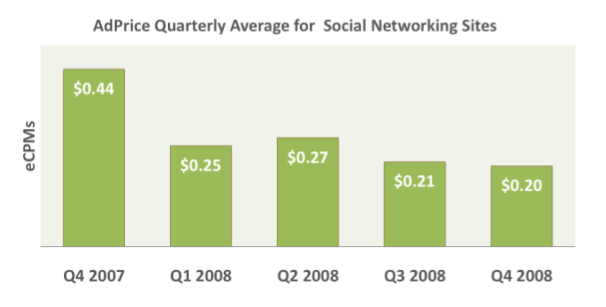
The Q4 2008 Pubmatic AdPrice Index (pdf) puts Social Networking sites at the bottom of all other verticals and the trend for Social Networking sites continues to slide.

social networking CPM q4 pubmatic adprice index

Many of these social sites have incredible engagement metrics. Users are there every day, multiple times a day and stay there for – sometimes – hours on end. You might think this would be a huge boon for potential advertisers. Yet, the exact opposite seems to be the case.

The Participatory Marketing Network (PMN) conducted a Generation Y study that detailed why “advertising remains a tough sell in these environments.”

84 percent noticed ads on social networks, 74 percent say they click infrequently/never (36 percent saying they don’t click on ads at all).

Then there’s a recent Nielsen study (pdf) of social networking users which showed that ‘false’ was the term most closely associated with ‘advertising’. Yeah … that’s not a good sign.

The high engagement on these sites means users become intimately aware of the structure of the site. They understand exactly where to look, how to navigate and what links to click.

The impetus for their visit compounds the problem. It is usually, and not surprisingly, social. Firing back responses to comments on your high school yearbook photo just isn’t the best advertising opportunity.

So while users may ‘notice’ ads I’m not sure they’re really ‘seeing’ them. They know where they are but they’re avoiding the advertising and they’re getting better and better at doing it.

Rearrange The Furniture

rearrange social media furniture

What if you made the navigation or design different. Not a major redesign but an ongoing number of smaller, incremental changes that break a user’s rote click pattern. Keep them on their toes!

Think of it as rearranging the furniture in a room. You’d still be able to find the couch, the coffee table, the chair and the TV, but it would all be just a little different. They’re in slightly different places or they’ve been reupholstered.

Wouldn’t that make you take stock of the entire room again? To get your bearings you’d see things you might have missed before. That picture on the wall that you hadn’t really looked at in ages?

Inconsistent Design

I’m not recommending something like this for just any site, but it makes sense for social sites where users become habituated to the design through repeated use. In these instances rearranging the furniture every month might help them see the paintings (aka banners) on the wall.

Is Facebook is seeing an increase in CTR since their much maligned redesign? Sure, 94% of users might be giving it a thumbs down but they’re looking at it with ‘new’ eyes. (Contact me if you had a campaign running during the redesign.)

A substantial redesign, nevermind the ruckus, wouldn’t scale well. Instead I’m thinking of smaller changes. It could be as big as moving columns or the order of top navigation or as small as a color change or resizing the logo.

The idea sounds radical even as I suggest it, but traditional techniques are not working. We take regular navigation off of lead generation and cart pages. Sure, that has more to do with keeping the user focused on a task, but it’s still a break in the natural design of the site.

Advertisers, by in large, still don’t understand how to market on social sites. I’m not sure any of us really know what’s going to work or not. So why not test inconsistent design, even if it’s a transitional measure?

FriendFeed Monetization? Focus Groups.

February 19 2009 // Marketing + Social Media // Comments Off on FriendFeed Monetization? Focus Groups.

The other day Steven Hodson wrote a post on the Inquistr that opined that Twitter could generate revenue through one big focus group. I like Hodson, who also writes the thought-provoking WinExtra, but I disagreed that Twitter was the place for focus groups.

As I wrote my response as to why, I realized that FriendFeed was the ideal environment for focus groups. I could even envision a new green FriendFeed icon to denote a sponsored conversation.

FriendFeed Focus Group

FriendFeed Focus Groups

Focus groups are conversational, which is exactly where FriendFeed excels. A typical focus group will have a moderator who will pose questions and follow-up to gain additional insight into the participant’s response.

For example, a focus group moderator might ask you to tell them what animal best represents a specific car. The moderator will likely be able to understand the categorization but might want to follow-up to ensure they understand why you chose to associate, say, a Hummer with a Hippopotamus.

These focus groups are already taking place – naturally – on FriendFeed. Conversations about different cameras and different phones. Discussions about music, books and movies. Debates between Mac and Windows enthusiasts. FriendFeed fosters this type of robust interaction where details and nuances are often revealed.

What about demographics?

The part that’s missing are the demographics. It’s missing from Twitter too. Facebook seems to be banking on the demographic targeting capability. Many companies do want to ensure they have the right sample and a good cross-section of users. Perhaps FriendFeed could present a small lightbox form to users prior to commenting on a sponsored conversation?

What about psychographics?

Then again, many companies put more stock into psychographics. Who exactly are these people? What do they like? Do they travel? Where do they go out to dinner? What do they read? What are their interests? This is where FriendFeed – again – provides added value.

Moderators would have access to the feeds or lifestreams of participants. The amount of data for each participant would clearly vary depending on the number and variety of services each fed into FriendFeed. Some might be limited but others would provide bonanza of data.

Imagine Netflix, GoodReads, YouTube, Google Shared Stuff, Amazon, Last.fm, LinkedIn, Delicious and even BrightKite. Talk about building a profile on potential customers! And could FriendFeed provide an abstract of each participant? A digest profile for each participant on a sponsored conversation?

Would it be interesting for marketers to see not only what each participant fed, but what they liked as well? Or a keyword (or other) analysis on their comments? The degree of interaction, variety of content and abundance of text make FriendFeed an interesting and dynamic data hub.

The right kind of engagement

Twitter simply does not support real conversations. It was built as a status update service (and it performs that service well.) Facebook often creates conversations but those conversations are both asynchronous (wall post time lag) and seem to be less topical and more personal in nature.

FriendFeed, by comparison, is built for conversation around topical content. It fosters the exact type of engagement savvy marketers crave.

What do you think. Will we see green FriendFeed icons and sponsored conversations?

2009 Internet and Technology Predictions

December 23 2008 // Advertising + Marketing + SEM + SEO + Social Media + Technology // 9 Comments

Now is the time when bloggers go on the record with their thoughts for the year ahead. Place your bets! Stake your claim! Here’s mine.

Crystal Ball 2009 Predictions for Internet and Technology

Facebook Becomes A Portal

Realizing that social media and advertising is like oil and water, Facebook repositions itself as a portal leveraging Microsoft’s Live Search as the revenue model. This also might result in the potential acquisition of Netvibes to provide a more robust offering to compete with Yahoo!

Identity Systems Fail

Confused about the difference between OpenID, Facebook Connect and Google Friend Connect, users throw up their hands and decide not to use any of the above.

Video Advertising Succeeds

The adoption of video is surging faster than many expected. Longer formats and better quality will bring even more eyeballs who will grudgingly accept advertising.

Microformats Go Mainstream

Why they aren’t already is shocking. Nevertheless, in 2009 we’ll see microformats become a standard and search results will become far more robust as a result.

Banner CTR Becomes Obsolete

Brands will finally realize that measuring success by click through rate (CTR) isn’t working. Measurement ‘beyond clicks’ will be the new yardstick, whether that’s through new brand advertising measurement services like Vizu or through monitoring services like Brandwatch and Trackur among a gaggle of others.

RSS Adoption Spikes

Someone will (finally) figure out how to market RSS to ‘the masses’ who will grasp the sublime benefits of having content come to you instead of the other way around.

Kindle 2.0 Flops

Amid a weak economy Amazon releases the newest version of Kindle. Other readers have gained ground where Kindle has not and at the core Kindle is a solution without a problem.

Google Search Share Stalls

The move by Facebook (see above) causes a radical change in the search landscape. Microsoft passes Yahoo! for second place and talks about a Microsoft Yahoo merger are (unbearably) reignited.

FriendFeed Surpasses Twitter

FriendFeed adoption increases at an accelerated pace due to quick innovation, uncluttered design and an interface that lends itself to communication.

Someone ‘Dies’

Users reach social media overload and VCs get even more nervous about revenue creating social media shrinkage. In this instance ‘Dying’ means a company goes under or is purchased for a song. My short list includes Plurk, Twitter, Digg and Seesmic. This isn’t a reflection of the people or product but the inability to truly reach the mainstream with a service that has a profit model.

There are plenty of other things that I believe will happen in 2009, but they seem more obvious or an extension of current trends. Instead I tried to be a bit more bold, at least on a few of my predictions.

We’ll check in this time next year to see how I fared. In the meantime, feel free to comment and provide your feedback and reaction to my predictions.

Facebook Embraces Search, Disses Apps for Brands

November 24 2008 // Advertising + Marketing // Comments Off on Facebook Embraces Search, Disses Apps for Brands

Facebook is changing as it seeks to find a sustainable revenue model. Over the last year it seems clear that Facebook is trying to make itself more relevant and attractive to brands before the sun sets on the buzz parade.

Facebook Embraces Search

Most recently Facebook added fan links to public pages, creating a tremendous density of internal links to brand and product pages. The likely goal of this change is to boost the visibility of brand pages in search results. The attention to SEO and search is an interesting change for the proponents of the walled garden.

If it works, Facebook pages could take up valuable shelf space on search engine results pages (SERPs). Brands and marketers would be wise to take advantage and spend a bit more time on a Facebook strategy aimed at acquiring fans.

And lets remember that Facebook recently integrated Microsoft Live Search into their standard search interface. If Facebook continues to integrate and highlight search, it could provide a substantial revenue stream as well as help Microsoft capture more of the search market.

Facebook Disses Apps

The major redesign implemented this year pushed a substantial number of applications out of the limelight. The redesign aimed to leverage life streaming and encourage user interaction not application interaction.

The good folks at allfacebook conducted a study that shows the impact the Facebook redesign had on applications. The more popular applications were essentially unchanged but there was a 13% to 15% drop in active users when you look beyond the top 50.

Social Advertising In Trouble

The rush to search and away from applications can be seen in the context of an anemic advertising environment. Social media advertising is quickly getting a bad reputation. Ted McConnell, general manager-interactive marketing and innovation at Procter & Gamble Co. had this to say at a November 15 forum on digital media.

What in heaven’s name made you think you could monetize the real estate in which somebody is breaking up with their girlfriend?

and …

I really don’t want to buy any more banner ads on Facebook.

The numbers don’t look good either. CPM rates on social networks are some of, if not the, lowest around. And the effectiveness, from a click measurement perspective, of these ads aren’t good. Allen Stern is conducting a Facebook ad test for his new start-up, CloudContacts. Recent tweets on performance look dismal and campaign results should be made public this week.

In the interim there are other benchmarks to review. Once again, allfacebook has done an interesting comparison of Facebook ads versus Google AdWords. The end result was a cost per lead of $0.72 using Google and $1.83 using Facebook.

Now, the comparison isn’t exactly fair since you’re matching passive (though well targeted) search versus active search. Clearly active search is far more valuable … which leads us back to Facebook’s recent focus on search. Brands understand search. They can easily measure search. Brands will spend on search.

Facebook has a huge audience but is running out of time and chances to translate that into dollars and advertising confidence.

Are Banner Ads Dying?

November 12 2008 // Advertising + Marketing + Technology // 1 Comment

Are banner ads dying?

I remember people shouting about this during the Web 1.0 hey day and there have been plenty of folks who have since cried wolf on the topic. Each time banner ads come back from the proverbial dead, walking the Internet with zombie like efficiency. Is this time any different?

Maybe.

More and more research indicates that young users are not responding to banner advertising. But can we blame them? We’re entering an era in which a whole generation has grown up with the Internet. At an increasingly young age children begin to surf the Internet. Yet, the sites they visit often have far less clutter and advertising than the traditional site.

Are we creating a generation of banner intolerant Internet users?

Those of us, myself included, who came to the Internet as young adults have been exposed to a higher degree of ad clutter from the start. We’re used to it. Not only that, our context for approaching the Internet was shaped through television. Television conditioned us to expect advertising to be part of the equation.

Yet, again, this is not the case for a new generation that has grown up with TiVo and other DVR products. These services have undermined normal TV watching patterns and preconceptions. Every day more of us are conditioned to simply hit the 30 second skip button when presented with a commercial. (As an aside, thank you to Fringe for telling me how many seconds the break is going to be. That’s very handy!)

These habits are particularly important since new research indicates that the heaviest TV viewers are also the heaviest Internet users.

Are social networks part of the problem?

Yes.

Social networking is one of (if not the) largest activity for the young. Sites like Piczo, MySpace and Facebook, among others, are like the middle school and high school of the Internet. These sites are, at their core, utilitarian in nature. They’re about communicating. They’re about making ‘friends’.

Some of them do use banner ads, but more and more evidence shows a growing banner blindness on these sites. I suspect the high number of visits (for a very specific purpose) exacerbates banner blindness on social networks.

If you use CPM rates as a proxy for effectiveness then it becomes obvious that social networks are in distress.

Can we blame Twitter?

Yes.

Twitter and even my current addiction, FriendFeed, contribute to the problem by not using banner ads. They are but one more site, one more application, one more widget that is providing a valued service for … nothing. Clearly advertising isn’t the only way to monetize these sites, but by not implementing any monetization strategy they send a signal to users that they can get something for nothing.

The ‘something for nothing’ mentality makes us less tolerant of advertising. I can surf the Internet with Firefox, supercharge my blog with WordPress plugins and use Google Analytics to track metrics for a slew of client sites all … for not one penny.

This isn’t a long term problem. A type of Internet Darwinism will take place where those without a true business (aka revenue) model will either fail or try to implement some sort of real revenue strategy. In most instances, that will be advertising or subscriptions.

Will it be advertising or subscriptions?

Just before the collapse of Web 1.0, I worked at Bluelight.com, the online version of Kmart. One of their major initiatives was an ad supported free ISP. We had millions of users! The thing is, it didn’t really work. They wound up converting it to a subscription based service which was ultimately acquired by United Online

Today, we’re conditioning a generation to ignore banner and display advertising. The cat is out of the bag. The genie is out of the bottle. So even if we want to return to it as a revenue stream it is becoming an ever weaker medium. And we only have ourselves to blame.

So perhaps subscription based sites, or networks are the wave of the future. Would you pay for Twitter?

Will banner ads die?

Of course not. Banners will never completely die, but a few things will have to happen for them to rise again to feast on the glorious eyeballs of Internet users.

They’ll need to be more engaging and use rich media in more appropriate ways. More importantly, the industry will need to measure banner ads not by CTR or traditional click-based ROI but by brand measurement metrics. There are a few companies who provide this service, though my favorite is Vizu Ad Catalyst. (Disclosure: I worked at Vizu for a short time but stand by the fact they are leaders in this new field.)

The current economic climate has forced many analysts to adjust their online advertising industry forecasts, some of them twice. Yet, I’m unsure any of them are accounting for this new generation of Internet users who are blind to banners at best and intolerant of them at worst.