— You Are At The Archives for the eCommerce Tag —

Sponsored Tweets are Robocalls

July 14 2009 // Advertising + Marketing + Rant + Social Media // 2 Comments

Paid Tweets

One of the great things about our new information culture is how disparate sources coalesce into something meaningful. Last week I read a Fortune magazine article on Marc Andreessen, news about IZEA’s Sponsored Tweets and research on the impact social media has on brands and eCommerce. When I put these pieces together the picture is of a powerful locomotive hurtling toward a creaky bridge.

Social Media and the Telephone

The telephone is a social platform. You call family and friends to talk about things from the trivial to the serious. If you know a person’s phone number you can call them. At some point, marketers figured out that they too could call you, so long as they had your phone number. Phone numbers weren’t hard to find.

This didn’t sit too well with most people. They didn’t want some stranger calling right at dinner trying to sell them something. The thing was, enough people actually did respond to these calls and telemarketing flourished. It was a lot more effective than direct mail.

Over time, more and more people became irate. Laws were passed so that you could opt-out of these unwanted calls. But there were loopholes. Giant gaping loopholes. Any company you had a ‘prior relationship’ with could still call you unless explicitly told otherwise.

You might have bought from them before, maybe even kept an eye out for coupons, but you didn’t want them to ring you up whenever they pleased.

Now replace phone number with user name. This story has already been written.

Sponsored Tweets and Telemarketing

Sponsored Tweets will not work like telemarketing. The reason why telemarketing works is because you can engage in a dialog. A good telemarketer changes their approach based on the subtle feedback they’re getting from the prospect. And they’ll certainly use every objection as an opportunity. I know a bit about this since I ran telemarketing programs for nearly five years.

The problem with Sponsored Tweets is that the lack of dialog. One way communication isn’t nearly as effective. It’s the reason why telemarketing beats direct mail. No, Sponsored Tweets are not like telemarketing.

Sponsored Tweets are Robocalls

Paid Tweets

You’ve probably received a robocall.

Robocall is American pejorative jargon for an automated telemarketing phone call that uses both a computerized autodialer and a computer-delivered recorded message.

I’m guessing you’ve gotten one during the election season or, most recently, from some company trying to sell you an auto warranty extension. You don’t like them.

Getting a robocall from Martin Sheen is the same as getting a Sponsored Tweet from a celebrity.

Context Shifting and Social Marketing

Marc Andreessen believes that advertising can be an effective part of social interactions.

He tells me Facebook “will be bigger than Apple” and declares that the social-networking company will become the mass-market window to the web, much as Google has been for the past six or seven years. Twitter, so far criticized for having no way to make real money, will get advertisers to pay to reach people as they are sending messages about the sponsor’s products.

The real issue here is context switching, a term my Caring.com engineers introduced to me. The general idea is that if you’re thinking in one way (about one thing) it takes some time and effort to stop and think about something else. The context of your attention has changed.

This is why I believe social marketers need to build an ice cream truck. They need to deliver something that forces people to shift their context.

The example of Google actually supports the idea of context switching. Eyetracking studies have shown substantial differences in how people scan results for transaction based queries (left) versus information based queries (right).
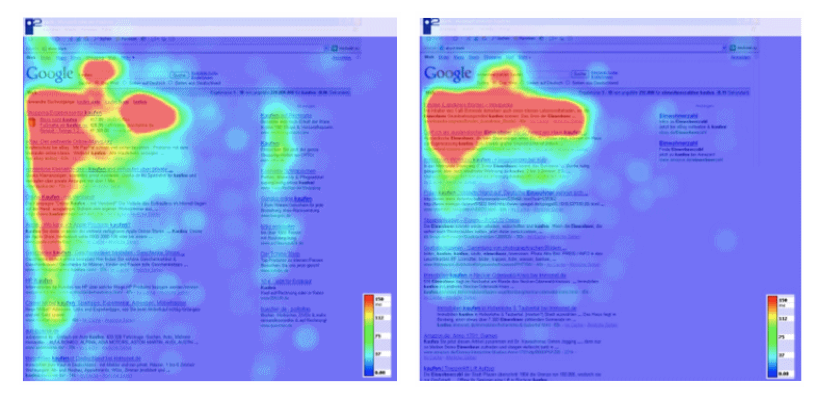
Google Query Types

All searches are not created equal. The intent of that query, of that action, defines the context.

Social Marketing’s Creaky Bridge

Others, like Andreessen, seem to believe that context is homogeneous and can be blended. That social messages and product based messages can live side by side. That as you’re telling someone about the cool new things your iPhone does that you’ll enjoy a message from Palm trying to persuade you that the Pre is the way to go.

… an overwhelming 96% of employed consumers say their opinion of a product brand does not change if that brand has no presence on a social networking site … In fact, just 12% of respondents say their opinion of a brand actually changes if that brand maintains a significant social networking presence and only 11% of social networkers report following any major brand through a social networking site.

This is but one of numerous datapoints that illustrates that creaky bridge I mentioned at the beginning of this post. The locomotive of social marketing continues to thunder down the tracks, ignoring the flashing yellow signals at their own peril.
eCommerce and RSS

January 11 2009 // eCommerce + Marketing + Technology // 1 Comment

Are eCommerce sites overlooking RSS?

RSS still hasn’t hit the mainstream, but could eCommerce sites help drive RSS adoption and at the same time increase the effectiveness and reduce the costs of their communications with customers? Yes!

Too many eCommerce sites seem to believe that the only place for RSS exists if they have their own blog. And lets face it, many don’t have the bandwidth to produce a decent blog. It’s a resource drain and one that many find hard to explain during budget meetings.

Yet, most eCommerce sites already have blogs, they just don’t know it. They’re called newsletters. So the time and effort argument is irrelevant.

Why push newsletters via RSS?

Most eCommerce sites use email as their primary method of communication. Yet, email has three big (and growing) drawbacks: deliverability, over saturation and cost.

Deliverability issues persist as email finds its way into spam folders or bounces due to changed email addresses. A 2007 Internet Retailer survey indicated that only 40% of respondents experienced 90%+ deliverability. And a 2008 Return Path report showed commercial deliverability at 88%.

Just like the old direct mail world, people move … a lot. Here’s the data from Jupiter Research (2008) and Return Path (2007) respectively.

17% of Americans create a new email address every 6 months

30% of subscribers change email addresses annually

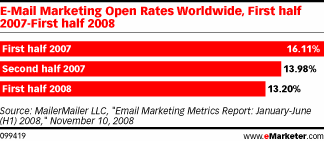
Part of the deliverability problem is over saturation. Email marketers have overused the medium, flooding mailboxes to the point where users feel overwhelmed. The result has been a steady decline in open rates, from nearly 40% in 2003 to 13% in 2008.

eMarketer Email Marketing Open Rates 2007-2008

Many eCommerce sites have increased the frequency of email to respond to declining open rates. The open rate might be low on each email but if you send six emails a month your total open rate might wind up being pretty good.

Yet, there is incremental cost associated with this increased volume. Not only that but it contributes to the over saturation problem which negatively impacts open rate and effectiveness. It’s a vicious and costly cycle in which eCommerce sites wind up paying more for less.

The advantages of RSS

RSS solves most, if not all, of the deliverability problem. There is no spam filter or black list. I’d also argue that you’re less likely to switch readers than email addresses, thus reducing the churn rate of your subscriber base.

Email has become unncessarily intrusive and ephemeral. An email will be pushed ‘below the fold’ of a person’s inbox with greater speed as the volume of email a person receives increases. The adage ‘out of sight, out of mind’ is apt in this instance.

Over saturation might be an issue in RSS but the format is a more ‘on demand’ type of solution. TV networks are starting to understand this, that forcing people to watch their show at 8pm on Thursday might not be optimal. Similarly, RSS allows subscribers to engage with your content on their own terms.

Subscribers will still get an inbound notification that new content has arrived, so you’ll still see an immediate (though perhaps less pronounced) traffic surge. And the content will have a longer life due to increased delivery and visibility in the reader.

Did I mention RSS would be radically cheaper than email? Leaps and bounds cheaper really.

But didn’t eCommerce already try RSS?

Yes and no. When RSS first arrived on the scene there was a big ruckus about how RSS could replace email. The problem was marketers didn’t have a clue how to really make that happen. Most didn’t even use RSS and found it confusing at best.

I speak from experience. I was smack dab in the middle of it all as Director of Marketing at Alibris. I sensed that it had potential but I didn’t fully grok RSS until later on, after I’d left the eCommerce space.

The topic was a blip on the radar at conferences and no one really wanted to upset the applecart. Email was a solid performer and search was the shiny new channel.

So any attempts made in those years were premature and uninformed for the most part.

Why could RSS succeed this time?

If eCommerce sites began to understand that RSS could help them achieve their goals they could be a force of change for the technology. RSS needs to be relaunched, rebranded or both. Who better to do that then those in the business of selling.

In addition, the reader market has matured and stabilized. I see no reason why Google wouldn’t want to partner with major retailers and offer their customers an easy (perhaps cobranded) way to start using RSS using Google Reader.

Finally, RSS can be used more creatively by eCommerce sites. In a tough economy, why not let users select products and create a price watch feed? Or let users subscribe to reviews of a product to help them through the sales cycle?

Email versus RSS

email vs rss

The revenue stream from email has obscured the growing cost of the channel. I don’t know of a single eCommerce retailer who really ‘likes’ their email service provider. The time and money dedicated to producing and sending email seems to grow and not shrink.

Yet, instead of looking at new ways to communicate with customers many simply look to ‘fix’ email or find another service provider. Deliverability in particular has given rise to a number of new businesses. That should be a clear signal for change.

I’m not saying eCommerce should abandon email, but the ones who figure out RSS will have a marked advantage.

Cyber Monday Facts and Fiction

November 26 2008 // Marketing // 1 Comment

Cyber Monday is defined as the Monday after Black Friday. It is heralded as the kick-off to the online holiday shopping season and/or the busiest day for online retailers.

What does it mean to me? Cyber Monday could be the case study for the power of marketing.

Hovercat

Cyber Monday hinges on the idea that shoppers make purchases upon returning to work on the Monday after Thanksgiving. These shoppers might be avoiding Black Friday altogether or are buying items they were unable to purchase offline. Combine this with the (once) natural day-of-week effect that shows Monday as the most trafficked day for retail and Cyber Monday seems to make a lot of sense.

In reality, Cyber Monday is a clever lie created by savvy marketers. The term was coined by Shop.org in 2005 and immediately drew media attention both good and bad. Naysayers pointed to the fact that Cyber Monday didn’t really pan out when you looked at the numbers.

But the numbers have changed in the last few years and what we’ve witnessed is the triumph of marketing.

Cyber Monday Statistics

It was widely reported in 2005 that Cyber Monday was historically only the 12th largest online shopping day of the year. Even a Shop.org study found that the busiest shopping day in 2005 was actually December 12th.

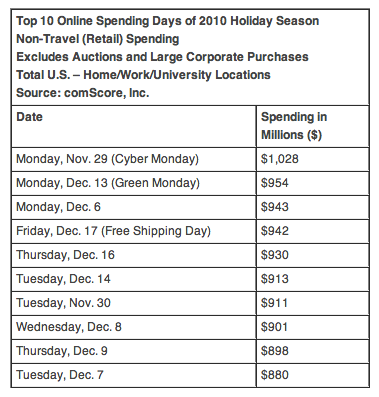
This trend continued until 2010 when Cyber Monday was the highest ranked online shopping day, raking in over one billion in sales.

2010 Top Holiday Ecommerce Days

That trend continued with Cyber Monday ranked the highest online shopping day in 2011. What’s fascinating here is that this is happening against the backdrop of some strong trends to the contrary.

Broadband adoption and fast internet connections have made the ‘wait-to-surf-at-the-office’ behavior far less powerful. And in recent years smartphones and tablets have all but erased these patterns.

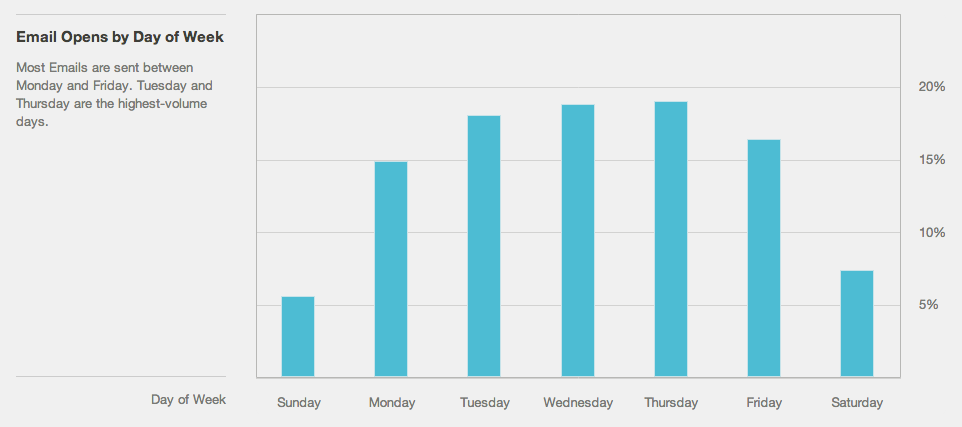
In fact, more and more retailers are finding that Monday is no longer the biggest day of the week. MailChimp Research also seems to indicate that Monday is less important than it used to be.

Day of Week Email Statistics

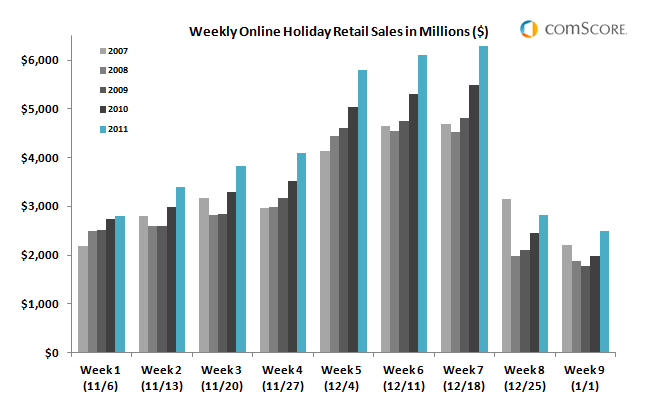
Lastly, while Cyber Monday may be the biggest day of the year it does not reside in the biggest week of the year.

eCommerce Holiday Sales Trends 2007 to 2011

So despite the bulk of the sales happening in the later weeks marketers have figured out a way to crank up the volume on Cyber Monday.

Is Black Friday really black?

Black Friday is a big shopping day for retailers. But is it the biggest day? Maybe.

Snopes has the data through 2002 which shows Black Friday ranks between the 4th and 8th biggest day of the year. Black Friday did take the top spot in 2003 and 2005 according to International Council of Shopping Centers. However, I’ve seen conflicting data from other sources.

More recent data from ShopperTrak seems to suggest that Black Friday has secured the top spot. Once again, belief in the Black Friday myth, and the marketing muscle behind it, made it real.

Seth Godin hits the nail on the head in All Marketers Are Liars.

Successful marketers don’t tell the truth. They don’t talk about features or even benefits. Instead, they tell a story. A story we want to believe.

Marketers succeed when they tell us a story that fits our worldview, a story that we intuitively embrace and the share with our friends.

Within this context, Cyber Monday is a well constructed and beautiful fiction. The knee-jerk reaction is to believe the Cyber Monday story (as well as Black Friday) and most won’t do the research to validate that belief.

TL;DR

The fact is Cyber Monday and Black Friday were both fiction, but ones that we collectively embraced (even Google). As such, our collective suspension of disbelief led both to become a reality. Marketers succeeded in telling a story that people believed. Perception became reality.