— You Are At The Archives for the digg Tag —

Could Inconsistent Design Save Social Advertising?

March 23 2009 // Advertising + Marketing + Social Media // Comments Off on Could Inconsistent Design Save Social Advertising?

Social media sites like Digg, MySpace, Facebook and others are finding it difficult (to say the least) to get by using an advertising based revenue model. A drum beat of research shows that users don’t like the ads on these venues or simply don’t see them. The poor performance of these social ads translates into dreary CPM ad rates.

Social Advertising

The Q4 2008 Pubmatic AdPrice Index (pdf) puts Social Networking sites at the bottom of all other verticals and the trend for Social Networking sites continues to slide.
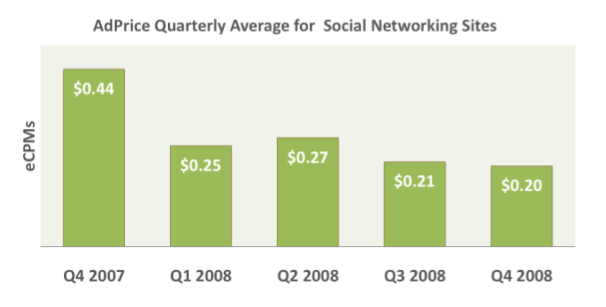
social networking CPM q4 pubmatic adprice index

Many of these social sites have incredible engagement metrics. Users are there every day, multiple times a day and stay there for – sometimes – hours on end. You might think this would be a huge boon for potential advertisers. Yet, the exact opposite seems to be the case.

The Participatory Marketing Network (PMN) conducted a Generation Y study that detailed why “advertising remains a tough sell in these environments.”

84 percent noticed ads on social networks, 74 percent say they click infrequently/never (36 percent saying they don’t click on ads at all).

Then there’s a recent Nielsen study (pdf) of social networking users which showed that ‘false’ was the term most closely associated with ‘advertising’. Yeah … that’s not a good sign.

The high engagement on these sites means users become intimately aware of the structure of the site. They understand exactly where to look, how to navigate and what links to click.

The impetus for their visit compounds the problem. It is usually, and not surprisingly, social. Firing back responses to comments on your high school yearbook photo just isn’t the best advertising opportunity.

So while users may ‘notice’ ads I’m not sure they’re really ‘seeing’ them. They know where they are but they’re avoiding the advertising and they’re getting better and better at doing it.

Rearrange The Furniture

rearrange social media furniture

What if you made the navigation or design different. Not a major redesign but an ongoing number of smaller, incremental changes that break a user’s rote click pattern. Keep them on their toes!

Think of it as rearranging the furniture in a room. You’d still be able to find the couch, the coffee table, the chair and the TV, but it would all be just a little different. They’re in slightly different places or they’ve been reupholstered.

Wouldn’t that make you take stock of the entire room again? To get your bearings you’d see things you might have missed before. That picture on the wall that you hadn’t really looked at in ages?

Inconsistent Design

I’m not recommending something like this for just any site, but it makes sense for social sites where users become habituated to the design through repeated use. In these instances rearranging the furniture every month might help them see the paintings (aka banners) on the wall.

Is Facebook is seeing an increase in CTR since their much maligned redesign? Sure, 94% of users might be giving it a thumbs down but they’re looking at it with ‘new’ eyes. (Contact me if you had a campaign running during the redesign.)

A substantial redesign, nevermind the ruckus, wouldn’t scale well. Instead I’m thinking of smaller changes. It could be as big as moving columns or the order of top navigation or as small as a color change or resizing the logo.

The idea sounds radical even as I suggest it, but traditional techniques are not working. We take regular navigation off of lead generation and cart pages. Sure, that has more to do with keeping the user focused on a task, but it’s still a break in the natural design of the site.

Advertisers, by in large, still don’t understand how to market on social sites. I’m not sure any of us really know what’s going to work or not. So why not test inconsistent design, even if it’s a transitional measure?

Should You Submit Your Own Content To Social Sites?

January 15 2009 // Marketing + Social Media // Comments Off on Should You Submit Your Own Content To Social Sites?

Is it ethical to submit your own content to social sites?

Should you Digg your own blog post? Should you bookmark it on Delicious? How about Stumbling it too? (If you can.)

promote your own content on social sites

My answer? Yes.

If you’re not confident enough to promote your own content, why would others do it for you? Sure, in a perfect world you want others to get the ball rolling but inertia remains high. In this instance, don’t rely on the kindness of strangers.

Remember, you’re not trying to game the system. You simply want to give your content the best chance to find an audience. Would you exclude your content from being indexed by Google? Heck no!

Would you refrain from Tweeting about a new blog post or exclude your own blog from your FriendFeed? Of course not!

Again, what happens to your content once it is submitted is out of your control. It could sit there in a corner doing nothing or it might find an audience who likes and shares it with friends. But it’s up to you to ensure it’s there in the first place.

Submitting versus spamming

Moderation in all things. Don’t go overboard. If you’re cranking out a lot of content, not all of it might be worthy of being submitted to every site. Pick your spots. Learn what works best on Reddit versus Digg. Figure out what content is most interesting to those using StumbleUpon.

Your personal brand will suffer if you are labeled a spammer, so don’t over submit your content.

Self submission increases content quality

Before you submit your own content, ask yourself if it is really worth submitting. If you hesitate that should tell you something. Again, you must be confident, and proud, of your content to submit it to social sites.

Use self submission as a filter to make your content better. It’ll help you deliver more value to readers and increase the chances of natural social media adoption.

No one likes a know it all

For best results you should participate on these sites. Not only will you better understand them but you can help and promote others. After all, these are social sites. Take as little as 15 minutes out of each day to promote recent posts by your favorite blogs or newly discovered websites.

Only promoting your own content makes you look selfish, vain, condescending and insecure all at the same time. But never promoting your own content might make you invisible.

2009 Internet and Technology Predictions

December 23 2008 // Advertising + Marketing + SEM + SEO + Social Media + Technology // 9 Comments

Now is the time when bloggers go on the record with their thoughts for the year ahead. Place your bets! Stake your claim! Here’s mine.

Crystal Ball 2009 Predictions for Internet and Technology

Facebook Becomes A Portal

Realizing that social media and advertising is like oil and water, Facebook repositions itself as a portal leveraging Microsoft’s Live Search as the revenue model. This also might result in the potential acquisition of Netvibes to provide a more robust offering to compete with Yahoo!

Identity Systems Fail

Confused about the difference between OpenID, Facebook Connect and Google Friend Connect, users throw up their hands and decide not to use any of the above.

Video Advertising Succeeds

The adoption of video is surging faster than many expected. Longer formats and better quality will bring even more eyeballs who will grudgingly accept advertising.

Microformats Go Mainstream

Why they aren’t already is shocking. Nevertheless, in 2009 we’ll see microformats become a standard and search results will become far more robust as a result.

Banner CTR Becomes Obsolete

Brands will finally realize that measuring success by click through rate (CTR) isn’t working. Measurement ‘beyond clicks’ will be the new yardstick, whether that’s through new brand advertising measurement services like Vizu or through monitoring services like Brandwatch and Trackur among a gaggle of others.

RSS Adoption Spikes

Someone will (finally) figure out how to market RSS to ‘the masses’ who will grasp the sublime benefits of having content come to you instead of the other way around.

Kindle 2.0 Flops

Amid a weak economy Amazon releases the newest version of Kindle. Other readers have gained ground where Kindle has not and at the core Kindle is a solution without a problem.

Google Search Share Stalls

The move by Facebook (see above) causes a radical change in the search landscape. Microsoft passes Yahoo! for second place and talks about a Microsoft Yahoo merger are (unbearably) reignited.

FriendFeed Surpasses Twitter

FriendFeed adoption increases at an accelerated pace due to quick innovation, uncluttered design and an interface that lends itself to communication.

Someone ‘Dies’

Users reach social media overload and VCs get even more nervous about revenue creating social media shrinkage. In this instance ‘Dying’ means a company goes under or is purchased for a song. My short list includes Plurk, Twitter, Digg and Seesmic. This isn’t a reflection of the people or product but the inability to truly reach the mainstream with a service that has a profit model.

There are plenty of other things that I believe will happen in 2009, but they seem more obvious or an extension of current trends. Instead I tried to be a bit more bold, at least on a few of my predictions.

We’ll check in this time next year to see how I fared. In the meantime, feel free to comment and provide your feedback and reaction to my predictions.

SearchWiki Turns You Into Free Mechanical Turk

November 21 2008 // SEO + Technology // 1 Comment

Yesterday Google launched SearchWiki, a search feature that lets users customize search results by moving, deleting, adding and commenting on search results. The search algorithm will now have access to a set of aggregated human data. As I’ve written about before, the Google search algorithm will benefit from having a human feedback mechanism.

Google SearchWiki turns users into a free Mechanical Turk.

Not familiar with Amazon’s Mechanical Turk? Here’s a relevant excerpt from Wikipedia:

The Amazon Mechanical Turk (MTurk) is one of the suite of Amazon Web Services, a crowdsourcing marketplace that enables computer programs to co-ordinate the use of human intelligence to perform tasks which computers are unable to do.

Now, clearly the search algorithm is able to produce search results. However, the algorithm still isn’t very smart. SearchWiki lets the algorithm learn as humans move, delete and add results for specific search queries.

While Google clearly states that your specific changes will not be seen by others, it seems impossible to think that Google won’t use that information to influence search results over time. Not convinced? SEO by the Sea reviews a recent Google patent that points to Google’s continuing goal of leveraging more data and behavior into search results.

Google has been experimenting with something like this for some time and finally seems ready for prime time. This also means the flirtation with Digg is likely done for good unless abuse by SEO practitioners overwhelms the signal.

How do SEO gurus react to SearchWiki?

If you employ a short term chase the algorithm type of SEO you’re seeing a threat and an opportunity. The threat is that the human feedback mechanism could help to curb over-optimization and subtle gaming. However, it also provides an opportunity to create a SearchWiki army that could coordinate changes to specific search results. The worst case scenario is that people are paid to delete, add or move certain results for specific searches.

I’m not saying SearchWiki is a bad thing. But make no mistake, Google is using it as a free way to make their core product better.

Google Search Algorithm Needs Digg Tutor

October 10 2008 // SEO + Technology // 3 Comments

The Google search algorithm needs Digg. Why? It provides a human feedback mechanism that can help continuously refine Google search results. If you subscribe to my blind five year old principle, social search data would be a stream of higher intelligence that will make the algorithm smarter.

Social search results would be the algorithm’s tutor.

Predictions of SEO mayhem are simply unwarranted. Google knows that only a small portion of users would use the interface. And that’s all it wants and needs. It simply wants to augment the algorithm for the vast majority of Google searches with a human quality assurance mechanism. In some ways, it would be a volunteer version of Mechanical Turk.

Google experimented with social search earlier this year and has been in on-again off-again negotiations with Digg. Clearly, there is a build versus buy dilemma. Google built some of the infrastructure, but might be struggling with the logic and filters to prevent gaming the system.

A black hat filter is critical since Google wouldn’t want to feed the algorithm bad data. Garbage in, garbage out. But done right, social search results would help identify web spam and curtail over-optimization.

Microsoft has also been sniffing around Digg and this week launched U Rank, which is eerily similar to Google’s social search experiment. Could Microsoft leapfrog Google and begin adding an intelligent data stream into their search algorithm? I find it hard to believe, but stranger things have happened.

I do believe the U Rank test will reignite Google’s interest in the concept (if it ever really waned) and might again bring rumors of a Digg acquisition back to life.