— You Are At The Archives for the chrome Tag —

Chrome is about Search

September 26 2008 // Marketing + Technology // 2 Comments

Google Chrome LogoThere’s a lot of talk (very good analysis actually) about Chrome in terms of functionality and technology. Sure, what’s under the hood is interesting and I’m intrigued by the speed tests. Yet, at the end of the day, I believe Chrome is really all about search.

Let’s first look at two core components that were absent from the launch. There are no add-ons and there is no Mac version. This tells me that the competitive target is not Firefox or Safari. It tells me that Chrome is aimed at converting more WIndows/IE users to Windows/Chrome users. (Yes, yes, it has an open API but that’s different then supporting add-ons a la Firefox.)

Next let’s look at how they’re marketing Chrome.

Google Chrome is a browser that combines a minimal design with sophisticated technology to make the web faster, safer, and easier.

One box for everything
Type in the address bar and get suggestions for both search and web pages.

Thumbnails of your top sites
Access your favorite pages instantly with lightning speed from any new tab.

Shortcuts for your apps
Get desktop shortcuts to launch your favorite web applications.

Faster. Safer. Easier. One box for everything. Shortcuts. I believe the messaging is aimed not at the early adopter but at the early majority instead. While the technology is sophisticated, the end product is simplistic.

A legion of folks exist out there who don’t even know they have a choice in how they surf the Internet. People aren’t going to be easily swayed by a relatively unknown brand like Firefox. But Google? Hey now, they know Google. They trust Google. They use Google!

Sure they can import their settings, but how many of them will and how many of them even knew about their settings in the first place? Google has disrupted inertia and created an artificial switching window. During this critical time, I believe more will choose to use Google as their default search engine. There is a subtle psychological pressure exerted by using Google’s browser that will encourage users to use Google as their search engine.

One could argue that many of these same users already use Google. And that’s true. But they’re also confused about exactly what to do when they want to search or go to a website. Remember that the top search terms in August were ebay and myspace. So these people could be accidentally using IE’s default search engine from time to time.

And that’s where the omnibox (aka ‘the god box’) comes in. Chrome’s one box for everything appeals to the same user who is confused about when they search and when they type in a website address. If my supposition above is correct, then Google suddenly has far more control over searches and, even more far reaching, directing users to specific destinations.

Google Chrome is about taking more of the search market away from Microsoft and Yahoo. As such, it is one of the few Google initiatives that I believe is perfectly aligned with their core business.
Tabbed Browsing Changes Everything

September 24 2008 // Marketing + Technology // Comments Off on Tabbed Browsing Changes Everything

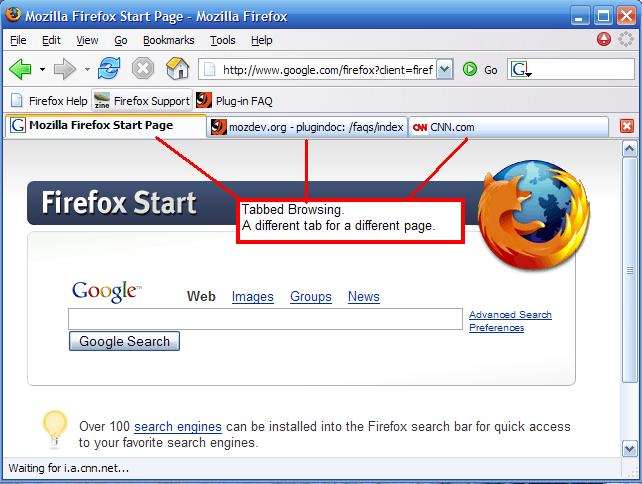
Tabbed browsing doesn’t seem to get the attention I think it deserves. Sites, strategy and brands will need to adjust as more and more of the early and late majority begin to use and understand tabbed browsing.

There was a lot of talk about how increased broadband usage would change the Internet landscape. The time it took to get from one site to the next was greatly reduced by the speed of connection. Yet, tabbed browsing takes that concept to the next level.

A 2006 article about tabbed browsing and its effect on web analytics framed the issue nicely.

Tabbed browsing has made comparing products, shopping for the right price, and researching products that much easier. For example, Chris is looking for a plasma television for his new home. He opens the browser and starts looking at ratings on Epinions. As he explores the ratings, he pops open links to pricing for a few different TVs in tabs. He decides to research a few different models on manufacturers’ sites.

The assumption is that review sites like Epinions or price comparison engines will continue to be the hub or start of any research on a product. I’m not sure this is a valid assumption. From my perspective, the de facto start to almost any (re)search for a product or service is a search engine – Google.

So what exactly does tabbed browsing mean to sites and brands?

Tabbed browsing means a greater focus on brand.

Users are going to be more apt to float from one site to the other for their purchases. The ‘switching costs’ of going from one site to the other is now virtually none. You want your site to be the first place users go or think of for your product or service. You’re also hoping that your brand is strong enough to suppress the tabbed browsing behavior.

The only way to circumvent Google is to have a site or brand that has a greater influence or mindshare for that niche. As an example, Amazon may still have the brand horse power to attract direct traffic for those looking for a book.

Strong brands don’t necessarily need to participate in shopping comparison sites since many users might simply check that brand’s offering in another tab whether or not they are displayed. Southwest airlines has largely taken this approach.

Tabbed browsing means user interfaces must be streamlined and easy.

Once you get a user to visit your site, the user interface must be incredibly easy. Confusion or roadblocks to purchase will give users time to open another tab. Whether it is to find another site with the same product or simply frustration induced ADD is immaterial. Sites must focus on making it difficult for users not to follow the appropriate conversion path. Lead generation marketers are a step ahead in figuring this out.

Tabbed browsing means sites need to invest in SEO.

If your brand isn’t strong enough to bring direct traffic the only way you can be first in the door is through search engine optimization. In addition, as users refine searches in subsequent tabs you want your site to continue to be served in the top results. Repetition will have a beneficial effect.

A new goal might be to have your site open in multiple tabs for any given user? And lets not forget that many confuse search with the address bar, pushing what could be direct traffic into searches. Weaker brands can leverage SEO against bigger brands.

Tabbed browsing means engagement is a better metric for success.

Engagement is going to become a much better metric for success since many will simply keep multiple sites open on a daily basis. I interact much more with FriendFeed but I usually still have Facebook and LinkedIn open in another tab. How this translates into online advertising is another interesting discussion.

Tabbed browsing could overwhelm users.

As people begin to use more and more tabs, it may lead to a backlash of sorts as it relates to Barry Schwartz’s The Paradox of Choice. Essentially, more choices doesn’t always lead to more purchases. In fact, in many cases it suppresses purchase behavior. This could mean a general deceleration in eCommerce growth or renewed reliance on trusted and/or known brands.

Google Chrome has upped the ante by creating a default tab page that includes your nine most visited pages. A quick survey of early adopters on FriendFeed shows the number of open tabs to be around 6 on average. I could argue for both fewer or more tabs on average for early and late majority users.

Time will tell. It is my opinion that tabbed browsing changes everything and we haven’t begun to determine how exactly it will play out.