— You Are At The Archives for the branding Tag —

Sponsored Tweets are Robocalls

July 14 2009 // Advertising + Marketing + Rant + Social Media // 2 Comments

Paid Tweets

One of the great things about our new information culture is how disparate sources coalesce into something meaningful. Last week I read a Fortune magazine article on Marc Andreessen, news about IZEA’s Sponsored Tweets and research on the impact social media has on brands and eCommerce. When I put these pieces together the picture is of a powerful locomotive hurtling toward a creaky bridge.

Social Media and the Telephone

The telephone is a social platform. You call family and friends to talk about things from the trivial to the serious. If you know a person’s phone number you can call them. At some point, marketers figured out that they too could call you, so long as they had your phone number. Phone numbers weren’t hard to find.

This didn’t sit too well with most people. They didn’t want some stranger calling right at dinner trying to sell them something. The thing was, enough people actually did respond to these calls and telemarketing flourished. It was a lot more effective than direct mail.

Over time, more and more people became irate. Laws were passed so that you could opt-out of these unwanted calls. But there were loopholes. Giant gaping loopholes. Any company you had a ‘prior relationship’ with could still call you unless explicitly told otherwise.

You might have bought from them before, maybe even kept an eye out for coupons, but you didn’t want them to ring you up whenever they pleased.

Now replace phone number with user name. This story has already been written.

Sponsored Tweets and Telemarketing

Sponsored Tweets will not work like telemarketing. The reason why telemarketing works is because you can engage in a dialog. A good telemarketer changes their approach based on the subtle feedback they’re getting from the prospect. And they’ll certainly use every objection as an opportunity. I know a bit about this since I ran telemarketing programs for nearly five years.

The problem with Sponsored Tweets is that the lack of dialog. One way communication isn’t nearly as effective. It’s the reason why telemarketing beats direct mail. No, Sponsored Tweets are not like telemarketing.

Sponsored Tweets are Robocalls

Paid Tweets

You’ve probably received a robocall.

Robocall is American pejorative jargon for an automated telemarketing phone call that uses both a computerized autodialer and a computer-delivered recorded message.

I’m guessing you’ve gotten one during the election season or, most recently, from some company trying to sell you an auto warranty extension. You don’t like them.

Getting a robocall from Martin Sheen is the same as getting a Sponsored Tweet from a celebrity.

Context Shifting and Social Marketing

Marc Andreessen believes that advertising can be an effective part of social interactions.

He tells me Facebook “will be bigger than Apple” and declares that the social-networking company will become the mass-market window to the web, much as Google has been for the past six or seven years. Twitter, so far criticized for having no way to make real money, will get advertisers to pay to reach people as they are sending messages about the sponsor’s products.

The real issue here is context switching, a term my Caring.com engineers introduced to me. The general idea is that if you’re thinking in one way (about one thing) it takes some time and effort to stop and think about something else. The context of your attention has changed.

This is why I believe social marketers need to build an ice cream truck. They need to deliver something that forces people to shift their context.

The example of Google actually supports the idea of context switching. Eyetracking studies have shown substantial differences in how people scan results for transaction based queries (left) versus information based queries (right).
Google Query Types

All searches are not created equal. The intent of that query, of that action, defines the context.

Social Marketing’s Creaky Bridge

Others, like Andreessen, seem to believe that context is homogeneous and can be blended. That social messages and product based messages can live side by side. That as you’re telling someone about the cool new things your iPhone does that you’ll enjoy a message from Palm trying to persuade you that the Pre is the way to go.

… an overwhelming 96% of employed consumers say their opinion of a product brand does not change if that brand has no presence on a social networking site … In fact, just 12% of respondents say their opinion of a brand actually changes if that brand maintains a significant social networking presence and only 11% of social networkers report following any major brand through a social networking site.

This is but one of numerous datapoints that illustrates that creaky bridge I mentioned at the beginning of this post. The locomotive of social marketing continues to thunder down the tracks, ignoring the flashing yellow signals at their own peril.
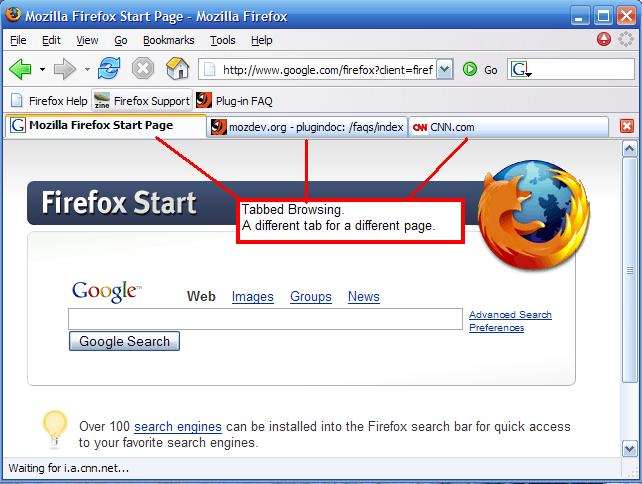
Tabbed Browsing Changes Everything

September 24 2008 // Marketing + Technology // Comments Off on Tabbed Browsing Changes Everything

Tabbed browsing doesn’t seem to get the attention I think it deserves. Sites, strategy and brands will need to adjust as more and more of the early and late majority begin to use and understand tabbed browsing.

There was a lot of talk about how increased broadband usage would change the Internet landscape. The time it took to get from one site to the next was greatly reduced by the speed of connection. Yet, tabbed browsing takes that concept to the next level.

A 2006 article about tabbed browsing and its effect on web analytics framed the issue nicely.

Tabbed browsing has made comparing products, shopping for the right price, and researching products that much easier. For example, Chris is looking for a plasma television for his new home. He opens the browser and starts looking at ratings on Epinions. As he explores the ratings, he pops open links to pricing for a few different TVs in tabs. He decides to research a few different models on manufacturers’ sites.

The assumption is that review sites like Epinions or price comparison engines will continue to be the hub or start of any research on a product. I’m not sure this is a valid assumption. From my perspective, the de facto start to almost any (re)search for a product or service is a search engine – Google.

So what exactly does tabbed browsing mean to sites and brands?

Tabbed browsing means a greater focus on brand.

Users are going to be more apt to float from one site to the other for their purchases. The ‘switching costs’ of going from one site to the other is now virtually none. You want your site to be the first place users go or think of for your product or service. You’re also hoping that your brand is strong enough to suppress the tabbed browsing behavior.

The only way to circumvent Google is to have a site or brand that has a greater influence or mindshare for that niche. As an example, Amazon may still have the brand horse power to attract direct traffic for those looking for a book.

Strong brands don’t necessarily need to participate in shopping comparison sites since many users might simply check that brand’s offering in another tab whether or not they are displayed. Southwest airlines has largely taken this approach.

Tabbed browsing means user interfaces must be streamlined and easy.

Once you get a user to visit your site, the user interface must be incredibly easy. Confusion or roadblocks to purchase will give users time to open another tab. Whether it is to find another site with the same product or simply frustration induced ADD is immaterial. Sites must focus on making it difficult for users not to follow the appropriate conversion path. Lead generation marketers are a step ahead in figuring this out.

Tabbed browsing means sites need to invest in SEO.

If your brand isn’t strong enough to bring direct traffic the only way you can be first in the door is through search engine optimization. In addition, as users refine searches in subsequent tabs you want your site to continue to be served in the top results. Repetition will have a beneficial effect.

A new goal might be to have your site open in multiple tabs for any given user? And lets not forget that many confuse search with the address bar, pushing what could be direct traffic into searches. Weaker brands can leverage SEO against bigger brands.

Tabbed browsing means engagement is a better metric for success.

Engagement is going to become a much better metric for success since many will simply keep multiple sites open on a daily basis. I interact much more with FriendFeed but I usually still have Facebook and LinkedIn open in another tab. How this translates into online advertising is another interesting discussion.

Tabbed browsing could overwhelm users.

As people begin to use more and more tabs, it may lead to a backlash of sorts as it relates to Barry Schwartz’s The Paradox of Choice. Essentially, more choices doesn’t always lead to more purchases. In fact, in many cases it suppresses purchase behavior. This could mean a general deceleration in eCommerce growth or renewed reliance on trusted and/or known brands.

Google Chrome has upped the ante by creating a default tab page that includes your nine most visited pages. A quick survey of early adopters on FriendFeed shows the number of open tabs to be around 6 on average. I could argue for both fewer or more tabs on average for early and late majority users.

Time will tell. It is my opinion that tabbed browsing changes everything and we haven’t begun to determine how exactly it will play out.