— You Are At The Archives for the adwords Tag —

Do AdWords Conversion Rates Vary by Position?

August 25 2009 // Advertising + Rant + SEM // 2 Comments

Last week the Google AdWords blog posted some ‘research’ conducted by Hal Varian, Chief Economist at Google, that stated that “conversion rates don’t vary much by position.”

Google Conversion Rate by Position Research

Do AdWords Conversion Rates Vary by Position?

My personal experience is that AdWords conversion rates DO vary by position. That’s not to say that I can’t be convinced otherwise, but I’ll need a lot more evidence then was provided in the blog post.

As a fundraiser many moons ago, my first instinct was to say that there would always be an inverse relationship between dollar amount and conversion rate. The lower the pledge amount, the higher the conversion rate.

Yet, I found that there wasn’t a tremendous difference between some giving levels. Conversion rates on $25 pledges weren’t substantially different from $100 pledges. However, that variance increased as you climbed up the solicitation ladder. Conversion rates for $500 pledges did vary materially from $25 pledges.

So, I’m not unwilling to be persuaded by real research and statistics that might contradict my anecdotal evidence. The problem is that the post didn’t link to the research to help validate the methodology or assumptions that led to this conclusion. Only a few variables are discussed, leaving a number of others open to interpretation or debate. It doesn’t help that one of the three links in the post goes to a 404 page.

How Did They Define Conversion?

That broken link … it was to the definition of conversion rate. Oddly, this is an important point. How did they define a conversion? Were only those conversions configured in AdWords included? Or did they pull from Analytics Goals as well? Essentially, we have no idea as to the universe of those who were included in this research, nor is there any mention as to what type of bias this might introduce.

Does the Type of Search Impact Conversion Rates?

Second, what type of searches were included? Given the differences in transactional versus informational queries one would believe that there might be a difference in conversion rates by position as well. An ad advertising a product (eCommerce or transactional) may exhibit different behavior as those advertising content (content or informational).

Does Query Length Impact Conversion Rates?

Blognation points out that an analysis of conversion by “token length” would be important.

Here’s a different way to think about the Google conversion rate data that I think would probably have a much different outcome. Do a conversion rate analysis by “token length”, which is search engine language for the number of words in a search query. If someone types in “baseball” for example, what’s the conversion rate differential between position #1 and position #10, versus a query for “buy Louisville slugger size 28 wooden baseball bat.”

I suspect that the conversion rate for the first query is going to be very low for the first position, simply because you are going to have a lot of browsers who simply click on the first ad that they see. Any browser who eventually makes it down to position #10’s result may very well have turned into an actual shopper after clicking on all the other ads. Conversely, if you already know the exact product you want – and your search query indicates that intent – you are much more likely to convert on the first ad you see that actually offers the specific product you want.

Related to this would be the conversion rate by position by match type. With so many advertisers unknowingly bidding solely on broad match, this type of analysis seems necessary and … useful!

Does CPC and Ad Category Impact Conversion Rates?

Finally, was this analysis performed to determine whether conversion rates by position remained constant depending on the average cost of the keyword? Could it not be true that different behavior could exist for a keyword with a $10 per click cost versus 10 cents?

Might different categories produce different conversion rates by position? Would the conversion rates for books, movies and music differ from long term care insurance? Could the number of competitors or volatility of a keyword impact the conversion rate by position?

Why Present AdWords Conversion Rate Research?

The presentation of this research without … the actual research makes me suspicious. What message is the AdWords team sending to advertisers? It seems to me that they’re encouraging advertisers to bid for the extra traffic received from higher ad positions. That advertisers can do so without negatively impacting their conversion rate and subsequent ROI.

Never mind that the higher CPC to achieve that extra traffic would reduce your margin. And that’s IF your conversion rate does remain the same. Should it not, you’ll pay a premium to obtain traffic that converts at a lower rate. So, who is this research advice really supposed to benefit?

Given the lack of supported evidence I can only rely on the experiences that I and my colleagues have had over numerous years. Experiential learning tells me to beware of monkey clicks, which do cause the top positions to have lower conversion rates.

I’m still willing to be convinced, but until something material is presented, this seems akin to evidence of the Loch Ness Monster. The cynic in me sees it as marketing copy meant to drive more advertiser dollars. I’d love for Google to prove me wrong.

PPC Display URL Initial Capitalization

April 13 2009 // SEM // Comments Off on PPC Display URL Initial Capitalization

Little changes can sometimes have a big impact. Nowhere is this more evident than in the display URL for pay per click (PPC) ads. Remember, the display URL comprises between a quarter or third of the entire ad unit!

Display URL

A recent SEOmoz post by User Centric confirmed the importance of the display URL through an eye tracking study.

PPC Ad Eye Tracking Results

In ads above the organic results the display URL carries a tremendous weight. While it carries the least for ads on the right, the impact of the display URL shouldn’t be ignored. Read on to find out why.

Subdomains and Subfolders

The same User Centric post goes on to detail tests of subdomains (subdomain.example.com) and subfolders (www.example.com/subfolder) on clickthrough rate (CTR). Their results mirror my own real world experiences. Subdomains and subfolders provide little value to PPC ads and often suppress CTR.

Why? Users are scanning the page and having a URL packed with information may simply overwhelm the eye. Simplicity remains paramount and more is not always better.

Initial Capitalization

What User Centric didn’t test, or perhaps took for granted, was the use of initial capitalization within the display URL.

Display URL Initial Capitalization

The above ads are exactly the same except for the display URL. I guarantee that your eye came to rest on the one on the right. The ad on the right uses initial capitalization and will consistently outperform other ad.

Time after time I’ve conducted this test. Initial capitalization produces a lift of between 10% and a whopping 50%. Why? The eye naturally gravitates toward capitalization. It’s how we parse sentences. For the more technically inclined, they almost serve as delimiters.

In general, initial capitalization works best with two word domains, but I’ve seen positive results for one word and multi-word domains as well. So don’t forget to make initial capitalization part of your testing plan.

Google SEM 101: Phrase Match and Exact Match

December 18 2008 // SEM // 24 Comments

In my time as a search engine marketing consultant, I’ve found that many overlook phrase match and exact match in their Google AdWords campaigns.

What’s the difference between broad match, phrase match and exact match?

Broad match

The AdWords system defaults to broad match which will serve your ad based on the loosest of requirements. For instance, let’s say you’re bidding on the keyword ‘bird bath’. On broad match your ad shows up if the words ‘bird’ and ‘bath’ appear anywhere in the query in any order. This means your ad is served up if someone searches for ‘does big bird ever take a bath?’ It’s not always relevant.

Phrase match

With phrase match your ad shows up only when ‘bird bath’ appears together, in that order, in the user query. Other words may still appear before or after, but the phrase must appear. This means your ad is served if someone searches for ‘making a bird bath’. Use phrase match to ensure your ad is shown to more relevant queries.

Exact match

To be precise, use exact match, which is … exactly what it sounds like. Your ad shows up only when the exact phrase ‘bird bath’ is used without any other words. The volume is low but you can be assured you’re reaching the right audience

Why is using phrase match and exact match so important?

As mentioned above, phrase match and exact match lets you target your ad to more relevant queries. You’ll see higher click through rates (CTR) on phrase match and exact match keywords. A high CTR isn’t just metric window dressing, it can actually help you reduce your CPC while maintaining your advertising position.

Read that last sentence again because it’s that important.

Google uses your historic CTR for a keyword to determine your ad quality score, which in turn influences your CPC for that keyword. Don’t believe me? Believe Google.

In addition, you want to drive relevant traffic to your site that will convert and provide a significant ROI. Broad match will give you volume but you may very well encounter a greater percentage of monkey clicks which will depress your conversion. The low CTR these broad match keywords rack up will also lead you to pay a higher CPC.

Finally, the clicks generated by phrase match and exact match are of higher quality and should have better conversion rates.

Can I use all three match types at the same time?

Yes. There’s no reason why beginners shouldn’t load up all three match types for all of their keywords. More advanced users may even choose to have different bid strategies for each match type, paying less for broad, a bit more for phrase, and a premium for exact match.

How can I add phrase match and exact match to my existing campaigns?

Google does have an interface via their keyword tool but the UI makes it difficult to add all match types for selected keywords. Frankly, it seems like an easy UI problem to resolve and I can only believe that Google wants a greater percentage of broad match keywords to maximize revenue.

Of course you can also do this using AdWords Editor but that’s not for the beginner. Instead you’ll likely be using the standard Edit Keywords interface.

To Google’s credit they do make a good case for adding phrase match and exact match (as well as negative keywords) in this interface. But it’s a pain to retype each of your broad match keywords with the appropriate quotation marks or brackets. From experience, you also often make mistakes and typos.

Use Excel to quickly add phrase match and exact match keywords

Create a new Excel spreadsheet with five columns. In the first row you’ll have the following in each column: keyword, “, “, [ , ]

As you can see, you’ll copy and paste your broad match keywords into the first column, labeled keyword. Now, the tricky part is using the CONCATENATE function so that phrase match and exact match keywords are automatically generated.

The formula you’ll type into the cell to the right of ‘bird bath’ (Column B) is =CONCATENATE($B$1, $A2, $C$1) and the one to the right of that (Column C) will be =CONCATENATE($D$1, $A2, $E$1)

Then simply copy those formulas down each column and you’ll have a phrase match and exact match generator. Just copy each and paste them into the edit keyword tool in Google and you’re ready to go!

Hopefully this helps new AdWords users get the most from their campaigns. Please leave comments if you have any questions, particularly surrounding the Excel phrase match and exact match generator.

AdWords Introduces Search Partners Metrics

October 22 2008 // SEM // Comments Off on AdWords Introduces Search Partners Metrics

Last week Google rolled out new AdWords metrics that provided advertisers a look at performance on Google versus Google Search Partners. These search partners include AOL and Ask but also a group of anonymous others of varying size and quality.

Many search engine marketers have been concerned that the performance on Google’s search partners might be substantially less than those on Google itself. The mentality is understandable since Google’s Content Network has such comparably poor performance. Yes, that can be explained by the difference between passive and active searches but you can’t blame folks for being skeptical. Could Google be hiding poor performing partners by combining Google and Google Search Partners together?

The verdict? Among the accounts that I monitor and manage the results from the Search Network seem solid, which is likely why Google agreed to this level of transparency. A few campaigns index above ‘The Google’, a few index below. Perhaps it’s always been this way, or perhaps Google has quietly gone about optimizing the Search Partner Network. I’m guessing this is in response to a rising trend of advertisers who were avoiding the Search Network.

Savvy search engine marketers will turn off poorly performing Search Network campaigns, but will also opt-in to the Search Network more readily now that they have this level of detail. Since this setting is at the campaign level it may force advertisers to split or divide their campaigns to toggle appropriate ad groups in or out of the Partner Network based on performance.

The net result of this change will be more advertisers participating on the Search Network but doing so when it makes economic sense. Another potential side effect will be greater competition within the Search Partner Network which could increase CPCs and decrease volume.

The thing is, there’s still a lot we don’t know. We don’t know which partners/sites are contributing to these metrics. Sure, we get to see the aggregate data, but we don’t get anything more. So you won’t be able to selectively block ads from appearing on certain partners based on performance, whether real or perceived.

As an aside, I find it interesting that they chose to feature an account which showed a low CPC (under ten cents), but also a very low CTR (under 1%). It seems like a not-so-subtle way to show that AdWords can be inexpensive. Never mind that a low CTR contributes negatively to your ad quality score.

While I would prefer more detail, it’s a step in the right direction and gives advertisers a new way to target and optimize their programs.

Beware of MonkeyClicks

September 18 2008 // SEM + SEO // 6 Comments

When I started managing my first search engine marketing (SEM) program at Alibris I quickly found that being the first ad on a Google search result wasn’t working. It seemed a bit counter-intuitive. The volume was great but the conversion was atrocious. But I had a theory for this phenomenon that I quickly dubbed MonkeyClicks.

My MonkeyClicks theory is that a user tends to click on the first result on the page regardless of whether it really meets his or her needs. It is plain ol’ human behavior. A knee jerk reaction of sorts. So you get a tremendous amount of volume. However, that first click doesn’t always match the needs of the user and even if it does they will often return to the search results to determine whether other options exist.

If you think of this outside of the small world of search engine marketing it makes perfect sense. If I’m looking to buy a car I’m likely not going to look at the first advertisement I see and then run off and buy that car. If I’m looking to buy a new bicycle on Craigslist I’m going to look at a number of matching results, not just the first one.

This makes sense but lets back it up with some data. (I like data!) Back in 2006 AOL accidentally released a chunk of user search results. It showed that 42% of all clicks on the first page of results came from the first position. In comparison, the second position racked up a distant 12% of clicks.

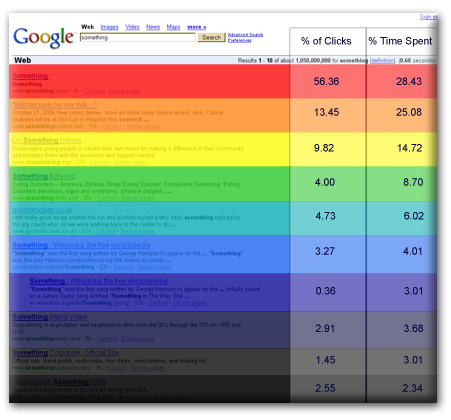
Another eye tracking study by Cornell, and reported by seoresearcher, showed the disparity in the % of clicks and % of time spent on each search result.

Google SERP Click Distribution

The ratio of clicks to time spent on the first position is a classic example of MonkeyClicks behavior. The first position garnered 56% of the clicks but only 28% of the time spent.

All of these studies are done with natural search results, but I’d argue that the paid results will look very similar. Not to mention that I’ve seen this time and again as I manage various SEM programs.

However, your mileage may vary! So don’t take my word for it, do a quick review of your own SEM program. If you’re running a Google AdWords program and Google Analytics, simply take a look at your Keyword Positions report.

And … beware of MonkeyClicks.