Cyber Monday is defined as the Monday after Black Friday. It is heralded as the kick-off to the online holiday shopping season and/or the busiest day for online retailers.
What does it mean to me? Cyber Monday could be the case study for the power of marketing.

Cyber Monday hinges on the idea that shoppers make purchases upon returning to work on the Monday after Thanksgiving. These shoppers might be avoiding Black Friday altogether or are buying items they were unable to purchase offline. Combine this with the (once) natural day-of-week effect that shows Monday as the most trafficked day for retail and Cyber Monday seems to make a lot of sense.
In reality, Cyber Monday is a clever lie created by savvy marketers. The term was coined by Shop.org in 2005 and immediately drew media attention both good and bad. Naysayers pointed to the fact that Cyber Monday didn’t really pan out when you looked at the numbers.
But the numbers have changed in the last few years and what we’ve witnessed is the triumph of marketing.
Cyber Monday Statistics
It was widely reported in 2005 that Cyber Monday was historically only the 12th largest online shopping day of the year. Even a Shop.org study found that the busiest shopping day in 2005 was actually December 12th.
This trend continued until 2010 when Cyber Monday was the highest ranked online shopping day, raking in over one billion in sales.
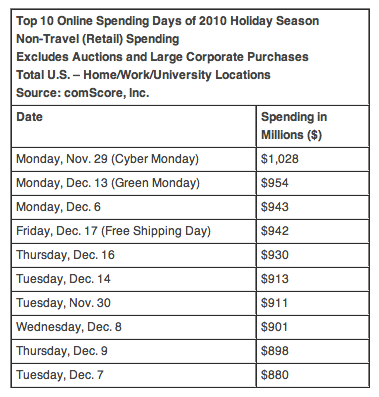
That trend continued with Cyber Monday ranked the highest online shopping day in 2011. What’s fascinating here is that this is happening against the backdrop of some strong trends to the contrary.
Broadband adoption and fast internet connections have made the ‘wait-to-surf-at-the-office’ behavior far less powerful. And in recent years smartphones and tablets have all but erased these patterns.
In fact, more and more retailers are finding that Monday is no longer the biggest day of the week. MailChimp Research also seems to indicate that Monday is less important than it used to be.
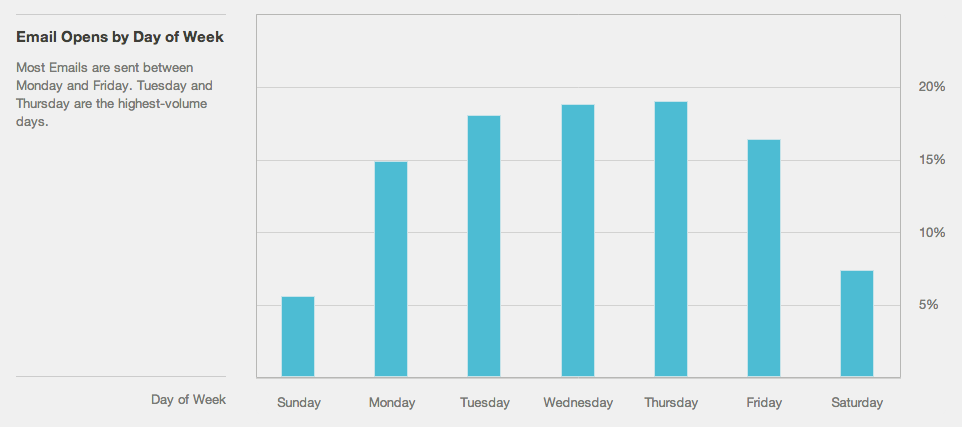
Lastly, while Cyber Monday may be the biggest day of the year it does not reside in the biggest week of the year.
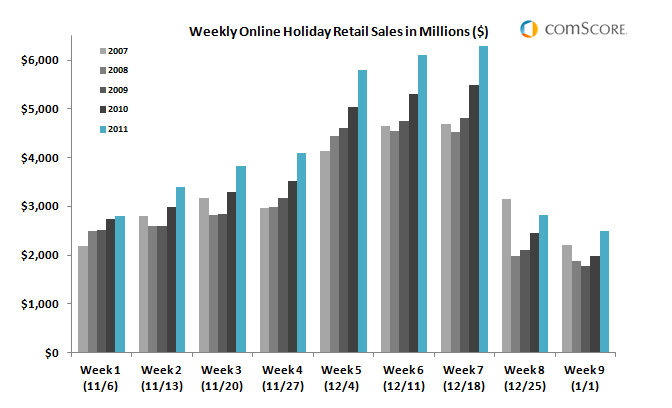
So despite the bulk of the sales happening in the later weeks marketers have figured out a way to crank up the volume on Cyber Monday.
Is Black Friday really black?
Black Friday is a big shopping day for retailers. But is it the biggest day? Maybe.
Snopes has the data through 2002 which shows Black Friday ranks between the 4th and 8th biggest day of the year. Black Friday did take the top spot in 2003 and 2005 according to International Council of Shopping Centers. However, I’ve seen conflicting data from other sources.
More recent data from ShopperTrak seems to suggest that Black Friday has secured the top spot. Once again, belief in the Black Friday myth, and the marketing muscle behind it, made it real.
Seth Godin hits the nail on the head in All Marketers Are Liars.
Successful marketers don’t tell the truth. They don’t talk about features or even benefits. Instead, they tell a story. A story we want to believe.
Marketers succeed when they tell us a story that fits our worldview, a story that we intuitively embrace and the share with our friends.
Within this context, Cyber Monday is a well constructed and beautiful fiction. The knee-jerk reaction is to believe the Cyber Monday story (as well as Black Friday) and most won’t do the research to validate that belief.
TL;DR
The fact is Cyber Monday and Black Friday were both fiction, but ones that we collectively embraced (even Google). As such, our collective suspension of disbelief led both to become a reality. Marketers succeeded in telling a story that people believed. Perception became reality.
The Next Post: That Guy Is Tom Wilkinson
The Previous Post: Could Zoetrope Be A SERP Tracking Tool?

1 trackbacks/pingbacks
Sorry, comments for this entry are closed at this time.
You can follow any responses to this entry via its RSS comments feed.