You Are Browsing The Advertising Category

Could Inconsistent Design Save Social Advertising?

March 23 2009 // Advertising + Marketing + Social Media // Comment

Social media sites like Digg, MySpace, Facebook and others are finding it difficult (to say the least) to get by using an advertising based revenue model. A drum beat of research shows that users don’t like the ads on these venues or simply don’t see them. The poor performance of these social ads translates into dreary CPM ad rates.

Social Advertising

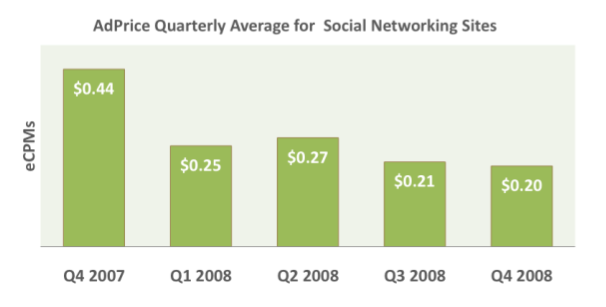
The Q4 2008 Pubmatic AdPrice Index (pdf) puts Social Networking sites at the bottom of all other verticals and the trend for Social Networking sites continues to slide.

social networking CPM q4 pubmatic adprice index

Many of these social sites have incredible engagement metrics. Users are there every day, multiple times a day and stay there for – sometimes – hours on end. You might think this would be a huge boon for potential advertisers. Yet, the exact opposite seems to be the case.

The Participatory Marketing Network (PMN) conducted a Generation Y study that detailed why “advertising remains a tough sell in these environments.”

84 percent noticed ads on social networks, 74 percent say they click infrequently/never (36 percent saying they don’t click on ads at all).

Then there’s a recent Nielsen study (pdf) of social networking users which showed that ‘false’ was the term most closely associated with ‘advertising’. Yeah … that’s not a good sign.

The high engagement on these sites means users become intimately aware of the structure of the site. They understand exactly where to look, how to navigate and what links to click.

The impetus for their visit compounds the problem. It is usually, and not surprisingly, social. Firing back responses to comments on your high school yearbook photo just isn’t the best advertising opportunity.

So while users may ‘notice’ ads I’m not sure they’re really ‘seeing’ them. They know where they are but they’re avoiding the advertising and they’re getting better and better at doing it.

Rearrange The Furniture

rearrange social media furniture

What if you made the navigation or design different. Not a major redesign but an ongoing number of smaller, incremental changes that break a user’s rote click pattern. Keep them on their toes!

Think of it as rearranging the furniture in a room. You’d still be able to find the couch, the coffee table, the chair and the TV, but it would all be just a little different. They’re in slightly different places or they’ve been reupholstered.

Wouldn’t that make you take stock of the entire room again? To get your bearings you’d see things you might have missed before. That picture on the wall that you hadn’t really looked at in ages?

Inconsistent Design

I’m not recommending something like this for just any site, but it makes sense for social sites where users become habituated to the design through repeated use. In these instances rearranging the furniture every month might help them see the paintings (aka banners) on the wall.

Is Facebook is seeing an increase in CTR since their much maligned redesign? Sure, 94% of users might be giving it a thumbs down but they’re looking at it with ‘new’ eyes. (Contact me if you had a campaign running during the redesign.)

A substantial redesign, nevermind the ruckus, wouldn’t scale well. Instead I’m thinking of smaller changes. It could be as big as moving columns or the order of top navigation or as small as a color change or resizing the logo.

The idea sounds radical even as I suggest it, but traditional techniques are not working. We take regular navigation off of lead generation and cart pages. Sure, that has more to do with keeping the user focused on a task, but it’s still a break in the natural design of the site.

Advertisers, by in large, still don’t understand how to market on social sites. I’m not sure any of us really know what’s going to work or not. So why not test inconsistent design, even if it’s a transitional measure?

Product (Re)Placement

February 05 2009 // Advertising + Technology // Comment

The other night I fell asleep watching Blade Runner.

Before nodding off I got to see a young Edward James Olmos (a nice juxtaposition to seeing him in Battlestar Galactica) and the amazing logo laden neon skylines that serve as the back drop to the epic Philip K. Dick story.

Blade Runner Coca-Cola Logo

A lot has been made of the product placement used in Blade Runner. Not because it was the first to use it, or that it was so prominent (which it was) but because many of the advertisers fell on hard times.

Among the folklore that has grown up around the film over the years has been the belief that the film was a curse to the companies whose logos were displayed prominently as product placements in some scenes. While they were market leaders at the time, many of them experienced disastrous setbacks over the next decade and hardly exist today. [Wikipedia]

The blatant product placement, track record of the advertisers and new technology got me thinking. What happens when an advertiser or brand ceases to exist? Right now that brand will live forever on film, locked on celluloid for eternity. But does it have to be that way?

Could product replacement be a new advertising venue?

In the digital age the logo of Coca-Cola can be swapped with that of Pepsi. Atari could be replaced by Wii. A dead brand can be replaced by the new thriving brand. Science Fiction has the greatest ability to make these changes because there are no inherent problems with anachronisms.

Period pieces would probably be off-limits (e.g. – Sense and Sensibility) and modern movies would pose potential, but not unsolvable, problems. For instance, the Mellow Yellow car featured in Days of Thunder couldn’t be digitally altered to promote ROCKST★R but could to promote Mountain Dew.

It’s an intriguing idea, though I’m sure some movie purists would howl at the moon if product replacement came to fruition. Yet, the new formats in which we’re consuming media make this type of substitution seem possible.

Product placement localization seems likely too. Imagine a character drinking from a branded bottle of beer. Couldn’t that brand be altered based on localization? Bud Light in the United States, Labatt Blue in Canada, Skol in Brazil and Krombacher in Germany.

Clearly this wouldn’t always make sense and could disrupt the suspension of disbelief necessary for many films. Make no mistake, product replacement is a Pandora’s box. But imagine the additional revenue potential of selling ‘dead brand’ space in movies.

Would you be disturbed by product replacement?

Yahoo Adds Ads To Alerts

December 26 2008 // Advertising + SEM // Comment

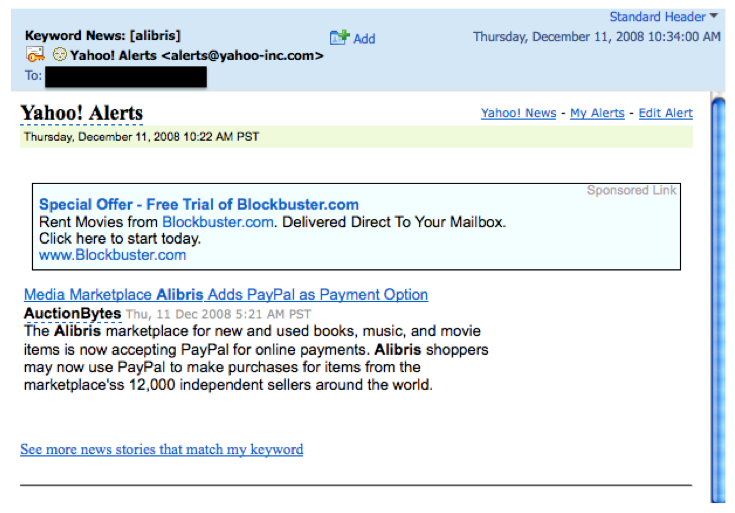
Yahoo is serving ads at the top of email alerts.
Yahoo Ads In News Alerts

Most of my alerts are with Google, but a few of my legacy alerts still reside at Yahoo. So I’m not sure exactly when this began but it seems like it started as of December 1st.

Both search giants are looking for ways to sustain growth in a maturing market. Sponsored search and network search just aren’t going to move the needle in eyebrow arching ways anymore – particularly in a weak economic environment.

This is an interesting move by Yahoo in light of Google’s advertising extensions via Feedburner (FeedSense) and Google Friend Connect (FriendSense).

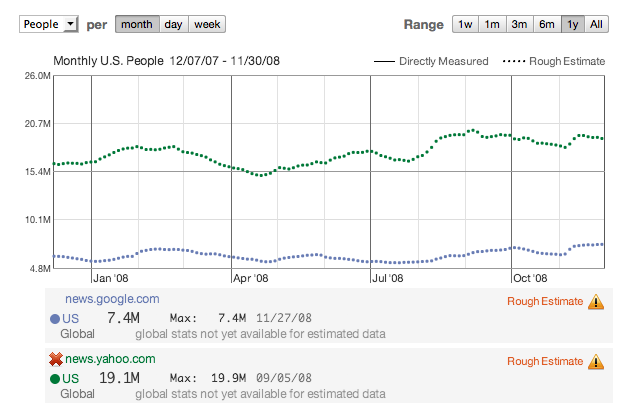
Remember, Yahoo still dominates news by a nearly 3 to 1 ratio. It’s nothing to sneeze at.

Yahoo News Versus Google News

If we use traffic as a proxy for number of alerts it’s easy to see how Yahoo could quickly increase its reach. Effectiveness, well that’s another issue.

But with this move by Yahoo, can AlertSense be far behind?

2009 Internet and Technology Predictions

December 23 2008 // Advertising + Marketing + SEM + SEO + Social Media + Technology // 8 Comments

Now is the time when bloggers go on the record with their thoughts for the year ahead. Place your bets! Stake your claim! Here’s mine.

Crystal Ball 2009 Predictions for Internet and Technology

Facebook Becomes A Portal

Realizing that social media and advertising is like oil and water, Facebook repositions itself as a portal leveraging Microsoft’s Live Search as the revenue model. This also might result in the potential acquisition of Netvibes to provide a more robust offering to compete with Yahoo!

Identity Systems Fail

Confused about the difference between OpenID, Facebook Connect and Google Friend Connect, users throw up their hands and decide not to use any of the above.

Video Advertising Succeeds

The adoption of video is surging faster than many expected. Longer formats and better quality will bring even more eyeballs who will grudgingly accept advertising.

Microformats Go Mainstream

Why they aren’t already is shocking. Nevertheless, in 2009 we’ll see microformats become a standard and search results will become far more robust as a result.

Banner CTR Becomes Obsolete

Brands will finally realize that measuring success by click through rate (CTR) isn’t working. Measurement ‘beyond clicks’ will be the new yardstick, whether that’s through new brand advertising measurement services like Vizu or through monitoring services like Brandwatch and Trackur among a gaggle of others.

RSS Adoption Spikes

Someone will (finally) figure out how to market RSS to ‘the masses’ who will grasp the sublime benefits of having content come to you instead of the other way around.

Kindle 2.0 Flops

Amid a weak economy Amazon releases the newest version of Kindle. Other readers have gained ground where Kindle has not and at the core Kindle is a solution without a problem.

Google Search Share Stalls

The move by Facebook (see above) causes a radical change in the search landscape. Microsoft passes Yahoo! for second place and talks about a Microsoft Yahoo merger are (unbearably) reignited.

FriendFeed Surpasses Twitter

FriendFeed adoption increases at an accelerated pace due to quick innovation, uncluttered design and an interface that lends itself to communication.

Someone ‘Dies’

Users reach social media overload and VCs get even more nervous about revenue creating social media shrinkage. In this instance ‘Dying’ means a company goes under or is purchased for a song. My short list includes Plurk, Twitter, Digg and Seesmic. This isn’t a reflection of the people or product but the inability to truly reach the mainstream with a service that has a profit model.

There are plenty of other things that I believe will happen in 2009, but they seem more obvious or an extension of current trends. Instead I tried to be a bit more bold, at least on a few of my predictions.

We’ll check in this time next year to see how I fared. In the meantime, feel free to comment and provide your feedback and reaction to my predictions.

3 Column Blogs Are Killing CPM Rates

December 16 2008 // Advertising // Comment

Okay, not all 3 column blogs are killing CPM rates but the design contributes to the problem by making it easy for bloggers to produce ad clutter.

Ad clutter is a big problem

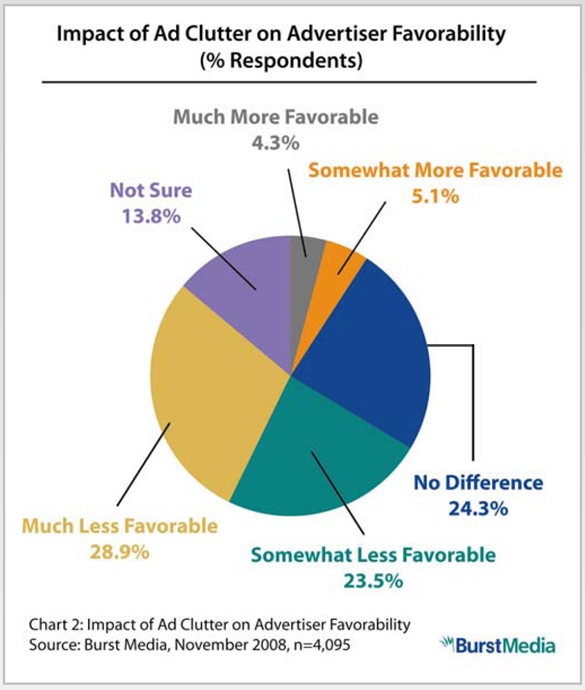
A recent BurstMedia survey revealed that 75% of users pay less attention to ads on cluttered sites.

Additionally, although respondents accept that advertising will appear on a web page, for a majority (52.6%), there is low tolerance for more than two advertising units per web page. More than one-quarter (29.9%) of survey respondents immediately leave a site if they perceive it to be cluttered.

So, it’s clear that CTR on these ads will go down as will user engagement on cluttered sites. But why not go for the trifecta! Ad clutter also tarnishes an advertiser’s brand equity.

Nielsen has also researched ad clutter and even introduced an ad clutter metric to assist media buyers. MarketingVOX reported the following finding from the Nielsen report.

The study also found that, from a content perspective, more niche websites – which attract smaller audiences – tend to have higher clutter.

Niche websites. Hummm. That seems like a nice way to point the finger at blogs without outright saying it.

Advertising CPM rates are dropping

CPM rates have been falling. The Rubicon Project reported an 11% decline in CPM rates in Q3 2008. Federated Media slashed rates on some of their hottest properties. These aren’t your run of the mill blogs but sites like TechCrunch and Silicon Alley Insider.

I believe ad clutter is a factor in this decline since it leads to banner blindness, which likely carries over, to some degree, from cluttered sites to those less cluttered. If you think of the Internet as a vast interdependent ecosystem it makes sense that the effects from one part of the ecosystem spill over to all.

The movie Jaws certainly spawned a fear of water beyond just that of the fictional Amity or the New England coast.

Are 3 column blogs really to blame?

Yes! Sure they’re not the only reason, but they are enablers to ad clutter. The two sidebar columns are ready made for advertising not to mention inline units in the main content column. A “more is better” philosophy for advertising exists among many bloggers. And on the face, more opportunities to click often do lead to more clicks. But there is a point of diminishing return which then results in lower CPM rates.

Unfortunately this might create a sort of death spiral. As the effectiveness of these ads go down, the CPM rates go down, which encourages bloggers to place additional advertising units on their sites to help maintain their revenue stream. That, of course, pushes CPM rates down even further.

You can be the proverbial shark or the police chief. Bruce or Brody. So pick your blog template wisely.

TweetSense

December 09 2008 // Advertising + Social Media // Comment

Does TweetSense make sense? And more importantly would it make cents?

Twits have been up in arms with the introduction of Twitter based ad networks like twitAD and Magpie. Magpie in particular drew a lot of coverage with notables like Mark ‘Rizzn’ Hopkins at Mashable and Michael Arrington at TechCrunch weighing in on the topic. Many claimed that it was outright spam that had no place on Twitter. Lots of huffing and stamping of feet. They’d unfollow anyone they saw using such a service!

I’m not opposed to this type of monetization if it’s implemented well.

The fact is, are you really going to notice? If you’re that attached to Twitter you probably use the service quite a bit. You follow a lot of people. Many are very active. The odds that you’re going to see an advertising tweet are quite low and if you did it would be gone from your existence in a matter of minutes.

Advertising tweets would be very ephemeral.

So, that begs the question: will these Twitter based ad networks be effective? Will people click on them enough to make it a viable advertising platform? They will if it’s done right.

Spare me the ‘nobody clicks on those things’ type of indignation. There’s this company called Google. They have these products called AdWords and AdSense. Both seem to be doing just fine even though many say they’ve never clicked on either type of ad unit.

The implementation will be paramount. They’ll fail if the ads become too frequent, overwhelming tweet streams for users. Essentially, if the noise drowns out the signal, it will fail. They’ll also fail if the ad content isn’t relevant. Viagra ad tweets mixed in with a discussion about Motrin Moms isn’t going fly.

The frequency and context of advertising tweets are critical to the success of this type of ad network. So, who is in the best position to pull this off?

Twitter!

Twitter knows your tweet velocity. Twitter has the ability to create dynamic tags for users based on keyword frequency analysis. As such, it is best placed to deliver timely and relevant tweets to their users. By doing so it would also remove the potential abuse of the service by those seeking personal, monetary gain.

Block the third party ad networks! With Twitter at the controls, the odds of success (for both users, advertisers and Twitter) go up, way up.

Twitter does need a revenue model. So why not TweetSense?

Forgive Me StumbleUpon For I Have Sinned

December 04 2008 // Advertising + Humor + Marketing + Technology // 1 Comment

StumbleUpon No EntryThe other day I updated my StumbleUpon toolbar (well, I was essentially forced to) and immediately couldn’t Stumble posts from this blog or my Used Books Blog. Each time I tried my Stumble just would not go through, stalling at a blank white box where the review and tagging takes place. I tried numerous times on a couple different browsers. Nothing worked.

I assumed that something had gone awry with the new toolbar. I even posted a message on FriendFeed calling eBay lame. But you know the old saying about assuming, right?

I sent feedback to StumbleUpon about my problem and got a prompt reply as follows.

Hello,

Thanks for writing in.

After reviewing your account history, it appears
that you’ve repeatedly submitted content from one
or more sites in particular.

Our site software detects behavior like this to
prevent the unauthorized use of StumbleUpon to
promote a specific Web site, product or service.

This limit will likely remain in place until you
use the StumbleUpon Toolbar more frequently to
rate, review and discover Web sites that can
shared with other members.

If you’re interested in using StumbleUpon to
advertise a Web site, please look into our
Advertising program:
http://www.stumbleupon.com/ads

If you have any other questions, please review our
Terms of Service and Community Rules:

http://www.stumbleupon.com/terms/
http://www.stumbleupon.com/rules.html

Thanks for your feedback,

Oops. I admit, I’ve only been Stumbling my own sites lately. However, I think they’re pretty good so I don’t see anything too wrong with that. Also, I’m pretty transparent. I don’t have a Stumble army nor do I have multiple profiles so I can distribute my Stumbles across accounts and dodge the software.

But I get it and I’m not really complaining. It’s not what StumbleUpon is really supposed to be about. And I respect them for protecting the product and StumbleUpon business model. It also got me to Stumble again and I discovered some interesting sites and images. So … thanks for that.

My one nit would be that I had to contact support to get this information. Instead of presenting the white box of frustration I suggest that StumbleUpon simply insert the text I received into that area. Not only would I have immediately understood what was going on and not throw invective into the htmlosphere but StumbleUpon would have saved a bit of money on customer support.

Forgive me StumbleUpon for I have sinned. My penance? Stumble.

Facebook Embraces Search, Disses Apps for Brands

November 24 2008 // Advertising + Marketing // Comment

Facebook is changing as it seeks to find a sustainable revenue model. Over the last year it seems clear that Facebook is trying to make itself more relevant and attractive to brands before the sun sets on the buzz parade.

Facebook Embraces Search

Most recently Facebook added fan links to public pages, creating a tremendous density of internal links to brand and product pages. The likely goal of this change is to boost the visibility of brand pages in search results. The attention to SEO and search is an interesting change for the proponents of the walled garden.

If it works, Facebook pages could take up valuable shelf space on search engine results pages (SERPs). Brands and marketers would be wise to take advantage and spend a bit more time on a Facebook strategy aimed at acquiring fans.

And lets remember that Facebook recently integrated Microsoft Live Search into their standard search interface. If Facebook continues to integrate and highlight search, it could provide a substantial revenue stream as well as help Microsoft capture more of the search market.

Facebook Disses Apps

The major redesign implemented this year pushed a substantial number of applications out of the limelight. The redesign aimed to leverage life streaming and encourage user interaction not application interaction.

The good folks at allfacebook conducted a study that shows the impact the Facebook redesign had on applications. The more popular applications were essentially unchanged but there was a 13% to 15% drop in active users when you look beyond the top 50.

Social Advertising In Trouble

The rush to search and away from applications can be seen in the context of an anemic advertising environment. Social media advertising is quickly getting a bad reputation. Ted McConnell, general manager-interactive marketing and innovation at Procter & Gamble Co. had this to say at a November 15 forum on digital media.

What in heaven’s name made you think you could monetize the real estate in which somebody is breaking up with their girlfriend?

and …

I really don’t want to buy any more banner ads on Facebook.

The numbers don’t look good either. CPM rates on social networks are some of, if not the, lowest around. And the effectiveness, from a click measurement perspective, of these ads aren’t good. Allen Stern is conducting a Facebook ad test for his new start-up, CloudContacts. Recent tweets on performance look dismal and campaign results should be made public this week.

In the interim there are other benchmarks to review. Once again, allfacebook has done an interesting comparison of Facebook ads versus Google AdWords. The end result was a cost per lead of $0.72 using Google and $1.83 using Facebook.

Now, the comparison isn’t exactly fair since you’re matching passive (though well targeted) search versus active search. Clearly active search is far more valuable … which leads us back to Facebook’s recent focus on search. Brands understand search. They can easily measure search. Brands will spend on search.

Facebook has a huge audience but is running out of time and chances to translate that into dollars and advertising confidence.

Are Banner Ads Dying?

November 12 2008 // Advertising + Marketing + Technology // 1 Comment

Are banner ads dying?

I remember people shouting about this during the Web 1.0 hey day and there have been plenty of folks who have since cried wolf on the topic. Each time banner ads come back from the proverbial dead, walking the Internet with zombie like efficiency. Is this time any different?

Maybe.

More and more research indicates that young users are not responding to banner advertising. But can we blame them? We’re entering an era in which a whole generation has grown up with the Internet. At an increasingly young age children begin to surf the Internet. Yet, the sites they visit often have far less clutter and advertising than the traditional site.

Are we creating a generation of banner intolerant Internet users?

Those of us, myself included, who came to the Internet as young adults have been exposed to a higher degree of ad clutter from the start. We’re used to it. Not only that, our context for approaching the Internet was shaped through television. Television conditioned us to expect advertising to be part of the equation.

Yet, again, this is not the case for a new generation that has grown up with TiVo and other DVR products. These services have undermined normal TV watching patterns and preconceptions. Every day more of us are conditioned to simply hit the 30 second skip button when presented with a commercial. (As an aside, thank you to Fringe for telling me how many seconds the break is going to be. That’s very handy!)

These habits are particularly important since new research indicates that the heaviest TV viewers are also the heaviest Internet users.

Are social networks part of the problem?

Yes.

Social networking is one of (if not the) largest activity for the young. Sites like Piczo, MySpace and Facebook, among others, are like the middle school and high school of the Internet. These sites are, at their core, utilitarian in nature. They’re about communicating. They’re about making ‘friends’.

Some of them do use banner ads, but more and more evidence shows a growing banner blindness on these sites. I suspect the high number of visits (for a very specific purpose) exacerbates banner blindness on social networks.

If you use CPM rates as a proxy for effectiveness then it becomes obvious that social networks are in distress.

Can we blame Twitter?

Yes.

Twitter and even my current addiction, FriendFeed, contribute to the problem by not using banner ads. They are but one more site, one more application, one more widget that is providing a valued service for … nothing. Clearly advertising isn’t the only way to monetize these sites, but by not implementing any monetization strategy they send a signal to users that they can get something for nothing.

The ‘something for nothing’ mentality makes us less tolerant of advertising. I can surf the Internet with Firefox, supercharge my blog with WordPress plugins and use Google Analytics to track metrics for a slew of client sites all … for not one penny.

This isn’t a long term problem. A type of Internet Darwinism will take place where those without a true business (aka revenue) model will either fail or try to implement some sort of real revenue strategy. In most instances, that will be advertising or subscriptions.

Will it be advertising or subscriptions?

Just before the collapse of Web 1.0, I worked at Bluelight.com, the online version of Kmart. One of their major initiatives was an ad supported free ISP. We had millions of users! The thing is, it didn’t really work. They wound up converting it to a subscription based service which was ultimately acquired by United Online

Today, we’re conditioning a generation to ignore banner and display advertising. The cat is out of the bag. The genie is out of the bottle. So even if we want to return to it as a revenue stream it is becoming an ever weaker medium. And we only have ourselves to blame.

So perhaps subscription based sites, or networks are the wave of the future. Would you pay for Twitter?

Will banner ads die?

Of course not. Banners will never completely die, but a few things will have to happen for them to rise again to feast on the glorious eyeballs of Internet users.

They’ll need to be more engaging and use rich media in more appropriate ways. More importantly, the industry will need to measure banner ads not by CTR or traditional click-based ROI but by brand measurement metrics. There are a few companies who provide this service, though my favorite is Vizu Ad Catalyst. (Disclosure: I worked at Vizu for a short time but stand by the fact they are leaders in this new field.)

The current economic climate has forced many analysts to adjust their online advertising industry forecasts, some of them twice. Yet, I’m unsure any of them are accounting for this new generation of Internet users who are blind to banners at best and intolerant of them at worst.